
台积电

Search documents
张坤隐藏股大曝光!
Ge Long Hui A P P· 2025-08-30 09:14
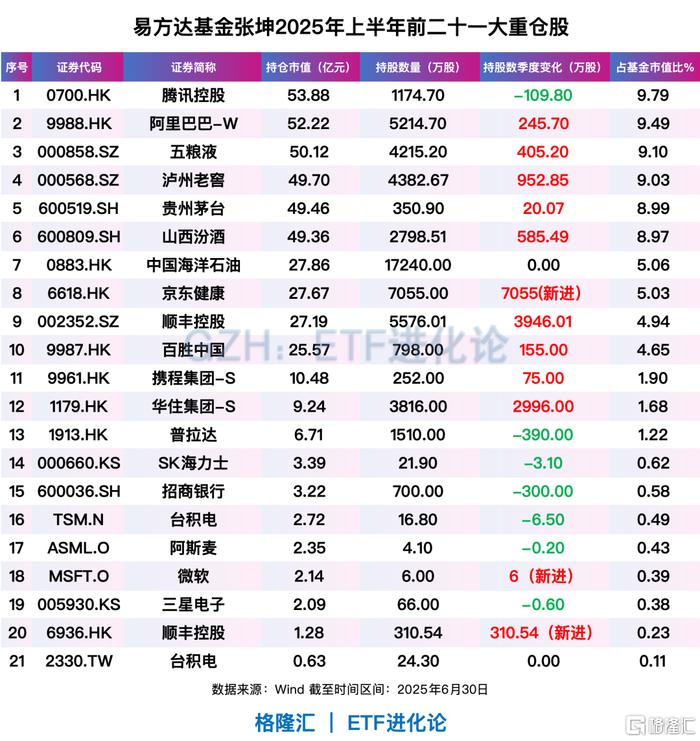
Group 1: Zhang Kun's Half-Year Report Insights - Zhang Kun's half-year report reveals all his holdings and argues against the pessimistic view on domestic consumption, citing data on disposable income and savings growth [1][2] - The report highlights that the per capita disposable income in China is projected to grow from CNY 32,189 in 2020 to CNY 41,314 in 2024, representing a compound annual growth rate (CAGR) of 6.4% [1] - Total household savings are expected to increase from CNY 93 trillion at the end of 2020 to CNY 152 trillion by the end of 2024, with a CAGR of 13%, significantly outpacing income growth [1] Group 2: Investment Strategy and Holdings - Zhang Kun believes that the current pessimistic market sentiment lacks a solid foundation and sees opportunities for long-term investors to acquire high-quality stocks at low valuations [4] - His fund has increased positions in domestic demand-related assets, including significant investments in companies like JD Health, SF Holding, and various liquor stocks [4][5] - The report lists the top holdings, with Tencent Holdings at CNY 53.88 billion, Alibaba at CNY 52.22 billion, and Wuliangye at CNY 50.12 billion, among others [5] Group 3: Alibaba's Q2 Financial Performance - Alibaba's Q2 revenue increased by 1.8% year-on-year, but adjusted net income fell by 18%, leading to initial stock price declines [6][7] - The company's cloud computing revenue grew by 26%, surpassing market expectations, and capital expenditures (Capex) reached CNY 38.7 billion, significantly higher than the anticipated CNY 30 billion [8] - Alibaba's management expressed confidence in their strategy, emphasizing the importance of investing in AI and consumer sectors as key growth opportunities [9] Group 4: Market Reactions and Trends - Following Alibaba's earnings report, the stock surged by nearly 13%, marking its best single-day performance since March 2023, and positively impacting indices like the Nasdaq Golden Dragon China Index [6][7] - Southbound capital continued to flow into Hong Kong stocks, with Alibaba receiving a net inflow of HKD 12.662 billion, leading the market [12][13] - ETFs tracking Hong Kong stocks saw significant inflows, with the top-performing ETF being the Fortune Hong Kong Internet ETF, which attracted HKD 12.824 billion [15][17]

深夜狂飙!阿里巴巴暴涨13%,市值一夜飙升2600亿元!特朗普与美联储的大战,正进入白热化...
雪球· 2025-08-30 03:05
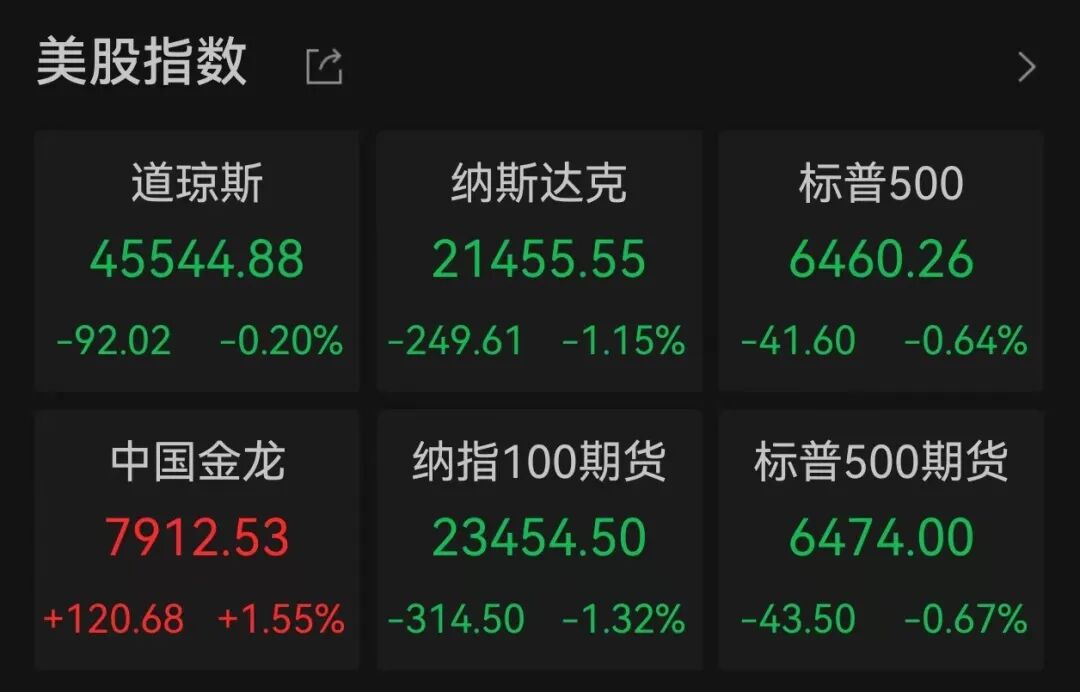
↑点击上面图片 加雪球核心交流群 ↑ 深夜,美股回调,阿里巴巴却带领中国资产大涨,其中阿里巴巴股价大涨近13%, 一夜之间,阿里巴巴市值上涨369亿美元,约合人民币2628亿 元。 盘面上大型科技股多数下跌,拖累了整体走势。个股方面,特斯拉跌超3%,英伟达跌逾3%,Meta跌超1%,亚马逊跌逾1%,微软跌0.58%,苹 果跌0.18%,谷歌涨0.6%。 芯片股同样普遍下跌,费城半导体指数大跌3.15%。个股方面,迈威尔科技跌超18%,博通、超威半导体、台积电等跌超3%。 01 美股三大指数收跌 大型科技股多数下跌 当地时间周五,美股三大股指全线收跌,道指跌0.2%报45544点,标普500指数跌0.64%报6460点,纳指跌1.15%报21455点。 其中,迈威尔科技在最新披露的财报中给出的业绩指引不及市场预期,引发了投资者对其未来业绩增长放缓的担忧。财报显示,该公司预计第三季 度的营收为20.6亿美元,低于分析师一致预期。 | 迈威尔科技 | | | --- | --- | | MRVL 已收盘08-29 16:00:00 美东 | | | 62.86 -14.36 -18.60% | 1.59万人加自选 ...


美股指下跌,英伟达股价重挫!中国金龙指数逆势上涨
Zhong Guo Zheng Quan Bao· 2025-08-30 01:28
Market Performance - On August 29, U.S. stock indices collectively declined, with the Dow Jones down 0.20%, S&P 500 down 0.64%, and Nasdaq down 1.15% [1][2] - The Nasdaq 100 futures and the Nasdaq China Golden Dragon Index showed contrasting performances, with the latter rising by 1.55% [2][8] Technology Sector - Major tech stocks experienced significant declines, with Nvidia's stock dropping over 3%, resulting in a market cap loss exceeding $140 billion, equivalent to over 10 billion RMB [2][4] - The Wind data indicated that the "Magnificent Seven" index, which includes major tech companies, fell by 1.31%, with Tesla and Nvidia both dropping more than 3% [3][4] Nvidia's Financial Results - Nvidia's recent financial report for Q2 of fiscal year 2026 showed substantial revenue and net profit growth compared to the previous year, but data center revenue of $41.1 billion fell short of market expectations [6][7] Chinese Stocks - Alibaba's stock surged nearly 13% following its strong financial results, reporting a revenue of 247.65 billion RMB for Q1 of fiscal year 2026, a 2% year-on-year increase, and a net profit increase of 76% to 42.38 billion RMB [10][8] Commodity Market - International precious metal prices increased, with gold futures reaching $3,516.1 per ounce, while oil prices declined, with NYMEX crude oil futures down 0.91% [12][13] - Analysts predict a strong short-term outlook for gold prices due to ongoing market conditions and expectations of Federal Reserve rate cuts, while the medium-term outlook for oil remains bearish [13]

利空突袭!深夜全线暴跌!芯片巨头暴跌
Xin Lang Cai Jing· 2025-08-29 23:51
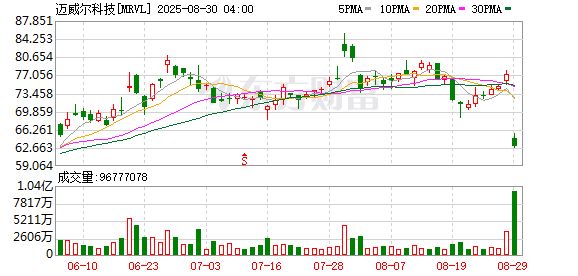
Core Viewpoint - The significant drop in Marvell Technology's stock price is attributed to disappointing earnings guidance, leading to a broader sell-off in the semiconductor sector [2][3]. Financial Performance - Marvell Technology expects third-quarter revenue of $2.06 billion, below the market expectation of $2.12 billion, with no growth anticipated in the data center business [3]. - The company reported second-quarter revenue of $2.01 billion, a 58% year-over-year increase, meeting analyst expectations, with data center revenue contributing $1.49 billion, a 69% year-over-year increase [3]. - Adjusted earnings per share for the second quarter were $0.67, in line with analyst expectations [3]. Market Reaction - Following the earnings report, Marvell's stock price fell nearly 19% intraday, closing down 18.6% at $62.87, marking a three-month low and reducing its market capitalization to $54.2 billion (approximately 386.4 billion RMB) [2]. - The Philadelphia Semiconductor Index dropped over 3%, with major companies like NVIDIA, Broadcom, and AMD also experiencing declines of over 3% [2]. Analyst Insights - Analysts attribute the volatility in Marvell's stock price to previously high expectations for AI chip stocks, which left little room for error in earnings reports [2][6]. - Morgan Stanley analysts expressed surprise at the ongoing decline in ASIC (Application-Specific Integrated Circuit) revenue, while also noting the strength of Marvell's optical solutions for data center applications [6][7]. - Summit Insights analysts highlighted Marvell's lack of scale compared to larger competitors, which may pressure profit margins due to multi-vendor procurement strategies from major clients [6]. Strategic Moves - Marvell's CEO, Matt Murphy, indicated that the company's custom chip business growth is expected to be "non-linear," with a stronger performance anticipated in the fourth quarter [3][4]. - The recent divestiture of the automotive Ethernet business is part of Marvell's strategy to focus on data center opportunities and enhance flexibility for stock buybacks [7][8]. - Marvell's data center segment currently accounts for three-quarters of total revenue, and the company plans to consolidate non-data center markets into a single reporting segment starting in the third quarter [8].
利空突袭!深夜,全线暴跌!
券商中国· 2025-08-29 23:24
Core Viewpoint - The article discusses the significant stock price drop of Marvell Technology, driven by disappointing earnings guidance and concerns over future growth in the AI chip market [1][5][6]. Financial Performance - Marvell Technology reported Q2 revenue of $2.01 billion, a 58% year-over-year increase, meeting analyst expectations [6]. - The company expects Q3 revenue to be $2.06 billion, below the market expectation of $2.12 billion, raising concerns about growth slowdown [5][6]. - The gross margin is projected to be between 51.5% and 52%, showing a sequential improvement [5]. Market Reaction - Following the earnings report, Marvell's stock price fell nearly 19% intraday, closing down 18.6% at $62.87, marking a three-month low and reducing its market capitalization to approximately $54.2 billion (about 386.4 billion RMB) [3][6]. - The Philadelphia Semiconductor Index dropped over 3%, with major companies like NVIDIA, Broadcom, and AMD also experiencing declines of more than 3% [1]. Analyst Insights - Analysts attribute the volatility in Marvell's stock price to previously high expectations for AI chip stocks, which left little room for error in earnings reports [8]. - Morgan Stanley analysts expressed surprise at the anticipated decline in ASIC revenue for the year, while also noting the strength of Marvell's optical solutions for data centers [9]. - Summit Insights analysts highlighted Marvell's lack of scale compared to larger competitors, which may pressure profit margins due to multi-vendor procurement strategies from major clients [8]. Strategic Moves - Marvell's CEO, Matt Murphy, indicated that the growth of the custom chip business is expected to be "non-linear," with potential for significant improvement in Q4 [6]. - The company recently divested its automotive Ethernet business to focus more on data center opportunities, which currently account for three-quarters of total revenue [9].

AI基础设施投资持续增长,英伟达展望显示需求依然强劲
Zhao Yin Guo Ji· 2025-08-29 08:48
Investment Rating - The report maintains a "Buy" rating for companies benefiting from the AI supply chain, specifically for 中际旭创 (300308 CH) and 生益科技 (600183 CH) [2][4]. Core Insights - AI infrastructure investment continues to grow, with NVIDIA's strong performance indicating sustained demand. NVIDIA's revenue for Q2 FY26 reached $46.7 billion, a 56% year-over-year increase and a 6% quarter-over-quarter increase, exceeding Bloomberg consensus estimates [2][4]. - The management expects Q3 revenue to be $54 billion, indicating a 16% quarter-over-quarter growth, which is significantly higher than previous quarters [2][4]. - The report highlights the robust growth in NVIDIA's data center revenue, which increased by 17% quarter-over-quarter, driven by high sales of Blackwell chips and strong network business growth [4]. Summary by Sections NVIDIA Performance - NVIDIA's Q2 FY26 revenue was $46.7 billion, with a Non-GAAP gross margin of 72.7%, expected to rise to around 75% by year-end [2][4]. - The net profit for Q2 was $25.8 billion, reflecting a 52% year-over-year increase and a 30% quarter-over-quarter increase [2][4]. Market Outlook - Management anticipates that the capital expenditure of the four major cloud providers will reach $600 billion by 2025, with market opportunities potentially expanding to $3-4 trillion by 2030 [4]. - The report emphasizes the improving return on investment for AI infrastructure, with GB200's ROI projected to be 10 times [4]. Geopolitical Considerations - NVIDIA's sales outlook in China remains uncertain due to geopolitical tensions, with potential revenue from H20 products estimated between $2 billion to $5 billion if conditions improve [4].
东兴证券:全球晶圆代工产能持续扩张 市场份额向头部企业集中
智通财经网· 2025-08-29 07:28
Core Viewpoint - The semiconductor wafer fabrication capacity is expected to grow from 31.5 million wafers per month in 2024 to 33.7 million wafers per month in 2025, driven by increasing chip demand, particularly from the AI and automotive electronics sectors [1][4] Group 1: Wafer Foundry Overview - Wafer foundry refers to the manufacturing of semiconductor wafers on behalf of integrated circuit design companies without engaging in design itself, playing a crucial role in the semiconductor industry [1] - The wafer foundry industry consists of upstream semiconductor materials, equipment, and design services, midstream wafer processing services, and downstream packaging/testing services, as well as end-use applications in consumer electronics, semiconductors, photovoltaic cells, and industrial electronics [1] Group 2: Manufacturing Processes - Wafer manufacturing processes can be categorized into advanced logic processes and specialty processes, with advanced processes defined as those below 14nm and mature processes as those 28nm and above [2] - The investment required for equipment significantly increases with process node evolution, with specialty processes requiring around $2-3 billion for every 50,000 wafers of capacity, while advanced processes require at least $4 billion [2] Group 3: Industry Advantages and Challenges - The wafer foundry industry currently benefits from a clear trend towards domestic production and sustained market demand [3] - Challenges include geopolitical instability, significant first-mover advantages for leading companies, reliance on key materials, and yield issues [3] Group 4: Market Status - The semiconductor industry is currently in a favorable economic cycle, with global semiconductor sales expected to grow at a compound annual growth rate (CAGR) of 9% from 2025 to 2030, surpassing $1 trillion by 2030 [4] - TSMC dominates the wafer foundry market with a 60% market share, while China is expected to lead in mature processes by 2027, with Taiwan maintaining dominance in advanced processes [4] Group 5: Key Domestic Players - Major domestic players include SMIC, Changhong Semiconductor, Jingxin Integrated Circuit, and Chipone Integrated Circuit, with SMIC being a leading global integrated circuit wafer foundry [5] - Huahong Semiconductor is recognized for its comprehensive specialty process platform, while Jingxin Integrated Circuit leads in the LCD panel driver chip foundry market [5] - Chipone Integrated Circuit focuses on power devices, MEMS, BCD, and MCU technology platforms, with AI being a new growth area [5] Group 6: Technology Development Trends - Global capacity is expanding, with market share concentrating among leading firms, and advanced processes like 3/2nm dominating the high-end market [6] - The collaboration between packaging and process technology is evolving, with 2nm processes expected to utilize GAAFET architecture, driven by increasing HPC demand due to AI advancements [6]




20cm速递|“寒王”股价超茅台,科创芯片景气持续!科创芯片ETF国泰(589100)午后领涨超5%,标的指数网罗国产芯片龙头!
Mei Ri Jing Ji Xin Wen· 2025-08-28 05:35
Group 1 - The core viewpoint of the article highlights the strong performance of the semiconductor industry, with Cambrian Technology's stock price surging by 7% to 1469.99 CNY per share, surpassing Moutai's 1448 CNY, thus becoming the "king of stocks" [1] - Guosen Securities notes that TSMC has raised its annual revenue growth forecast from 25% to 30%, indicating sustained high prosperity in the semiconductor sector [1] - The North American computing power surge has driven the switch and server supply chain to become a major sentiment booster, with global silicon wafer shipment area in Q2 2025 showing a significant increase, marking a new high since Q3 2023 [1] Group 2 - Demand for AI data center chips remains strong, with a recovery observed in sectors outside of storage, and prices for niche storage products are gradually rebounding [1] - Major overseas tech companies are increasing their capital expenditures, reflecting continued enthusiasm for AI computing investments [1] - The Guotai ETF (589100), which tracks the semiconductor index (000685), can experience daily fluctuations of up to 20%, focusing on semiconductor and electronic companies listed on the Sci-Tech Innovation Board [1]
“AI信仰”受挫!英伟达(NVDA.US)指引显示增长放缓,美股狂欢迎来降温信号?
Zhi Tong Cai Jing· 2025-08-28 02:09
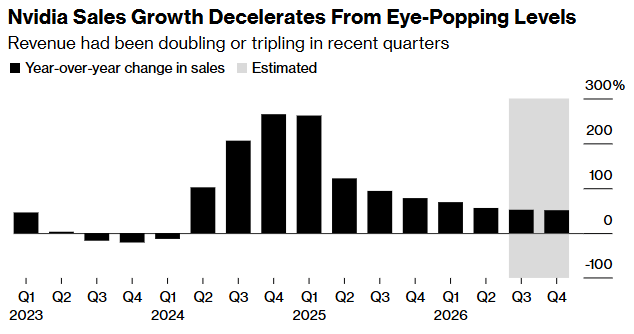
Core Viewpoint - Nvidia's latest guidance indicates a slowdown in growth after two years of rapid expansion, raising concerns about the sustainability of investments in artificial intelligence [1][12]. Financial Performance - For the period ending July 27, Nvidia reported a revenue increase of 56%, reaching $46.7 billion, slightly above the average expectation of $46.2 billion [2]. - The adjusted earnings per share were $1.05, surpassing the analyst expectation of $1.01 [2]. - The data center segment generated $41.1 billion in sales, also reflecting a 56% year-over-year growth, while gaming-related revenue was $4.29 billion, exceeding expectations [2]. Market Challenges - Nvidia faces challenges in the Chinese market due to intensified U.S.-China competition, with restrictions on semiconductor exports impacting revenue potential [3][6]. - The company reported no sales of its H20 AI chips to Chinese customers in the second quarter, and the future sales depend on U.S. government approvals [6][12]. AI Investment Trends - Analysts suggest that the initial surge in AI investments may be waning, with large data center operators potentially reducing spending if short-term benefits remain difficult to quantify [7]. - Nvidia's major clients, including Meta, Alphabet, Microsoft, and Amazon, are heavily investing in infrastructure to develop AI models and services [7]. Stock Performance and Valuation - Nvidia's stock price has surged 35% this year, pushing its market capitalization above $4 trillion, but investors are becoming more critical of its performance amid high valuations [14][15]. - The company's price-to-earnings ratio is approximately 34 times its expected earnings for the next 12 months, which is considered reasonable for a tech company with strong growth [13]. Future Outlook - Nvidia's forecast suggests a potential revenue of $54 billion for the third quarter, aligning with Wall Street expectations but falling short of some analysts' predictions of over $60 billion [1][12]. - The company has approved an additional $60 billion stock buyback plan, indicating confidence in its long-term prospects despite current challenges [1].
两路径布局!科技业加快供应链多元化态势
Jing Ji Ri Bao· 2025-08-27 23:45
Core Insights - The technology industry is accelerating supply chain diversification in response to changing U.S. tariff policies [1] - There are two main trends: server production is shifting to the U.S. and Mexico, while smartphone and PC manufacturing remains concentrated in Asia to control costs [1] - The U.S. market for servers, smartphones, and PCs is projected to generate $565 billion in 2024, accounting for over half of the tech hardware revenue [1] Group 1 - Server production has been migrating since 2018, with a focus on U.S. and Mexican manufacturing for products aimed at the U.S. market [1] - Major Taiwanese ODMs, including Foxconn, Quanta, Wistron, and Inventec, have established production bases in the U.S. to meet customer demands and mitigate tariff pressures [1] - TSMC's expansion of advanced chip production in Arizona further reinforces this trend towards localized manufacturing [1] Group 2 - AI servers are strategically positioned to largely avoid the impact of U.S. tariffs, with many manufacturers establishing cross-regional operational networks [1] - Components and subsystems are primarily produced in Asia, with final assembly occurring in Taiwan or Mexico, the latter benefiting from tariff exemptions under the USMCA [1] - The preference for U.S. assembly is growing due to simplified assembly processes and enhanced customer support efficiency, particularly for high-priced AI servers [2]