海信视像

Search documents
A股市场短期受全球避险情绪冲击,500质量成长ETF(560500)红盘蓄势
Xin Lang Cai Jing· 2025-11-24 03:42
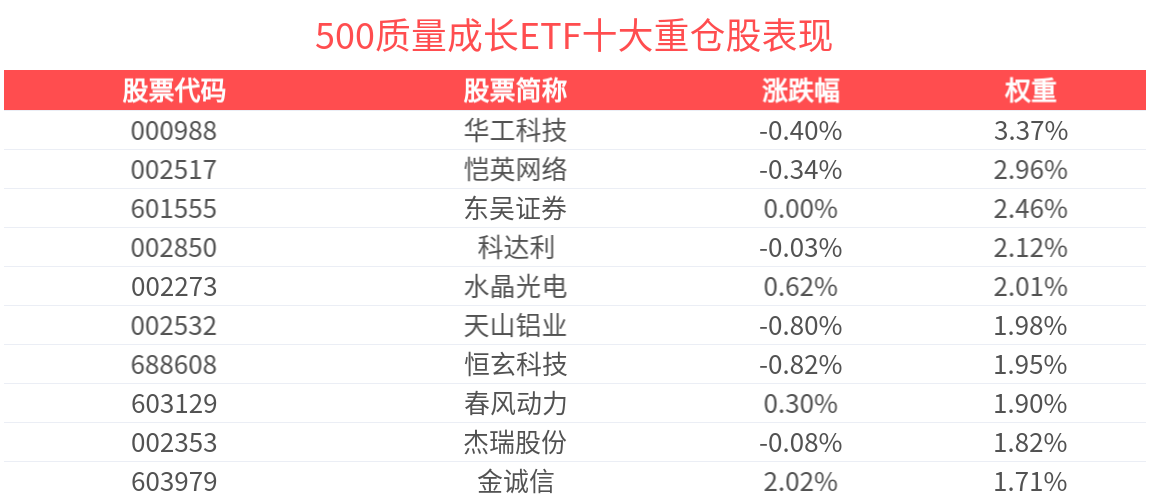
Core Viewpoint - The recent fluctuations in the A-share market are influenced by global market trends, particularly concerns over the "AI bubble," expectations of a Federal Reserve interest rate cut, and cautious investor sentiment, although the fundamental factors supporting the Chinese stock market's upward trend remain unchanged [1][2]. Group 1: Market Performance - As of November 24, 2025, the CSI 500 Quality Growth Index increased by 0.20%, with notable gains from stocks such as Binjiang Group (up 4.64%) and China National Materials International (up 3.06%) [1]. - The CSI 500 Quality Growth ETF (560500) saw a slight increase of 0.09%, with a trading volume of 60.89 million yuan and a turnover rate of 0.14% [1]. Group 2: Market Analysis - Huatai Securities reported that recent debates around AI narratives and tightening liquidity have contributed to increased market volatility, but the current market adjustment shows potential for support around the late September market center [2]. - China Galaxy Securities noted that the A-share market exhibits a "high cut low" characteristic, driven by previous gains and heightened market concerns, yet the upward trend in corporate profits and industrial development remains intact [2]. Group 3: Index Composition - As of October 31, 2025, the top ten weighted stocks in the CSI 500 Quality Growth Index accounted for 21.64% of the index, with Huagong Technology and Kaiying Network being the top two [3]. - The CSI 500 Quality Growth Index selects 100 companies with high profitability, sustainable earnings, and strong cash flow from the CSI 500 Index, providing diverse investment options for investors [2].

SID中国区主办的沉浸式交互显示闪展在沪举办
Zhong Zheng Wang· 2025-11-24 01:48
Core Insights - The exhibition "Outstanding · Within Reach" was held in Shanghai from November 21 to 23, showcasing immersive interactive display technologies to the public for free [1][2] - The theme "Display · Interaction · Perception of the Future" aimed to bring cutting-edge display technology to the streets, allowing the public to experience technological transformations firsthand [1] Industry Highlights - Leading companies in the display industry showcased their latest products and technologies, including BOE's AI smart display and AR/VR devices for home and office applications [2] - Visionox demonstrated the flexibility and innovative forms of display screens through flexible screen interactions [2] - Tianma Microelectronics and AUO presented a "Future Mobility Experience Cabin" featuring a multi-screen interactive infotainment system for future vehicles [2] - Hisense showcased an RGB MiniLED living room system that replicates a cinema-level audio-visual experience [2] - Yunshi Technology's electronic fish tank created a tranquil healing space amidst the bustling city with realistic imagery [2] Organizational Background - The Society for Information Display (SID) was established in 1962 and is headquartered in Silicon Valley, USA, recognized as a globally influential professional organization in the display field [2] - The exhibition effectively promoted the popularization of display technology and industry integration through scenario-based and interactive presentations, reflecting China's active exploration and market vitality in new display applications [2]
彩电零售市场的下一步困惑且无助!
Sou Hu Cai Jing· 2025-11-23 05:06
Core Insights - The Chinese television market is facing significant challenges, with declining sales and a shift in consumer preferences away from traditional TV viewing [3][5][6] Group 1: Market Performance - In Q3 2025, the retail volume of the Chinese TV market is projected to be 6.15 million units, a year-on-year decline of 12.1%, while retail revenue is expected to be 25.2 billion yuan, down 8.1% [3] - For the first three quarters of this year, retail volume and revenue were 19.91 million units and 81.4 billion yuan, respectively, showing a year-on-year decline of 2.9% in volume but a growth of 2.1% in revenue [3] - The overall retail revenue for the Chinese TV market is forecasted to reach 120.8 billion yuan in 2025, a decrease of 5% year-on-year, with retail volume expected to be 28.92 million units, down 6% [3] Group 2: Consumer Behavior - The TV usage rate has significantly dropped from 70% in 2016 to below 30% in 2022, with recent reports indicating it may fall below 25% [4] - A survey shows that 25.57% of users watch TV once a week or less, while only 15.27% watch it six times or more per week [4] - Many consumers express dissatisfaction with TV complexity, advertising, and content accessibility, leading to a decline in TV usage among younger generations [4][5] Group 3: Industry Challenges - The decline in TV sales is not just a problem for individual companies like Hisense, TCL, Sony, and Samsung, but reflects a broader industry crisis [5] - Despite efforts to innovate with smart TVs and diverse applications, the market has not met expectations, as consumers find larger screens and additional features impractical [5][6] - The industry is experiencing a "distorted" evolution in its supply chain, with a concentration of sales channels and a lack of effective user engagement strategies [6]

中国品牌逆袭海外,年轻人主动买单,核心逻辑太意外
Sou Hu Cai Jing· 2025-11-23 01:40
Core Insights - Generation Z has become a dominant force in the global consumer market, accounting for 25% of the global population and holding a spending power of $9.8 trillion, projected to rise to $12.6 trillion by 2030 [3][12] - Their consumption logic challenges traditional views, favoring brands that communicate authenticity, equality, and emotional connection over established luxury brands [3][8] Consumer Behavior - Unlike Millennials, Generation Z's purchasing decisions resemble a "trust vote" within their social circles, showing skepticism towards traditional advertising while valuing content shared by influencers [8] - This generation prioritizes brands that align with their values and integrate into their daily lives, reflecting a shift towards user-driven market dynamics [12][31] Brand Preferences - Generation Z exhibits a strong preference for local Chinese brands, demonstrating an openness to innovation and high cost-performance ratios, which presents opportunities for Chinese brands to expand internationally [12][15] - The top Chinese global brands favored by Generation Z include Tencent, Xiaomi, and SHEIN, with 26 3C brands recognized for their quality, innovation, and integration into local ecosystems [13][20] Brand Strategy - Chinese brands are transitioning from merely exporting products to establishing a global brand presence, leveraging a combination of hard strengths (quality and innovation) and soft communication strategies [15][17] - Effective communication involves engaging local communities through relatable content and influencers, transforming them into trust intermediaries rather than just sales channels [17][31] Technological Integration - The use of technology, such as AR, enhances user experience and engagement, with examples including Tencent's immersive gaming experiences and SHEIN's virtual fitting rooms [19][27] - AIGC technology is expected to play a crucial role in future brand strategies, enabling personalized experiences and localized communication without the need for large teams [23][25] Future Trends - The competition for Generation Z's loyalty will hinge on brands' abilities to provide ongoing engagement and personalized experiences, shifting from traditional advertising to deeper emotional connections [27][29] - The perception of Chinese brands is evolving from being seen as cost-effective to being recognized as innovative partners in trends, reflecting a cultural exchange that benefits both parties [29][31]

10月家电出口有所承压,新兴市场维持稳健增长
SINOLINK SECURITIES· 2025-11-22 12:45
Investment Rating - The report suggests a positive outlook for the home appliance industry, particularly for leading brands that are expected to achieve stable growth due to their integrated advantages and strong pricing power [5]. Core Insights - In October, home appliance exports faced pressure, with a year-on-year decline in quantity and value of -9.2% and -13.3% respectively. However, emerging markets showed robust growth, particularly in Southeast Asia and Africa [12][14]. - The report highlights that air conditioning exports in Southeast Asia led the growth, with a year-on-year increase of 13% in October [17]. - The overall market sentiment is slightly pressured for white goods and black goods, while kitchen and bathroom appliances are stabilizing at the bottom, and vacuum cleaners maintain high prosperity [4]. Summary by Sections 1. Home Appliance Export Performance - October saw a decline in air conditioner exports by 29.3%, while washing machine exports increased by 7.7%. The total export figures for refrigerators and televisions also showed declines of 5.5% and 3.1% respectively [12]. - Southeast Asia and Africa led the growth in exports, with Southeast Asia's cold appliance export value reaching approximately 6.7 billion yuan, up 14% year-on-year [14]. - North America, the Middle East, and Europe experienced significant declines in export values, with North America down 23% and Europe down 8% [15]. 2. Market and Sector Tracking - The Shanghai and Shenzhen 300 Index fell by 3.77%, while the home appliance index decreased by 2.30% during the week [23]. - Key raw material prices showed a slight decline, with copper and aluminum prices down by 1.05% and 1.16% respectively in the week of November 17-21 [25]. - The USD to RMB exchange rate was reported at 7.09, with a weekly increase of 0.21% [30]. 3. Investment Recommendations - The report recommends leading companies such as Hisense, Midea Group, Haier, and TCL Electronics for their potential in both domestic and international markets, especially as the U.S. enters a rate-cutting cycle which may boost demand for home appliances [5][44].



家电周报:海尔机器人与INDEMIND达成战略合作,比依股份定增获批-20251122
Shenwan Hongyuan Securities· 2025-11-22 07:49
Investment Rating - The report maintains a positive outlook on the home appliance sector, highlighting that the sector outperformed the CSI 300 index during the week [2][3]. Core Insights - The home appliance sector index fell by 2.3%, while the CSI 300 index dropped by 3.8%, indicating a relative strength in the sector [2][3]. - Key companies such as Aopu Technology, Zhejiang Meida, and Supor showed gains, while companies like Joyoung, Beiqi, and Biyi experienced significant declines [4]. - Haier Robotics and INDEMIND signed a strategic cooperation agreement to advance the application of embodied robots in home settings [8]. - Biyi Electric received approval from the China Securities Regulatory Commission for a specific stock issuance [9]. Sales Data - In October, sales of cleaning appliances increased year-on-year, with robotic vacuum sales rising by 36.01% to 500,900 units and sales revenue increasing by 35.34% to 1.025 billion yuan [29]. - Sales of washing machines also saw a significant increase, with units sold rising by 60.11% to 429,300 and revenue increasing by 60.34% to 756 million yuan [29]. - Personal care products showed mixed results, with hairdryer sales slightly up by 0.31% but revenue down by 18.17%, while electric shaver sales rose by 29.12% with revenue up by 38.05% [34]. Industry Dynamics - The report identifies three main investment themes: 1. The potential of leading white and black appliance companies characterized by low valuations, high dividends, and stable growth [2]. 2. Upstream core component manufacturers are diversifying into emerging tech fields such as robotics and data center cooling [2]. 3. The increasing penetration of new consumer categories like cleaning appliances presents significant growth opportunities [2]. Macro Economic Environment - As of November 21, 2025, the USD to CNY exchange rate was reported at 7.0875, reflecting a year-to-date decrease of 1.40% [40]. - In October 2025, the total retail sales of consumer goods reached 46,291 billion yuan, showing a year-on-year increase of 2.90% [42].



2026 年家电行业投资策略:红利、科技与出海:2026 家电投资三主线
Shenwan Hongyuan Securities· 2025-11-21 11:01
Group 1 - The demand for home appliances has significantly improved, with the white goods sector showing a rebound in valuation. In the first nine months of 2025, air conditioning sales reached 90.81 million units, a year-on-year increase of 8.4% [2][3] - The "old-for-new" policy implemented in July 2024 has positively impacted sales, particularly in the kitchen appliance sector, where retail sales of range hoods and gas stoves saw year-on-year increases of 14.9% and 15.7%, respectively [2][3][24] - The overall valuation of the home appliance sector has declined, but it is currently at a near-bottom level, indicating high cost-effectiveness for investment [2][3][29] Group 2 - Three main investment themes are identified: 1. **Dividend**: Leading white and black goods companies exhibit low valuation, high dividends, and stable growth, making them attractive for investment [4] 2. **Technology**: Core component manufacturers are diversifying into emerging tech fields such as robotics and data center cooling, seeking cross-industry transformation [4] 3. **Overseas Expansion**: The penetration rate of new consumer categories, such as clean appliances, is increasing, indicating substantial growth potential [4][5] Group 3 - The white goods sector is expected to maintain stable growth due to the ongoing effects of the "old-for-new" policy, with head companies like Haier, Midea, and Gree being recommended for investment [4][5] - The kitchen appliance sector shows a clear division in performance, with traditional categories benefiting from government subsidies while new categories like integrated stoves face challenges [24][25] - The export market is experiencing a gradual decline in demand, with air conditioning exports dropping by 12.9% year-on-year in Q3 2025, influenced by previous tariff policies and high base effects [3][9][18]
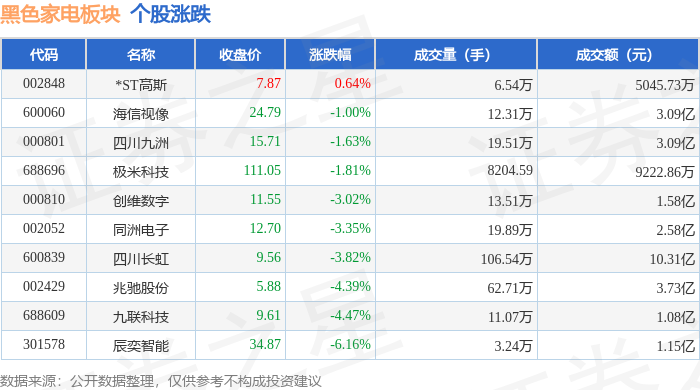
黑色家电板块11月21日跌2.93%,辰奕智能领跌,主力资金净流出3.24亿元
Zheng Xing Xing Ye Ri Bao· 2025-11-21 09:33
Market Overview - The black home appliance sector experienced a decline of 2.93% on November 21, with Chenyi Intelligent leading the drop [1] - The Shanghai Composite Index closed at 3834.89, down 2.45%, while the Shenzhen Component Index closed at 12538.07, down 3.41% [1] Stock Performance - Key stocks in the black home appliance sector showed varied performance, with *ST Gauss rising by 0.64% to a closing price of 7.87, while Chenyi Intelligent fell by 6.16% to 34.87 [1] - Other notable declines included Sichuan Changhong down 3.82% to 9.56 and Zhaochi Co. down 4.39% to 5.88 [1] Capital Flow - The black home appliance sector saw a net outflow of 324 million yuan from main funds, while retail investors contributed a net inflow of 340 million yuan [1] - The capital flow data indicates that major funds withdrew significantly from several stocks, including Sichuan Changhong and Zhaochi Co., while retail investors showed interest in stocks like *ST Gauss and Sichuan Jiuzhou [2]


山东首列“高配版”中欧班列开行
Da Zhong Ri Bao· 2025-11-21 01:13
Core Viewpoint - The launch of the "high-spec" China-Europe freight train from Jinan to Budapest significantly reduces transportation time and enhances logistics efficiency for enterprises in Shandong province [2][3]. Group 1: Train Operation and Efficiency - The first train, X8182/1, departed on November 20, 2023, carrying 104 standard containers and is expected to reach Budapest in approximately 12 days, which is over 7 days faster than regular trains [2]. - The new service operates under a full timetable system, ensuring precise scheduling and coordination across different railway segments, which compresses the overall transport time by about 30% compared to standard services [3]. - The full timetable freight train enjoys a "three priority" guarantee mechanism, which includes priority in train assembly, loading, and departure, thus minimizing waiting times at key transfer points [3]. Group 2: Impact on Trade and Logistics - The operation of the full timetable train is expected to provide more reliable and efficient logistics services for Shandong's import and export enterprises, facilitating better planning and faster turnover of goods and capital [3][4]. - The regular operation of this service, scheduled to run every two weeks, will enhance the logistics network between Shandong and Europe, solidifying Jinan's position as a logistics hub [4]. - The connection to Budapest's extensive road and rail network will enable quick distribution of goods to neighboring countries, supporting domestic and international trade [4].

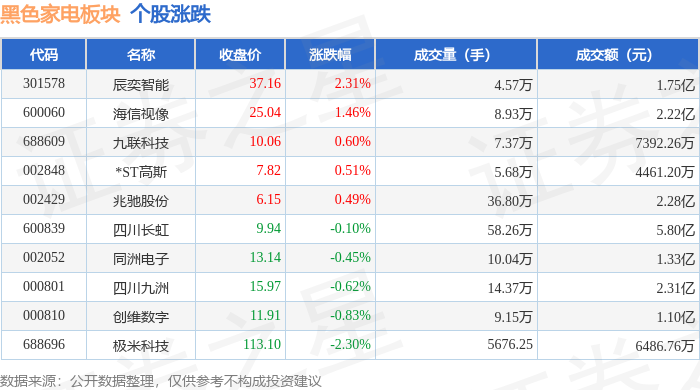
黑色家电板块11月20日涨0.11%,辰奕智能领涨,主力资金净流出3920.97万元
Zheng Xing Xing Ye Ri Bao· 2025-11-20 09:09
Market Overview - The black home appliance sector rose by 0.11% compared to the previous trading day, with Chenyi Intelligent leading the gains [1] - The Shanghai Composite Index closed at 3931.05, down 0.4%, while the Shenzhen Component Index closed at 12980.82, down 0.76% [1] Stock Performance - Key stocks in the black home appliance sector showed varied performance, with Chenyi Intelligent closing at 37.16, up 2.31%, and Hisense Visual at 25.04, up 1.46% [1] - Other notable performances include Jiulian Technology at 10.06, up 0.60%, and ST Gauss at 7.82, up 0.51% [1] - Conversely, XGIMI Technology saw a decline of 2.30%, closing at 113.10 [1] Capital Flow - The black home appliance sector experienced a net outflow of 39.21 million yuan from institutional investors, while retail investors saw a net inflow of 39.92 million yuan [1] - Detailed capital flow data indicates that Chenyi Intelligent had a net inflow of 8.34 million yuan from institutional investors, while retail investors had a net outflow of 19.46 million yuan [2] - Other stocks like Sichuan Changhong and Creative Digital also faced significant net outflows from institutional investors, amounting to 22.26 million yuan and 21.99 million yuan respectively [2]