
三生制药

Search documents
强势上涨!重磅利好来了!
Sou Hu Cai Jing· 2025-11-03 12:17
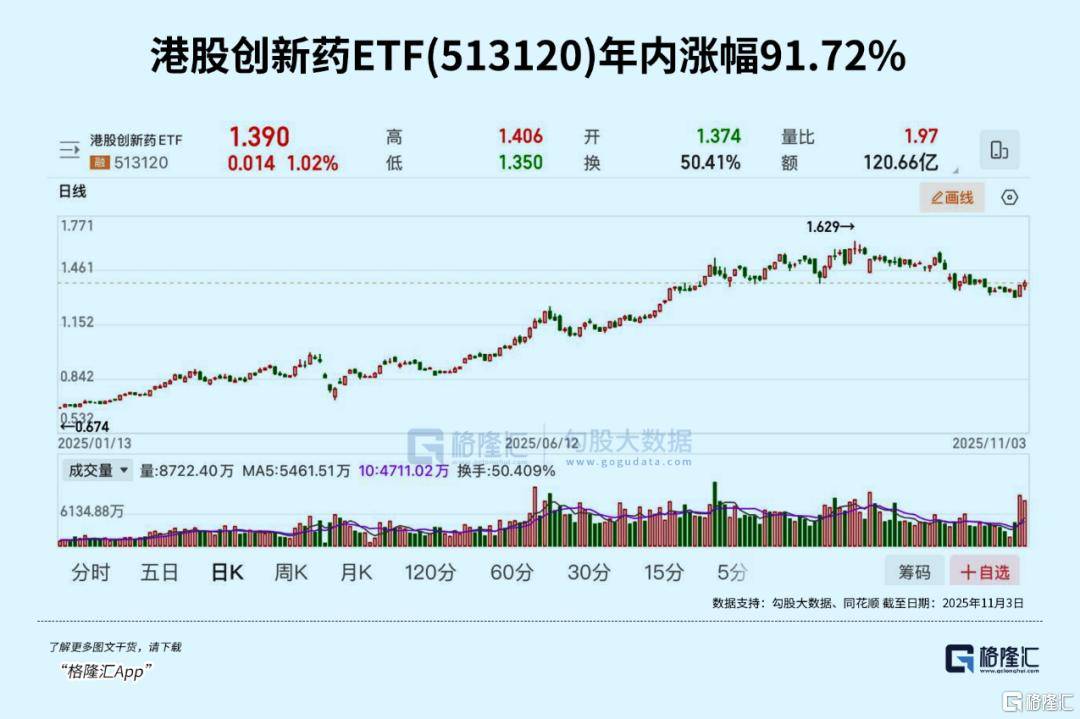
Core Insights - The Chinese stock market is experiencing a divergence, with the innovative drug sector showing strong performance following significant meetings and US-China tariff negotiations [1] - The Hong Kong innovative drug ETF (513120) has seen a year-to-date increase of 91.72%, focusing on high-quality biotech companies in the innovative drug, gene therapy, and cutting-edge biotechnology sectors [3] Group 1: Policy and Market Developments - The annual pharmaceutical procurement has sparked renewed interest in the pharmaceutical and biotech sectors, with negotiations for the 2025 National Drug Directory adjustments taking place from October 30 to November 2 [4] - This adjustment marks the eighth since the establishment of the National Medical Insurance Administration, introducing a commercial health insurance innovative drug directory, which represents a shift from a single basic insurance model to a collaborative payment model involving both insurance types [5] - A total of 535 drugs passed the formal review, with 310 generic names seeing a 24.5% increase compared to 2024, indicating a record high for submissions [4][5] Group 2: Financial Implications for Companies - The commercial insurance innovative drug directory allows pharmaceutical companies to apply for both basic insurance and commercial insurance, potentially opening up significant revenue streams for high-value innovative drugs [5][6] - For instance, the drug Masitide from Innovent Biologics, which is a high-priced prescription drug not included in basic insurance, could generate tens of billions in revenue if included in the commercial insurance directory [6] - The projected payment scale for commercial insurance for innovative drugs is expected to rise from 12.4 billion yuan in 2024 to 440 billion yuan by 2035, a 35-fold increase [6] Group 3: Company Performance and Market Sentiment - The innovative drug sector has seen a surge in business development (BD) collaborations, with over $100 billion in total licensing agreements in the first ten months of 2025, surpassing the total for 2024 [12][15] - Notable collaborations include a $12 billion upfront payment deal between Innovent Biologics and Takeda, and a $16.4 billion deal between Prigen and Kite Pharma [15] - Recent quarterly reports from companies like Innovent Biologics and Kelun Biotech show strong revenue growth, with Innovent reporting over 3.3 billion yuan in Q3 2025, a 40% year-on-year increase [16][17] Group 4: Investment Trends - The innovative drug ETF (513120) has attracted over 10 billion yuan in net inflows in the last ten days, with a total of 92.18 billion yuan year-to-date, indicating strong institutional interest [18] - The ETF's focus on high-quality biotech companies, with a weight of 88.9% in innovative drugs and chemical pharmaceuticals, positions it as a leading investment vehicle in the sector [23][24] - The market sentiment remains optimistic, with funds re-entering the sector during price corrections, reflecting confidence in the industry's future growth potential [19][20]

A股绝地反击!创新药爆发,港股通创新药ETF放量上探3.37%强势领跑!生猪价格显著回升,农牧渔ETF收涨超1%
Xin Lang Ji Jin· 2025-11-03 11:53
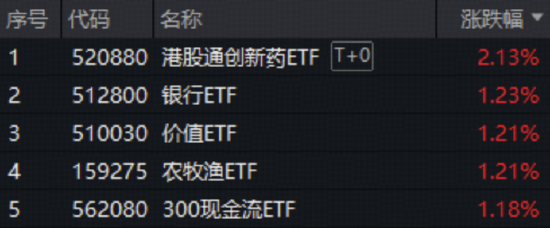
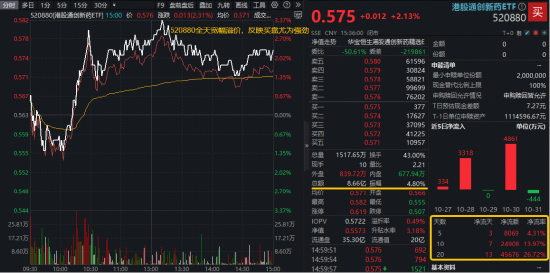
Market Overview - The A-share market experienced a significant reversal on November 3, with all three major indices closing in the green. The Shanghai Composite Index rose by 0.55%, the Shenzhen Component Index increased by 0.19%, and the ChiNext Index gained 0.29%. The total trading volume exceeded 2.1 trillion yuan [1] Sector Performance Innovative Drugs - The innovative drug sector continued to thrive, with the high-volatility Hong Kong Stock Connect Innovative Drug ETF (520880) closing up by 2.13%, leading the market in the pharmaceutical ETF category. The ETF saw a trading volume of 866 million yuan, marking a new high since September 12 [1][3] - The ETF covers 37 innovative drug companies, with 33 stocks closing in the green. Notable performers included Shengxian Pharmaceutical, which surged by 7.36%, and other companies like Kangnuo Pharmaceutical and Yuan Da Pharmaceutical, which rose over 6% [4] Banking Sector - The banking sector showed resilience, with the top-tier Bank ETF (512800) rising by 1.23%, recovering both the 5-day and 10-day moving averages. The sector's performance was bolstered by a stable net interest margin and increased holdings from insurance companies [1][11] - The overall banking index rose by 1.31%, with 40 out of 42 listed banks reporting gains. Major banks like China Construction Bank and China Merchants Bank saw increases of over 2% [8][9] Agriculture, Animal Husbandry, and Fisheries - The agriculture, animal husbandry, and fisheries sector exhibited strong performance, with the only agricultural ETF (159275) closing up by 1.21%. The rise was attributed to a significant rebound in pig prices, which increased by 6.1% from the previous week [1][13] - Key stocks in this sector included Zhongxing Junye and Luoniushan, both of which hit the daily limit, while Hainan Rubber surged by 5.67% [13] Future Outlook - Analysts from Guosen Securities noted that the A-share market is currently supported by multiple favorable factors, including the "14th Five-Year Plan" providing clear investment pathways and a reduction in overseas disturbances, which has improved market risk appetite [3] - The banking sector is expected to benefit from a shift in market style, with a focus on low-value stocks, while the innovative drug sector may transition towards a phase driven by fundamental improvements rather than just capital inflows [5][12]
国证国际港股晨报-20251103
Guosen International· 2025-11-03 11:41
Group 1: Market Overview - The Hong Kong stock market experienced a decline, with the Hang Seng Index falling by 1.43%, the Hang Seng China Enterprises Index down by 1.91%, and the Hang Seng Tech Index decreasing by 2.37% [2][3] - Various sectors faced pressure, particularly semiconductor and tech stocks, due to slowing performance from Chinese chip companies and ongoing inventory adjustments [3] - The renewable energy sector, including wind, solar, and hydrogen concepts, also saw significant declines, with concerns over policy subsidies and cost pressures affecting market sentiment [3] Group 2: Sector Performance - The pharmaceutical sector showed resilience, with segments like medical aesthetics, biopharmaceuticals, and innovative drugs performing well, supported by improved US-China relations and favorable policy expectations [4] - Defensive consumer sectors such as education, home appliances, and cosmetics attracted investment as funds shifted from high-valuation growth stocks to more stable options [4] Group 3: Company Analysis - BYD Electronics - BYD Electronics reported a slight revenue decline in Q3, with profitability under pressure due to a shift in product mix towards lower-margin assembly business [8][9] - The automotive segment saw over 20% revenue growth year-on-year, driven by smart cockpit and active suspension businesses, despite a slight decline in overall vehicle sales [8] - Looking ahead to 2026, multiple business segments are expected to experience growth, particularly in components for new models and the automotive sector, which will benefit from new product launches and market expansion [9][10]
创新药,卷土重来?高弹性港股通创新药ETF(520880)放量上探3.37%强势领跑!基金经理重申“高胜率区间”
Xin Lang Ji Jin· 2025-11-03 11:37
Core Viewpoint - The innovative drug sector is experiencing a significant rebound, with the Hong Kong Stock Connect Innovative Drug ETF (520880) showing strong performance and increased trading volume, indicating robust investor interest [1][2]. Group 1: Market Performance - The Hong Kong Stock Connect Innovative Drug ETF (520880) saw a V-shaped reversal, rising by 3% in the morning and peaking at 3.37% in the afternoon, ultimately closing up by 2.13%, outperforming all other pharmaceutical ETFs in the market [1]. - The ETF recorded a trading volume of 8.66 billion yuan, the highest since September 12, and has seen two consecutive days of increased volume [1]. - Out of the 37 innovative drug companies covered by the ETF, 33 stocks closed in the green, with notable gains from companies like First Signal Pharmaceuticals (+7.36%) and Innovent Biologics (+4.32%) [1]. Group 2: Policy and Industry Developments - The introduction of a "commercial insurance innovative drug catalog" mechanism in the 2025 national medical insurance negotiations is expected to benefit the sector, along with the anticipated breakthrough in pricing negotiations for CAR-T therapies [1]. - At the ESMO 2025 conference, domestic innovative drug companies had 35 research projects selected for oral presentations, setting a new record [1]. - A significant collaboration was announced between Innovent Biologics and Takeda, with a total scale of up to 11.4 billion USD, highlighting the growing partnerships in the industry [1]. Group 3: Future Outlook - The fund manager of the Hong Kong Stock Connect Innovative Drug ETF (520880) emphasized that the innovative drug market could see another surge, suggesting that the current period may represent a high-probability zone for medium to long-term investments in innovative drugs [2]. - The market is expected to transition from a funding-driven phase to a fundamental-driven phase, with a focus on quality factors, potentially favoring leading companies [2]. - The ETF is designed to track the Hang Seng Hong Kong Stock Connect Innovative Drug Select Index, which exclusively includes innovative drug development companies, with over 70% of its holdings in large-cap leaders [2].
智通港股通活跃成交|11月3日
智通财经网· 2025-11-03 11:02
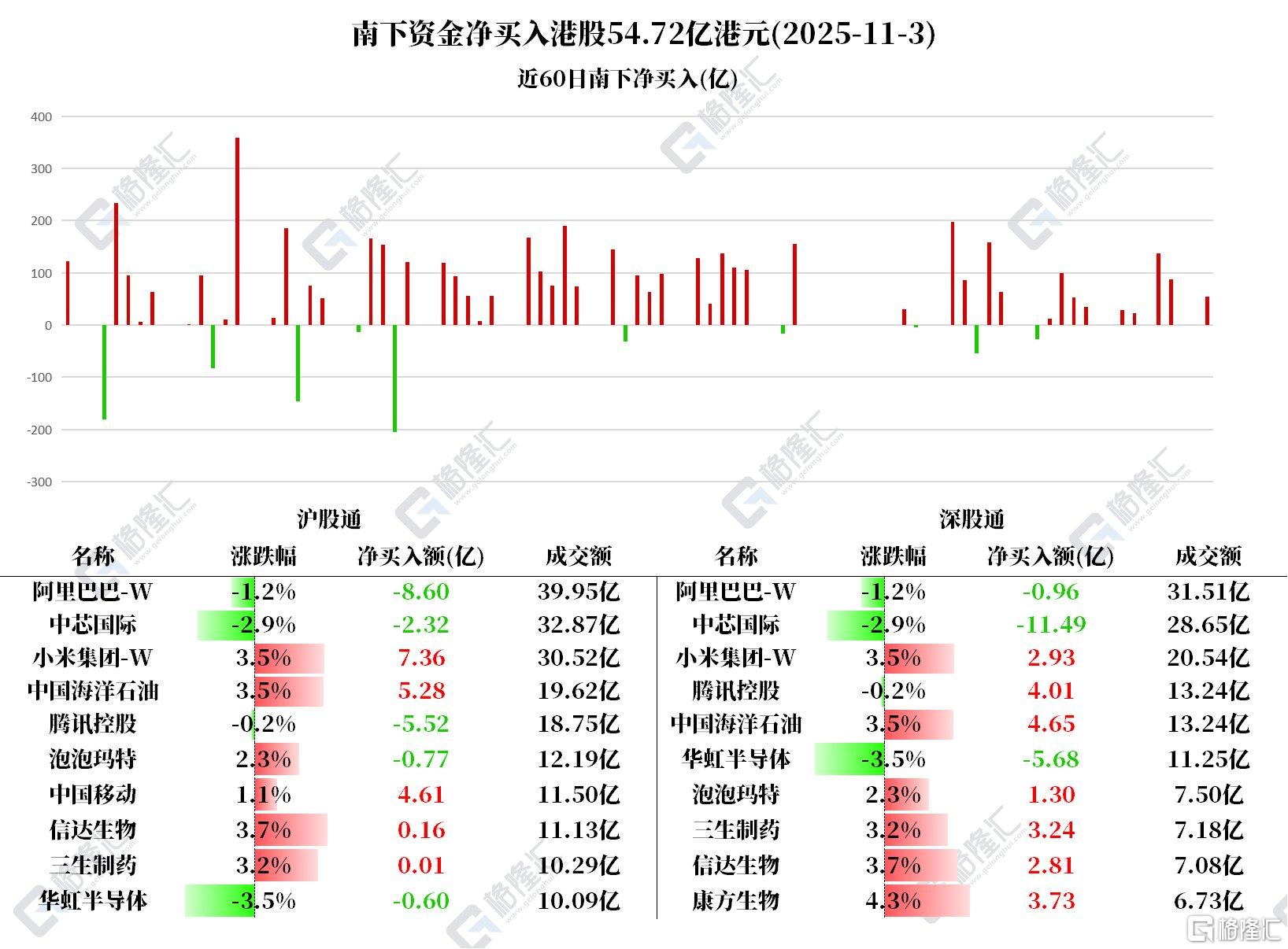
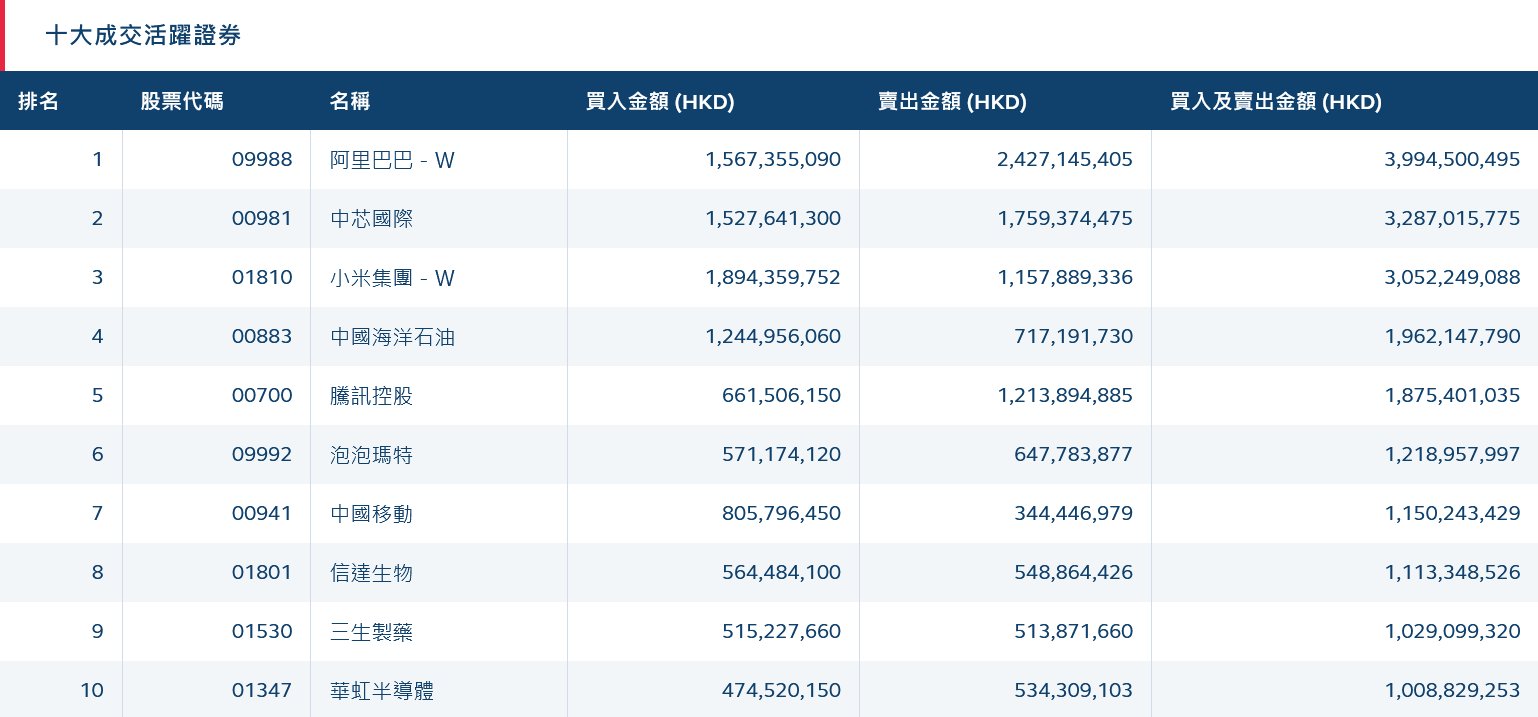
Core Insights - On November 3, 2025, Alibaba-W (09988), SMIC (00981), and Xiaomi Group-W (01810) were the top three companies by trading volume in the Southbound Stock Connect, with trading amounts of 3.151 billion, 2.865 billion, and 2.054 billion respectively [1] Group 1: Southbound Trading Activity - Alibaba-W (09988) had a trading amount of 3.151 billion with a net buy of -96.034 million [2] - SMIC (00981) recorded a trading amount of 2.865 billion with a net buy of -1.149 billion [2] - Xiaomi Group-W (01810) achieved a trading amount of 2.054 billion with a net buy of +293 million [2] - Tencent Holdings (00700) had a trading amount of 1.324 billion with a net buy of +401 million [2] - China National Offshore Oil Corporation (00883) also had a trading amount of 1.324 billion with a net buy of +465 million [2] - Hua Hong Semiconductor (01347) reported a trading amount of 1.125 billion with a net buy of -568 million [2] - Pop Mart International (09992) had a trading amount of 750 million with a net buy of +130 million [2] - Sanofi (01530) recorded a trading amount of 718 million with a net buy of +324 million [2] - Innovent Biologics (01801) had a trading amount of 708 million with a net buy of +281 million [2] - CanSino Biologics (09926) achieved a trading amount of 673 million with a net buy of +373 million [2]





三生国健:辉瑞在某网站上登记PD-1/VEGF双抗PF-08634404(SSGJ-707)的两项全球III期临床试验其最终付款尚存在不确定性
Zhi Tong Cai Jing· 2025-11-03 10:36
Core Viewpoint - Sanofi has granted Pfizer exclusive rights for the development, production, and commercialization of the dual-specific antibody product targeting PD-1 and VEGF, known as project 707, for both human and veterinary uses [1] Group 1: Licensing Agreement - The licensing agreement between Sanofi and Pfizer will officially take effect on July 24, 2025 [1] - The agreement covers all therapeutic, diagnostic, and preventive indications within the licensed area [1] - Payments from Pfizer to Sanofi will be distributed between the company and Shenyang Sanofi [1] Group 2: Clinical Trials - Pfizer has registered two global Phase III clinical trials for the PD-1/VEGF dual antibody PF-08634404 (SSGJ-707) on ClinicalTrials.gov as of October 30, 2025 [1] - The milestone payments outlined in the licensing agreement are contingent upon meeting specific conditions, leading to uncertainty regarding final payments [1]

三生国健:辉瑞10月30日在ClinicalTrials.gov网站上登记了PD-1/VEGF双抗PF-08634404(SSGJ-707)的两项全球III期临床试验
Mei Ri Jing Ji Xin Wen· 2025-11-03 10:15
Core Viewpoint - Sanofi has granted Pfizer exclusive rights for the development, production, and commercialization of the dual-targeting antibody product SSGJ-707, which targets both PD-1 and VEGF, under a licensing agreement that will take effect on July 24, 2025 [1] Group 1: Licensing Agreement Details - The licensing agreement involves a product known as project 707, which is a dual-specific antibody targeting PD-1 and VEGF [1] - All payments made by Pfizer to the licensors will be distributed between the company and Shenyang Sanofi [1] - The agreement includes milestone payments that are contingent upon meeting specific conditions, leading to uncertainty regarding final payments [1] Group 2: Clinical Trials - On October 30, 2025, Pfizer registered two global Phase III clinical trials for the PD-1/VEGF dual antibody PF-08634404 (SSGJ-707) on ClinicalTrials.gov [1]
资金动向 | 北水连续4日扫货小米,抛售中芯国际13.81亿港元
Ge Long Hui· 2025-11-03 10:10
Group 1 - Xiaomi Group has seen a net buy of HKD 1.029 billion, with a total of HKD 19.1269 billion net bought over four consecutive days [1] - CNOOC reported a net buy of HKD 0.993 billion, totaling HKD 16.0304 billion net bought over three consecutive days [1] - Tencent Holdings experienced a net sell of HKD 1.51 billion, with a total of HKD 19.9056 billion net sold over four consecutive days [1] Group 2 - Xiaomi's automotive division announced that it will deliver over 40,000 vehicles by October 2025, with a significant reduction in delivery times due to increased production capacity [3] - CNOOC's Q3 revenue reached CNY 104.895 billion, a year-on-year increase of 5.7%, while net profit decreased by 12.2% [3] - China Mobile, along with China Unicom and China Telecom, has received approval to conduct commercial trials for eSIM mobile services, which are expected to enhance user communication needs and provide opportunities for domestic software and systems [4]


北水动向|北水成交净买入54.72亿 北水全天抢筹创新药概念 继续抛售芯片股
智通财经网· 2025-11-03 09:56
Core Insights - The Hong Kong stock market saw a net inflow of 54.72 billion HKD from northbound trading on November 3, with 13.04 billion HKD from the Shanghai Stock Connect and 41.68 billion HKD from the Shenzhen Stock Connect [1] Group 1: Stock Performance - The most net bought stocks included Xiaomi Group-W (01810), CNOOC (00883), and China Mobile (00941) [1] - The most net sold stocks were SMIC (00981), Alibaba-W (09988), and Hua Hong Semiconductor (01347) [1] Group 2: Individual Stock Analysis - Xiaomi Group-W (01810) received a net inflow of 10.29 billion HKD, with Citigroup estimating that its electric vehicle deliveries exceeded 40,000 units in October, bringing the year-to-date total to over 308,000 units, achieving 88% of its 2025 target of 350,000 units [5] - CNOOC (00883) saw a net inflow of 9.93 billion HKD, with OPEC+ announcing a production increase of 137,000 barrels per day in December, while also planning to pause production increases from January to March next year [5] - Kangfang Biopharma (09926) had a net inflow of 3.72 billion HKD, as its dual-specific antibody drug was included in the breakthrough therapy designation list, accelerating its clinical development [6] - Three-Sixty Biopharma (01530) received a net inflow of 3.25 billion HKD, with Pfizer starting two global Phase III clinical trials for its dual-specific antibody [6] - Innovent Biologics (01801) had a net inflow of 2.96 billion HKD, reporting a 40% year-on-year increase in total product revenue for Q3 2025 and forming a global strategic partnership with Takeda Pharmaceutical [7] Group 3: Market Trends - There is a continued reduction in holdings of semiconductor stocks, with SMIC (00981) and Hua Hong Semiconductor (01347) experiencing net outflows of 1.38 billion HKD and 628 million HKD, respectively [7] - China Mobile (00941) and Pop Mart (09922) received net inflows of 461 million HKD and 52.96 million HKD, respectively, while Tencent (00700) and Alibaba-W (09988) faced net outflows of 151 million HKD and 955 million HKD [7]

创新出海节奏恢复,关注复苏细分领域
Huaxin Securities· 2025-11-03 08:49
Investment Rating - The report maintains a "Recommended" investment rating for the pharmaceutical industry [1] Core Insights - The rhythm of innovative drug licensing-out transactions has recovered, with a total of 103 transactions and a total amount of $92.03 billion in the first three quarters of 2025, representing a 77% increase compared to the total amount for 2024 [2] - The research and CXO sectors continue to lead the recovery in the pharmaceutical industry, with significant profit growth in these areas [4] - The medical device bidding market has shown a steady recovery, with a year-on-year growth of 29.8% in the third quarter of 2025 [5] - The self-immune field has seen breakthroughs in overseas licensing, indicating a growing alignment with global R&D trends [6] - The weight loss market is experiencing competitive mergers and acquisitions, highlighting its attractiveness and potential impact on Chinese companies [7] - Trends in respiratory infectious diseases are expected to influence the demand for detection and treatment medications [8] Summary by Sections 1. Pharmaceutical Market Tracking - The pharmaceutical industry outperformed the CSI 300 index by 1.74 percentage points in the last week, ranking 9th among 31 primary industry indices [21] - In the last month, the pharmaceutical industry underperformed the CSI 300 index by 1.83 percentage points, ranking 24th [25] 2. Pharmaceutical Sector Trends and Valuation - The pharmaceutical industry index has a current PE (TTM) of 38.80, above the five-year historical average of 31.26 [42] 3. Recent Research Achievements - The report highlights various recent research outputs, including weekly industry reports and insights on innovative drug licensing trends [48] 4. Recent Industry Policies and News - The National Healthcare Security Administration has initiated reforms for immediate settlement of medical insurance funds, aiming for 80% coverage by the end of 2025 [50] - Recent news includes significant breakthroughs in GLP-1 therapies and the approval of new drugs for chronic hepatitis B [51][52] 5. Recommended Companies and Profit Forecasts - The report provides a list of recommended companies with their respective EPS and PE ratios, indicating a positive outlook for several firms in the pharmaceutical sector [10]

