零跑

Search documents
零跑Lafa5上市 限时惊喜价9.28万元起
Mei Ri Shang Bao· 2025-12-03 22:16
Core Viewpoint - Leapmotor has launched the Lafa5, a high-performance sports sedan, with two versions offering 515km and 605km of range, priced between 92,800 to 116,800 yuan until December 31, 2025 [2] Group 1: Product Features - The Lafa5 is equipped with the Qualcomm 8295P flagship cockpit chip, featuring a 14.6-inch 2.5K HD central control screen and an 8.8-inch LCD instrument panel, enhancing the immersive visual interaction experience [2] - The vehicle incorporates DeepSeek and Tongyi Qianwen AI models, providing advanced understanding and conversational capabilities [2] - Leapmotor has introduced a unique feature called "Leapmotor Zero Motion Stick," allowing customization of up to six buttons through Bluetooth connection for personalized functionality [2] Group 2: Driving Assistance and Charging - The Lafa5 includes 27 high-precision perception hardware components, including LiDAR, and is powered by the Qualcomm 8650 chip, enabling end-to-end driving assistance without reliance on high-precision maps [2] - The vehicle boasts a long-range capability of 605km (CLTC), with a charging time of only 18 minutes from 30% to 80% state of charge (SOC) [2]

新势力系列点评二十五:11月新能源渗透率提速,新势力销量向上
Guolian Minsheng Securities· 2025-12-03 13:22
Investment Rating - The report maintains a "Recommended" rating for the industry, indicating a potential upside of over 15% relative to the benchmark index [7]. Core Insights - The penetration rate of new energy vehicles (NEVs) is accelerating, with a projected retail market size of approximately 2.25 million units in November, reflecting a year-on-year decline of 8.7% but a significant increase in NEV sales, expected to reach 1.35 million units, achieving a penetration rate of 60% for the first time [4][3]. - The report highlights the resilience of new energy vehicle sales, with key players showing varied performance. Leap Motor leads with a 75.1% year-on-year increase, while Li Auto experienced a decline of 31.9% [3][5][9]. Summary by Company Leap Motor - In November, Leap Motor delivered 70,327 vehicles, a year-on-year increase of 75.1% and a slight month-on-month increase of 0.1%. The growth is attributed to strong sales of models C10 and B01, with the company expected to continue its upward trajectory as new models are launched [5][14]. Xpeng Motors - Xpeng Motors reported 36,728 deliveries in November, marking an 18.9% increase year-on-year but a 12.6% decrease month-on-month. The company has expanded its charging network significantly, with over 2,840 self-operated stations and approximately 16,000 charging piles [6][14]. NIO - NIO delivered 36,275 vehicles in November, reflecting a 76.3% year-on-year increase but a 10.2% month-on-month decline. The report notes the strong performance of models ES8 and ET5T [6][14]. Li Auto - Li Auto's November deliveries totaled 33,181 units, down 31.9% year-on-year but up 4.5% month-on-month. The company is expanding its charging network, which is expected to enhance competitiveness as new electric models are introduced [9][14]. Zeekr - Zeekr delivered 28,843 vehicles in November, a 6.8% year-on-year increase and a significant month-on-month increase of 34.6%. The report highlights the successful launch of new models, contributing to sales growth [10][14]. Xiaomi - Xiaomi reported over 40,000 vehicle deliveries in November. The new SUV YU7 has been well-received, with significant pre-order numbers indicating strong market interest [11][14]. Industry Trends - The report emphasizes the ongoing shift towards intelligent driving technologies, with companies like Xpeng and Huawei leading the charge. The expectation is that advancements in smart driving will lower hardware costs and expand market access, particularly in the sub-200,000 yuan segment [11][12]. - The report suggests that the new energy vehicle supply chain and smart electric growth are expected to strengthen, with a focus on intelligent driving and new energy vehicle components [12].
创始人因「嫌年薪435万少」拒当董事长?公司回应:不满激励机制;OPPO刘作虎亲自带队攻坚Pocket项目;苹果宣布AI主管卸任
雷峰网· 2025-12-03 00:55
Group 1 - The founder of Aibison, Ding Yanhui, expressed dissatisfaction with the chairman's salary of 4.3556 million yuan, which represents a 51% increase from the previous year's salary of 2.8845 million yuan, leading to a unique dissenting vote during the board election [5][6] - Aibison clarified that the dissenting vote was due to dissatisfaction with the company's incentive mechanism rather than the salary itself, indicating a need for reform in governance and profit distribution [6] Group 2 - OPPO's Chief Product Officer, Liu Zuohua, is personally leading the Pocket project, indicating the company's strong commitment to the handheld imaging market, which has seen significant growth [8][9] - The global sales of DJI's Pocket camera have reached approximately 10 million units, with expected revenue from handheld products surpassing 50 billion yuan this year [8] Group 3 - Xiaomi has exceeded its annual car sales target of 350,000 units, with total deliveries surpassing 500,000 units since April 3, 2024, and November deliveries consistently exceeding 40,000 units [14][15] - The CEO of Zhiyu, Zhang Peng, announced that the company's annual recurring revenue from model sales has exceeded 100 million yuan, positioning it as a leading player in the Chinese AI sector [17][18] Group 4 - The automotive market in November saw BYD leading with 480,186 units sold, a month-on-month increase of 8.71%, while other brands like NIO and Xpeng experienced significant declines in sales [26][28] - The competition in the new energy vehicle market is intensifying, with BYD maintaining a strong lead while other brands show signs of fatigue in growth [28] Group 5 - Apple is undergoing a leadership restructuring in its AI division, with John Giannandrea stepping down and Amar Subramanya taking over, aiming to accelerate the development of personalized AI features [40] - OpenAI has entered a "red alert" status, focusing resources on improving ChatGPT's user experience in response to competitive pressures from companies like Google [42][43]




苏州创新药企冲刺港股IPO,负债27亿亏超20亿,腾讯高瓴参投
21世纪经济报道· 2025-12-02 07:37
Core Viewpoint - The company Kewang (Suzhou) Pharmaceutical is facing significant financial challenges and is under pressure to go public to avoid bankruptcy, despite having a promising pipeline of clinical-stage assets [2][5][11]. Financial Situation - Kewang has accumulated losses exceeding 2 billion yuan (approximately 20.67 billion yuan) since its establishment, with a cash reserve of only 32.82 million yuan as of the end of 2024, down 88% from the previous year [5][10]. - The company has a net debt of 2.738 billion yuan due to convertible redeemable preferred shares, which come with mandatory redemption clauses if the IPO is not completed by a specific date [5][11]. Pipeline and R&D - Kewang's pipeline includes 7 major assets, with 4 in clinical stages, including its core product ES102, a six-valent OX40 agonist antibody [2][9]. - The clinical data for ES102 has raised concerns, showing a low objective response rate (ORR) of 11.1%, which is below the average for other treatments in similar indications [9][10]. Market and Valuation - The company's valuation has seen significant fluctuations, rising from 20 million USD at its first round of financing to 600 million USD by 2021, but is now facing scrutiny due to high market-to-research ratios compared to industry averages [10][11]. - The recent changes in the Hong Kong Stock Exchange's listing rules have increased the requirements for unprofitable biotech companies, making it more challenging for Kewang to secure a successful IPO [11].

东北雨姐再被点名,大号已被封13个月
21世纪经济报道· 2025-12-02 07:37
Group 1 - The article criticizes the behavior of internet celebrities with poor reputations, specifically targeting "Beijing Prince" for flaunting wealth and tax evasion, and "Northeast Rain Sister" for selling counterfeit goods [1] - "Northeast Rain Sister," whose real name is Chang Xiaoyu, gained over 17 million followers despite being banned for false advertising for more than 13 months [1] - The local authorities have not disclosed whether "Northeast Rain Sister" will have her account unbanned, following her brief reappearance on a secondary account [1] Group 2 - A storage company has seen its stock rise over 370% this year, indicating strong market performance [2] - NIO has reported a loss of 3 billion yuan in the third quarter, while Li Auto has shifted from profit to loss, and Leap Motor has achieved profitability, suggesting increased competition among new energy vehicle manufacturers [2] - A major lithium battery company with a market capitalization of 500 billion yuan is currently suspended due to significant asset restructuring [2]

具身智能产业动态:松延动力完成近2亿元Pre-B轮融资,灵心巧手完成数亿元A加轮融资
GUOTAI HAITONG SECURITIES· 2025-12-02 06:23
Investment Rating - The report does not explicitly state an investment rating for the industry Core Insights - The embodied intelligence industry is primarily represented by embodied robots and smart vehicles, which are mutually reinforcing in their development [7] - Recent trends in the embodied robot sector include significant funding rounds, technological advancements, and the establishment of industry standards [10][11][12] - The smart vehicle sector is witnessing strong sales growth, with notable performance from new energy vehicle manufacturers [16][17] Summary by Sections 1. Embodied Robot Industry Dynamics - The LET dataset, the largest full-size humanoid robot dataset in China, has been released, providing over 60,000 minutes of real machine data to support the development of humanoid robots [10] - The Ministry of Industry and Information Technology has announced the members of the humanoid robot standardization technical committee, including notable figures from leading companies [11] - GigaAI has launched its first wheeled humanoid robot, Maker H01, featuring advanced sensor configurations and a self-developed operational algorithm [12] - Zhiyuan Robotics has introduced the LinkSoul platform, allowing users to customize robot personalities and behaviors easily [13] - Star Motion Era has unveiled a logistics warehousing solution, marking the first real-world application of an end-to-end VLA model in logistics [14][15] 2. Smart Vehicle Industry Dynamics - In October, the top three new energy vehicle manufacturers by delivery volume were Leap Motor (70,289 units), Hongmeng Zhixing (68,216 units), and XPeng (42,013 units) [16][18] - Pony.ai reported a 72% year-on-year revenue increase in Q3 2025, with significant growth in its Robotaxi business, which is expected to expand to 3,000 vehicles by 2026 [17] - Strategic partnerships are being formed to enhance the development of autonomous driving services, including collaborations between Pony.ai and Sunshine Travel [17][20] 3. Investment and Financing Events - From November 24 to November 30, 2025, there were 10 significant financing events in the embodied intelligence sector, including: - Songyan Power completed nearly 200 million RMB in Pre-B financing to enhance humanoid robot R&D [34] - Lingxin Qiaoshou raised several hundred million RMB in A+ financing, maintaining a dominant market share in dexterous robotic hands [35] - He Mountain Technology completed multiple rounds of financing totaling several hundred million RMB to accelerate tactile perception technology [28]
新势力交付再洗牌!蔚小理排位大反转
Guo Ji Jin Rong Bao· 2025-12-02 03:08
Core Insights - The new energy vehicle (NEV) market is experiencing significant changes in delivery volumes among various companies, with some achieving record highs while others struggle to meet their targets [3][4][5]. Delivery Performance - Hongmeng Zhixing achieved a record monthly delivery of 81,900 units in November, marking a year-on-year increase of 89.61% and a 20% increase from October [3][4]. - Leap Motor delivered 70,300 units in November, a year-on-year increase of over 75%, and has exceeded its annual target of 500,000 units with a total of 536,000 units delivered in the first eleven months [5]. - Xiaomi's total deliveries surpassed 40,000 units in November, but specific figures were not disclosed, and the company is facing challenges related to production capacity and customer cancellations [7]. - Xpeng delivered 36,700 units in November, but this was a decrease from October's 42,000 units, with a total of 391,900 units delivered in the first eleven months, achieving 89% of its annual target [8][10]. - NIO delivered 36,300 units in November, a year-on-year increase of 76.3%, but is struggling to meet its annual target of 440,000 units with a completion rate of 63.15% [10][12]. - Li Auto's deliveries fell to 33,200 units in November, a year-on-year decline of 31.92%, with a completion rate of only 56.58% against its annual target of 640,000 units [12]. Market Trends - The NEV market is seeing a reordering of delivery rankings among the "new forces" in the industry, with companies like Hongmeng Zhixing and Leap Motor leading the charge [4][5]. - The introduction of new models and strategic initiatives, such as Leap Motor's new Lafa5 model, is aimed at boosting future sales and achieving ambitious delivery targets [5]. - Xiaomi's new purchasing model, "current vehicle selection," aims to address inventory issues and customer dissatisfaction due to long wait times for vehicle delivery [7]. - The overall market is facing challenges, including a decline in new orders and increased competition, which may impact future sales and profitability for several companies [8][12].


蔚来跌超6%三季度亏30亿,理想由盈转亏,零跑盈利,造车新势力洗牌加剧
2 1 Shi Ji Jing Ji Bao Dao· 2025-12-02 02:43
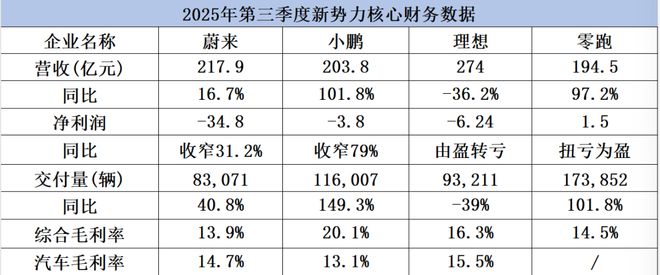
Core Viewpoint - The competitive landscape of new energy vehicle manufacturers is reshaping as Q3 2025 financial reports are released, highlighting significant performance variations among companies, with some showing improved profitability while others struggle with losses [1][3]. Group 1: Company Performance - Xiaopeng Motors achieved a revenue of 203.8 billion yuan, a year-on-year increase of 101.8%, despite a net loss of 3.9 billion yuan, which narrowed by 79% [2][5]. - NIO reported a revenue of 217.9 billion yuan, a year-on-year increase of 16.7%, but remains the largest loss-maker among new energy vehicle companies with a net loss of 34.8 billion yuan, although this loss narrowed by 31.2% [2][13]. - Li Auto, once profitable, faced a revenue decline of 36.2% to 274 billion yuan, resulting in a net loss of 6.24 billion yuan, ending its streak of 11 consecutive profitable quarters [2][10]. - Leap Motor recorded a revenue of 194.5 billion yuan, a year-on-year increase of 97.2%, and achieved a net profit of 1.5 billion yuan, marking its second consecutive profitable quarter [2][16]. Group 2: Strategic Adjustments - Xiaopeng Motors is shifting its strategy by embracing range-extended electric vehicles (REEVs) and enhancing its overseas market presence, with a focus on models like the Xiaopeng X9 [5][8]. - NIO is refocusing on its core automotive business, reducing costs, and aiming for improved sales efficiency while cutting down on non-core expenditures [13][14]. - Li Auto is pivoting towards AI technology, emphasizing the transformation of vehicles into smart terminals, while still facing challenges in its electric vehicle transition [11][10]. - Leap Motor is entering the REEV market and targeting the high-end SUV segment, attempting to elevate its brand image beyond its previous focus on cost-effectiveness [16][17]. Group 3: Market Dynamics - The Chinese new energy vehicle market is transitioning from growth to competition for existing market share, with companies needing to enhance their product, technology, and brand strengths to survive [3][17]. - The competitive landscape is characterized by companies learning from each other and adjusting their strategies to remain relevant in a rapidly evolving market [3][17]. - The overall profitability of the new energy vehicle sector is under scrutiny, with the upcoming financial results expected to determine which companies will thrive in the future [17].
蔚来跌超6%三季度亏30亿,理想由盈转亏,零跑盈利,造车新势力洗牌加剧
21世纪经济报道· 2025-12-02 02:37
Core Insights - The competitive landscape of new energy vehicle manufacturers is undergoing significant changes as companies report their Q3 2025 financial results, with Xpeng showing remarkable revenue growth while still facing losses [1][3] - NIO is attempting to recover from substantial losses by focusing on cost-cutting measures, although it remains the most unprofitable among its peers [1][3] - Li Auto has shifted from profitability to losses, facing challenges in its transition to pure electric vehicles, compounded by a recent recall incident [1][3] - Leap Motor has achieved profitability for the second consecutive quarter but faces challenges with its long-term pricing strategy affecting gross margins [1][3] Financial Performance Summary - Xpeng reported a revenue of 203.8 billion, with a year-on-year growth of 101.8%, and a net loss of 3.9 billion, which is a 79% reduction compared to the previous year [2] - NIO's revenue was 217.9 billion, with a year-on-year increase of 16.7%, but it recorded the largest net loss of 34.8 billion, a 31.2% reduction year-on-year [2] - Li Auto's revenue was 274 billion, down 36.2% year-on-year, with a net loss of 6.24 billion, marking a shift from previous profitability [2] - Leap Motor achieved a revenue of 194.5 billion, with a 97.2% year-on-year growth, and a net profit of 1.5 billion, marking a significant turnaround [2] Strategic Adjustments - Xpeng is focusing on enhancing its supply chain and product offerings, launching new models like the X9 Super Range Extender to address market needs [5][7] - Li Auto is pivoting towards AI technology, emphasizing the transformation of vehicles into smart terminals, while still facing challenges in its core automotive business [10] - NIO is narrowing its focus to core automotive operations, reducing costs, and aiming for improved sales efficiency while still grappling with significant losses [11][12] - Leap Motor is entering the range extender market and targeting the high-end SUV segment, although it faces challenges in changing consumer perceptions [14] Market Dynamics - The Chinese new energy vehicle market is transitioning from growth to competition for existing market share, with companies needing to adapt their strategies to survive [3][15] - The competitive edge is shifting towards comprehensive strengths in product definition, technology implementation, cost control, and brand perception [15]
造车新势力Q3财报:李斌、李想、何小鹏终于活成了对方的模样
2 1 Shi Ji Jing Ji Bao Dao· 2025-12-01 22:38
Core Insights - The competitive landscape of new energy vehicle manufacturers in China is undergoing significant changes as Q3 2025 financial reports are released, with companies adjusting strategies to improve profitability and market positioning [1][2] Company Summaries XPeng Motors - XPeng Motors has seen a remarkable turnaround with a revenue increase of 101.8% year-on-year, despite a net loss of 380 million yuan, which has narrowed by 79% compared to the previous year [1][3] - The company achieved a record delivery volume of 116,000 vehicles in Q3, marking a 149.3% increase year-on-year [4] - XPeng is launching the X9 Super Extended Range model, which has received four times the pre-order volume compared to its predecessor, indicating strong market interest [5] NIO - NIO has managed to reduce its net loss by 31.2% year-on-year, although it remains the largest loss-maker among new energy vehicle manufacturers [1][3] - The company is focusing on cost reduction and efficiency, with a significant cut in R&D expenses by 28% year-on-year [8] - NIO's delivery volume reached 87,000 vehicles in Q3, with a goal to achieve a gross margin of 20% for the ES8 model in Q4 [9] Li Auto - Li Auto reported a revenue of 27.4 billion yuan in Q3, a decline of 36.2% year-on-year, marking the end of its 11-quarter profitability streak with a net loss of 624 million yuan [6][7] - The company is shifting its focus towards AI technology, aiming to transform vehicles into intelligent products, while still facing challenges in its pure electric vehicle transition [7] - Li Auto's delivery volume fell by 39% year-on-year, indicating a need for strategic reassessment [6] Leap Motor - Leap Motor achieved a revenue of 19.45 billion yuan in Q3, with a year-on-year growth of 97.2%, and reported a net profit of 150 million yuan, marking its second consecutive profitable quarter [10][11] - The company is entering the extended range market with its new D19 model, targeting the competitive 300,000 yuan SUV segment [10] - Despite strong sales growth, Leap Motor's profitability remains low, raising concerns about its long-term financial health [11] Industry Trends - The Chinese new energy vehicle market is transitioning from growth to a more competitive landscape, where companies must leverage product, technology, and brand strengths to survive [2] - The focus on profitability is becoming increasingly critical as the market matures, with companies needing to adapt their strategies to meet evolving consumer demands and competitive pressures [1][10] - The competitive dynamics are shifting as companies learn from each other, blurring the lines of their original market positioning [2]