Amkor Technology

Search documents
美国人不让建封装厂,特朗普芯片计划陷入困境
半导体行业观察· 2025-06-12 00:41
Core Viewpoint - The article discusses the delays and challenges faced by semiconductor manufacturing projects in the U.S. due to local opposition and regulatory hurdles, particularly highlighting the impact of the CHIPS Act and geopolitical tensions in the semiconductor industry [1][5][6]. Group 1: Project Delays and Local Opposition - Amkor's $2 billion advanced packaging plant in Peoria, Arizona, faces local resistance due to concerns over water resources and traffic congestion, with residents threatening legal action [2]. - Micron's $100 billion DRAM production facility in Clay, New York, has encountered delays in environmental assessments and public feedback, pushing back the construction timeline originally set for 2024 [3][4]. - The delays in Micron's project could result in a loss of $5 million per day, affecting its ability to meet production goals for DRAM in the late 2020s [3]. Group 2: Importance of Semiconductor Manufacturing - The advanced packaging plant by Amkor is crucial for the local semiconductor supply chain, which includes TSMC's Fab 21 and multiple suppliers, and is expected to be one of the largest in the world [2]. - Micron's facility is intended to be its largest manufacturing base and a key part of its strategy to increase U.S. production of DRAM, aiming for 40% of its output to be produced domestically by the mid-2030s [4]. Group 3: Geopolitical Context and Industry Dynamics - The semiconductor trade, valued at $600 billion, has become a focal point in discussions about global security and economic dominance, particularly between the U.S. and China [5]. - The CHIPS Act aims to bolster U.S. semiconductor manufacturing and reduce reliance on Taiwan, which currently produces about 90% of the world's advanced semiconductors [6][7]. - The article highlights the contrasting strategies of the Biden and Trump administrations regarding semiconductor policy, with Biden focusing on investment incentives and Trump emphasizing tariffs [7][8].


这两个亚洲国家,豪赌芯片
半导体行业观察· 2025-06-07 02:08
Group 1 - Vietnam is rapidly emerging as a significant player in the global semiconductor market, supported by strategic government initiatives, substantial foreign direct investment (FDI), and increasing global demand for semiconductors. The semiconductor supply chain market in Vietnam is projected to reach $31.28 billion by 2027, with a compound annual growth rate (CAGR) of approximately 11.6% from 2023 to 2027 [1] - By 2024, the value of Vietnam's semiconductor industry is expected to be around $18.23 billion, primarily driven by foreign enterprises such as Intel, Amkor Technology, and Hana Micron, which have established large-scale operations in the country [1] - The Vietnamese government has set an ambitious semiconductor industry development strategy aiming to establish at least 100 chip design companies and one semiconductor manufacturing plant by 2030, with a long-term goal of exceeding $100 billion in annual output by 2050 [2] Group 2 - The electric vehicle (EV) market in Vietnam is becoming a significant growth opportunity for the semiconductor industry, with domestic and global automakers accelerating their investments in the region. Global EV sales have increased by 35% year-on-year, and it is expected that by 2035, EVs will account for 50% of new car sales [2] - Vietnam's AI ecosystem is also rapidly developing, contributing to the demand for semiconductors, with FPT Group announcing a $200 million investment in collaboration with Nvidia to enhance capabilities in AI and semiconductors [3] - Vietnam faces challenges such as a shortage of skilled talent, with only about 6,000 semiconductor engineers available, while the demand is estimated at 150,000 per year. The government aims to train approximately 50,000 semiconductor engineers by 2030 [3] Group 3 - The rapid expansion of Vietnam's semiconductor industry is driven by government initiatives, strategic foreign partnerships, and global demand. Vietnam's geographical proximity to China, competitive labor costs, and political stability position it favorably in the trend of supply chain diversification [4] - The success of Vietnam's semiconductor ambitions hinges on upgrading infrastructure, cultivating a skilled workforce, and achieving differentiation in a competitive regional landscape [4] - India is also making significant strides in its semiconductor industry, with a $21 billion investment plan aimed at establishing itself as a key player in the global chip supply chain, particularly in assembly, testing, marking, and packaging (ATMP) [5][6]
共封装光学,达到临界点
半导体行业观察· 2025-06-04 01:09
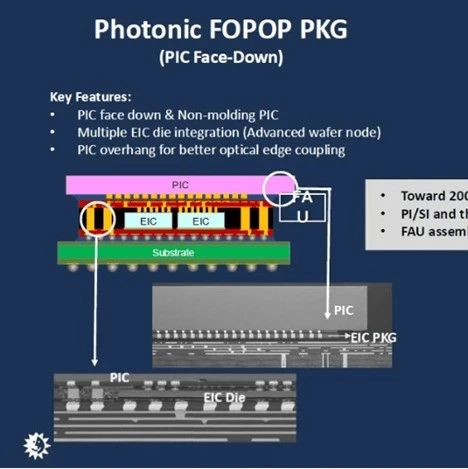
Core Viewpoint - Co-packaged optics (CPO) technology is emerging as a promising solution to enhance bandwidth and energy efficiency in data centers, particularly for applications involving generative AI and large language models. However, manufacturing challenges remain, particularly in fiber-to-photonics integrated circuit (PIC) alignment, thermal management, and optical testing strategies [1][20]. Group 1: CPO Technology and Benefits - CPO enables network switches to route signals at speeds of terabits per second while significantly improving bandwidth and reducing power consumption required for AI model training [1][20]. - The technology achieves a bandwidth density of 1 Tbps/mm, optimizing rack space in increasingly crowded data centers [1][6]. - CPO can reduce power consumption associated with high-speed data transmission from approximately 15 pJ/bit to around 5 pJ/bit, with expectations to drop below 1 pJ/bit [6][7]. Group 2: Manufacturing Challenges - Key challenges in CPO manufacturing include achieving precise alignment between fiber and PIC, which is critical for effective optical signal coupling [8]. - The most common passive alignment method is the V-groove technique, which connects the fiber directly to the PIC to minimize loss [8][9]. - Efficient coupling between standard single-mode fibers and silicon waveguides is complicated due to significant differences in size and refractive index, leading to potential light loss [8][9]. Group 3: Thermal Management - CPO systems are sensitive to temperature fluctuations caused by high-power devices like GPUs and ASICs, which can affect the performance of photonic devices [11][12]. - A temperature change of just 1°C can lead to approximately 0.1nm wavelength shift in most photonic systems, necessitating careful thermal management strategies [11][12]. - Advanced thermal interface materials and monitoring circuits are deployed to maintain PIC temperature within predefined ranges [11][13]. Group 4: Reliability Design - Ensuring reliability in CPO systems is crucial, especially with multi-chip integration, requiring known good die (KGD) testing and optical testing solutions [14][16]. - High reliability designs incorporate redundancy, such as backup lasers, to maintain operation in case of component failure [15][16]. - Integrated monitoring and self-correcting features are being developed to detect performance degradation and facilitate quick recovery [15][16]. Group 5: Integration Techniques - Both 2.5D and 3D packaging methods are utilized in CPO, with 2.5D placing electronic ICs and PICs side by side on a silicon interposer [17][18]. - 3D integration allows for optimal manufacturing processes for each chip type, enhancing performance while increasing complexity and cost [18][19]. - The integration of optical features with traditional CMOS processes is becoming more compatible, facilitating advancements in CPO technology [17][18].
先进封装,成为主角
半导体行业观察· 2025-06-03 01:26
Core Insights - Advanced packaging is transitioning from a "non-mainstream Plan B" to a "mainstream Plan A" in the semiconductor industry, driven by three key forces [1][4][7] Group 1: Key Forces Driving Advanced Packaging - The first force is the explosion of computing power, while process advancements are slowing down, necessitating chip cutting, stacking, and reorganization. Chiplets are seen as a solution to overcome limitations in chip area [1][2] - The second force is the diversification of applications, moving away from a single-chip solution to modular system designs. Advanced packaging combined with chiplets offers a balance of design flexibility and efficiency [1][2] - The third force is the rising cost of data transportation, where energy consumption for data movement often exceeds that of computation. Advanced packaging addresses this by reducing the distance data needs to travel, enhancing overall efficiency [2] Group 2: Market Growth and Investment - The advanced packaging industry is projected to achieve a compound annual growth rate (CAGR) of 12.9% over the next six years, with revenues expected to grow from $39.2 billion in 2023 to $81.1 billion by 2029 [4] - Major players in the industry, including TSMC, Intel, and Samsung, are significantly investing in advanced packaging capabilities, with an estimated $11.5 billion investment planned for 2024 [4][7] - Despite a seasonal decline in Q1 2024, advanced packaging revenue is expected to rebound in Q2 2024, reaching $10.7 billion, indicating resilience in the market [4][7]
FormFactor (FORM) Up 7.5% Since Last Earnings Report: Can It Continue?
ZACKS· 2025-05-30 16:37
Core Viewpoint - FormFactor (FORM) shares have increased by approximately 7.5% over the past month, outperforming the S&P 500, raising questions about the sustainability of this trend leading up to the next earnings release [1] Group 1: Earnings Report and Estimates - Estimates for FormFactor have been revised upward, with the consensus estimate shifting by 11.66% in the past month [2] - The stock has a Zacks Rank of 3 (Hold), indicating expectations for an in-line return in the coming months [4] Group 2: VGM Scores - FormFactor has a Growth Score of A, but a low Momentum Score of F, and a Value Score of C, placing it in the middle 20% for the value investment strategy [3] Group 3: Industry Performance - FormFactor is part of the Zacks Electronics - Semiconductors industry, where Amkor Technology (AMKR) has seen a 7.1% increase in the past month [5] - Amkor Technology reported revenues of $1.32 billion for the last quarter, reflecting a year-over-year decline of 3.2%, with EPS dropping from $0.24 to $0.09 [5] - Amkor Technology is projected to post earnings of $0.16 per share for the current quarter, indicating a year-over-year decrease of 40.7% [6]


英伟达Q1业绩会实录:没有美国芯片,中国AI照样一路狂飙
3 6 Ke· 2025-05-29 09:48
Financial Performance - Nvidia reported Q1 FY2026 revenue of $44.062 billion, a 69% year-over-year increase [1] - Net profit reached $18.775 billion, up 26% year-over-year [1] - Earnings per share (EPS) was $0.76, reflecting a 27% increase year-over-year [1] - Data center business, driven by AI chips and related products, saw a 73% revenue increase, accounting for 88% of total revenue [1] Impact of Export Controls - U.S. export controls on chips significantly impacted Nvidia's performance, leading to a $4.5 billion inventory write-down and an estimated loss of $2.5 billion in potential sales [1] - An additional loss of approximately $8 billion is expected in Q2 due to these restrictions [1] - The Chinese market, valued at around $50 billion, is now largely inaccessible to U.S. companies due to the H20 chip export ban [3][12] AI Market Dynamics - China is a major player in the global AI market, with half of the world's AI researchers located there [3] - The inability to deploy Hopper architecture products in China limits Nvidia's market share and growth potential in this region [3][12] - The competition in AI is not just about chips but also about who leads the entire technology stack [4] Domestic Manufacturing Initiatives - Nvidia supports the vision of bringing advanced manufacturing back to the U.S., with significant investments in local chip production facilities [7] - Partnerships with companies like TSMC and Foxconn are underway to establish AI supercomputer manufacturing plants in the U.S. [7] AI Infrastructure and Development - The company emphasizes the importance of AI as a foundational infrastructure that will transform various industries [12][14] - New enterprise AI products are being launched to support local developers and businesses, indicating a shift towards internal AI deployment [14] - The future of AI infrastructure is expected to include AI factories within manufacturing plants, enhancing operational efficiency [14]

2025年中国半导体先进封装市场研读:后摩尔时代,先进封装引领半导体创新趋势
Tou Bao Yan Jiu Yuan· 2025-05-20 12:16
Investment Rating - The report does not explicitly state an investment rating for the semiconductor advanced packaging industry Core Insights - Advanced packaging technology is a critical link between chip design and application, significantly enhancing chip performance and reducing power consumption while alleviating constraints in high-end chip manufacturing processes [2] - The Chinese government places high importance on the development of the semiconductor industry, implementing various policies to support independent innovation and technological breakthroughs [2] - The advanced packaging market is expected to grow rapidly, with China's packaging market projected to reach 355.19 billion yuan by 2025, with advanced packaging accounting for 32% of the market [45][47] Summary by Sections Overview of the Semiconductor Packaging Industry - Packaging is a core process in semiconductor manufacturing, involving the placement, fixation, sealing of chips, and connecting chip contacts to the package shell [14][18] - The development of semiconductor packaging technology can be divided into four stages, with the current stage being advanced packaging [19][21] Advanced Packaging Technology Types - The global advanced packaging market includes IDM, Foundry, and OSAT manufacturers, with leading companies adopting a "large platform + technology branch" architecture [4][51] - Major OSAT manufacturers in China have formed industrial capabilities through independent research and acquisitions, covering a wide range of applications from consumer electronics to AI chips [7] Market Dynamics - The global packaging testing market is expected to grow from $51 billion in 2016 to $72.27 billion by 2025, with advanced packaging projected to capture half of the market share [47] - China's packaging testing market is growing at a compound annual growth rate (CAGR) of 12.54%, significantly higher than the global market's 3.89% [47] Importance of Advanced Packaging - Advanced packaging is essential for integrating multiple functions within a system, enhancing overall system performance beyond the limitations of Moore's Law [35][38] - The report highlights that advanced packaging can improve chip performance without shrinking process nodes, addressing the rising costs associated with advanced process development [39][44]
摩根大通:半导体设备 -TMC 会议总结:人工智能数据中心需求持续强劲;半导体行业整体周期性改善
摩根· 2025-05-19 09:58
Investment Rating - The overall investment rating for the semiconductor and semiconductor capital equipment industry is cautiously optimistic, with specific companies rated as Overweight (OW) including AVGO, MRVL, ADI, KLAC, CDNS, SNPS, ALAB, N MTSI, SYNA, WDC, MU, MKSI, and AMKR [5][27][30][39][24]. Core Insights - The semiconductor industry is in the early stages of an up-cycle, driven by strong AI and datacenter demand, with broad-based cyclical improvements observed [1][6]. - Companies are experiencing positive trends in bookings and inventory management, indicating a potential cyclical recovery despite uncertainties related to tariffs and trade dynamics [6][10]. - AI infrastructure build-outs are driving strong demand for semiconductors, particularly in custom ASICs, with expectations for increased market share in edge applications [1][6][30]. - The outlook for wafer fabrication equipment (WFE) spending remains strong, supported by advanced technology migrations and increased spending in leading-edge applications [6][33]. Company Summaries NXP Semiconductors - NXP is not currently experiencing significant tariff impacts, with positive order trends suggesting a cyclical recovery [10]. - The company is focusing on supply chain diversification, particularly in China, to mitigate tariff risks [10]. - Multi-year growth drivers in automotive and industrial sectors remain intact, with strong demand for software-defined vehicle platforms [10]. Synaptics Inc - Synaptics is not seeing tariff impacts, with consistent order patterns indicating stable demand [15]. - The company has a strong design win pipeline, particularly in IoT, which is expected to drive long-term revenue growth [15]. - New product cycles, including Wi-Fi 7, are anticipated to contribute to revenue growth in the near term [15]. Intel - Intel is focused on simplifying its organization to improve execution and drive its AI strategy [18]. - The company aims to enhance its manufacturing and foundry capabilities, targeting profitability by 2027 [18]. - Core compute execution is a priority, with a strong ecosystem expected to provide a competitive advantage [18]. GlobalFoundries - GlobalFoundries is seeing positive revenue trends for the first time in eight quarters, with expectations for growth driven by communications infrastructure and data center markets [20]. - The company has a strong supply chain diversification strategy and is mitigating tariff impacts effectively [20]. - Continued margin recovery is anticipated, supported by improved utilization and product mix [20]. Amkor Technology - Amkor is not experiencing significant tariff impacts, with consistent bookings patterns [22]. - The company is making progress with its lead wireless customer and sees growth opportunities in advanced packaging technologies [22]. - Positive trends in automotive and industrial applications are expected to drive growth [22]. Lam Research - Lam Research is well-positioned to benefit from technology migrations and strong WFE spending outlook [24]. - The company is focusing on advanced packaging and expects to sustain a balanced mix of memory and foundry/logic spending [24]. - Strong visibility to margin expansion is anticipated due to operational efficiencies [24]. Western Digital - Western Digital is benefiting from strong cloud/hyperscaler spending, with positive demand trends expected to continue [27]. - The company is executing well on product launches and is focused on margin improvement [27]. - Continued capital return strategies are in place, with a focus on dividend increases and share buybacks [27]. Micron Technology - Micron is seeing strong demand trends in both DRAM and NAND, with positive pricing dynamics [30]. - The company is expanding its low power solutions and is in discussions for HBM supply allocations [30]. - Manufacturing and technology node ramps are on track, with disciplined supply expansion strategies [30]. KLA Corporation - KLA expects WFE and process control to outgrow overall semiconductor revenues, driven by complexity challenges and leading-edge investments [33]. - The company is exploring its manufacturing supply chain to mitigate tariff exposure [33]. - Continued market share gains are anticipated in process control segments [33].
每周观察 | 2024年全球前十大封测厂营收排名;2024年SiC衬底营收年减9%;云端巨头自研ASIC进程…
TrendForce集邦· 2025-05-16 04:08
Group 1: SiC Substrate Market - The global N-type SiC substrate market is projected to experience a revenue decline of 9% in 2024, amounting to $1.04 billion, due to weakened demand in the automotive and industrial sectors, alongside intensified market competition and significant price drops [1] Group 2: Semiconductor Packaging and Testing Market - The combined revenue of the top ten semiconductor packaging and testing companies is expected to reach $41.56 billion in 2024, reflecting a year-on-year growth of 3% [4] - ASE Holdings and Amkor maintain their leading positions, while companies like JCET and Tianshui Huatian are experiencing double-digit growth, posing strong challenges to the existing market structure [4][5] Group 3: AI Chip Development - The demand for AI servers is accelerating the self-research of ASIC chips among major North American cloud service providers, with new versions expected to be released every 1-2 years [6] - The proportion of AI chips sourced from foreign suppliers like NVIDIA and AMD in the Chinese market is anticipated to decrease from approximately 63% in 2024 to about 42% in 2025, while local suppliers are expected to increase their share to 40% under government policy support [6]

小鹏汽车公布足式机器人步态控制专利,可行走于崎岖地面;通用汽车与LG新能源合作开发新型LMR方形电池丨智能制造日报
创业邦· 2025-05-14 03:22
Group 1 - Xiaopeng Motors has published a patent for a bipedal robot's gait control method, enabling it to walk on rugged terrain by controlling the leg's swing and support phases with a delay mechanism [1] - General Motors and LG Energy Solution are collaborating to commercialize a new lithium manganese-rich (LMR) square battery for future electric trucks and full-size SUVs, aiming to be the first automaker to deploy LMR batteries in electric vehicles by 2028 [1] - Samsung Electronics has achieved over 60% yield for its 3nm and over 40% yield for its 2nm nodes based on GAA transistor structure, and is in the final stages of performance evaluation for advanced process orders with external clients [1] Group 2 - The global top ten semiconductor packaging and testing companies are projected to generate a combined revenue of $41.56 billion in 2024, reflecting a 3% year-on-year growth, with notable growth for Changdian Technology and Tianshui Huatian due to policy support and local demand [1]