大成基金

Search documents
债券ETF规模加速增长 百亿元级产品达二十一只
Zheng Quan Shi Bao· 2025-07-27 17:22
Core Insights - The total market size of bond ETFs has surpassed 500 billion yuan, reaching 510.5 billion yuan as of July 25, driven by the recent launch of 10 sci-tech bond ETFs and continuous growth in government bond and convertible bond ETFs [2][3][4] Market Growth - The rapid increase in bond ETF size is significantly attributed to the newly launched 10 sci-tech bond ETFs, which raised nearly 29 billion yuan, pushing the overall bond ETF size above 400 billion yuan [2][3] - The 30-year government bond ETF has seen a notable increase of over 30 billion yuan, reaching a size of over 200 billion yuan, marking it as the largest ultra-long-term bond ETF in the market [2][3] Product Diversity - The number of bond ETFs with over 100 billion yuan in size has increased from 15 to 21, indicating a growing diversity in the bond ETF market [4] - The leading bond ETFs by size include the Hai Fu Tong fund's short-term bond ETF at over 530 billion yuan and the Fu Guo fund's policy financial bond ETF at approximately 514.94 billion yuan [4] Investor Interest - Bond ETFs are favored by institutional investors due to their lower management fees and characteristics such as pledgeability, which are not as pronounced in actively managed bond funds [5] - The entry of institutional funds, particularly from wealth management, has been a major factor in the recent growth of bond ETFs [5] Future Development - The bond ETF market is expected to continue expanding in terms of product types and issuer diversity, with 34 additional fund companies yet to launch bond ETFs [6][7] - There is significant potential for growth in the domestic bond ETF market, as current market penetration is lower compared to the U.S. [7] - Future opportunities exist in areas such as comprehensive bonds, green bonds, and central enterprise themes, which are currently underrepresented [7]


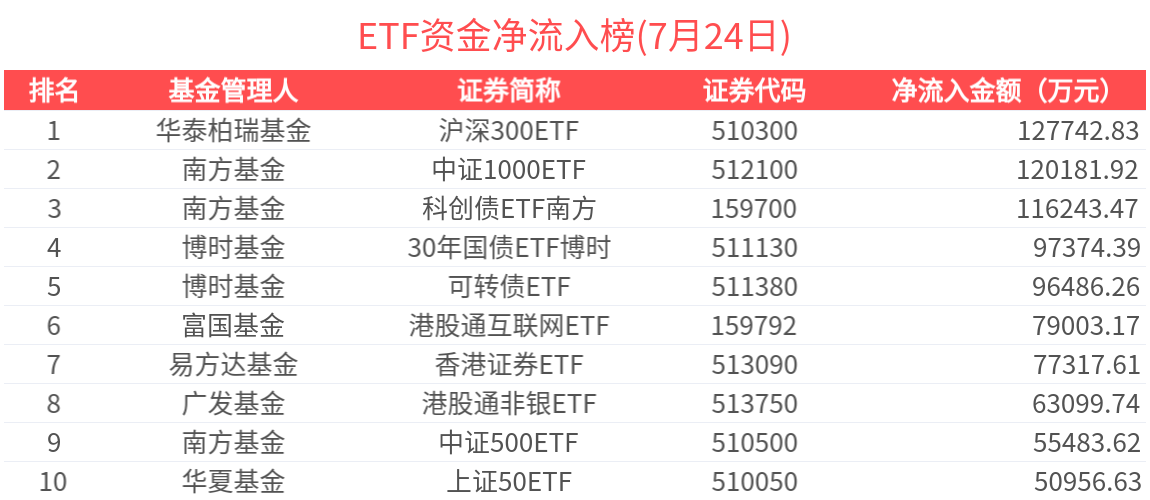
ETF资金榜 | 中证2000增强ETF(159552)资金加速流入,沪深300等宽基吸金居前-20250724
Sou Hu Cai Jing· 2025-07-25 02:36
Summary of ETF Fund Flows Core Insights - On July 24, 2025, a total of 257 ETFs experienced net inflows, while 505 ETFs saw net outflows, indicating a significant disparity in investor sentiment towards different funds [1] - The top five ETFs with notable net inflows included the CSI 300 ETF, CSI 1000 ETF, and several bond ETFs, with inflows exceeding 1 billion yuan for each [1][3] - Conversely, 47 ETFs recorded net outflows exceeding 1 billion yuan, with the Shanghai Company Bond ETF and Gold ETF among the most affected [1][5] Net Inflows - The top five ETFs by net inflow amounts were: - CSI 300 ETF (510300) with a net inflow of 1277.42 million yuan - CSI 1000 ETF (512100) with a net inflow of 1201.81 million yuan - Southern Innovation Bond ETF (159700) with a net inflow of 1162.43 million yuan - 30-Year Government Bond ETF (511130) with a net inflow of 973.7 million yuan - Convertible Bond ETF (511380) with a net inflow of 964.86 million yuan [3] Net Outflows - The top five ETFs by net outflow amounts were: - Shanghai Company Bond ETF (511070) with a net outflow of 1010.3 million yuan - Gold ETF (518880) with a net outflow of 785.3 million yuan - Policy Financial Bond ETF (511520) with a net outflow of 675.36 million yuan - Silver Flower Daily Profit ETF (511880) with a net outflow of 523.6 million yuan - Southern Innovation Bond ETF (551030) with a net outflow of 499.8 million yuan [5] Continuous Inflows - A total of 146 ETFs have seen continuous net inflows, with the top performers being: - CSI 2000 Enhanced ETF with 19 consecutive days of inflows totaling 28.054 million yuan - Hong Kong Dividend Low Volatility ETF with 17 consecutive days of inflows totaling 43.86 million yuan [7] Continuous Outflows - 344 ETFs have experienced continuous net outflows, with the leading ones being: - CSI A50 Index ETF with 31 consecutive days of outflows totaling 933.51 million yuan - CSI A500 ETF with 28 consecutive days of outflows totaling 212.575 million yuan [9] Recent Trends - Over the past five days, 91 ETFs have recorded net inflows exceeding 1 billion yuan, with the top inflow being the Southern Innovation Bond ETF with 4.588 billion yuan [10] - In contrast, 123 ETFs have seen net outflows exceeding 1 billion yuan, with the Silver Flower Daily Profit ETF leading with a net outflow of 3.760 billion yuan [10]
世界人工智能大会即将启幕,AI投资热度升温!大成创业板人工智能ETF(159242.SZ)上市受关注!
Xin Lang Cai Jing· 2025-07-25 01:46
Group 1 - The 7th World Artificial Intelligence Conference (WAIC 2025) will be held on July 26 in Shanghai, featuring major AI companies like Huawei, Alibaba, Baidu, and SenseTime, focusing on cutting-edge topics such as large models, robotics, smart chips, and industrial integration, reigniting interest in the AI market [1] - The newly launched Dacheng ChiNext AI ETF (159242.SZ) achieved impressive performance on its first day, ranking among the top two in terms of trading volume and latest scale compared to similar products [1] - The ChiNext AI Index has seen a cumulative increase of 151.75% in 2023, significantly outperforming the Sci-Tech Innovation Board AI Index at 82.02% and the CSI AI Index at 102.88%, indicating strong growth potential and market capture ability [1] Group 2 - The ChiNext AI Index focuses more on "hardware + underlying support" compared to the Sci-Tech AI Index, which emphasizes algorithms and software, with heavy investments in optical modules, computing chips, edge computing, and operating systems, aligning with the core logic of current AI industry expansion [1] - Key companies in the index, known as the "three musketeers of optical modules"—Zhongji Xuchuang, Xinyi Sheng, and Tianfu Communication—are deeply embedded in the supply chains of global tech giants like Nvidia, benefiting from global computing upgrades and the iteration of 1.6T high-speed optical modules, with expected net profit growth rates exceeding 50% by 2025 [1] - Guosheng Securities highlights the long-term growth potential of the A-share computing power sector, suggesting that as AI applications transition from laboratories to commercialization, computing infrastructure is poised to become a core driver in the next "cloud computing golden decade" [2]


公募基金2025Q2季报分析:抱团松动,头部持仓集中度回落
Xinda Securities· 2025-07-24 09:59
Fund Market Overview - The total scale of public funds exceeded 33.67 trillion yuan as of Q2 2025, with a quarter-on-quarter growth of 6.71% [6][11] - The growth structure indicates a clear preference for bond funds, money market funds, and passive index products, while actively managed equity funds continue to face net redemption pressure [6][11] - The number of newly established funds in Q2 2025 was 378, with a total fundraising scale of 286.12 billion yuan, marking an increase of approximately 29.2 billion yuan from Q1 [11][12] Fund Performance - The median return for various fund types was positive, with cross-border equity products performing particularly well; QDII mixed and QDII equity funds had median returns of 9.25% and 8.05%, respectively [2][6] - Active equity funds had a total scale of approximately 3.34 trillion yuan, remaining stable quarter-on-quarter but showing a continuous decline in share, reflecting cautious investor sentiment [2][15] Active Equity Fund Configuration - Active equity funds showed a clear trend of increasing positions, with the average stock position rising to 88.13%, indicating a rebound in risk appetite [2][6] - The allocation to Hong Kong stocks continued to rise, reaching 17.01%, while the concentration of holdings decreased for three consecutive quarters, indicating a weakening of the "hugging" effect [2][6] Heavyweight Stocks Analysis - As of the end of Q2 2025, the top five heavy holdings in active equity funds included Ningde Times, Kweichow Moutai, Midea Group, Zijin Mining, and Luxshare Precision [2][3] - The report highlighted a shift in holding structure towards technology growth, with significant increases in positions for stocks like Zhongji Xuchuang and Xinyi Sheng [3][26] Market Analysis and Outlook - Fund managers expressed structural optimism, noting that the macroeconomic environment is gradually improving, despite challenges such as weak domestic demand and external uncertainties [4][6] - The "barbell strategy" remains popular, focusing on high-dividend assets and technology growth sectors as key areas for excess returns [4][6]
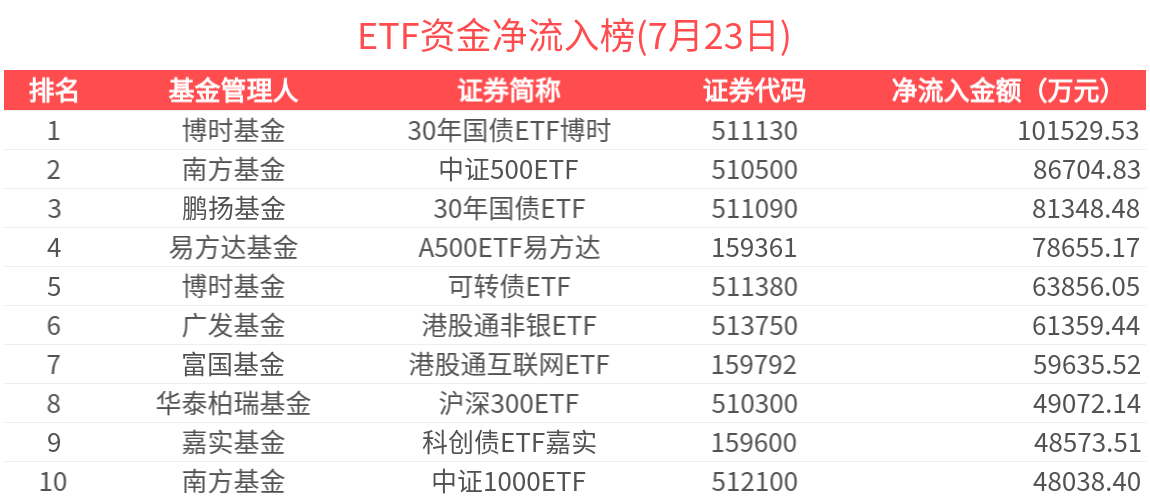
ETF资金榜 | 中证2000增强ETF(159552)资金加速流入,多只科创债ETF近5日吸金超百亿-20250723
Sou Hu Cai Jing· 2025-07-24 02:45
Core Insights - On July 23, 2025, a total of 259 ETFs experienced net inflows, while 552 ETFs saw net outflows, indicating a significant disparity in investor sentiment towards different funds [1][3] - Among the ETFs with net inflows exceeding 100 million yuan, the top performers included the 30-Year Treasury Bond ETF from Bosera, the CSI 500 ETF, and the A500 ETF from E Fund, with net inflows of 1.0152 billion yuan, 867.04 million yuan, and 787.87 million yuan respectively [1][3] - Conversely, 38 ETFs recorded net outflows exceeding 100 million yuan, with the Silver Hua Daily ETF and Gold ETF leading the outflows at 1.352 billion yuan and 1.044 billion yuan respectively [1][5] Net Inflows - A total of 133 ETFs have seen continuous net inflows, with the CSI 2000 Enhanced ETF leading with 25.351 million yuan over 18 days, followed by the Hong Kong Dividend Low Volatility ETF with 41.31 million yuan [1][7] - The CSI 2000 Enhanced ETF's rapid inflow has increased its fund size to 348 million yuan [1][7] Net Outflows - There are 369 ETFs that have experienced continuous net outflows, with the CSI A50 Index ETF leading with a total outflow of 896.71 million yuan over 30 days [1][9] - The CSI A500 ETF has seen a significant outflow of 1.964 billion yuan over 27 days, resulting in a rapid decrease in its fund size to 483.1 million yuan [1][9] Recent Trends - Over the past 5 days, 91 ETFs have recorded net inflows exceeding 100 million yuan, with the top inflow coming from the Sci-Tech Bond ETF from Harvest, totaling 11.827 billion yuan [1][10] - In contrast, 116 ETFs have seen net outflows exceeding 100 million yuan in the same period, with the Silver Hua Daily ETF experiencing the largest outflow of 3.236 billion yuan [1][10]
公募FOF二季度加仓了哪些基金?【国信金工】
量化藏经阁· 2025-07-23 15:07
Group 1: Overview of Public FOF Funds in Q2 2025 - As of Q2 2025, a total of 518 FOF products have been established, with a combined scale of 166.198 billion yuan, representing a 10.01% increase compared to Q1 2025 [1][6][9] - The scale of different types of FOFs in Q2 2025 is as follows: 92.091 billion yuan for bond-type FOFs, 32.454 billion yuan for balanced-type FOFs, and 41.652 billion yuan for equity-type FOFs, with median returns of 1.20%, 1.76%, and 2.62% respectively [1][6][16] Group 2: FOF Fund Manager Preferences - The most held active equity funds by FOFs in Q2 2025 are Dachen Gaoxin A, Fuguo Stable Growth A, and Bodao Growth Zhihang C, with the largest holdings being Dachen Gaoxin A, Yifangda Kerong, and Yifangda Information Industry Selected C [2][23] - In the bond fund category, the most held funds are Yifangda Suifeng Tianli A, Guangfa Pure Bond A, and Yifangda Credit Bond A, with the largest holdings being Boshi Credit Preferred A, Yifangda Suifeng Tianli A, and Boshi Credit Pure Bond A [2][23] Group 3: Changes in Fund Allocations - Compared to Q1 2025, the most net increased active equity funds by FOFs in Q2 2025 are Dachen Gaoxin A, Huashang Yuanjian Value C, and Qianhai Kaiyuan Gold and Silver Jewelry A, with the largest net increase in scale for Jiao Yin Technology Innovation C, Yifangda Smart Manufacturing Advantage C, and Yifangda Supply-side Reform [3][39] - In the bond fund category, the most net increased funds are Xingquan Stable A, Huatai Bairui Seasonal Red A, and Fuguo Industrial Bond A, with the largest net increase in scale for Boshi Credit Preferred A, Boshi Credit Pure Bond A, and Boshi Anyue Short Bond A [3][39] Group 4: FOF Fund Managers - The top three active equity fund managers with the most FOF allocations are Liu Xu, Fan Yan, and Xu Yan, while the top three "fixed income +" fund managers are Wang Xiaocheng, Peng Chengjun, and Zhang Ting [4][23] Group 5: FOF Stock Investment Situation - As of Q2 2025, 149 FOFs have directly invested in stocks, with the highest proportion of stock investments in balanced-type FOFs, followed by equity-type FOFs [5][6] - The top three stocks held by FOFs are Ningde Times, Changjiang Electric Power, and Zijin Mining, with the highest market value held in Ningde Times, Haomai Technology, and Wuliangye [5][6]
公募基金2025年二季报解读点评
2025-07-23 14:35
Summary of Key Points from the Conference Call Industry Overview - The report focuses on the public fund industry in China, specifically analyzing the performance and trends of various fund types in the second quarter of 2025. Core Insights and Arguments Public Fund Performance - In Q2 2025, the number and scale of newly launched active equity funds significantly increased, with an average fundraising scale of 520 million yuan, focusing on dividend value and technology growth [1][2] - Despite a market rebound, the overall share of active equity funds decreased by 2.2% due to redemptions of older products, maintaining a scale of 3.33 trillion yuan [1][2] - Fixed income plus products surpassed the levels of the second half of 2023, reaching 2.16 trillion yuan, with a notable expansion in mixed bond FOFs [1][2] Fund Categories - Active equity funds showed strong performance, with a 3.1% increase in the equity fund index, outperforming broad-based indices [1][5] - The new issuance of FOF products continued at a high level, with a total new scale of 18.6 billion yuan, leading to a 10% increase in the overall market scale of FOFs to 166.2 billion yuan [1][4] Investment Trends - Active equity funds increased their stock positions slightly, with a notable rise in holdings of Hong Kong stocks, which now account for 17% of their portfolios [3][26] - The communication and financial sectors received increased allocations, while consumer and manufacturing sectors saw reductions [27] Performance Metrics - The median returns for active equity funds in Q2 were strong, with ordinary stock, mixed equity, and flexible allocation products achieving median returns of 2.0%, 2.1%, and 1.8% respectively, all outperforming major indices [19][20] - Fixed income plus funds achieved positive returns across all subcategories, with convertible bond funds leading in performance [22][23] Additional Important Insights - The competitive landscape for FOF products shows a slight decrease in the market share of the top ten managers, which now account for 60.8% of the market [4][8] - The concentration of holdings in active equity funds has decreased, indicating a more diversified investment approach, with the CR10 and CR20 ratios at 17.5% and 25.8% respectively [28] - Notable stock holdings include Ningde Times, which remains the most favored stock among funds, despite a slight reduction in holdings [29] Market Dynamics - The passive index product market reached a total scale of 5.79 trillion yuan by the end of Q2, with a 12.6% quarter-on-quarter growth [11] - The issuance of passive stock products hit a historical high, with 109 new products launched in Q2 2025 [9][10] Sector-Specific Performance - The innovative pharmaceutical sector led the market in Q2, with corresponding theme funds achieving a median return of 10.1% [21] - The report highlights the strong performance of small-cap growth and value products, with median returns of 3.4% and 3.2% respectively [20] This summary encapsulates the key findings and insights from the conference call regarding the public fund industry, highlighting performance metrics, investment trends, and sector-specific dynamics.
金融工程专题研究:公募FOF基金2025年二季报解析
Guoxin Securities· 2025-07-23 13:58
- The total number of FOF products established in the market by the end of Q2 2025 reached 518, with a combined scale of 1661.98 billion RMB, marking a 10.01% increase compared to Q1 2025[2][12][71] - FOFs are categorized into three types based on their equity asset penetration ratio: debt-oriented FOFs (less than 30%), balanced FOFs (30%-60%), and equity-oriented FOFs (greater than 60%)[13][71] - The scale of debt-oriented FOFs in Q2 2025 was 920.91 billion RMB, accounting for 55.41% of the total, followed by equity-oriented FOFs at 416.52 billion RMB and balanced FOFs at 324.54 billion RMB[13][71] - The median returns for Q2 2025 were 1.20% for debt-oriented FOFs, 1.76% for balanced FOFs, and 2.62% for equity-oriented FOFs[2][24][71] - The equity penetration ratio of FOFs is calculated using the formula: $W=\sum_{i}Fund_{i}\times Fund_{-}Stock_{i}+Stock$ where $Fund_{i}$ represents the scale of fund i as a proportion of net value, $Fund_{-}Stock_{i}$ represents the stock investment value of fund i as a proportion of its net value, and $Stock$ represents the direct stock investment value of the FOF as a proportion of net value[12] - The top three actively managed equity funds most heavily allocated by FOFs in Q2 2025 were Dachen Gaoxin A, Fuguo Wenjian Growth A, and Bodao Growth Zhihang C, with Dachen Gaoxin A being the largest in terms of scale at 3.88 billion RMB[32][33][34] - The top three passive index equity funds most heavily allocated by FOFs were Huaxia Hang Seng Technology ETF, Fuguo China Internet ETF, and Huaxia Hang Seng ETF, with Huaxia Hang Seng ETF having the largest scale at 8.35 billion RMB[36][38] - The top three enhanced index funds most heavily allocated by FOFs were Zhaoshang CSI 300 Enhanced C, Zhaoshang CSI 1000 Enhanced A, and Huitianfu CSI 300 Enhanced A, with Huitianfu CSI 300 Enhanced A having the largest scale at 0.98 billion RMB[37][39] - The top three bond funds most heavily allocated by FOFs were Yifangda Suifeng Tianli A, Guangfa Pure Bond A, and Yifangda Credit Bond A, with Boshi Credit Preferred A having the largest scale at 11.26 billion RMB[40][41] - The top three "fixed income+" funds most heavily allocated by FOFs were Huatai Baoxing Zunhe A, Anxin Target Income A, and Xibulide Huixiang A, with Yifangda Yuxiang Huibao A having the largest scale at 6.36 billion RMB[42][46] - The formula for estimating the net increase in FOF holdings of a fund is: $\Delta N=\sum_{i}I_{i}$ where $I_{i}=1$ if the investment share increased, $I_{i}=-1$ if it decreased, and $I_{i}=0$ if unchanged[44][45] - The formula for estimating the net increase in FOF investment scale in a fund is: $\Delta MV=\sum_{i}\Delta uv\times\Delta Share_{i}$ where $\Delta uv$ represents the average daily net value of the fund during the period, and $\Delta Share_{i}$ represents the change in investment shares[45] - The top three actively managed equity funds with the highest estimated net increase in FOF holdings in Q2 2025 were Dachen Gaoxin A, Huashang Yuanjian Value C, and Qianhai Kaiyuan Gold and Jewelry A[43][47] - The top three bond funds with the highest estimated net increase in FOF holdings in Q2 2025 were Xingquan Wentai A, Huatai Baorui Jiji Red A, and Fuguo Industry Bond A[48][50] - The top three actively managed equity fund managers most allocated by FOFs in Q2 2025 were Liu Xu (Dachen Fund), Fan Yan (Fuguo Fund), and Xu Yan (Dachen Fund)[51][54] - The top three "fixed income+" fund managers most allocated by FOFs in Q2 2025 were Wang Xiaochen (Yifangda Fund), Peng Chengjun (Jingshun Changcheng Fund), and Zhang Ting (Huatai Baoxing Fund)[53][55] - A total of 149 FOFs directly invested in stocks by Q2 2025, with balanced FOFs having the highest proportion of stock investments at 32.26%, followed by equity-oriented FOFs at 30.46%[59][61] - The top three stocks most heavily allocated by FOFs in Q2 2025 were Ningde Times, Changjiang Electric Power, and Zijin Mining, with Ningde Times having the largest scale at 0.98 billion RMB[62][66]

下半年"淘金"路线图出炉!优秀FOF舵手放大招:穿透持仓呈现“成长+黄金+港股”多元结构
Sou Hu Cai Jing· 2025-07-23 13:22
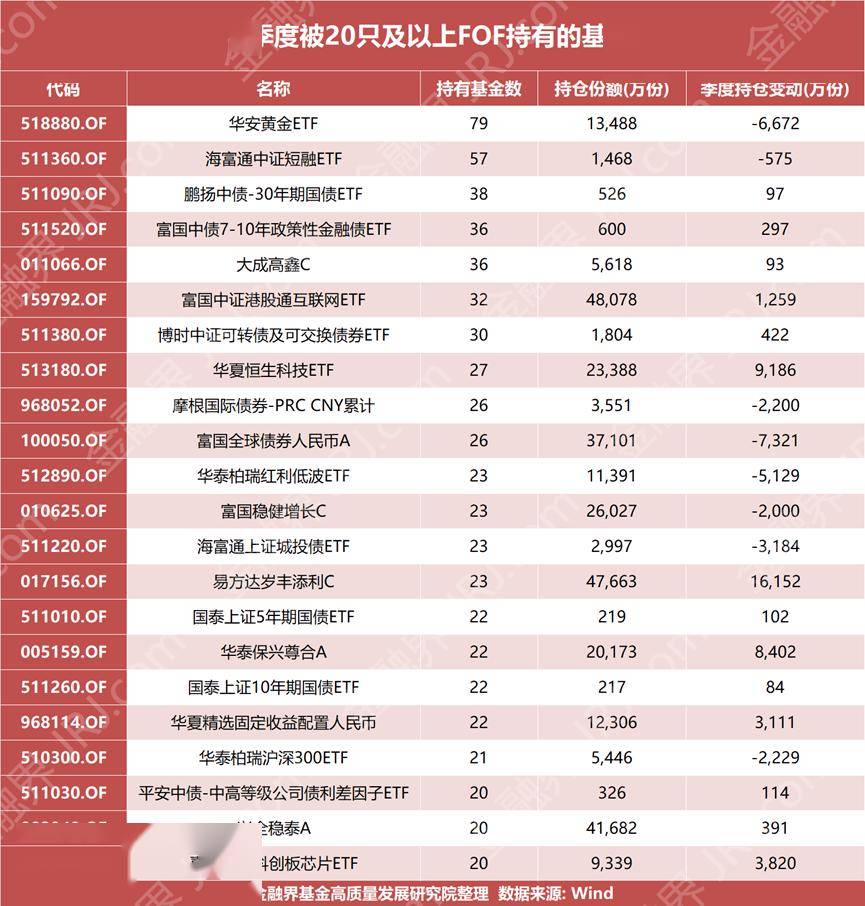
Group 1 - The core point of the article highlights the changing dynamics in FOF (Fund of Funds) investments, particularly the decline in holdings of gold ETFs, despite their popularity among fund managers [1][2] - As of the end of Q2 2025, the Huazhong Gold ETF has the highest number of FOF holdings, totaling 78, with a market value of 987 million yuan [1] - The top five funds with the most FOF purchases include Huazhong Gold ETF, Hai Futong Zhongzheng Short Bond ETF, Pengyang Zhongzheng 30-Year Treasury ETF, and others, indicating a shift in investment focus [2] Group 2 - The article discusses the performance of FOFs, noting that several funds have achieved over 20% returns year-to-date, with specific funds like Guotai Preferred Navigation and ICBC Smart Progress leading the way [4][5] - Fund managers are adopting a proactive investment strategy, focusing on sectors such as Hong Kong technology, innovative pharmaceuticals, and A-share new productivity themes, which are driving net asset value growth [3][6] - The outlook for the market suggests a focus on industry rotation opportunities, with key investment themes including rare earths, innovative pharmaceuticals, resource commodities, and the financial real estate sector [6][7]
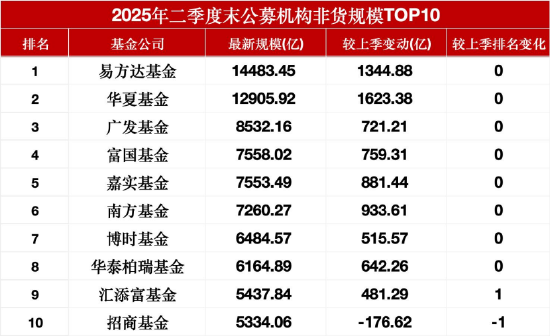
公募二季度规模战报:汇添富超越招商排名第九,鹏华规模近5000亿逼近前十,海富通成最大黑马
Xin Lang Ji Jin· 2025-07-23 05:45
Core Viewpoint - The public fund industry is experiencing a competitive landscape characterized by a solidified top tier, intense battles in the middle tier, and a rising tail tier as of the end of Q2 2025, indicating a silent scale competition among different tiers [1][15]. Group 1: Top 10 Fund Companies - The top 10 public fund companies by non-monetary scale as of Q2 2025 are: E Fund, Huaxia Fund, GF Fund, Fuguo Fund, Harvest Fund, Southern Fund, Bosera Fund, Huatai-PB Fund, Huitianfu Fund, and China Merchants Fund [2][3]. - E Fund and Huaxia Fund both surpassed significant thresholds, with E Fund exceeding 1.4 trillion and Huaxia Fund surpassing 1.2 trillion in non-monetary scale [3]. - Southern Fund and Huaxia Fund both achieved a growth rate exceeding 14%, while E Fund, Harvest Fund, Huatai-PB Fund, and others saw growth rates above 10% [3]. Group 2: Notable Changes in Rankings - Huitianfu Fund emerged as a "dark horse," with a significant increase of 481 million, moving up from 10th to 9th place, surpassing China Merchants Fund [5]. - China Merchants Fund is the only company in the top 10 to experience a decline in scale, with a decrease of 281 million since the beginning of the year and 177 million by the end of the quarter [4]. Group 3: 11-20 Tier Performance - The 11-20 tier includes companies like Penghua Fund, Invesco Great Wall Fund, and Guotai Fund, with Penghua Fund nearing 500 billion and achieving a quarterly growth of 525 million, marking a 11.9% increase [7][8]. - Guotai Fund's quarterly growth of 471 million, representing a 12.6% increase, has propelled it to 13th place, indicating strong momentum for higher rankings [8]. Group 4: 21-30 Tier Dynamics - The competition in the 21-30 tier is intense, with Xinyi Fund leading the pack, achieving a quarterly increase of 441 million, marking a nearly 20% growth [11][13]. - Haifutong Fund experienced a remarkable surge, with a quarterly increase of 559 million, resulting in a 45% growth and a jump to 28th place [13]. Group 5: Overall Industry Trends - The public fund industry is witnessing three major trends: solidification of the top tier with ongoing internal competition, significant upward momentum from the second tier, and high variability in the middle tier, which serves as a source of potential changes in rankings [15]. - The competition has evolved from mere scale expansion to a comprehensive contest involving product strength, channel effectiveness, and strategic determination [15].