
零跑汽车

Search documents
【一周投资热点】宁德时代/新宙邦/珩创纳米再扩产!盐湖股份/盛新锂能/雪天盐业现大手笔收购
Xin Lang Cai Jing· 2026-01-03 03:51
Investment Expansion - CATL has signed an investment cooperation agreement for a new 30GWh power and energy storage battery production base in Guizhou, expanding its existing facility which already has a 30GWh capacity [1] - Capchem plans to invest up to 200 million RMB in Poland to enhance its lithium-ion battery materials production capacity by 50,000 tons per year through technical upgrades [2] - Capchem also announced a project in Saudi Arabia with an investment of approximately 260 million USD to produce 200,000 tons of carbonate solvent and 100,000 tons of ethylene glycol [3] - Hanchuang has launched a 4.8 billion RMB project in Ningxia to produce 130,000 tons of lithium manganese iron phosphate annually, enhancing the local battery materials industry [4] Production Commencement - CATL's subsidiary, Yichang Bangpu, has officially launched a new 450,000 tons per year lithium iron phosphate project, achieving a record of signing, starting, and completing the project within the same year [6][7] Major Projects and Developments - The largest independent energy storage demonstration project in China, with a capacity of 500,000 kW and 3 million kWh, has been completed in Inner Mongolia [8][9] - The largest all-vanadium flow battery energy storage station in China has been put into operation in Xinjiang, with a rated power of 200,000 kW and a storage capacity of 1 million kWh [10] Mergers and Acquisitions - Salt Lake Co. plans to acquire a 51% stake in Wenkang Salt Lake for 4.605 billion RMB to enhance its position in the salt lake industry [12] - Shengxin Lithium Energy intends to acquire a 30% stake in Qicheng Mining for 2.08 billion RMB, gaining full control over the company [13] Financing Activities - Taiblue New Energy has completed a financing round of over 400 million RMB to accelerate the production of solid-state batteries [14] - CATL is set to invest 2.563 billion RMB in Jiangxi Shenghua to gain a controlling stake in the company [15] Company Orders - CATL has signed contracts for 55 electric cargo ships, marking a significant milestone in the electric shipping industry [18] - LG Energy Solution has lost contracts worth 39 trillion KRW due to a client exiting the battery industry, impacting its revenue significantly [19]




车企2026谁家强?我们列出了13家看好与“欠佳”
虎嗅APP· 2026-01-03 03:13
Core Viewpoint - The Chinese automotive industry has shifted from a phase of rapid expansion driven by investment and storytelling to a focus on efficiency and realization, emphasizing cash flow, profitability models, technology compliance, and global operational capabilities [2][3]. Group 1: Market Volume - The key question for 2026 is whether the new energy vehicle (NEV) market can surpass the 20 million unit threshold, with growth driven by factors such as trade-in programs, lower-tier markets, and improved charging experiences [4][5]. - The Chinese government has introduced a new trade-in subsidy policy for 2026, which is expected to stimulate demand in the automotive sector [6][7]. - Predictions for 2026 NEV sales vary, with estimates ranging from a 10% growth (14.14 million units) to a more optimistic 28.4% growth (16.5 million units), particularly in the 150,000 to 200,000 yuan price range [8][10]. Group 2: Profit Expectations - The industry is transitioning from a focus on scale to profitability, with competition intensifying in the 200,000 to 400,000 yuan price range [9][22]. - Companies like Geely are expected to see profit growth from multiple sources, while others like GAC face significant challenges [31][32]. Group 3: L3 and Intelligent Driving - The introduction of L3 autonomous driving is expected to shift responsibility from drivers to manufacturers, leading to systemic changes in the automotive ecosystem [38][40]. - The L3 era will likely drive the standardization of L2 features across all vehicles, increasing competition in the intelligent driving space [42][43]. Group 4: Luxury Narrative - The luxury narrative in the NEV sector is becoming increasingly complex, with a need for brands to establish genuine value propositions beyond just high-end features [50][51]. - The market for luxury vehicles priced above 300,000 yuan is growing slowly, while more affordable segments are seeing significant growth [57][60]. Group 5: Overseas Expansion - Chinese automotive exports are projected to exceed 8 million units in 2025, with significant growth in markets like Mexico and the UAE [67][68]. - The establishment of overseas production facilities is crucial for meeting demand and avoiding trade barriers, with many companies rapidly expanding their international manufacturing capabilities [72][73]. Group 6: AI Cross-Industry Moves - The focus for 2026 will likely shift away from ambitious cross-industry ventures towards enhancing core automotive services through AI, as companies learn from past experiences [78][81].

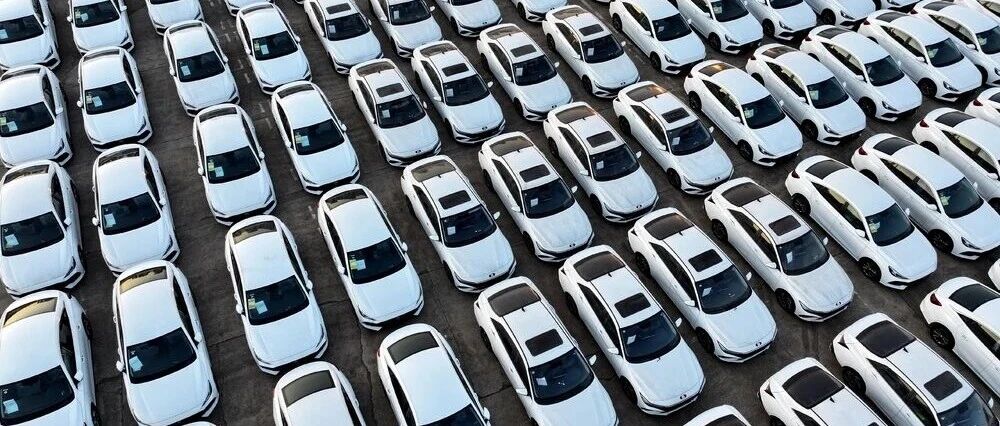
每10辆就有1辆中国造,中国车企在欧洲卖爆了
创业邦· 2026-01-03 01:13
Core Viewpoint - Chinese electric vehicles (EVs) are significantly increasing their market share in Europe, overcoming high tariffs and competition from established local brands, indicating a successful penetration into a historically challenging market [5][7]. Market Performance - In 2025, Chinese brands are projected to capture 12.8% of the European EV market and over 13% in the hybrid vehicle sector, marking a historic high [7]. - In the UK, sales of Chinese automotive brands reached 187,800 units in the first 11 months of the year, doubling from the previous year, with expectations to exceed 200,000 units in 2025 [8][11]. - The average market share of Chinese brands in Western Europe is around 6%, with significant growth in countries like Spain and Norway [11]. Competitive Advantages - Chinese automakers benefit from a mature supply chain for new energy vehicles, allowing for stable supply and cost advantages compared to European manufacturers facing high production costs and battery shortages [13]. - The strategy of localizing production, such as Chery's assembly in Barcelona and BYD's new factory in Hungary, helps avoid tariffs and brings products closer to European consumers [14]. Technological Edge - Chinese companies lead in battery technology, with innovations like BYD's blade battery and CATL's high-energy-density batteries, meeting European demands for longer range and safety [14]. - Advanced smart features in vehicles from brands like XPeng and Leap Motor cater to tech-savvy European consumers [15]. Challenges Ahead - Trade barriers, such as a 45% anti-subsidy tax, and upcoming regulatory requirements pose significant challenges for Chinese automakers [15][17]. - Service and brand recognition remain weak compared to established European brands, with limited service networks and slower response times affecting customer retention [17]. - Adapting to stringent European standards for charging interfaces and carbon footprints adds to the cost of vehicle modifications [17].



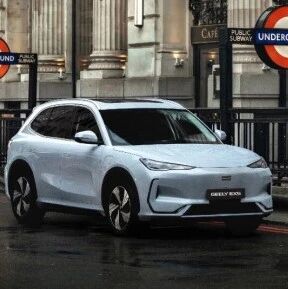
全球新能源汽车新王者诞生,特斯拉黯然让位
Xin Lang Cai Jing· 2026-01-02 15:29
Core Insights - BYD has surpassed Tesla in global electric vehicle sales, achieving 2.26 million units in 2025, a nearly 28% increase from 2024, while Tesla's deliveries fell to 1.6 million, marking an 8.6% decline, the largest annual drop in its history [2][8] - Despite not yet entering the U.S. market, BYD's growth in the electric vehicle sector has outpaced Tesla, which relies heavily on the U.S. market for nearly half of its revenue [8][9] - Tesla's sales have been impacted by increased competition from BYD and other automakers, as well as political controversies surrounding CEO Elon Musk, leading to a significant drop in demand [9][10] Company Performance - BYD's total vehicle sales, including electric and plug-in hybrid models, are projected to exceed 4.6 million units in 2025, but the growth rate has fallen to its lowest in five years, indicating challenges in the Chinese market [10][11] - In the first three quarters of 2025, BYD's net profit declined, reflecting the pressures of intense competition and price wars in the domestic market [11] - BYD's market share in China has decreased from 35% in 2023 to 29% in the first eleven months of 2025, while competitors like Geely have seen significant growth [11] Market Dynamics - The U.S. electric vehicle market showed signs of weakness in late 2025, with Tesla's fourth-quarter deliveries dropping by 15.6% compared to the previous quarter [8][9] - Tesla's strategy to introduce lower-priced versions of its Model 3 and Model Y has not fully mitigated the impact of the expiring tax incentives, as these models come with reduced range and features [9] - The competitive landscape in China remains fierce, with over 150 automotive brands and more than 50 electric vehicle manufacturers, intensifying the pressure on BYD [11]

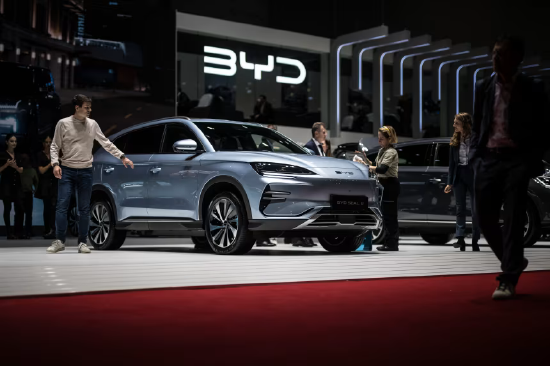
2025年车企销量排名出炉:比亚迪、吉利、奇瑞稳居前三,造车新势力分化加剧,零跑、小鹏、小米完成目标
Feng Huang Wang Cai Jing· 2026-01-02 14:45
Core Insights - The Chinese automotive industry is experiencing a significant transformation, with traditional giants expanding rapidly while new energy vehicle startups face intense competition and market reshuffling [1] Traditional Giants' Performance - BYD continues to lead the market with total sales exceeding 4.6 million units in 2025, marking a nearly 8% year-on-year increase. Pure electric vehicle sales reached 2.2567 million units, up 27.86% [2] - BYD's overseas sales surpassed 1 million units for the first time, achieving 1.0496 million units, a staggering 145% increase year-on-year [2] - Geely Automotive achieved over 3.02 million units in sales, exceeding its target of 3 million units with a 39% year-on-year growth, driven by a 90% increase in new energy vehicle sales [3] - Chery Automotive sold over 2.8 million units, a 7.8% increase, and maintained its position as the top exporter of Chinese passenger cars for 23 consecutive years [5] - Great Wall Motors sold over 1.32 million units, a 7.33% increase, with new energy vehicle sales reaching 403,700 units, up 25.44% [7] New Energy Vehicle Startups' Struggles - The new energy vehicle sector shows significant differentiation, with only Leap Motor, Xiaomi, and XPeng meeting their annual sales targets [8] - Leap Motor emerged as a surprise leader with nearly 600,000 units sold, achieving a target completion rate of over 119% [8] - Homtruck followed closely with 589,100 units sold, but fell short of its 1 million target, achieving only 59% of its goal [8] - XPeng sold 429,400 units, surpassing Li Auto, with a year-on-year growth of 125.94% and a target completion rate of over 113% [10] - Li Auto faced a decline, selling 406,300 units, down 18.81% year-on-year, and only achieving 58.05% of its target [10] Market Dynamics and Future Outlook - The competitive landscape is shifting, with traditional automakers gaining strength while new entrants like Leap Motor and Xiaomi are rising [11] - The upcoming subsidy policies for 2026 are expected to intensify competition, focusing on product strength, technological capabilities, and brand value [12] - The automotive industry is poised for further transformation as market dynamics evolve, indicating that no company's position is guaranteed [12]
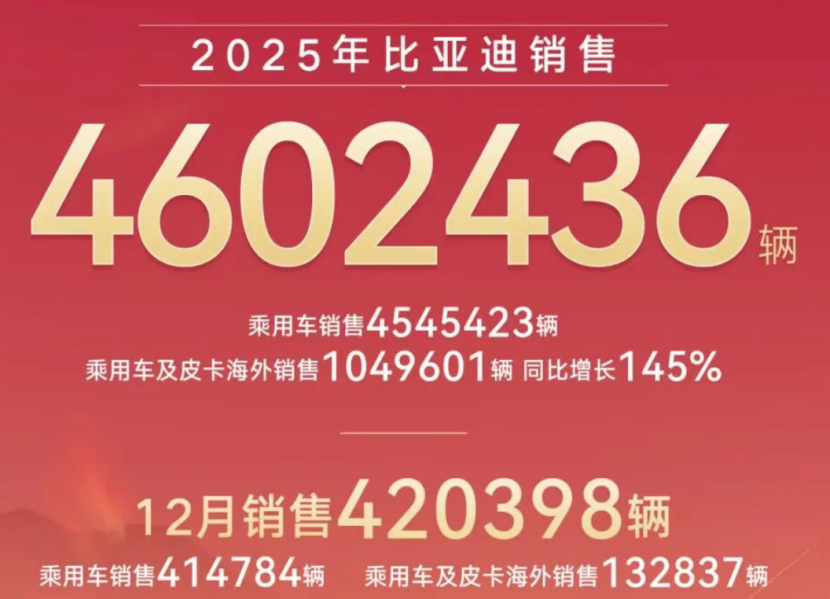
2025车市,谁封神谁掉队?
凤凰网财经· 2026-01-02 13:42
Core Viewpoint - The Chinese automotive industry is undergoing a significant transformation, with traditional giants expanding rapidly while new energy vehicle startups face intense competition and market reshuffling [1][2]. Group 1: Traditional Giants' Performance - BYD continues to lead the market with total sales exceeding 4.6 million units in 2025, marking an 8% year-on-year increase. Pure electric vehicle sales reached 2.2567 million units, up 27.86% [3]. - BYD's overseas sales surpassed 1 million units for the first time, with a remarkable 145% increase year-on-year, indicating its growth as a global player [3]. - Geely achieved over 3.02 million units in sales, exceeding its target of 3 million units with a 39% year-on-year increase. Its new energy vehicle sales approached 1.69 million units, soaring by 90% [5]. - Chery sold over 2.8 million units, a 7.8% increase, and maintained its position as the top exporter of Chinese passenger cars for 23 consecutive years, with exports exceeding 1.34 million units, up 17.4% [8]. - Great Wall Motors sold over 1.32 million units, a 7.33% increase, with new energy vehicle sales reaching 403,700 units, up 25.44% [10]. Group 2: New Energy Vehicle Startups' Performance - The new energy vehicle startups showed significant differentiation, with only Leap Motor, Xiaomi, and XPeng meeting their annual sales targets [12]. - Leap Motor emerged as a surprise leader with nearly 600,000 units sold, achieving a target completion rate of over 119% [12]. - XPeng sold 429,400 units, surpassing its target with a 125.94% year-on-year growth, while NIO sold 326,000 units, a 46.9% increase [15]. - Li Auto faced challenges, selling 406,300 units, down 18.81% year-on-year, and only achieving 58.05% of its target [15]. - Xiaomi's sales reached over 35,000 units, successfully meeting its annual target, while other brands like Deep Blue and Avita struggled to meet their goals [16]. Group 3: Market Dynamics and Future Outlook - The automotive market is expected to become more competitive as new subsidy policies are introduced in 2026, emphasizing product strength, technological capabilities, and brand value [19]. - The rapid changes in market positions among startups highlight the volatility and competitive nature of the industry, with no brand's position being secure [17].
智通港股解盘 | 科技引领港股开门红 商业火箭第一股申请上市推波助澜
Zhi Tong Cai Jing· 2026-01-02 12:56
Market Overview - The Hong Kong stock market opened positively in 2026, with the index breaking through the 26,000-point mark and closing up by 2.76% [1] - The offshore RMB strengthened, surpassing 6.97 against the USD, reaching a new high since May 2023 [1] - Aluminum prices hit $3,000, the highest since 2022, driven by supply tightening and long-term demand expectations [1] Technology Sector - Baidu announced that Kunlun Chip has submitted a listing application to the Hong Kong Stock Exchange, aiming for a valuation between $3 billion and $11 billion for Baidu's 59% stake [2] - Baidu's stock rose over 9%, positively impacting other tech giants like Alibaba and Tencent, which also saw gains of over 4% [2] Semiconductor Industry - Wall Street's first GPU stock, Birun Technology, saw a subscription rate of 1,583.50 times, with an opening price of HKD 35.7, reflecting an 82% premium [3] - Semiconductor stocks like TSMC and Hua Hong Semiconductor also experienced gains, with Hua Hong's stock rising over 9% [3] Aerospace Sector - The commercial aerospace sector saw a surge, with Blue Arrow Aerospace's IPO application accepted, leading to a stock price increase of over 20% for Goldwind Technology [4] Satellite Industry - SpaceX announced a reduction in the orbital height of thousands of Starlink satellites to mitigate collision risks, leading to significant stock increases for Chinese satellite companies [5] - Companies like China Technology Group and Asia Pacific Satellite saw stock increases of nearly 43% and over 34%, respectively [5] Renewable Energy - Skyworth Group's stock rose over 10% following the signing of a 10MW distributed solar power project in Italy, marking significant progress in the European market [6] - The Chinese government is enhancing regulatory measures in the solar industry to ensure fair competition and sustainable development [6] Consumer Electronics - The home appliance sector saw a boost, with major companies like Midea and Haier rising over 4% due to positive market sentiment [7] Automotive Industry - Chinese brands captured a record 12.8% market share in the European electric vehicle market, with significant sales growth reported by companies like BYD and Geely [8] - New energy vehicle sales in Europe doubled compared to the previous year, indicating strong demand for Chinese automotive brands [8] Aluminum Industry - China Aluminum's stock is expected to benefit from rising aluminum prices, which have reached a new high, with a projected revenue increase due to strong demand from the electric vehicle and solar sectors [10][11] - The company reported a 90.31% year-on-year increase in net profit for Q3 2025, driven by cost control and resource optimization [11]


七成新势力车企年度KPI翻车! 谁是“销量倒退玩家”?
Xin Lang Cai Jing· 2026-01-02 10:11
Core Insights - The new energy vehicle industry is facing significant challenges, with many companies failing to meet their annual sales targets, indicating a competitive and rapidly evolving market environment [2][11]. Group 1: Performance of Key Players - Among the "Wei Xiao Li" trio, only XPeng Motors met its sales target, while NIO fell short but achieved a nearly 50% year-on-year growth, and Li Auto was the only company in the top 15 to experience a year-on-year sales decline of 18.8% [3][5][10]. - Xiaomi's automotive division achieved approximately 410,000 units in sales, surpassing its target by 17% [4][11]. - Overall, 8 out of 12 new energy vehicle companies failed to meet their annual targets, representing about 67% of the companies analyzed [4][11]. Group 2: Company-Specific Challenges - NIO aimed for a sales target of 440,000 units but only sold 326,000 units, despite a year-on-year growth of 46.88% [5][13]. - Li Auto's sales for the year were 406,300 units, achieving only 58.05% of its ambitious target of 700,000 units, marking a significant setback for the company [6][14]. - Changan's brands, including Avita and Deep Blue, also struggled, with Deep Blue's sales falling short of its revised target of 360,000 units, achieving only 333,100 units [8][16]. Group 3: Market Dynamics and Future Outlook - The competitive landscape is characterized by overcapacity, intense competition, and price wars, making it difficult for companies to meet their sales goals [17]. - Industry experts suggest that the current instability in the new energy vehicle market contrasts with the more stable dynamics of traditional fuel vehicles, indicating a period of rapid evolution and competition [17].


七成新势力车企年度KPI翻车!谁是“销量倒退玩家”?
新浪财经· 2026-01-02 10:05
Core Viewpoint - The article discusses the annual sales performance of new energy vehicle companies in 2025, highlighting the competitive landscape and the challenges faced by key players in the industry, particularly the "Wei Xiaoli" trio: NIO, Li Auto, and Xpeng [3][4][7]. Group 1: Sales Performance of Key Players - Among the "Wei Xiaoli" trio, Xpeng is the only company that exceeded its sales target, while NIO achieved a nearly 50% year-on-year growth but fell short of its annual goal. Li Auto lagged behind, completing only 58% of its target and experiencing an 18.8% decline in year-on-year sales, making it the only company in the top 15 to report a decrease [4][6][8]. - Xiaomi's automotive division achieved approximately 410,000 units in sales, surpassing its target by 17% [5]. - Of the 15 new energy vehicle companies analyzed, 8 failed to meet their annual targets, representing about 67% of the group [6]. Group 2: Individual Company Insights - NIO aimed for a sales target of 440,000 units but only sold 326,000 units, despite a year-on-year growth of 46.88%. The founder emphasized the need for strategic focus and resilience in a competitive environment [7][8]. - Li Auto's sales for the year were 406,300 units, significantly below its target of 700,000 units, marking a year-on-year decline of 18.81% [8]. - Leap Motor achieved a record annual sales of 596,600 units, with a year-on-year growth of 103.1%, and aims for a million sales in 2026 [9]. Group 3: Challenges Faced by Other Companies - Changan's brands, including Avita and Deep Blue, did not meet their sales targets, with Deep Blue's sales falling short despite a revised target [11]. - Dongfeng's brand, Lantu, also failed to meet its goal, selling 150,200 units, achieving a completion rate of 75.1% [11]. - The overall market environment is characterized by overcapacity, intense competition, and price wars, making it difficult for companies to achieve their sales targets [11].


2025 全年汽车销量 / 交付榜出炉:比亚迪 460 万辆蝉联第一,零跑夺新势力销冠
Xin Lang Cai Jing· 2026-01-02 04:26
Group 1 - In 2025, the domestic automotive market is highly competitive, with BYD leading in sales at 4,602,436 units, marking a year-on-year increase of 7.73% [1][2] - BYD's overseas sales surpassed 1 million units for the first time, showing a significant growth of 145% [2] - China FAW achieved sales of 3,301,963 units, a 3.2% increase, with notable growth in its Hongqi brand, which sold over 460,000 units, up 11.7% [2] Group 2 - Geely Auto reported sales of 3,024,567 units, a 39% increase, exceeding its annual target of 3 million units [2] - Chery Group's sales reached 2,631,381 units, an 8% increase, with its Jetour brand growing by 10% [2] - Great Wall Motors sold 1,323,672 units, with its WEY brand experiencing a remarkable growth of 86.29% [3] Group 3 - Li Auto's sales were 406,343 units, reflecting a decline of 18.8%, while NIO reported 326,028 units, a growth of 46.9% [3] - Xpeng Motors achieved sales of 429,445 units, a significant increase of 126%, with overseas deliveries reaching 45,008 units, up 96% [3] - The overall performance of new energy vehicles is strong, with several brands, including SAIC-GM Wuling, surpassing 1 million units in annual sales [2][3]