华为

Search documents
苹果卫星通信功能重大升级!消息称Phone 18 Pro系列支持发送卫星图片【附卫星通信行业市场分析】
Qian Zhan Wang· 2026-02-05 03:20
Core Viewpoint - Apple is set to significantly upgrade its satellite communication capabilities with the upcoming iPhone 18 Pro series, introducing a feature called "Satellite 5G" that allows for the transmission of satellite image messages, marking a shift from emergency backup to a regular connectivity protocol [2]. Group 1: Apple’s Satellite Communication Upgrade - The iPhone 18 Pro will enhance satellite communication bandwidth from Kbps to Mbps and even Gbps, enabling the sending and receiving of images [2]. - The new "Pocket Direct Connect" technology allows users to maintain satellite connectivity without needing to manually align their phones with the satellite, even in pockets or indoors [2]. Group 2: Competitive Landscape - Huawei has already implemented satellite image messaging in its Pura 70 series, utilizing advanced AI compression algorithms to transmit images in just 800 Bytes, ahead of Apple by approximately two years [3]. - Chinese telecom operators have begun to establish mobile satellite direct connection services, with China Telecom launching such services in 2023, supporting devices like the Huawei Mate 60 Pro [3]. Group 3: Industry Trends - The mobile satellite direct connection technology is becoming a focal point in the satellite internet sector, with companies like AST SpaceMobile, Lynk, Omnispace, and SpaceX accelerating their technological developments [4]. - The demand for satellite communication chips is expected to rise significantly as the market for mobile satellite direct connection technology opens up, with several A-share listed companies already investing in the satellite communication technology supply chain [6]. Group 4: Future of Communication - The founder of Galaxy Space suggests that mobile satellite direct connection will lead the 6G communication revolution, proposing a network architecture that integrates ground networks with satellite broadband and mobile direct connections [8]. - The demand for satellite broadband is rapidly increasing, indicating a key step towards making satellite communication accessible to the general public [9].


2025胡润中国500强:最具价值国企前三名为农业银行、工商银行、国家电网
Xin Lang Cai Jing· 2026-02-05 03:06
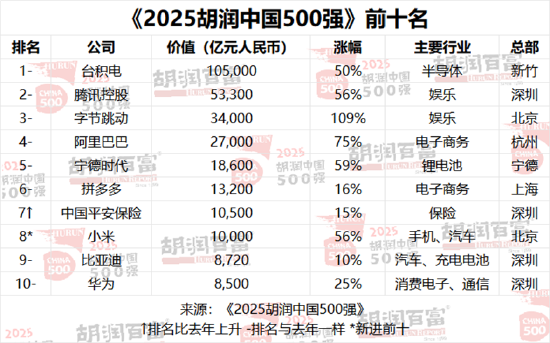
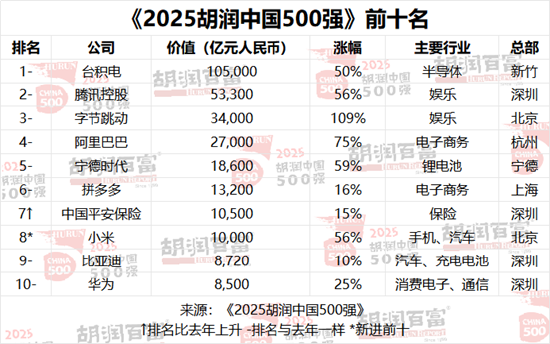
Core Insights - The "2025 Hurun China 500" report highlights TSMC as the highest-valued private enterprise in China, with a valuation increase of 3.5 trillion RMB, reaching 10.5 trillion RMB [1][4] - Tencent follows as the second highest, with a valuation growth of 1.9 trillion RMB, totaling 5.3 trillion RMB [1][4] - ByteDance ranks third, increasing its value by 1.8 trillion RMB to 3.4 trillion RMB [1][4] - Xiaomi enters the top ten for the first time, with a valuation increase of 357 billion RMB, reaching 1 trillion RMB [1][4] Top Ten Private Enterprises - TSMC: Valuation of 105,000 million RMB, growth of 50% [2][5] - Tencent: Valuation of 53,300 million RMB, growth of 56% [2][5] - ByteDance: Valuation of 34,000 million RMB, growth of 109% [2][5] - Alibaba: Valuation of 27,000 million RMB, growth of 75% [2][5] - CATL: Valuation of 18,600 million RMB, growth of 59% [2][5] - Pinduoduo: Valuation of 13,200 million RMB, growth of 16% [2][5] - Ping An Insurance: Valuation of 10,500 million RMB, decline of 15% [2][5] - Xiaomi: Valuation of 10,000 million RMB, growth of 56% [2][5] - BYD: Valuation of 8,720 million RMB, growth of 10% [2][5] - Huawei: Valuation of 8,500 million RMB, growth of 25% [2][5] Top Ten State-Owned Enterprises - Agricultural Bank: Valuation of 202,000 million RMB [3][6] - Industrial and Commercial Bank: Valuation of 274,000 million RMB [3][6] - State Grid: Valuation of 266,000 million RMB [3][6] - China National Railway Group: Valuation of 224,000 million RMB [3][6] - China Construction Bank: Valuation of 203,000 million RMB [3][6] - Kweichow Moutai: Valuation of 182,000 million RMB [3][6] - China Petroleum: Valuation of 176,000 million RMB [3][6] - Bank of China: Valuation of 170,000 million RMB [3][6] - China Mobile: Valuation of 175,000 million RMB [3][6] - CITIC Group: Valuation of 156,000 million RMB [3][6]




东华软件表示和华为在医疗信创领域持续深化合作,政策+市场双轮驱动我国信创产业快速发展
Mei Ri Jing Ji Xin Wen· 2026-02-05 03:04
Group 1 - The core viewpoint of the news highlights the performance of the domestic information technology application innovation industry index, which has seen a decline of 0.94% as of 10:45, with mixed results among constituent stocks [1] - The leading stock, Borui Data, increased by 7.92%, while the lagging stock, Fanwei Network, decreased by 4.71% [1] - The Xinchang ETF (562570) has also experienced a decline of 1.47%, with the latest price at 1.48 yuan [1] Group 2 - In terms of liquidity, the Xinchang ETF had a turnover of 4.86% during the trading session, with a transaction volume of 22.07 million yuan [2] - The Xinchang ETF has seen a significant growth in scale over the past week, increasing by 607.49 million yuan, leading its peers [2] - Over the last three days, the Xinchang ETF has experienced continuous net inflows, with a maximum single-day net inflow of 30.00 million yuan, totaling 37.58 million yuan, averaging 12.53 million yuan in daily net inflow [2] Group 3 - Northeast Securities indicates that the information technology application innovation industry is rapidly developing due to a dual drive from policy and market, with the market size reaching 2,096.19 billion yuan in 2023, reflecting a year-on-year growth of 25.6% [3] - A national-level policy framework has been established, consisting of "top-level design - special support - standard specifications" [3] - The information technology application innovation industry encompasses IT infrastructure, basic software, application software, and information security, forming a complete industrial chain and ecosystem [3] - The industry has developed a strategic layout of "2+8+N," covering key sectors such as government, finance, telecommunications, and healthcare, along with various consumer markets [3] - The Xinchang ETF (562570) closely tracks the domestic information technology application innovation index, emphasizing domestic full-stack substitution and integrating key areas such as storage chips, CPUs, and AI applications [3]

2025胡润中国500强发布:寒武纪价值增长3700亿元,位列第16
Xin Lang Cai Jing· 2026-02-05 03:04
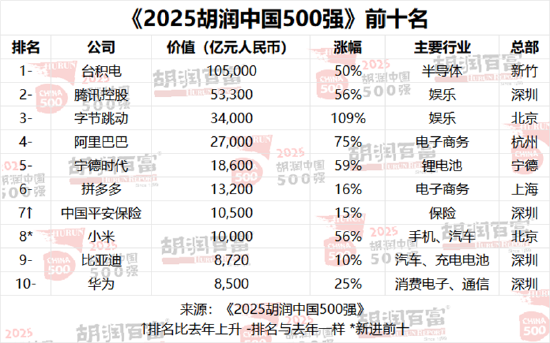
来源:5D调查 胡润研究院发布2月5日发布《2025胡润中国500强》,台积电价值增长3.5万亿元,以10.5万亿元再度蝉 联中国价值最高的民营企业。腾讯价值增长1.9万亿元,以5.3万亿元稳居第二。字节跳动价值增长1.8万 亿元,以3.4万亿元保持第三。小米新进前十,价值增长3570亿元,以1万亿元位列第八。 | | | | 《2025胡润中国500强》 前十名 | | | | | --- | --- | --- | --- | --- | --- | --- | | 排名 | 公司 | 价值(亿元人民币) | | 涨幅 | 三是得行业 | SHI | | | 合肥皂 | alle Par 200 - 100, 000 | | 50% | | | | 2- | 腾讯控股 | 53,300 | | 56%500 | 娱乐 | 深圳 | | 3- | 字节跳动 | 34,000 | | 109% | 娱乐 | 北京 | | 4- | 阿里巴巴 | 27,000 | | 75% | 电子商务 | 杭州 | | | 宁德时代 | 18,600 | 1981-1991 | 59% | 一理申池 | 宁德 | | | ...



广货行天下,金融放大招!这些“真香福利”何以点燃消费热潮
Nan Fang Du Shi Bao· 2026-02-05 02:43
2月2日,商务部等9单位印发《2026"乐购新春"春节特别活动方案》,其中提出,鼓励金融机构与重点 商户合作,策划春节专属活动,推出消费红包、消费立减等优惠,扩大活动覆盖面。结合地方促消费活 动,推出支付满减、积分抵现等优惠措施,鼓励使用数字人民币智能合约消费红包。 政策暖风之下,市场迅速响应。金融机构与重点商户联动推出专属优惠,一场围绕春节消费的惠民盛宴 已经开启。在这股新春消费浪潮中,"广货"以深厚的历史积淀和鲜活的时代气息,成为市民采购和消费 的心头好。金融力量的加入,更为这份消费热情"上大分"。从信用卡分期免息到支付立减,再到数字人 民币红包等,这些"真香"福利,不仅降低消费门槛,更打通了从心动到行动的最后一环,让更多优质广 货借力春节消费热潮,走出岭南、行销天下。 消费金融降低门槛,引爆"广货"市场 "国补500元,生日券减200元,信用卡减150元,门店优惠100元,最终4249元拿下。"1月27日,海南的 李先生购买了一部华为Mate80。说到价格方面的优惠,他精确地报出这串数字。 春节将至,消费热潮奔涌。金融,正为这升腾的人间烟火助力。 同样通过信用卡优惠"锁定"心仪广货的,还有浙江的小游。在 ...

GDP全球第二还在喊穷?中国如果不做一件事,永远是给西方打工
Sou Hu Cai Jing· 2026-02-05 02:41
Group 1 - The core viewpoint of the article highlights the contrast between macroeconomic prosperity and microeconomic challenges in China, indicating that while the overall economy shows growth, individual experiences remain strained [2][10]. - China's GDP is projected to reach 140.1879 trillion yuan by 2025, reflecting a stable growth rate of 5.0% year-on-year, marking a historical high [2]. - The total value of goods trade has exceeded 45 trillion yuan, with a year-on-year growth of approximately 6%, and the Shanghai Composite Index has risen over 10% for the year, indicating a recovery in capital market confidence [4]. Group 2 - Despite the positive macroeconomic indicators, individuals face financial pressures, with rising living costs outpacing income growth, leading to cautious consumer behavior [6][10]. - The manufacturing sector, while busy with orders, experiences profit dilution, and workers often face increased workloads without corresponding bonuses [8][10]. - The economic structure requires adjustment, as the benefits of growth have not been evenly distributed, with a significant portion of profits flowing to design and branding sectors outside of China [8][10]. Group 3 - China's manufacturing industry relies heavily on labor-intensive models, accounting for nearly 30% of global output and consuming over 50% of the world's coal, steel, and cement [12]. - The logistics sector is inefficient, contributing 14.1% to the economy, compared to 7%-8% in Europe and the U.S., leading to significant annual losses [14]. - The country is urged to shift towards a knowledge-based economy, with a target of 40% in productive services and 25% in manufacturing by 2040 to enhance competitiveness and profit retention [19][27]. Group 4 - The transition to a knowledge economy involves upgrading production lines, training workers in new skills, and implementing smart technologies [25][27]. - The article emphasizes the need for structural reforms to alleviate individual financial pressures and improve overall economic vitality [10][23]. - China's international engagement includes reforming its contributions to the United Nations and advocating for fairer global economic rules [21].
从电商年货节榜单看消费新趋势
Jing Ji Wang· 2026-02-05 02:41
Group 1 - The core theme of consumer spending during the upcoming Spring Festival focuses on purchasing new year goods and gifts, with a notable increase in demand for smart and personalized products [1][2] - E-commerce platforms are leveraging technology and promotional activities to enhance consumer engagement and stimulate spending, indicating a robust consumer demand this year compared to previous years [1][3] Group 2 - Smart technology products are emerging as popular choices for new year gifts, with significant sales increases reported in home appliances, such as a 121% rise in sales of robotic vacuum cleaners and a 114% increase in embedded micro-steaming ovens [2] - The trend of "instant purchasing" for new year goods is gaining traction, with platforms like Meituan reporting substantial year-on-year sales growth in various categories, including a 572% increase in foot massage machines and a 503% increase in action cameras [2] Group 3 - The gifting of new year presents for elders and family members is a significant aspect of consumer behavior, with 45.6% of surveyed consumers prioritizing gifts for parents and elders, emphasizing health and safety as key considerations [3] - The e-commerce landscape is characterized by trends such as smart, personalized, and immediate consumption, driven by factors like consumption upgrades and improved infrastructure [3] Group 4 - Service consumption related to traditional activities, such as haircuts and cleaning, is experiencing a surge, with beauty services like hair dyeing seeing a 78% increase in search volume on Meituan [4] - The home cleaning service sector is also witnessing a peak in demand, particularly in major cities, with a doubling of orders for daily cleaning services [4] Group 5 - E-commerce platforms are actively developing AI applications to streamline the shopping experience, with initiatives like Meituan's AI search tool and JD's AI New Year Goods Map system aimed at enhancing consumer convenience and operational efficiency [5][6] - AI is expected to play a significant role in personalized recommendations and inventory management, potentially transforming the consumer market [6] Group 6 - New trends in gifting include creative products like blind boxes and culturally themed items, with 65.6% of consumers indicating plans to purchase themed gift boxes for the Year of the Horse [7] - The popularity of traditional clothing, such as Ming-style Hanfu, is on the rise, with sales in this category increasing by over 100% in the past month [7] Group 7 - E-commerce platforms are implementing various promotional strategies, including discount coupons and interactive live-streaming events, to further stimulate consumer spending during the New Year shopping season [7][8] - Future e-commerce operations should focus on enhancing value and building ecosystems that meet quality and cultural demands while expanding fulfillment networks in lower-tier markets [8]


海外市场成车企销量关键支撑
Jin Rong Shi Bao· 2026-02-05 02:31
Core Insights - In January 2026, the Chinese automotive market entered a traditional off-season, with new energy vehicle (NEV) companies facing significant sales pressure and a reshuffling of the sales rankings [1][2] New Energy Vehicle Sales Dynamics - Hongmeng Zhixing topped the new energy vehicle sales in January with 57,915 units delivered, marking a 65.6% year-on-year increase [2] - Xiaomi Auto delivered over 39,000 units, with a focus on the YU7 model as the initial SU7 model has been phased out [2] - Leap Motor delivered 32,059 units, a 27% year-on-year increase, but showed a notable month-on-month decline [2] - Li Auto's deliveries were 27,668 units, experiencing both year-on-year and month-on-month declines due to delays in the i6 model's delivery [3] - NIO delivered 27,182 units, a 96.1% year-on-year increase, with the new ES8 model performing exceptionally well [3] - XPeng Motors delivered 20,011 units, facing declines as it is in a product iteration phase [3] Traditional Automakers' Performance - BYD achieved total NEV sales of 210,051 units in January, with exports reaching 100,482 units, a 51.47% year-on-year increase [4] - Chery Group exported 119,605 vehicles, a 48.1% year-on-year increase, maintaining its position as a leading exporter [4] - SAIC Group sold 327,413 vehicles, a 23.9% year-on-year increase, with a significant rise in overseas sales [4] - Geely's total sales reached 270,167 units, with a notable increase in exports, achieving a doubling in export numbers [4] - Great Wall Motors sold 90,312 vehicles, with overseas sales growing by 43.77% [5] Market Trends and Future Outlook - The decline in market demand is attributed to changes in the new energy vehicle purchase tax policy and the release of pent-up demand from 2025 [5] - Analysts suggest that the domestic passenger car market's growth momentum will shift towards overseas markets, with companies focusing on international expansion as a core growth strategy [5]

中国太保董事长傅帆:数智化转型是生存和发展的必答题
Zhong Zheng Wang· 2026-02-05 02:29
Core Viewpoint - China Pacific Insurance (601601) is launching a new strategic initiative focused on "AI+" to reshape the insurance value chain, emphasizing proactive risk management, enhanced service experience, and collaborative productivity [1][2] Group 1: Strategic Initiatives - The company has officially initiated three major strategies: "Health and Wellness," "Internationalization," and "AI+" [1] - The "AI+" strategy is identified as the core force for transforming the insurance value chain [1] Group 2: Key Focus Areas - The first focus area is to reshape risk management from a reactive to a proactive approach, transitioning from "post-compensation" to "pre-risk control and in-process reduction" [1] - The second focus area aims to enhance service experience by ensuring technology delivers a brand promise of being "by your side" at every service moment [1] - The third focus area involves transforming productivity and organizational collaboration through pilot "AI-native subsidiaries," moving from "human-driven" to "human-machine collaboration" [1] Group 3: Digital Transformation - The chairman emphasized that digital transformation is not optional but a necessity for survival and development [1] - The implementation of the "AI+" strategy will involve strong leadership, dynamic assessment, and a commitment to genuine digital transformation rather than superficial changes [1] Group 4: Collaborative Ecosystem - At the conference, China Pacific Insurance announced collaborations with Tencent Cloud, iFlytek (002230), Huawei, Baidu Cloud, and Alibaba Cloud to showcase advancements in various AI applications [2] - The company aims to leverage AI technology as a core engine to shift from traditional compensation models to proactive risk management, fostering a new open and symbiotic insurance technology ecosystem [2]

2025胡润中国500强发布:台积电、腾讯、字节跳动位列前三
Xin Lang Cai Jing· 2026-02-05 02:27
Core Insights - The 2025 Hurun China 500 list shows significant growth in company valuations, with TSMC leading as the highest valued private enterprise in China at 10.5 trillion RMB, followed by Tencent and ByteDance [1][9]. Company Performance - TSMC's value increased by 3.5 trillion RMB, driven by strong demand for artificial intelligence, advanced process technology, and a solid market position [3][11]. - Tencent's valuation rose by 1.9 trillion RMB, attributed to strong performance in gaming, advertising, and fintech [3][11]. - ByteDance's value grew by 1.8 trillion RMB, benefiting from advancements in AI [3][11]. - Alibaba's value increased by 1.2 trillion RMB, due to strategic investments in AI and cloud computing, alongside a recovery in traditional e-commerce [4][12]. - CATL's valuation rose by 690 billion RMB, supported by sustained demand in the electric vehicle market [4][12]. - Xiaomi entered the top ten with a valuation increase of 357 billion RMB, driven by growth in its automotive business and premium smartphone sales [4][12]. - Other notable companies include Cambricon, which saw a valuation increase of 370 billion RMB, and NetEase, which grew by 238 billion RMB due to strong gaming performance [4][12]. Industry Trends - The total value of the Hurun China 500 companies increased by 21 trillion RMB (38%) to reach 77 trillion RMB [2][10]. - The semiconductor industry experienced the most significant growth, surpassing the life sciences sector to become the second-largest industry in the list, while industrial products remained the largest [2][10]. - The real estate sector faced the largest decline, followed by retail [2][10]. - The average age of the top 500 companies is 29 years, indicating a relatively young corporate landscape [11]. Geographic Insights - Beijing, Shanghai, and Shenzhen are the top three cities with the most companies on the list, housing 59, 57, and 49 companies respectively [2][10]. - Suzhou emerged as the preferred manufacturing base with 68 companies, while Shanghai was the leading research and development hub with 101 companies [2][10]. New Entrants and Market Dynamics - A total of 95 companies (19%) made it to the list for the first time, with seven companies valued over 100 billion RMB [2][10]. - The threshold for entry into the 2025 Hurun China 500 increased by 7.5 billion RMB to 34 billion RMB, reflecting a 28% rise [2][10].