泸州老窖

Search documents
华源晨会精粹20251225-20251225
Hua Yuan Zheng Quan· 2025-12-25 14:38
Group 1: Food and Beverage Industry - The report indicates a gradual recovery in the food and beverage sector, with soft drinks and snacks leading the recovery, followed by the catering supply chain, condiments, dairy products, beer, and finally, liquor [2][9][10] - The analysis draws parallels with Japan's 1990s consumption differentiation, highlighting that successful industries often address demand pain points and have low penetration rates [10][11] - Investment strategies focus on sectors with stabilizing ROA and potential valuation recovery, emphasizing price as the primary selection logic, while volume is secondary [11][12] Group 2: Construction and Building Materials - The construction sector is expected to experience a "spring rally" in 2026, supported by historical investment patterns and major national projects [13][14] - The report highlights three core investment themes: major national projects, high-dividend low-valuation state-owned enterprises, and private construction firms leveraging cash flow for new growth areas [14][15] - Infrastructure investment data shows a decline in both narrow and broad infrastructure investment, indicating a need for policy support to stabilize the sector [15][16] Group 3: Real Estate Industry - The real estate sector continues to face pressure, with significant declines in new housing sales and investment, despite government efforts to promote high-quality development [18][20] - The report notes that the Ministry of Housing and Urban-Rural Development emphasizes maintaining a balance in supply and demand, which is crucial for economic stability [20][22] - Specific data indicates a 31.4% year-on-year decline in real estate development investment and a 26.1% drop in sales revenue, highlighting ongoing challenges in the market [20][21] Group 4: Electronics and Robotics - The report on Changying Precision emphasizes the introduction of employee stock ownership and stock option plans to enhance long-term development confidence and attract core talent [23][24] - The company is positioned as a leader in solder paste printing equipment, with a focus on high-end product demand driven by AI trends [33][34] - New product lines, including dispensing and packaging equipment, are expected to contribute to growth, with significant revenue increases anticipated [34][36] Group 5: Media Industry - The report on Giant Legend highlights the rapid growth of its IPs, particularly the "Zhou Classmate" and "Liu Genghong," which have gained substantial popularity on social media platforms [28][29] - The company is expanding its strategic investments to enhance collaboration with international stars and develop consumer products linked to its IPs [29][30] - Future growth is expected through a diversified approach that integrates emotional value into various products and experiences, positioning the company as a "disseminator of happiness" [30][31] Group 6: Mechanical and Building Materials - The report on Kaige Precision Machine outlines the company's leadership in solder paste printing equipment and its expansion into new product categories driven by AI [33][34] - The company is expected to see significant growth in its new product lines, including flexible automation equipment, which are crucial for enhancing manufacturing efficiency [34][36] - Profit forecasts indicate strong growth potential, with expected net profits increasing significantly over the next few years [36]


食品饮料行业 2026 年度投资策略报告(二):白酒:底部信号夯实,重视优质酒企配置机会-20251225
Guoxin Securities· 2025-12-25 13:59
Group 1 - The report indicates that the liquor industry is currently facing supply-demand imbalances, with companies reducing growth expectations and releasing channel pressures. The white liquor index has dropped by 12% since the beginning of 2025, underperforming the CSI 300 index by 33% [1][11] - The report highlights that the overall market demand for white liquor has shown slight recovery, but actual demand remains weak, with mainstream product prices in a downward trend. Companies like Wuliangye and Gujing Gongjiu are reducing growth expectations, leading to significant declines in Q3 performance [1][22] - The report suggests that the white liquor sector is entering a configuration phase, with leading companies like Kweichow Moutai improving their price-volume relationship and showcasing dividend asset attributes, with a projected dividend yield of 4% in 2026 [3][4] Group 2 - Looking ahead to 2026, the report anticipates that supply-side optimization and channel clearing will occur, with a focus on quality company configurations. The industry is expected to see gradual recovery in demand, particularly during the Spring Festival sales period [2][29] - The report notes that channel inventory has decreased since Q3 2025, and companies are focusing on maintaining dynamic profits for distributors. Leading companies are gradually relaxing channel policies, indicating a stabilization trend in product prices post-holiday [2][42] - The competitive landscape is shifting from price differentiation to brand and organizational capabilities, with companies that can establish pricing power in specific regions or demographics likely to emerge from the adjustment cycle first [2][29] Group 3 - Investment recommendations suggest that the white liquor sector is now in a configuration zone, with a focus on brands that can navigate through cycles, such as Kweichow Moutai and Shanxi Fenjiu, which are expected to see valuation improvements as market liquidity increases [3][4] - The report emphasizes the importance of companies that have established advantages in pricing and regional market share during the adjustment phase, such as Luzhou Laojiao, Gujing Gongjiu, and Jinhui Liquor [3][4] - The report also highlights companies with strong shareholder returns and cash flow safety margins, such as Wuliangye, as potential investment opportunities [3][4]





从“卖产品”到“卖文化” 酒企出海新征程
Bei Jing Shang Bao· 2025-12-25 13:52
Core Viewpoint - The Chinese liquor industry is increasingly focusing on international markets as domestic competition intensifies, with a significant number of companies expanding overseas to seek new growth opportunities [1][8]. Group 1: Market Expansion - As of December 25, 2023, 63.9% of Chinese liquor companies are either expanding or have already established a presence in overseas markets, indicating a collective shift towards internationalization [1]. - Major brands like Moutai, Wuliangye, and Luzhou Laojiao are actively entering global markets, while Huangjiu brands such as Guyue Longshan and Kuaijishan are also leveraging traditional culture alongside their products [1][3]. Group 2: Product Strategy - Companies are adopting two distinct strategies for internationalization: "cultural integration" with tailored products for foreign markets, and "value output" by exporting established domestic products [3]. - Moutai has launched a series of products specifically designed for international markets, while other brands like Luzhou Laojiao and Wuliangye are exporting their star products that have already gained traction in China [3][4]. Group 3: Cultural Integration - The cultural aspect of product export is becoming increasingly important, with companies recognizing that successful internationalization involves not just product sales but also cultural storytelling [6]. - Initiatives such as Wuliangye's "He Mei Global Tour" and various cultural exchange activities by other brands aim to promote Chinese liquor culture globally [6][7]. Group 4: Market Challenges - Despite the enthusiasm for international expansion, challenges remain, including the need for localization and the predominance of Chinese consumers in overseas markets [8][9]. - The Southeast Asian market is currently the primary focus for many companies, supported by a significant Chinese diaspora, but broader acceptance among local consumers is still a hurdle [8][9]. Group 5: Future Directions - To penetrate mainstream overseas markets, companies must innovate and adapt their products to local tastes, particularly through the integration of liquor with Chinese cuisine [9].



2025酒业年度盘点|从“卖产品”到“卖文化” 营销变革下酒企出海新征程
Bei Jing Shang Bao· 2025-12-25 13:32
Core Insights - The Chinese liquor industry is increasingly focusing on international markets as domestic competition intensifies, with many companies adopting overseas expansion as a strategic choice [1][4] - By 2025, 63.9% of Chinese liquor companies are expected to have established or be expanding into overseas markets, indicating a collective shift towards seeking new growth opportunities [4] Group 1: Product Strategies - Companies are employing two distinct yet complementary strategies for internationalization: "cultural integration" through tailored products and "value output" by exporting established domestic products [5] - Moutai has launched a series of new products specifically designed for overseas markets, marking a significant expansion after six years [5] - Other companies, such as Luzhou Laojiao and Wuliangye, are exporting their star products that have already established a market presence in China [5][6] Group 2: Cultural Integration - The cultural aspect of product export is becoming increasingly important, with many companies recognizing that successful internationalization involves not just product sales but also cultural storytelling [7] - Major companies are engaging in high-profile cultural activities to promote Chinese liquor culture globally, such as Wuliangye's "Harmony Global Tour" and Shanxi Fenjiu's participation in international branding events [7][8] Group 3: Market Dynamics - The export of Chinese liquor has shown a positive trend, with a total export value of $704 million in the first three quarters, reflecting a year-on-year increase of 5.3% [9] - Southeast Asia is emerging as a primary market for Chinese liquor exports, supported by a significant Chinese diaspora that influences local consumption patterns [10][11] Group 4: Challenges and Opportunities - Despite the enthusiasm for international markets, challenges remain, including the need for deeper localization and adaptation to local consumer preferences [10][11] - Companies are encouraged to explore innovative product offerings that align with local tastes and cultural contexts, such as lower-alcohol beverages and collaborations with local culinary traditions [11]
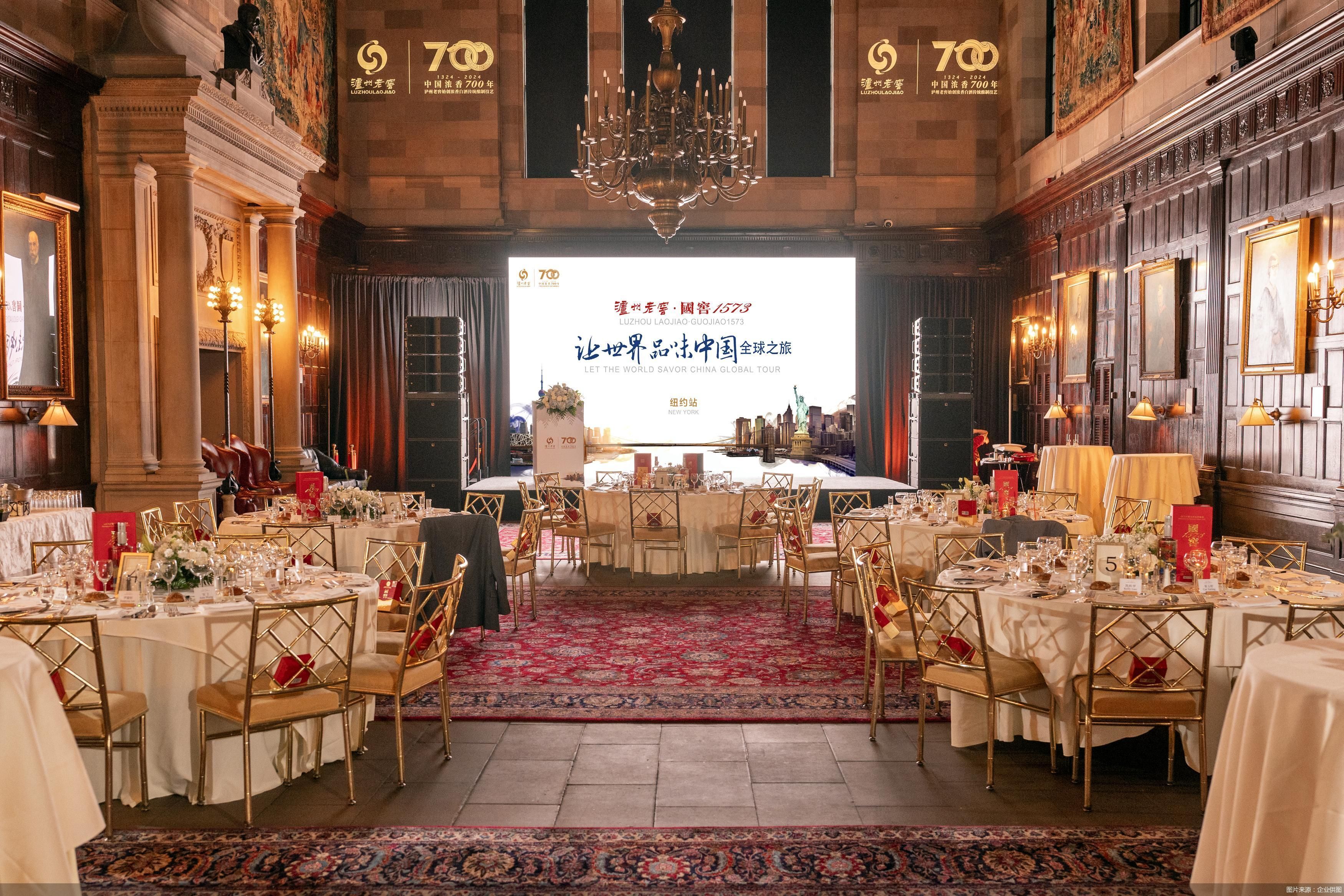
从“卖产品”到“卖文化” 营销变革下酒企出海新征程
Bei Jing Shang Bao· 2025-12-25 13:30
Core Viewpoint - The Chinese liquor industry is increasingly focusing on international markets as domestic competition intensifies, with a significant number of companies expanding overseas to seek new growth opportunities [1][7]. Group 1: Market Expansion - As of December 25, 2023, 63.9% of Chinese liquor companies are either expanding or have already established a presence in overseas markets [1]. - Major brands like Kweichow Moutai, Wuliangye, and Luzhou Laojiao are actively entering international markets, alongside traditional yellow wine brands like Guyue Longshan and Kuaijishan [1][2]. Group 2: Product Strategy - Companies are adopting two distinct strategies for internationalization: "cultural integration" with tailored products for foreign markets and "value output" by exporting established domestic products [2]. - Kweichow Moutai has launched a series of new products specifically designed for overseas markets, marking a significant expansion after six years [2]. - Luzhou Laojiao is innovating with products like ready-to-drink cocktails and oak barrel liquor to cater to international consumer preferences [3]. Group 3: Cultural Integration - The liquor industry recognizes that cultural storytelling is essential for successful international expansion, with many companies engaging in high-profile cultural activities to promote Chinese liquor [4][5]. - Initiatives like Wuliangye's "He Mei Global Tour" and the opening of tasting houses by Guyue Longshan in Paris highlight the industry's focus on cultural exchange [5][6]. Group 4: Market Challenges - Despite the enthusiasm for international markets, challenges remain, including a reliance on Chinese consumers abroad and the need for deeper localization to appeal to diverse international tastes [7][8]. - The Southeast Asian market is identified as a primary target for expansion, supported by a significant Chinese diaspora that influences local consumption patterns [7]. Group 5: Future Directions - Industry experts suggest that to penetrate mainstream markets, liquor companies must innovate and adapt products to local tastes, potentially developing lower-alcohol or pre-mixed beverages [8]. - There is a call for greater integration of liquor with Chinese cuisine to enhance market appeal and consumer acceptance [8].
白酒浮华消散,行业寻找新主场|2025中国经济年报
Hua Xia Shi Bao· 2025-12-25 12:57
Core Insights - The Chinese liquor industry is still in a deep adjustment phase as of the end of 2025, shifting from volume growth to a focus on market share redistribution due to declining demand pressures [2][3] - The high-end market is losing its appeal, leading to a downward adjustment in mainstream price ranges, with distributors adopting a cautious outlook for the upcoming Spring Festival sales [2][3] - Key issues facing the industry include overcapacity, high inventory levels, price inversions, and a lack of consumption scenarios, as highlighted by industry leaders [2][3] Market Dynamics - The price of Moutai liquor has become a significant indicator of industry adjustments, with its wholesale price dropping to 1500 yuan per bottle in December 2025, reflecting broader market challenges [3][4] - Among 20 A-share listed liquor companies, only Guizhou Moutai and Shanxi Fenjiu reported positive growth in the first three quarters of the year, while the remaining 18 experienced negative growth [3][4] - The new regulations on government consumption and changing preferences among younger consumers are contributing to the industry's downturn [3][4] Industry Adjustments - The current adjustment is characterized by a proactive approach from leading companies, focusing on quality improvement and channel optimization rather than aggressive price cuts [4][5] - There is a significant market differentiation occurring, with top brands managing to maintain their positions while smaller and less established brands face existential threats [4][5] - The industry is expected to enter a "U-shaped" recovery phase in 2026, driven by structural differentiation and improvements in actual sales and inventory levels [5][6] Strategic Shifts - The industry is undergoing a transformation in response to new consumer behaviors, with a consensus on the need for lower-alcohol products to cater to younger demographics [6][7] - Companies are increasingly embracing e-commerce and new retail models to adapt to changing market dynamics [6][7] - Internationalization is becoming a necessary strategy, with companies like Luzhou Laojiao expanding into over 70 countries, although challenges such as trade barriers and cultural differences remain [7][8] Future Outlook - The industry is expected to realign its value propositions to connect more closely with consumers' daily lives, marking a significant shift in survival logic [8]

A股又见小作文兴风作浪,一则“剑南春要收购水井坊”消息传出,水井坊直线涨停,单日市值增加超17亿元,双方各自回应
Jin Rong Jie· 2025-12-25 10:29
Core Viewpoint - The rumor of Jian Nan Chun acquiring Shui Jing Fang led to a significant surge in Shui Jing Fang's stock price, causing a ripple effect across the entire A-share liquor sector, with all 20 listed liquor companies experiencing gains [1][3]. Group 1: Stock Market Reaction - Shui Jing Fang's stock price jumped 10% to 39.8 yuan per share, adding over 1.7 billion yuan to its market capitalization within half an hour [1]. - Other liquor stocks also saw substantial increases, with Huangtai Liquor rising over 7%, Jiu Gui Liquor up more than 5%, and Jin Hui Liquor increasing by over 4% [1]. Group 2: Company Responses - Representatives from Shui Jing Fang and Jian Nan Chun stated that they had not received any acquisition information, and Shui Jing Fang has not made any official announcements regarding the rumor [3]. - This is not the first time rumors of Shui Jing Fang being acquired have surfaced; previous claims regarding Xi Jiu acquiring shares were denied by Shui Jing Fang's management [4]. Group 3: Shareholding Structure - Diageo holds a 63.27% stake in Shui Jing Fang, having gradually increased its share since acquiring 43% of the controlling shareholder in 2006 [5]. - Shui Jing Fang's historical performance has been volatile, with periods of significant challenges, including being labeled as a "ST" (special treatment) stock [5]. Group 4: Jian Nan Chun Developments - Jian Nan Chun has been active, with a recent change in shareholding where the local state-owned asset management center acquired approximately 14.51% of the company, becoming its second-largest shareholder [6]. - The acquisition was made through a debt investment, which has led to speculation regarding potential trademark disputes [7]. Group 5: Industry Outlook - Some brokerages believe that the liquor sector is showing clear signs of bottoming out, with expectations of a gradual recovery in the coming years [9]. - The industry is currently undergoing a deep adjustment, with only a few top brands like Moutai and Fenjiu showing positive growth [9].

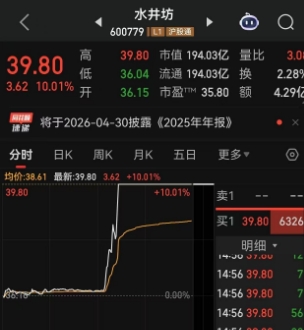
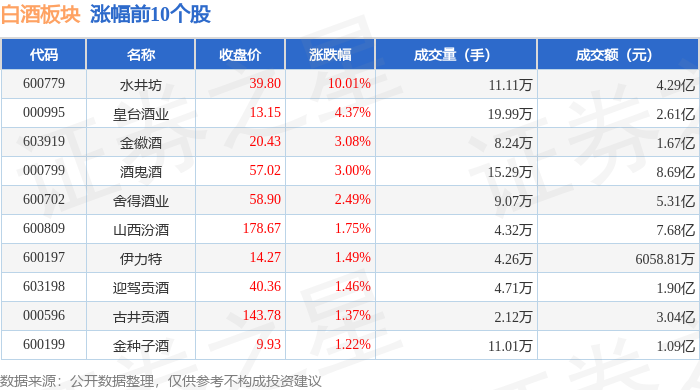
白酒板块12月25日涨1.13%,水井坊领涨,主力资金净流入8.74亿元
Zheng Xing Xing Ye Ri Bao· 2025-12-25 09:07
Core Viewpoint - The liquor sector experienced a rise of 1.13% on December 25, with Shui Jing Fang leading the gains, while the Shanghai Composite Index rose by 0.47% and the Shenzhen Component Index increased by 0.33% [1] Group 1: Liquor Sector Performance - Shui Jing Fang (600779) closed at 39.80, up 10.01% with a trading volume of 111,100 shares [1] - Other notable performers include Sanlong Jibei (000995) with a 4.37% increase, and Quan Wei Jiu (616809) rising by 3.08% [1] - The total net inflow of funds into the liquor sector was 874 million yuan, while retail investors saw a net outflow of 325 million yuan [1] Group 2: Fund Flow Analysis - Major net inflows were observed in Kweichow Moutai (600519) with 319 million yuan, accounting for 9.67% of the total [2] - Shui Jing Fang (600779) had a net inflow of 154 million yuan, representing 35.78% of its trading volume [2] - The retail investor net outflow for Shui Jing Fang was 93.49 million yuan, indicating a significant withdrawal from this stock [2]


20只白酒股上涨 贵州茅台1414.17元/股收盘
Bei Jing Shang Bao· 2025-12-25 08:36
Core Viewpoint - The article highlights the recent performance of the Chinese stock market, particularly the rise of the liquor sector, indicating a competitive landscape among major liquor companies [1] Industry Summary - The three major indices collectively rose, with the Shanghai Composite Index closing at 3959.62 points, up by 0.47% [1] - The liquor sector index closed at 2220.34 points, increasing by 1.09%, with 20 liquor stocks experiencing gains [1] Company Summary - Kweichow Moutai's stock closed at 1414.17 CNY per share, up by 0.95% [1] - Wuliangye's stock closed at 110.60 CNY per share, up by 1.21% [1] - Shanxi Fenjiu's stock closed at 178.67 CNY per share, up by 1.75% [1] - Luzhou Laojiao's stock closed at 120.72 CNY per share, up by 0.65% [1] - Yanghe Brewery's stock closed at 62.69 CNY per share, up by 0.95% [1] Competitive Landscape - CITIC Securities reports that the liquor industry has entered an era of competition among famous brands, with increasing internal differentiation among listed companies [1] - Companies are actively managing market order, promoting product iterations, and enhancing consumer engagement, while increasing expenditure to boost sales and facilitate inventory reduction, thereby improving market share [1]
海南封关开启,酒企南下“抢滩”
Xin Lang Cai Jing· 2025-12-25 08:24
Core Viewpoint - The official launch of the Hainan Free Trade Port's full island closure operation on December 18 is expected to create significant policy advantages and institutional dividends for various industries, including the liquor industry, which is poised to leverage this opportunity for international expansion [1][4]. Group 1: Liquor Companies' Moves in Hainan - Major liquor companies such as Fenjiu, Wuliangye, and Langjiu have recently established operations in Hainan, indicating a trend of companies positioning themselves to capitalize on the new opportunities presented by the free trade port [4][5]. - The establishment of Fenjiu International Trade (Hainan) Co., Wuliangye's supply chain management company with a registered capital of 100 million yuan, and Langjiu's collaboration with Hainan Ecological Software Park exemplify proactive strategies by these companies [4][5]. - Other brands like Moutai and Luzhou Laojiao have also made significant investments in Hainan, with Moutai establishing a resort and Luzhou Laojiao setting up an international trade company [4][5]. Group 2: Supply Chain and Trade Dynamics - Hainan's closure policy is designed to enhance trade efficiency by allowing easier access for foreign goods and capital while maintaining regulatory controls for goods entering mainland China [1][5]. - The policy encourages the consolidation of processing activities within Hainan, reducing costs and improving logistics efficiency for liquor companies [5][6]. - The port of Yangpu is highlighted as a key hub for integrating scattered processing stages, which can significantly lower operational costs for liquor exporters [5][6]. Group 3: Hainan as a New Trade Hub - Hainan is positioned to potentially divert some trade flows from Singapore, which has historically been a significant hub for Chinese liquor exports [6][7]. - The region's capabilities are expected to evolve into a composite function that combines the roles of both Singapore and Hong Kong, facilitating not only trade but also production and brand showcasing for liquor companies [8][9]. - The zero-tariff policy in Hainan is anticipated to lower production costs for liquor companies, enhancing their competitiveness in international markets [8][9]. Group 4: Policy and Market Implications - The dual benefits of policy empowerment and innovative pathways provided by Hainan's closure are seen as advantageous for the liquor industry, simplifying processes and enhancing efficiency [9][10]. - The establishment of a trade network connecting Hainan, Southeast Asia, and the global market is expected to accelerate the penetration of Chinese liquor into ASEAN countries [9][10]. - The new institutional framework and shorter pathways for liquor exports from Hainan are viewed as revitalizing the long-standing topic of liquor internationalization [10].