
德邦股份

Search documents
两会前瞻与消费地产动向
2026-03-03 02:52
两会前瞻与消费地产动向 20260302 摘要 地缘冲突对市场的影响通常是短暂的,中期趋势由宏观基本面决定。油 价上涨引发的通胀预期更具持续性,取决于霍尔木兹海峡的油运状况和 伊朗原油的供应。 霍尔木兹海峡出现船只积压,形成"半堵塞"状态,市场对"可能封 锁"持观望态度。OPEC+确认 4 月增产 20.6 万桶/日,目前该状态对油 价的影响大致对应 10-15 美元的溢价。 若霍尔木兹海峡被完全封锁,油价可能冲击 100 美元以上。新兴市场跌 幅通常更大,港股调整大于 A 股,避险资产相对占优。MSCI 中国指数 中,能源受益,公用事业跌幅较小,成长板块跌幅较大。 恒生科技指数跑输主要受情绪和趋势拖累,美债利率下滑提供支撑。头 部权重股拖累明显,若剔除这些股票,指数表现可能改善。 港股资金面逆风包括美联储政策担忧、港股 IPO 与再融资活跃。人民币 升值并非直接利好港股,可能影响南向资金吸引力。 2026 年港股资金面预计紧平衡,南向资金规模或难超 2025 年。外资 流入取决于基本面改善,资金需求端 IPO、解禁与再融资规模上升。 北京和上海二手房挂牌去化周期已接近或低于历史上房价能够稳住的区 间水平,库 ...
零碳物流园区发展白皮书
荣续智库· 2026-03-02 09:25
S Shanghai Services Federation 上海现代服务业联合会 荣续智库 零碳物流园区发展白皮书 摘要 零碳物流园区,不仅是现代物流体系升级的必然选择,更是企业践行ESG理念、城市实现可持续发展的重要支点。它以技术 创新为引擎,以政策标准为框架,将低碳基因融入仓储、运输、管理的每一个环节,重新定义着物流基础设施的生态价值。 本白皮书深耕零碳物流园区的发展脉络、技术路径与实践案例,愿为行业破局提供思路。 PREFACE ANALYST 前言 研究员 作为物流网络的核心节点,物流园区承载着货物集散、仓储管理、 孙旭灿 CFAESG证书:102257287 信息交互等关键功能,其碳排放强度直接影响着产业链的绿色水平。 近年来,中国物流园区数量已突破2500家,但传统园区"重规模、 轻低碳"的发展模式与生态环境保护的矛盾日益尖锐,零碳转型成 国际通用ESG高级分析师:SH7514FBA0189 为破解资源环境约束、提升行业竞争力的核心路径。 从全球视角看,零碳物流园区建设已形成多元探索格局。欧盟通过 吴虹静 高级注册ESG分析师:23RZQLKC003184A "绿色新政"推动物流设施能源结构转型 ...


大消费行业周报:上游板块受资金青睐,关注刚性内需细分-20260301
Ping An Securities· 2026-03-01 11:46
证券研究报告 大消费行业周报 上游板块受资金青睐, 关注刚性内需细分 平安证券研究所大消费团队 证券分析师: 胡琼方S1060524010002(证券投资咨询)邮箱:HUQIONGFANG722@pingan.com.cn 王源S1060524010001(证券投资咨询)邮箱:WANGYUAN468@pingan.com.cn 王萌S1060522030001(证券投资咨询)邮箱:WANGMENG917@pingan.com.cn 张晋溢S1060521030001(证券投资咨询)邮箱:ZHANGJINYI112@pingan.com.cn 王星云S1060523100001(证券投资咨询)邮箱:WANGXINGYUN937@pingan.com.cn 2026年3月1日 请务必阅读正文后免责条款 -6% -4% -2% 0% 2% 4% 6% 8% 10% 12% 14% 钢铁 有色金属 基础化工 煤炭 电力及公用事业 建筑 石油石化 国防军工 通信 建材 综合金融 电子 机械 农林牧渔 交通运输 综合 纺织服装 电力设备及新能源 轻工制造 计算机 沪深300 房地产 商贸零售 汽车 医药 家电 银行 非银 ...
电商发货怎么寄快递便宜?实操攻略+避坑指南全在这了!
Sou Hu Cai Jing· 2026-02-27 23:49
记得我刚开始做电商那会儿,第一单发货就傻眼了。看着手里的小商品,满脑子都是问号:该找哪家快递?怎么寄才不亏?电话打了一圈,报价从8块到20 块都有,差点被忽悠着选了最贵的。后来摸爬滚打,学费交了不少,才终于搞明白——寄快递想省钱又靠谱,真不是瞎蒙就行的。如果你也正在为发货成本 头疼,感觉快递水太深,那这篇掏心窝子的攻略就是为你写的。咱们不整虚的,直接上干货,把"怎么便宜寄"和"怎么避坑"一次说清。 核心疑问解答:新手最关心的几个问题 Q:电商发货,怎么寄快递才能最便宜? A:便宜的核心就两点:选对渠道和实时比价。千万别傻乎乎直接打快递员电话或者上官网原价寄,那基本是"冤大头"模式。现在有很多正规比价平台,能 同时拿到多家快递的折扣价,一对比,差价可能差出一半。 Q:便宜了会不会不靠谱?丢件、破损怎么办? A:这是最大误区!便宜≠不靠谱。关键要看渠道是否正规。只要是聚合了快递公司官方授权的折扣价,物流轨迹全程在快递公司系统可查,售后和打官方 电话一样,那就完全放心。怕不靠谱?重点是避开那些个人转手、没有保障的野路子。 Q:快递价格到底由啥决定?怎么估个大概? A:记住四个字:重、大、远、急。 主流快递官网价实测 ...


寄大件物流哪家最便宜?寄大件物流哪家便宜 不同重量跨省搬家价格对比
Sou Hu Cai Jing· 2026-02-27 12:37
寄大件物流怎么选 不同重量和距离哪家最便宜 当要寄大件行李时,当要进行搬家时,或者当要网购家具时,物流费用常常会占据较大比例。许多人的 第一反应是去寻找顺丰,或者去寻找德邦,然而实际上不同的物流公司,针对不同的重量段,以及针对 不同的发货区域,其定价策略存在着很大的差别,要是选错了,有可能会多花费几百块。寄大件物流的 核心并非单纯去寻找最便宜的公司,而是去寻找能够匹配你需求的那一家。 寄大件物流怎么包装才能省钱 不少人忽视包装对于运费造成的影响,大件物流计费依据体积重,一个显得松松垮垮的纸箱极有可能使 体积重实现翻倍,自个儿进行打包之际,运用真空压缩袋去处理衣物棉被,运用缠绕膜来包裹家具以防 刮蹭,能够切实减少体积,针对于一些诸如自行车或者大型玩具这种不规则物品,能够拆解之后再进行 捆扎,如果自个儿不擅长开展打包工作,在寄物物平台下单之时也能够挑选打包服务,其费用相较于现 场找物流师傅购买材料而言要更为透明一些。 寄冰箱洗衣机这种大家电哪家物流最划算 带压缩机的冰箱、洗衣机、电视机等家电,不少快递公司鉴于运输风险高会拒收,或加收高额保价费。 在此情形下,德邦与顺丰的大件业务要相对更规范些,虽说基础运费略微高些 ...

这家物流公司,拟主动退市!
Jin Rong Shi Bao· 2026-02-27 11:58
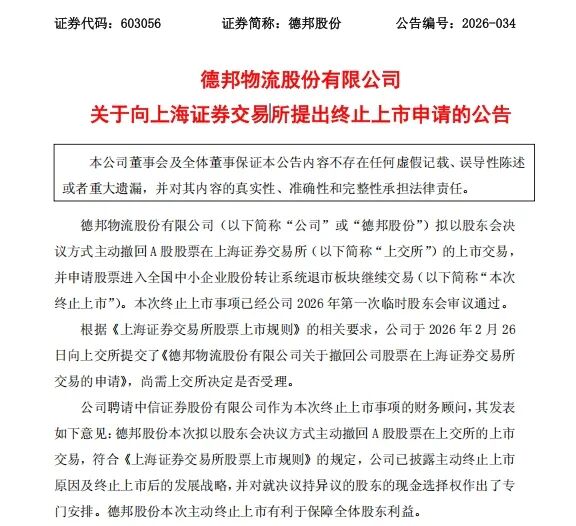
又一家A股上市公司拟主动退市。 2月26日晚间,德邦物流股份有限公司(以下简称"德邦股份(603056)")发布公告称,公司拟以股东 会决议方式主动撤回A股股票在上海证券交易所(以下简称"上交所")的上市交易,并申请股票进入全 国中小企业股份转让系统退市板块继续交易(以下简称"本次终止上市")。 值得注意的是,德邦股份属于主动退市,与那些被强制退市的公司相比性质上有明显不同,主动退市公 司一般是出于公司战略发展、吸收合并等原因而主动提出退市。 就在前一天(2月25日)晚间,JD Logistics,Inc.(京东物流股份有限公司,以下简称"京东物流")披露 公告称,德邦股份现金选择权已正式完成,本次交易后京东物流对德邦股份的持股比例升至约99.7%。 主动终止上市 春节假期后,在物流行业集体开工的节点,德邦股份的退市公告成为行业重磅消息。 2月26日晚间,德邦股份发布多份公告。根据公告,德邦股份拟以股东会决议方式主动撤回A股股票在 上交所的上市交易,并申请股票进入全国中小企业股份转让系统退市板块继续交易。 根据上交所相关要求,德邦股份于2月26日向上交所提交了《德邦物流股份有限公司关于撤回公司股票 在上海证券 ...

前瞻全球产业早报:中国手机厂商或将集体涨价
Qian Zhan Wang· 2026-02-27 10:43
京津冀协同发展12年外贸进出口值增长25.7% 2月26日京津冀协同发展12周年。12年来,三地优势互补、携手共进,外贸进出口实现快速发展。据海关统 计,京津冀地区进出口值从2014年的3.74万亿元人民币增至2025年的4.7万亿元,增长25.7%。 广州:正规划10平方公里穗港马产业深度合作区,已准备超万亩发展空间打造世界级马产业高地 从2月6日召开的广州从化区高质量发展大会获悉:从化是内地唯一、世界第53个获国际认可的马匹"无疫 区"。香港赛马会从化马场正成为联通湾区、链接世界的马产业平台。据悉,香港赛马会从化马场今年10月 份将历史性迎来常规国际标准速度赛马比赛。同时,广州正规划建设10平方公里穗港马产业深度合作区 , 全面释放粤港澳大湾区千亿级高端消费市场潜力。另外,已经准备超万亩的发展空间,致力打造立足湾区、 辐射全国、链接世界的世界级马产业高地。 德国总理默茨专程参观宇树科技 据《科创板日报》26日消息,供应链最新信息显示,继2024年下半年触底反弹后,手机内存及存储芯片价格 已连续多个季度保持上涨趋势,2026年伊始涨幅进一步扩大。 多位产业链人士向《科创板日报》记者证实,当前智能手机存储芯片 ...

玻璃纯碱3月报:玻碱走势分化,关注两会环保表述-20260227
Yin He Qi Huo· 2026-02-27 08:49
1. Report Industry Investment Rating No relevant content provided. 2. Core Viewpoints of the Report - In March, with the warming of the macro - sentiment, it is recommended to be cautious about short - selling soda ash. In the medium - to - long term, the price of soda ash may rise first and then fall, and the monthly strategy suggests a bullish view. For glass, due to the weak fundamentals, it is advisable to short on rallies or sell call options monthly. However, if the macro - sentiment is good, the price may remain stable. It is also recommended to go long on soda ash and short on glass for spread trading [2][3][5]. 3. Summary According to the Directory Part One: Preface - In February, the non - ferrous and precious metal sectors experienced a rapid decline and slow recovery, releasing market risks and repairing the mis - priced valuations. The soda ash, glass, and black sectors were mainly in a downward trend before the Spring Festival and had a strong bullish sentiment after the festival. The market anticipates a general rise in commodity prices in spring, mainly due to the macro - sentiment repair brought by the Two Sessions and inflation logic. The uncertainty of US tariffs still exists, but the tariff peak may have passed. Attention should be paid to the statements on carbon emissions in the Two Sessions, as environmental protection may be an important measure to promote anti - involution this year. The release of the "Shanghai Seven - Point Notice" triggered discussions on the bottom - out rebound of the real estate market, but it has little short - term impact on the overall demand recovery in the real estate sector [2]. Part Two: Soda Ash Fundamental Analysis 1. Market Review - In February, the futures price of the main soda ash contract declined. The SA05 contract fluctuated between 1146 - 1235 yuan/ton, with increased volatility and a lower trading range. The SA2605 - 09 spread was stable, ending at - 62 yuan/ton at the end of the month, with a monthly change of - 2 yuan/ton. The basis of SA05 was - 19 yuan/ton, with a monthly change of + 24 yuan/ton. The FG05 - SA05 spread first rose and then fell, ending at - 132 yuan/ton at the end of the month, with a monthly change of + 19 yuan/ton. Spot prices of soda ash manufacturers were stable to slightly weak [7]. 2. Risk Release in Non - ferrous Metals and Approaching Two Sessions - In February, the non - ferrous and precious metal sectors declined to release risks, with silver leading the decline with a monthly drop of 22%. The non - ferrous and precious metal sectors rebounded after hitting the bottom. By the end of the month, the non - ferrous sector had a decline of 7.8%, and the precious metal sector had a decline of 18.4%. The market risk was quickly released, and the mis - priced valuations were repaired. The Two Sessions in March will focus on new - quality productivity, stable growth, expanding domestic demand, industrial upgrading, security development, and people's livelihood security. Attention should be paid to the statements on carbon emissions, and environmental protection may be an important measure to promote anti - involution. The release of the "Shanghai Seven - Point Notice" triggered discussions on the bottom - out rebound of the real estate market, but it has little short - term impact on the overall demand recovery in the real estate sector. From April 1, 2026, the VAT export tax rebate for 249 photovoltaic and chemical products will be cancelled. In the United States, the mid - term elections will be held in November 2026, and Trump's overall support rate has dropped to about 38% [10][11]. 3. Soda Ash Production at a Historical High and Gradually Accumulating Inventory Pressure - In February, the new production capacity of soda ash was gradually increased, with a monthly output of about 3.14 million tons, a year - on - year increase of 8%. Some soda ash enterprises had maintenance or shutdowns, while some increased production. Overall, there were few maintenance activities, and the release of new production capacity led to an increase in comprehensive supply. In March, Zhongyan Kunshan has a maintenance plan, and other enterprises have no clear maintenance plans yet. The concentrated increase in new production capacity will gradually put pressure on the soda ash supply. Before discussing the elimination of high - cost production capacity, more attention should be paid to the fluctuations in the operating rate of soda ash enterprises, which is the core observation indicator for the marginal change in the supply - demand relationship [15]. 4. Resilient Demand for Light and Heavy Soda Ash and Lower - than - Expected Inventory Accumulation - During the Spring Festival, the inventory of soda ash increased by 306,400 tons, a rise of 19.29%. By the end of the month, the total inventory of domestic soda ash manufacturers was 1.8944 million tons. The inventory accumulation rate during the Spring Festival was lower than market expectations, indicating resilient demand. In March, with the warming of the macro - sentiment, it is recommended to be cautious about short - selling. However, in the medium - to - long term, the price may rise first and then fall, and the monthly strategy suggests a bullish view. In February, the average weekly apparent demand for soda ash was about 669,000 tons, equivalent to an average daily apparent demand of about 96,000 tons, a 7.7% decrease compared to the previous month. Among them, the average weekly apparent demand for heavy soda ash was 362,000 tons, a decrease of about 41,000 tons compared to the previous month. The apparent demand for light soda ash was 307,000 tons, a decrease of about 19,000 tons compared to the previous month [20]. 5. Pressure on Cost Transmission in Photovoltaic Glass and Increasing Downward Pressure on Post - Festival Demand - As of the end of February, the daily melting capacity of photovoltaic glass was 88,560 tons, an increase of 1,600 tons compared to the beginning of the month. It is expected that the global production of downstream components in March will be about 36GW, and the domestic production will be about 28GW. The cancellation of the 9% VAT export tax rebate for core photovoltaic products such as silicon wafers and components from April 1, 2026, led to increased procurement of photovoltaic glass by downstream component enterprises in advance. However, after the industry dividend fades in late March, it is still uncertain whether domestic demand in April can support the high - production of upstream enterprises. On the supply side, most kilns are operating normally, but enterprises are in a state of continuous loss. On the demand side, although supported by export orders, the production of components in February was weak, and the supply - demand gap in the industry remained high. After the Spring Festival, the inventory pressure increased rapidly [25][26][27]. 6. Resilient and Unexpected Demand for Light Soda Ash - As the price of soda ash decreases, its advantage as a basic chemical product becomes prominent. The decentralized downstream demand brings resilience. In 2025, the apparent demand for light soda ash increased unexpectedly, with the annual apparent demand reaching 16.4 million tons, a year - on - year increase of 9.1%, far exceeding the previous growth rate range of - 2.6% to 4.5%. The quantifiable part is mainly due to the rapid growth of lithium carbonate production. In 2025, the lithium carbonate production was 944,000 tons, and the production of lithium carbonate required about 1.89 million tons of light soda ash. In February, the monthly apparent demand for light soda ash was about 1.284 million tons [30]. 7. Exit of US Soda Ash Plants and Expected Increase in China's Export Share - As the price of soda ash falls, the export window opens. In 2025, the average monthly export of soda ash was over 180,000 tons, and it is expected that the high - level export of soda ash will continue in 2026. The top five trading partners are Indonesia, Vietnam, Bangladesh, South Korea, and Malaysia, accounting for 37% of the total export volume. China's main export regions are Jiangsu, Shandong, and Hebei, and the export volume from Qinghai and Inner Mongolia has increased significantly. The exit of a US soda ash manufacturer will increase China's export share in the overseas market, especially in Southeast Asia [35]. 8. Weak Raw Material Prices and Slight Decline in Cost Range - In February, the price of sea salt was stable, the price of anthracite coal increased slightly, the price of thermal coal fluctuated upwards, and the cost increased. The price of by - product ammonium chloride increased significantly. As of February 26, 2026, the theoretical profit of soda ash produced by the ammonia - soda process in China was - 90.15 yuan/ton, a month - on - month decrease of 0.90 yuan/ton. The theoretical profit (double - ton) of soda ash produced by the combined - soda process was - 1.50 yuan/ton, a month - on - month increase of 95.38%. The price of thermal coal strengthened, the supply and demand of domestic thermal coal were both weak, and the market trading was light. The price of ammonium chloride increased, and the supply enterprises advanced production conservatively. The coke market price remained stable [40]. Part Three: Glass Fundamental Analysis 1. Market Review - In February, the main glass contract FG2605 weakened. The FG05 contract fluctuated between 1037 - 1120 yuan/ton, with a lower price range. The spread between the 05 and 09 contracts of glass narrowed, ending at - 97 yuan/ton at the end of the month, with a monthly change of + 11 yuan/ton. The basis between the main glass contract and the spot price in Shahe was - 40 yuan/ton, with a monthly change of + 10 yuan/ton. The spot prices of glass manufacturers in Hubei and Shahe remained basically unchanged [45]. 2. Slight Decrease in Float Glass Supply and Attention to Carbon Emission Statements in the Two Sessions - As of the end of the month, the daily melting capacity of float glass was 149,000 tons, a decrease of 2,400 tons compared to the beginning of the month. There were 296 glass production lines in China (with a daily melting capacity of 199,500 tons) after excluding zombie production lines, of which 209 were in production and 87 were shut down for cold repair. Attention should be paid to the statements on carbon emissions in the Two Sessions. Environmental protection may be an important measure to promote anti - involution. It is expected that the glass supply in 2026 will decrease by 8.2% year - on - year to 52.93 million tons, equivalent to a daily melting capacity of 145,000 tons [47]. 3. Glass Demand May Be Weaker than Expected - In February, the average weekly apparent demand for glass was 750,000 tons, a year - on - year decrease of 7%. After the Spring Festival, the domestic float glass market was quiet. Most downstream processing plants were shut down and planned to resume work after the Lantern Festival, resulting in weak overall demand. In terms of inventory structure, the glass inventory increased by 45% to 76 million heavy boxes in February, with significant inventory accumulation in North China and Central China. It is expected that the glass demand in 2026 will be 51.04 million tons, a year - on - year decrease of 10.5%. The continued decline of the real estate market has a significant negative impact on glass demand, while the demand for home - decoration glass remains stable, and the demand for automotive glass shows resilience [52]. 4. Further Relaxation of Purchase Restrictions in Shanghai and Urban Renewal as the Future Focus - The release of the "Shanghai Seven - Point Notice" triggered discussions on the bottom - out rebound of the real estate market. The further relaxation of purchase restrictions in Shanghai will have a siphon effect on second - and third - tier cities, increasing the differentiation and having little short - term impact on the overall demand recovery in the real estate sector. The recovery of the real estate market will be slow and complex, and the completion data in 2026 is expected to hover at a low level. The future recovery will depend more on the long - term improvement of the real estate market, such as the continuous recovery of the sales market and the improvement of the self - financing ability of real estate enterprises [56]. 5. Decrease in Soda Ash Price and Increase in Glass Cost - As of February 26, 2026, according to the production cost calculation model of Longzhong Information, the weekly average profit of float glass using natural gas as fuel was - 142.26 yuan/ton, a month - on - month increase of 24.29 yuan/ton; the weekly average profit of float glass using coal - made gas as fuel was - 30.79 yuan/ton, a month - on - month decrease of 1.92 yuan/ton; the weekly average profit of float glass using petroleum coke as fuel was 43.93 yuan/ton, remaining unchanged month - on - month [60].
行情在消息情绪,看清机构行为不踩坑
Sou Hu Cai Jing· 2026-02-27 07:52
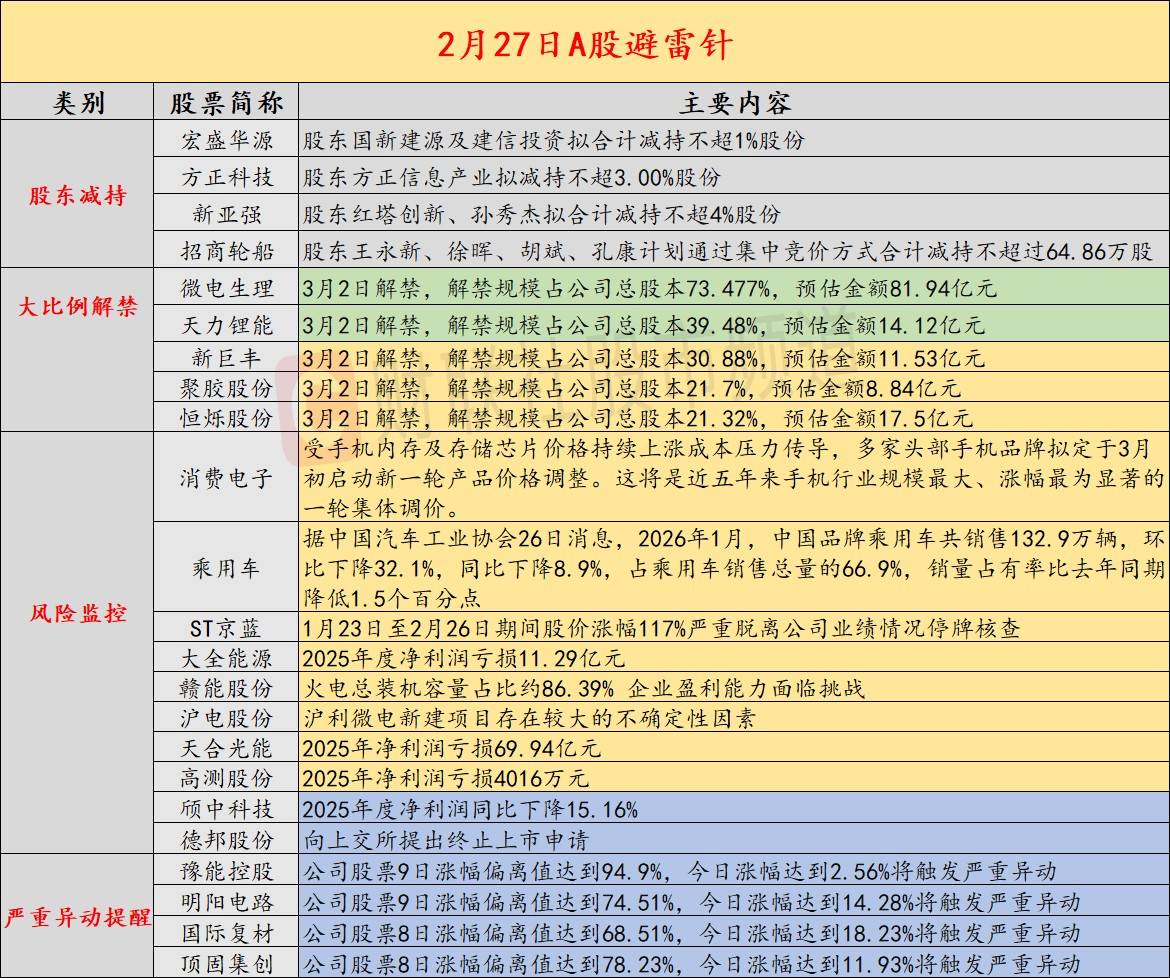
Core Viewpoint - The article emphasizes that market movements are influenced more by underlying trading behaviors rather than just news events, suggesting that a quantitative data approach can help investors understand the true market dynamics [1]. Group 1: Market Dynamics - Various smartphone brands are planning to adjust product prices due to rising costs from memory and storage chips, marking the largest price increase in the smartphone industry in five years [2]. - In the automotive sector, Chinese brand passenger car sales in January 2026 reached 1.329 million units, a decrease of 32.1% month-on-month and 8.9% year-on-year, with a market share drop of 1.5 percentage points [2]. Group 2: Shareholder Actions - Shareholders of Hongsheng Huayuan and Fangzheng Technology plan to reduce their stakes by up to 1% and 3% respectively [2]. - A significant share unlock is expected for several companies on March 2, including: - China Merchants Shipping with a 64.86% unlock, estimated at 81.94 billion [2]. - Weidian Physiotherapy with a 73.477% unlock, estimated at 14.12 billion [2]. - New Giant Hand with a 30.88% unlock, estimated at 11.53 billion [2]. - JuJiao Co. and HengLian Co. with unlocks of 21.7% and 21.32%, estimated at 8.84 billion and 17.5 billion respectively [2]. Group 3: Trading Behavior Insights - The article introduces four core trading behaviors identified through quantitative data: - "Bullish Dominance" indicates active buying [4]. - "Profit Taking" shows that previous investors are cashing out [4]. - "Bearish Dominance" reflects a tendency for investors to sell [4]. - "Short Covering" indicates that previously exited investors are re-entering the market [4]. Group 4: Behavioral Analysis - The article discusses how "Profit Taking" can mislead investors into thinking a stock is still on an upward trend when in fact, funds are exiting [6]. - Conversely, "Short Covering" can lead to price increases despite negative news, as funds may be entering the market during panic selling [10]. - Quantitative data can reveal these hidden behaviors, allowing investors to make more informed decisions and avoid emotional reactions to market fluctuations [13].
服务消费成春节“暖经济”主力,聚焦港股通消费ETF华夏(513230)布局窗口
Mei Ri Jing Ji Xin Wen· 2026-02-27 03:15
Group 1 - The Hong Kong stock market showed slight recovery after several days of adjustment, with the consumption sector experiencing narrow fluctuations, particularly the Hong Kong Stock Connect Consumption ETF, which saw a minor increase [1] - Notable gainers in the holdings included Lao Pu Gold, Mao Ge Ping, Mengniu Dairy, and Samsonite, while Unification Enterprise China, Conant Optical, and Smoore International faced declines [1] - The Spring Festival travel period in 2026 recorded a historic high of 9.5 billion person-times of cross-regional movement, with over 2.8 billion person-times during the 9-day holiday, marking a 21% increase from 2025 [1] Group 2 - The service industry consumption is a key focus of policy support, with the general travel sector expected to continue benefiting from this trend [1] - The K-shaped recovery trend remains anticipated, with low base effects for mid-tier consumption leaders becoming evident, and overseas demand transitioning from pilot exploration to large-scale replication [1] - Supply-side innovations are expected to enhance emotional value premiums, supported by policy guidance, while AI empowerment is anticipated to improve efficiency and cost optimization [1] Group 3 - Various ETFs related to consumption sectors are being monitored for recovery opportunities, including the Food and Beverage ETF, which tracks a detailed food index covering leading companies in alcohol, dairy, condiments, beer, and soft drinks [2] - The Consumption ETF Huaxia tracks the main consumption industry index, providing balanced coverage across various consumption sub-sectors [2] - The Hong Kong Stock Connect Consumption ETF Huaxia encompasses nearly all areas of Hong Kong's consumption sector, while the Tourism ETF focuses on service consumption, excluding goods consumption, covering sectors like duty-free, airlines, and hotel dining [2]