
地方政府债务结存限额

Search documents
多省公开 5000亿增量债务所获额度
Sou Hu Cai Jing· 2025-12-10 16:53
Group 1 - The central government has allowed local governments to issue an additional 500 billion yuan in bonds in the fourth quarter to stabilize the economy and mitigate risks [1] - As of December 10, at least 18 provinces and municipalities have adjusted their budgets in response to the allocation of the 500 billion yuan bond limit [1][2] - The distribution of the bond limit has been clarified, with Jiangsu, Zhejiang, Sichuan, Shenzhen, Qingdao, Xinjiang, and Jilin receiving significant portions of the total [1][3] Group 2 - As of the end of October, the total balance of local government bonds in China was approximately 54.01 trillion yuan, with a debt limit of 57.99 trillion yuan approved by the National People's Congress [2] - The 500 billion yuan allocation from the debt limit includes 300 billion yuan to support local governments in resolving existing project debts and 200 billion yuan for project construction in major economic provinces [2] - Local governments have begun issuing bonds aggressively since November, with total issuance exceeding 1 trillion yuan, driven by the new bond limits [3][4] Group 3 - Jiangsu province received 53.5 billion yuan from the bond limit, with 23.5 billion yuan allocated for refinancing and 30 billion yuan for specific project support [3] - The adjustment of budgets in provinces like Jiangsu has led to increased public budget revenues and expenditures, reflecting the impact of the new bond issuance [4] - Experts suggest that the rapid issuance of the 500 billion yuan bond limit will alleviate fiscal pressures and promote effective investment, aiding economic stability [4]
多省公开5000亿增量债务所获额度,江苏目前最多
Di Yi Cai Jing· 2025-12-10 04:31
Group 1 - The central government has allowed local governments to issue an additional 500 billion yuan in bonds in the fourth quarter to stabilize the economy and mitigate risks [1][2] - As of December 10, at least 18 provinces and municipalities have adjusted their budgets in response to the allocation of the 500 billion yuan debt limit, which has led to increased debt income and expenditures [1][2] - The distribution of the 500 billion yuan debt limit has been clarified, with Jiangsu, Zhejiang, Sichuan, and others receiving significant portions, indicating a focus on major project funding [1][3] Group 2 - The total balance of local government bonds in China was approximately 54 trillion yuan as of the end of October, with a debt limit of 57.9 trillion yuan approved by the National People's Congress [2] - The 500 billion yuan allocation includes 300 billion yuan for enhancing local government financial capacity and 200 billion yuan for supporting project construction in major economic provinces [3][5] - Local governments have begun to issue bonds aggressively, with over 1 trillion yuan issued from November to December 10, indicating a strong push for funding [3][4] Group 3 - Adjustments in local budgets have been made to accommodate increased bond issuance, with Jiangsu adjusting its public budget expenditures significantly [4] - Experts suggest that the rapid issuance of the 500 billion yuan debt limit and new policy financial tools will alleviate local fiscal pressures and promote effective investment [5]
5000亿地方债结存限额加快落地
21世纪经济报道· 2025-11-27 06:34
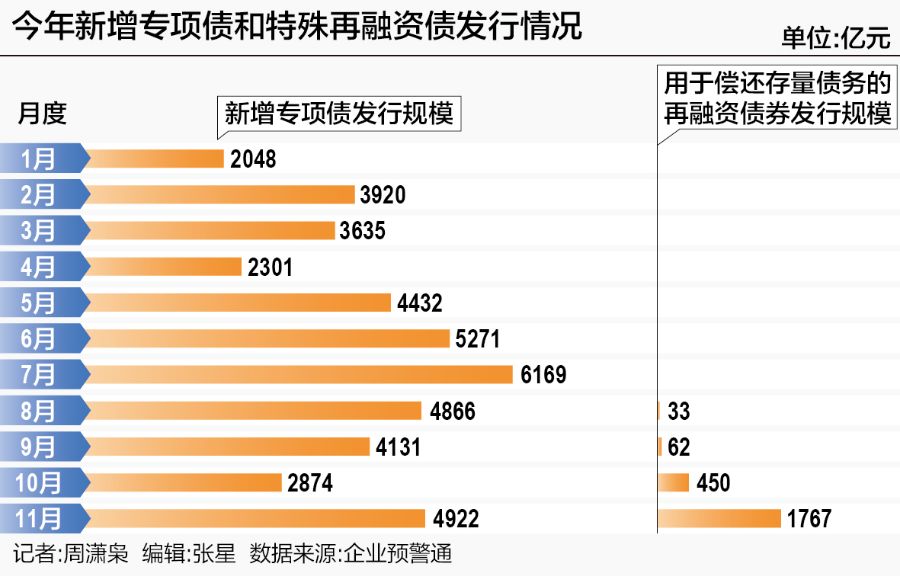
Core Viewpoint - The article highlights the significant increase in local government bond issuance in November, driven by the need to address existing debt and stimulate investment, with a focus on the issuance of special bonds and refinancing bonds to support local projects and alleviate financial pressures [1][3][5]. Group 1: Bond Issuance and Debt Management - In November, the issuance of new special bonds reached 492.2 billion yuan, an increase of over 200 billion yuan compared to the previous month [1] - The issuance of special refinancing bonds amounted to 176.7 billion yuan, up by more than 130 billion yuan from the previous month [1] - The increase in bond issuance is attributed to the accelerated release of a 500 billion yuan local debt balance limit, aimed at supporting local governments in managing existing debts and funding project construction [3][5] Group 2: Investment and Debt Resolution Focus - The primary focus of local debt issuance this year has been on resolving existing hidden debts and supporting investment, with nearly 3.5 trillion yuan allocated for debt resolution and over 3.9 trillion yuan for investment expansion in the first eleven months [3] - The fourth quarter will see an additional 400 billion yuan allocated from the local debt balance limit to further support debt resolution and address overdue payments to enterprises [5][6] Group 3: Infrastructure Investment Challenges - Infrastructure investment growth has faced challenges, with a reported 0.1% year-on-year decline in infrastructure investment from January to October, indicating a need for increased funding to stimulate this sector [9] - Despite the substantial issuance of new bonds, the impact on infrastructure investment has been limited due to a higher proportion of funds being directed towards debt resolution and land acquisition rather than direct investment [9][10] Group 4: Government Investment Funds - The issuance of special bonds for government investment funds is in an exploratory phase, aimed at leveraging private investment to drive economic growth, particularly in emerging industries [11] - As of the end of November, 81.5 billion yuan in new special bonds had been issued for government investment funds, indicating a growing trend in this area [10][11]

5000亿地方债结存限额加快落地,更多资金助力稳投资和化债
2 1 Shi Ji Jing Ji Bao Dao· 2025-11-26 13:22
Core Viewpoint - The issuance of local government bonds, including special bonds and refinancing bonds, has significantly increased in November, driven by a 500 billion yuan local debt balance limit aimed at addressing existing government investment project debts and boosting investment [1][4][5]. Group 1: Bond Issuance - In November, the issuance of new special bonds reached 492.2 billion yuan, an increase of over 200 billion yuan compared to the previous month [1][9]. - The issuance of special refinancing bonds amounted to 176.7 billion yuan in November, up by over 130 billion yuan from the previous month [1][6]. - The total issuance of special refinancing bonds from August to November reached approximately 231.2 billion yuan, with a notable increase in November [6]. Group 2: Debt Management and Investment - The 500 billion yuan local debt balance limit is allocated to support local governments in resolving existing debts and enhancing investment, with 300 billion yuan designated for debt resolution and 200 billion yuan for stabilizing investment [4][5]. - By the end of November, nearly 3.5 trillion yuan had been allocated for resolving hidden debts and overdue payments to enterprises, while over 3.9 trillion yuan was directed towards expanding investment [4]. - The issuance of new general bonds and special bonds has been substantial, with 7.317 trillion yuan in general bonds and approximately 4.46 trillion yuan in special bonds issued by the end of November [9]. Group 3: Future Outlook - The fourth quarter will see an additional 400 billion yuan in local debt balance limits to further support debt resolution and investment stabilization [5][11]. - The current economic environment, characterized by weak domestic demand and external uncertainties, may lead to an increase in new government debt in 2026 compared to this year [11].
10月财政数据点评:财政支出缘何“骤降”?
Shenwan Hongyuan Securities· 2025-11-18 13:15
Revenue and Expenditure Overview - In the first ten months of 2025, the national general public budget revenue was 186,490 billion yuan, a year-on-year increase of 0.8%[6] - National general public budget expenditure reached 225,825 billion yuan, a year-on-year increase of 2%[6] Fiscal Spending Decline - In October 2025, the year-on-year growth rate of broad fiscal expenditure dropped to -19.1%, a decrease of 21.4 percentage points from September[1] - The completion rate of the broad fiscal expenditure budget in October was 5.6%, lower than 7.2% in 2024 and the five-year average of 6.2%[7] Factors Contributing to Decline - The decline in fiscal expenditure was attributed to a high base effect from 2024, a drop in revenue, and a decrease in government debt financing[1] - Broad fiscal revenue in October fell by -0.6%, a decline of 3.8 percentage points compared to September[4] Government Debt Financing - Government net financing in October 2025 decreased by 5,602 billion yuan year-on-year, contributing to the slowdown in fiscal expenditure growth[12] - The rapid use of fiscal funds in 2025, including special bonds and other projects, limited the available financing for October[12] Future Outlook - With the introduction of 5,000 billion yuan in new policy financial tools and local debt limits, there may be a recovery in fiscal expenditure growth towards the end of the year[18] - The support from "quasi-fiscal" funds is expected to accelerate as these funds are deployed in key sectors like digital economy and artificial intelligence[14]
2025年1-10月财政数据解读:财政支出增速放缓,高基数、年内节奏前置是主因
ZHESHANG SECURITIES· 2025-11-18 11:59
Fiscal Performance - In October 2025, national general public budget revenue increased by 3.2% year-on-year, primarily driven by accelerated tax revenue growth[1] - National general public budget expenditure in October 2025 decreased by 9.8% year-on-year, a significant decline compared to the previous month's growth of 3.1%[1] - The completion rate of the general fiscal budget revenue from January to October 2025 was 60.5%, consistent with the same period in 2024, while the expenditure completion rate was 72.7%, exceeding the 2024 level[2] Government Fund Budget - The revenue from the government fund budget in October 2025 saw a year-on-year decline of 18.4%, contrasting with a previous increase of 5.6%[2] - The expenditure growth rate for the government fund budget in October 2025 was -38.2%, down from 0.4% in the previous month[2] - The total government fund budget revenue from January to October 2025 was 34,473 billion yuan, a decrease of 2.8% year-on-year, with land use rights transfer income dropping by 7.4%[9] Tax Revenue Insights - Tax revenue in October 2025 reached 20,700 billion yuan, reflecting an 8.6% year-on-year increase, while non-tax revenue fell by 33%[4] - From January to October 2025, domestic VAT, consumption tax, corporate income tax, and personal income tax grew by 4.0%, 2.4%, 1.9%, and 11.5% respectively, indicating a stable recovery in the macroeconomic environment[5] Expenditure Trends - The expenditure in key areas such as social security and employment, health, and education showed strong progress, with completion rates of 85.6%, 79%, and 76.4% respectively[8] - To meet the annual expenditure targets, an increase in fiscal spending in November and December 2025 is necessary[2] Risks and Outlook - Potential risks include the possibility of fiscal policies not being implemented as expected and the increase of hidden debts beyond projections[14][46] - The introduction of new policy financial tools and the allocation of 500 billion yuan from central fiscal resources to local governments are expected to support economic recovery in the fourth quarter[3]
10月工业增速高位放缓,高技术制造业仍有亮眼表现
Sou Hu Cai Jing· 2025-11-14 03:52
Core Insights - In October, the industrial added value of large-scale enterprises increased by 4.9% year-on-year, a decline of 1.6 percentage points compared to September. For the period from January to October, the industrial added value grew by 6.1% [1] - The manufacturing Purchasing Managers' Index (PMI) for October was 49.0%, down 0.8 percentage points from the previous month, indicating a contraction in manufacturing activity [1] - Among the three major sectors, mining added value grew by 4.5%, manufacturing by 4.9%, and the production and supply of electricity, heat, gas, and water by 5.4% in October [1] Economic Type Analysis - In October, state-owned enterprises saw a 6.7% year-on-year increase in added value, while joint-stock enterprises grew by 5.2%, foreign and Hong Kong, Macao, and Taiwan-invested enterprises by 4.0%, and private enterprises by 2.1% [2] High-tech Manufacturing Insights - High-tech manufacturing added value increased by 7.2% year-on-year in October, surpassing the overall industrial added value growth by 2.3 percentage points. Cumulatively, from January to October, high-tech manufacturing added value rose by 9.3% [3] Industry Performance - Out of 41 major industries, 29 reported year-on-year growth in added value in October. Notable growth was seen in the automotive manufacturing sector at 16.8%, transportation equipment manufacturing at 15.2%, electrical machinery and equipment manufacturing at 4.9%, and computer, communication, and other electronic equipment manufacturing at 8.9% [5] - The decline in industrial production momentum in October is attributed to the fading impact of short-term factors from September and a decrease in export growth, which is expected to affect industrial production [5] Policy and Economic Outlook - The National Development and Reform Commission announced that 500 billion yuan in new policy financial tools have been fully allocated, supporting 2,300 projects with a total investment of approximately 7 trillion yuan. Additionally, 500 billion yuan in special bonds have been allocated to support local investment projects [6] - Analysts predict a potential slight rebound in exports in November, supported by fiscal policies aimed at stabilizing growth, which may bolster industrial production [6] - The economic growth momentum is expected to shift from manufacturing to services, marking a significant change from the previous year [6] - Despite supportive policies, challenges remain with a persistent imbalance between strong supply and weak demand, alongside pressures from slowing exports and rising base effects [6][7]
补充地方财力 支持部分省份加快投资
Sou Hu Cai Jing· 2025-11-06 23:11
Core Viewpoint - The establishment of a new Debt Management Department by the Ministry of Finance and the allocation of 500 billion yuan for local government debt limits aims to enhance local financial capacity and stimulate effective investment [1][2]. Group 1: Local Government Debt Management - The local government debt balance has not exceeded the "ceiling" set by the National People's Congress, with a limit of 57.99 trillion yuan approved for 2025, and the current balance standing at 53.70 trillion yuan as of September 2025 [1][2]. - The new 500 billion yuan debt quota allows local governments to issue new bonds to alleviate financial pressure and expand investment, which is crucial given the declining fixed asset investment [2][3]. Group 2: Economic Context and Investment Impact - Fixed asset investment (excluding rural households) for the first three quarters was 37.15 trillion yuan, showing a year-on-year decrease of 0.5%, with private investment down by 3.1% [2]. - The additional 500 billion yuan in local debt is expected to marginally boost investment, particularly in infrastructure and service sectors, addressing the current economic downturn and insufficient effective demand [3][4]. Group 3: Special Bonds and Project Implementation - Of the 500 billion yuan, 200 billion yuan is designated as special bonds for specific provinces, aimed at accelerating project implementation and ensuring funds are directed to effective projects [5][6]. - The focus is on projects that are ready to commence within the year, with an emphasis on thorough financial assessments and performance targets to avoid ineffective spending [6].
买入200亿元! 央行10月恢复公开市场国债买卖操作
Mei Ri Jing Ji Xin Wen· 2025-11-05 14:49
Core Viewpoint - The People's Bank of China (PBOC) has resumed trading government bonds in the secondary market, purchasing 20 billion yuan worth of bonds in October 2025, indicating a strategic move to enhance liquidity and align with fiscal policies [1][3][4]. Group 1: Central Bank Operations - In October 2025, the PBOC's liquidity provision remained reasonably ample, with a focus on the introduction of new policy financial tools to support technological innovation, consumption expansion, and stabilization of foreign trade [2][6]. - The PBOC's bond trading operations are seen as a significant policy reserve, with plans to incorporate these operations into the central bank's policy toolbox starting in 2024 [4][5]. - The PBOC aims to flexibly conduct both buying and selling of government bonds based on the needs for base currency issuance and market conditions, ensuring smooth monetary policy transmission and stable financial market operations [3][4]. Group 2: Fiscal Policy Coordination - The PBOC's bond trading operations are primarily focused on releasing liquidity and coordinating with fiscal policies, particularly in the context of local government debt issuance [5][6]. - The Ministry of Finance plans to continue the practice of pre-allocating new local government debt limits for 2026 to support major projects and ensure timely funding for key initiatives [6][7]. - Recent arrangements for local government debt limits have increased in scale and expanded in scope, with 500 billion yuan allocated to support local governments in addressing existing debt and enhancing investment [7].

受季节性影响? 10月制造业PMI回落至49.0%
Sou Hu Cai Jing· 2025-11-03 13:25
Group 1 - The manufacturing PMI for October is reported at 49.0%, a decrease of 0.8 percentage points from the previous month, breaking the upward trend since August [1] - The production index fell by 2.2 percentage points to 49.7%, marking the first contraction since April, largely due to seasonal factors and the impact of the Mid-Autumn Festival [2] - The new orders index decreased by 0.9 percentage points to 48.8%, indicating weakened market demand, influenced by the diminishing effects of recent policies and ongoing adjustments in the real estate market [2][3] Group 2 - Despite the decline in the overall PMI, the production and business activity expectation index remains optimistic at 52.8%, indicating a positive outlook among most manufacturing enterprises [4] - The implementation of 500 billion yuan in new policy financial tools is expected to accelerate infrastructure investment, providing support for macroeconomic stability [4] - Industries such as non-ferrous metal smelting and processing, as well as railway, shipbuilding, and aerospace equipment, have seen their expectation indices rise above 60.0%, indicating robust activity [4] Group 3 - The non-ferrous metal industry is experiencing increased demand due to the ongoing economic transformation and the rise of digital and green initiatives, particularly in the renewable energy sector [5] - The railway, shipbuilding, and aerospace sectors are benefiting from significant upgrades during the 14th Five-Year Plan, with China's shipbuilding industry maintaining a global order share of 64.2%, an increase of 15.1 percentage points from the previous plan [6]