成本推动型通胀

Search documents
安粮期货热点报告:伊以互炸油气设施,对商品的核心影响盘点
An Liang Qi Huo· 2026-03-20 02:15
Report Industry Investment Rating No information provided in the given content. Core Viewpoints of the Report - The conflict between Iran and Israel, involving the bombing of oil and gas facilities, has escalated from a local military conflict to a systemic shock to the global energy supply chain and commodity market. It will have a profound impact on commodities, agriculture, industrial metals, and global financial stability [10]. - In 2026, inflation in the commodity market is likely to be a foregone conclusion [16]. Summary by Relevant Catalogs 1. Event Tracking - On March 18, a new round of mutual bombings between Iran, Israel, and the US began. Iran issued evacuation warnings for multiple energy facilities in the Gulf region, while Israel bombed some petrochemical facilities in Iran's Bushehr province. The key factor driving the rise in the energy and chemical sector has shifted from the通畅 of the Strait of Hormuz to the spread of the war and potential damage to oil and gas resources and facilities in the Middle East [3]. 2. Middle East's Major Oil and Gas Fields Output and Global Supply Share Saudi Arabia - Samref Refinery: Processes 400,000 barrels of crude oil per day, exports mainly refined products to Asia - Pacific, Europe, and Africa, accounting for about 0.4% of global refining capacity [5]. - Jubail Petrochemical Complex: Produces 13.05 million tons of ethylene per year, accounting for 5% of global ethylene production; about 12 million tons of polyolefins per year, accounting for about 12% of global polyolefins production [5]. UAE - Hassan Gas Field: Produces about 10 billion cubic meters of natural gas per year, accounting for 5% of global LNG production; about 10 million tons of LNG per year, accounting for about 60% of UAE's LNG exports [5]. Qatar - Mesaieed Petrochemical Complex: Refines 137,000 barrels of oil per day, produces 5.6 million tons of urea per year, accounting for about 5% of global urea production and 2% of global LDPE production [6]. - Ras Laffan Refinery & LNG Base: Processes 292,000 barrels of condensate/oil per day, accounting for 18.8% - 20% of global LNG production. All of Qatar's LNG is shipped from here [6]. Iran - South Pars Gas Field: Produces about 26.6 billion cubic meters of natural gas per year, accounting for about 6.4% of global natural gas production. After the attack on March 18, 2026, 3 - 6 phases of processing capacity were damaged, accounting for about 40% of Iran's natural gas processing capacity [8]. - Asaluyeh Petrochemical Complex: Produces 17.16 million tons of methanol per year (9 - 10 million tons in output), accounting for about 9.2% of global methanol capacity and 26% - 29% of global methanol trade; about 7.88 million tons of ethylene per year (Asaluyeh accounts for over 60% of Iran's total), accounting for 3.3% - 3.5% of global ethylene capacity; 13 million tons of urea per year (9 - 10 million tons in exports), accounting for about 5.42% of global urea capacity and 10% - 15% of global urea exports [9]. 3. Impact on Futures Varieties Crude Oil - As the "mother of commodities", rising crude oil prices will drive up the cost of basic chemical products and gradually transmit to downstream industries, leading to cost - push inflation. Shipping and insurance costs will also increase, making commodity prices more likely to rise [11]. Urea - The increase in urea prices will directly raise the global agricultural product planting cost. The shutdown of the Asaluyeh Petrochemical Complex and rising natural gas prices have led to a significant shortage in global fertilizer supply, intensifying agricultural inflation expectations [12]. Precious Metals and Non - ferrous Metals - Gold has short - term adjustment pressure due to liquidity issues and the Fed's hawkish policy. Industrial metals are suppressed by recession expectations. Silver, with both hedging and industrial attributes, is accelerating its decline [15]. Extreme Tail Risks - If the conflict expands, it may lead to long - term blockage of the Strait of Hormuz, energy trade interruption, and a series of financial problems, posing a potential risk of a phased collapse of the global financial system [16].
环球视野|中东断供风暴:全球商品市场的三重死亡螺旋
对冲研投· 2026-03-18 00:05
Core Viewpoint - The article discusses the structural collapse of the global energy market triggered by geopolitical tensions, particularly the blockade of the Strait of Hormuz, leading to significant disruptions in oil and gas supply chains and a reconfiguration of pricing mechanisms in the commodity markets [4][5][14]. Group 1: Global Energy Market Collapse - The blockade of the Strait of Hormuz, which accounts for 30% of global seaborne oil and 20% of LNG trade, has disrupted the transport of 20.9 million barrels of oil daily [5]. - Global floating storage inventories have plummeted to 80 million barrels, significantly below the five-year average of 120 million barrels, indicating a critical supply shortage [5]. - Insurance costs for oil tankers in Iranian waters have surged, with rates increasing from 0.15% to 0.5% of cargo value, resulting in a 400% rise in per-vessel insurance costs [6]. Group 2: Natural Gas and Chemical Raw Material Crisis - Following attacks on Qatar's liquefaction facilities, European TTF natural gas futures surged by 80% in one week, with potential price increases mirroring the 300% rise seen in 2022 if the blockade persists [7]. - The disruption in supply chains has led to a 40% increase in Northeast Asia's ethylene spot prices, reaching $1,200 per ton, as Iran's 10% share of global methanol production is jeopardized [7]. Group 3: Energy Pricing System Reconstruction - The Brent crude oil market has shifted from contango to backwardation, with near-month premiums reaching $1.2 per barrel, indicating a significant change in market dynamics [8]. - Current pricing models suggest an equilibrium price of $112 per barrel, factoring in a daily oil supply shortage of 15 million barrels due to the blockade [8]. Group 4: Economic and Supply Chain Disruptions - The collapse of the chemical-manufacturing supply chain has led to significant reductions in production rates, with key facilities like Qatar's QAFCO reducing urea output by 50% [9]. - Shipping costs have skyrocketed, with soybean import costs from Brazil and the U.S. rising to 3,800 yuan per ton due to increased fuel prices [10]. - The agricultural sector faces severe challenges, with a potential 30-50% reduction in global fertilizer supply if the blockade continues, impacting major crops like soybeans and corn [12]. Group 5: Systemic Financial Risks - The article highlights a shift in inflation mechanisms, with supply chain bottlenecks driving costs rather than demand, leading to a significant increase in transportation costs [14]. - Emerging market countries are facing rising external debt repayment costs, with some at risk of default, particularly those heavily reliant on oil imports [15]. - The article predicts a reconfiguration of commodity pricing from economic cycle-based to resource scarcity and monetary system restructuring [16]. Group 6: Future Price Trends and Market Dynamics - The article suggests that the current strong performance of oil and chemical sectors will continue, but with high volatility, and warns against blindly chasing prices [18]. - The agricultural sector may see upward price adjustments due to fertilizer shortages and planting season impacts, with a focus on long-term risks [19].


四问油价对中国的影响
Lian He Zi Xin· 2026-03-12 11:29
Group 1: Short-term Impact of Oil Price Increase - The recent geopolitical conflict in the Middle East has pushed international oil prices to around $85 per barrel, potentially raising the long-term price center to approximately $80 per barrel[4] - The increase in oil prices will directly raise costs in the petrochemical industry, leading to a rise in the Producer Price Index (PPI) with a lag of 1 to 3 months, and indirectly affecting the Consumer Price Index (CPI) with a lag of 3 to 6 months[6] - If oil prices remain above $100 per barrel for over three months, it could shift inflation pressure from "accumulation" to "alert" status, especially if prices approach the $130 per barrel threshold[10] Group 2: Long-term Trends and Risks - The long-term trend indicates that oil prices are likely to stabilize around $80 per barrel due to supply constraints and increased production costs[4] - The current geopolitical situation may accelerate China's energy transition and enhance the attractiveness of RMB-denominated assets[15] - There is a significant risk of global stagflation if the conflict escalates, leading to widespread damage to oil supply infrastructure[15] Group 3: Policy Responses and Economic Implications - China's policy toolbox is sufficient to stabilize prices, including strategic oil reserves and price controls, while maintaining a moderately loose monetary policy[11] - If CPI exceeds 2% for three consecutive months due to rising oil prices, it may delay interest rate cuts and reserve requirement ratio reductions[12] - The impact of rising oil prices on CPI is expected to be limited and concentrated in the energy sector, without widespread inflationary effects[14]
粤开宏观:我们需要的不是通胀本身,而是通胀背后的经济良性循环
Yuekai Securities· 2026-03-10 12:22
Group 1: Economic Growth and Inflation Targets - The economic growth target for 2026 is set at 4.5% to 5%, focusing on genuine investment and consumption rather than ineffective output numbers[6] - The inflation target is around 2%, aimed at breaking the negative cycle of low prices and weak economic activity, promoting sustainable income growth for residents[6] Group 2: Impact of Rising Oil Prices - A 10% increase in oil prices is estimated to raise domestic PPI and CPI by 0.4 and 0.1 percentage points, respectively[2] - Rising oil prices lead to cost-push inflation, which increases living costs, particularly affecting low-income households[8] - The increase in oil prices may weaken trade conditions, increasing foreign exchange outflow pressure and posing challenges to the stability of the RMB[10] Group 3: Policy Recommendations - Enhance energy security and smooth out the impact of international oil price fluctuations through strategic oil reserves and flexible pricing mechanisms[13] - Provide targeted relief and subsidies to affected industries and low-income groups to stabilize operations and protect basic livelihoods[14] - Maintain macroeconomic policy stability, focusing on core CPI and output gaps, while managing market expectations regarding inflation and monetary policy[15]
殊途难同归:油价上涨能否助推物价合理回升?
Yuekai Securities· 2026-03-10 05:41
Group 1: Economic Indicators - In January and February 2026, China's CPI and PPI recorded year-on-year changes of 0.8% and -1.2%, respectively, indicating a potential negative GDP deflator in Q1[1] - The government aims to shift the price level from negative to positive and achieve a moderate recovery in consumer prices[1] Group 2: Oil Price Impact - International oil prices surged from around $70 per barrel in late February to nearly $120 per barrel by March 9, before retreating below $100 due to political statements[2] - A 10% increase in oil prices is estimated to raise domestic PPI and CPI by 0.4 and 0.1 percentage points, respectively[6] Group 3: Inflation Dynamics - The desired inflation is demand-driven, contrasting with the current cost-push inflation caused by rising oil prices, which could harm consumer purchasing power[7] - The report emphasizes the need for a sustainable economic cycle where moderate inflation reflects genuine economic recovery rather than mere price increases[3] Group 4: Policy Recommendations - To mitigate cost-push inflation, the report suggests enhancing energy security, providing targeted subsidies to affected industries, and maintaining a stable macroeconomic policy focus[10] - The government should manage public expectations regarding inflation and monetary policy to prevent misinterpretations of price data[10]
PPI上行如何影响AH权益?
HTSC· 2026-03-02 05:50
Group 1: Core Insights - The report predicts that China's PPI is expected to turn positive in May-June 2026 for the first time since October 2022, with an average PPI for the year projected to rise from -2.6% to +0.1% [1] - Historical data shows that there have been seven periods of PPI increases since 2000, with the correlation between AH market performance and PPI being slightly higher in Hong Kong than in A-shares [2][7] - The report identifies five main drivers of PPI increases: input-driven inflation, demand-pull inflation, cost-push inflation, monetary-driven inflation, and mixed inflation, with historical trends indicating a shift from demand-driven to cost-push factors post-2012 [3][25] Group 2: Industry Performance During PPI Increases - During periods of PPI increases, industries such as energy metals, non-metallic materials, and steel raw materials are expected to benefit, while sectors like consumer electronics and food processing may suffer [3][31] - The report highlights that during PPI uptrends, cyclical goods, midstream manufacturing in A-shares, and certain essential consumer sectors in Hong Kong typically benefit from the rise in PPI [8][7] - The analysis indicates that the market tends to react to PPI changes approximately two quarters in advance, aligning with the timing of PPI bottoming out [7][19] Group 3: Sector-Specific Insights - The report provides a scoring model to identify industries that benefit from different types of inflation, emphasizing that sectors like photovoltaic equipment and construction materials are likely to perform well under cost-push inflation conditions [4][30] - For demand-pull inflation, industries such as passenger vehicles and other power equipment are expected to gain, while sectors like general retail and kitchen appliances may face challenges [3][31] - The report also notes that large-cap stocks tend to show higher elasticity compared to small-cap stocks during PPI increases, with value stocks outperforming growth stocks [2][7]
STARTRADER星迈:瑞银展望 2026 美经济 AI 泡沫破衰退概率达 50%
Sou Hu Cai Jing· 2026-01-27 02:34
Core Viewpoint - UBS's 2026 U.S. Economic Outlook report indicates that the seemingly robust growth of the U.S. economy is heavily reliant on the AI sector, and a potential AI bubble burst could raise the probability of a recession to 50% [1] Economic Growth and Risks - The foundation of U.S. economic growth is extremely narrow, with AI-related equipment investment increasing by approximately 17% over the past four quarters, while non-AI equipment investment has declined by about 1% [3] - Non-residential construction investment has contracted for six consecutive quarters, and residential investment has decreased in four out of the last five quarters [3] - Without the contribution from AI, the U.S. economy is essentially stagnating [3] - Consumer spending shows a K-shaped divergence, with high-income groups benefiting from AI-driven stock market wealth effects, while middle and low-income groups face erosion of purchasing power due to inflation and tariffs [3] Labor Market Conditions - The labor market's weakness is more pronounced than surface data suggests, with non-farm employment declining by an average of 41,000 per month in the last four months of 2025 when excluding healthcare and social assistance sectors [3] - The broader U-6 unemployment rate has risen to 8.43%, significantly above pre-pandemic levels [3] - There are indications that current employment data may overestimate job growth by about 60,000 per month, suggesting that labor market weakness poses a risk to the economy [3] Monetary Policy Insights - UBS believes that the market has mispriced the timing of the Federal Reserve's interest rate cuts, with current expectations suggesting a delay until June [4] - Factors such as actual labor market weakness and potential soft signals from the February non-farm report indicate a higher necessity for rate cuts before June than the market anticipates [4] - UBS forecasts two rate cuts of 25 basis points each in 2026, bringing the federal funds rate target range down to 3.00%-3.25% [4] Market Divergence - There is a clear divide among market participants regarding UBS's outlook, with optimistic views suggesting a 2.7% GDP growth in 2026 and a 36% year-on-year increase in AI-related capital expenditures [5] - Some institutions agree with UBS's assessment of economic fragility, highlighting the risks associated with over-reliance on AI and the hidden weakness in the labor market [5] Tariff Policy Implications - The current weighted average tariff rate in the U.S. has risen to 13.2%, equivalent to a tax burden of 1.1% of GDP, which is gradually being passed on to consumers and pushing core PCE inflation higher [6] - Inflation is expected to peak in the summer of 2026 and remain around 3% in the long term, which limits the Federal Reserve's ability to cut rates [6] - Fiscal policy may provide short-term support, but the impact of tax rebates in Q2 2026 is expected to diminish quickly [6] - Key variables influencing the U.S. economic trajectory and Federal Reserve policy include the conversion of AI investment into productivity gains, the visibility of labor market weakness, the extent of tariff-induced inflation, and the Fed's balancing act between inflation and employment goals [6]


日本经济展望维持谨慎乐观 警示美国贸易政策潜在风险
智通财经网· 2026-01-22 09:19
Group 1 - The Japanese government maintains a cautiously optimistic view of the economy, while warning about potential downward risks from U.S. trade policies [1] - The Cabinet Office's January economic assessment reiterates that Japan's economy, as the world's fourth-largest, is experiencing moderate recovery, but highlights potential impacts on the automotive industry due to U.S. policies [1] - Private consumption, which accounts for over 50% of Japan's economy, has been assessed as remaining stable for the fifth consecutive month, described as "showing a recovery trend" [1] Group 2 - Japan's economy contracted at an annualized rate of 2.3% in the third quarter, marking the first negative growth in six quarters, primarily due to declining exports from high tariffs [2] - The Bank of Japan recently raised the benchmark interest rate to 0.75%, the highest in 30 years, but is expected to maintain this rate in the upcoming monetary policy meeting [2] - Political developments, including the announcement of an early House of Representatives election, have increased economic uncertainty, with concerns that proposed fiscal spending and tax policies may worsen Japan's already strained public finances [2]
罕见八连跌 贵州茅台后市怎么走?知名公募基金已减仓
Zheng Quan Shi Bao Wang· 2026-01-22 08:42
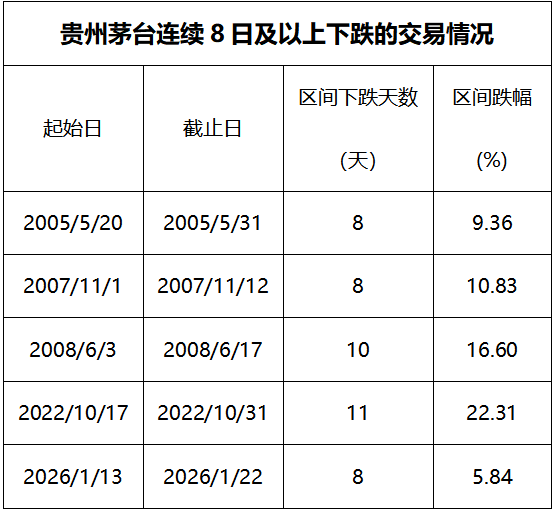
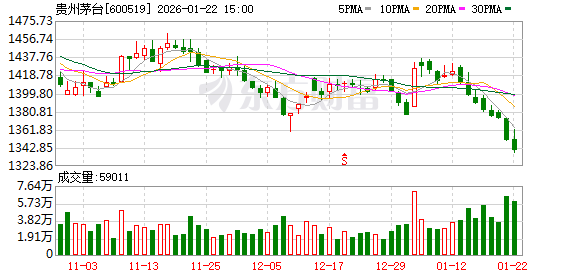
Group 1 - The core point of the article highlights that despite various measures taken by Kweichow Moutai, including share buybacks and marketing strategy optimization, the company's stock price continues to decline, experiencing an 8-day consecutive drop as of January 22, with a cumulative decline of 5.84% during this period and 2.7% for the month of January [2][4] - Historical data shows that Kweichow Moutai has previously experienced similar streaks of consecutive declines, including 8-day drops in May 2005 and November 2007, a 10-day drop in June 2008, and an 11-day drop in October 2022 [3] - Analysis indicates that after a streak of 5 or more consecutive down days, Kweichow Moutai has less than a 50% probability of seeing an increase on 6 or more of the next 10 trading days [2] Group 2 - As of January 22, Kweichow Moutai's closing price was 1340.06 CNY per share, falling below that of Cambricon Technologies (1353 CNY), marking the 19th time since August 2025 that Cambricon has surpassed Kweichow Moutai's closing price [4] - The decline in Kweichow Moutai's stock price reflects a broader investor disinterest in the consumer sector, as evidenced by significant reductions in holdings by public funds, including notable funds managed by Xiao Nan, which have adjusted their white liquor allocations [4] - Xiao Nan's strategy indicates a shift towards the livestock industry, suggesting a focus on inflation-driven cost increases rather than demand-driven growth in the coming two years [4]

罕见八连跌,贵州茅台后市怎么走?知名公募基金已减仓
Zheng Quan Shi Bao Wang· 2026-01-22 08:33
Core Viewpoint - Guizhou Moutai's stock price continues to decline despite various measures taken by the company, including buybacks and marketing strategy optimization, with an 8-day consecutive drop observed recently [1] Group 1: Stock Performance - As of January 22, Guizhou Moutai's stock price has dropped 5.84% from January 13 to January 22, with a total decline of 2.7% in January [1] - Historical data shows that Guizhou Moutai has experienced multiple instances of consecutive declines, including an 8-day drop in May 2005 and November 2007, a 10-day drop in June 2008, and an 11-day drop in October 2022 [2] - After a series of declines, the probability of the stock price rising in the following 10 trading days is less than 50% if it has fallen for 5 days or more [1] Group 2: Market Position and Investor Sentiment - As of January 22, Guizhou Moutai's closing price was 1340.06 CNY per share, falling below that of Cambricon Technologies (1353 CNY), marking the 19th time since August 2025 that Cambricon has surpassed Moutai's closing price [3] - The decline in Guizhou Moutai's stock reflects a broader investor disinterest in the consumer sector, as evidenced by significant reductions in holdings by public funds, including E Fund's adjustments in its white liquor portfolio [3] - Notably, E Fund's manager has shifted focus from high-end liquor to the livestock industry, anticipating a greater likelihood of cost-push inflation over demand-pull inflation in the next two years [3]