
收入分配制度

Search documents
上证研究 | 中国收入分配制度究竟好在哪里?
Xin Lang Cai Jing· 2026-02-24 11:05
Group 1 - The core argument of the article emphasizes the need for improving the income distribution system in China to achieve common prosperity and ensure that modernization benefits all citizens fairly [1][11] - The article contrasts the challenges faced by Western welfare states, such as high welfare leading to economic stagnation and unsustainable policies, with China's unique income distribution advantages rooted in Marxist theory [1][6][11] Group 2 - Western welfare states are characterized by high taxes supporting extensive welfare, which negatively impacts capital investment and labor supply, leading to industrial hollowing and economic stagnation [2][19] - The high welfare levels in Western countries create a vicious cycle of high welfare, high taxes, and increasing debt, exacerbating fiscal risks [3][20] - The political manipulation of welfare policies in Western countries results in a facade of fairness that conceals substantial inequality, as wealth distribution favors the wealthy [4][21] Group 3 - China's income distribution system is effective in balancing social welfare and economic vitality, contrasting sharply with the inefficiencies of Western welfare states [6][23] - The Chinese model emphasizes the integration of market mechanisms with government intervention, ensuring both efficiency and equity in income distribution [8][26] - The approach of gradual improvement in welfare without overcommitting to high welfare promises allows for sustainable fiscal management in China [10][27] Group 4 - The "Belt and Road" initiative exemplifies China's commitment to sharing its income distribution experiences globally, focusing on infrastructure, technology transfer, and capacity building to promote equitable development [12][29] - The initiative aims to create mutual benefits for participating countries while adhering to principles of efficiency and fairness, as seen in projects like the China-Laos railway [30][31]
粤开宏观:如何明显提高居民消费率?
Yuekai Securities· 2026-01-27 12:31
Group 1: Importance of Increasing Consumption - Increasing the resident consumption rate is crucial for promoting internal economic circulation and improving external geopolitical economic patterns[6] - A higher consumption rate can reduce reliance on external demand, enhance economic autonomy, and alleviate international trade tensions[8] Group 2: Current Consumption Characteristics - In 2023, China's resident consumption rate was 39.6%, significantly lower than the U.S. rate of 67.9%, with a gap of approximately 28 percentage points[10] - Over the past 75 years, China's consumption rate has been above 40% for two-thirds of the time, indicating potential for improvement[12] Group 3: Structural Challenges - Service consumption in China is insufficient, with only 17.9% of GDP compared to the U.S. at 45.8%, a difference of 27.9 percentage points[15] - The share of improvement-oriented consumption is low, with about 40% of Chinese consumption still focused on basic needs, compared to 24% in the U.S.[16] Group 4: Policy Recommendations - The government should create a consumption-oriented macro governance system, shifting tax policies to stimulate local consumption[26] - Enhancing the income distribution system is essential to increase residents' consumption capacity and confidence[28]
上海“十五五”规划建议目标:提高劳动报酬,鼓起百姓“钱袋子”
2 1 Shi Ji Jing Ji Bao Dao· 2026-01-20 01:24
Group 1 - The core viewpoint of the article emphasizes the importance of increasing residents' income as a means to improve livelihoods and stimulate domestic demand, aligning with the goals of the 14th Five-Year Plan [3][4] - The "Suggestions" document outlines that during the 15th Five-Year Plan period, the synchronization of residents' income growth with economic growth and the increase of labor remuneration alongside productivity is a primary objective [2][3] - The document proposes to enhance the proportion of residents' income in national income distribution and to improve the share of labor remuneration in primary distribution, aiming to create a more equitable income distribution system [4][5] Group 2 - The "Suggestions" advocate for a market-based evaluation of contributions to determine remuneration, promoting a system where those who work more, possess higher skills, or innovate are rewarded accordingly [5][6] - Several companies have announced salary increases in response to national policies aimed at boosting residents' income, indicating a positive trend in corporate responsibility and economic health [6][7] - The actions of leading companies like ByteDance and BYD reflect a long-term strategic vision to attract and retain talent, which is crucial for enhancing competitiveness in the global market [7]


理响中国丨怎样健全扩大内需的长效机制?
Xin Lang Cai Jing· 2025-12-21 05:42
Core Viewpoint - The article emphasizes the importance of expanding domestic demand as a strategic initiative, requiring both proactive macro policies and the establishment of long-term mechanisms to effectively guide consumption, savings, and investment [1] Group 1: Macroeconomic Policies - The need for more proactive macroeconomic policies is highlighted, aligning with the directives from the Central Economic Work Conference [1] - The article calls for reforms to eliminate institutional barriers that restrict the expansion of domestic demand, aiming to cultivate a complete domestic demand system [1] Group 2: Income Distribution System - The article stresses the importance of improving the income distribution system, noting that consumption is a function of income, which is the key factor influencing consumption [1] - It suggests a collaborative approach across initial, redistributive, and third distribution areas to form an olive-shaped distribution pattern dominated by the middle-income group [1] - Specific measures include addressing structural employment issues, optimizing labor market conditions, and enhancing wage determination mechanisms to increase labor compensation's share in initial distribution [1] Group 3: Market Mechanisms - The article advocates for a robust market mechanism that aligns with the construction of a strong domestic market, emphasizing the decisive role of the market in resource allocation [1] - It identifies existing institutional shortcomings such as local protectionism and market fragmentation that hinder consumption choices and distort investment signals [1] - Recommendations include formulating national regulations for a unified market, eliminating barriers in resource acquisition, and promoting smooth flow of goods and factors across broader regions [1] Group 4: Consumption Promotion - The article points out the prominent institutional barriers that currently restrict the expansion and upgrading of consumption [1] - It calls for the removal of unreasonable restrictions in the consumption sector and the expansion of high-quality goods and services supply [1] - The need for reforms in consumption tax collection to better align local fiscal revenues with local consumption market prosperity is also emphasized [1] Group 5: Economic Potential - The article concludes that China's market has significant potential, resilience, and vitality, with long-term supportive conditions for economic growth remaining unchanged [1] - It asserts that implementing comprehensive policies to expand domestic demand will continuously unleash greater potential for consumption and investment, thereby stabilizing the economy and promoting high-quality development [1]
怎样健全扩大内需的长效机制?
Xin Lang Cai Jing· 2025-12-21 03:17
Group 1 - The core viewpoint emphasizes the need for macro policies and long-term mechanisms to expand domestic demand, as highlighted in Xi Jinping's article in "Qiushi" magazine [1] - The article stresses the importance of improving the income distribution system to enhance consumption, advocating for a balanced distribution structure with a focus on the middle-income group [1] - It calls for coordinated efforts in initial, redistributive, and third distribution to increase labor compensation and provide better public services [1] Group 2 - The construction of a robust domestic market requires a unified and competitive market system, addressing existing institutional shortcomings such as local protectionism and market segmentation [2] - The article suggests the establishment of national regulations for a unified market to facilitate the smooth flow of goods and resources, promoting a more open and competitive environment [2] - It highlights the need for improved logistics and reduced costs to enhance market connectivity and efficiency [2] Group 3 - The article identifies significant barriers to consumption expansion and upgrading, advocating for the removal of unreasonable restrictions and the enhancement of quality standards and credit systems [3] - It points out the historical focus on production over consumption by local governments, linking this to the distribution of value-added tax and suggesting reforms to shift consumption tax collection [3] - The potential for domestic demand to drive economic growth is emphasized, with a call for comprehensive policies to stimulate consumption and investment [3]
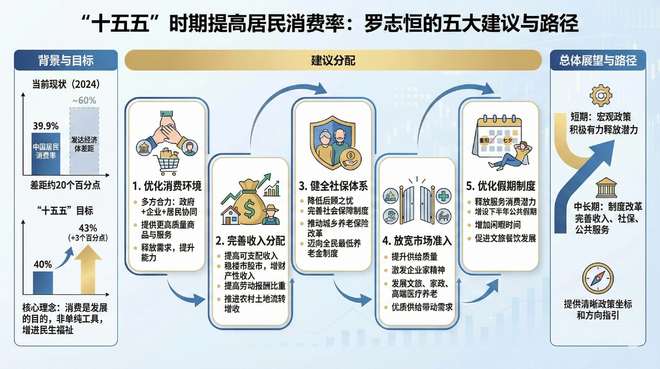
粤开证券罗志恒:“十五五”时期可从五大方面提高居民消费率
Zhong Guo Jing Ying Bao· 2025-12-17 09:01
Core Viewpoint - It is expected that by 2026, there will be a marginal recovery in household consumption, driven by the implementation of subsidy policies in areas such as childcare and elderly care, along with the wealth effect from rising stock markets [2] Group 1: Economic Context - The "14th Five-Year Plan" aims to significantly increase the household consumption rate, which is defined as the proportion of final household consumption expenditure to GDP [2] - In 2024, China's household consumption rate is projected to be 39.9%, an increase of 4.3 percentage points since 2012, but still about 20 percentage points lower than major developed economies [2] Group 2: Consumption Rate Improvement Strategy - To raise the household consumption rate from 40% to 43% during the "14th Five-Year Plan," an average annual growth rate of 6.5% in household consumption is required, assuming a nominal GDP growth rate of about 5% [4] - The increase in consumption is not merely a temporary measure but a strategic move related to the transformation of the economic development model, emphasizing that consumption should enhance the well-being of citizens rather than being treated as a mere policy tool [4] Group 3: Systematic Approaches to Boost Consumption - Five systematic approaches are proposed to enhance household consumption: 1. Optimize the consumption environment to create a collaborative effort among government, enterprises, and residents [5] 2. Improve the income distribution system to solidify the consumption foundation, focusing on increasing disposable income and enhancing property income [5] 3. Strengthen the social security system to alleviate residents' concerns about future expenditures [5] 4. Relax market access to improve supply quality, which can stimulate entrepreneurial spirit and accelerate the development of service industries [6] 5. Optimize holiday systems to release service consumption potential, thereby balancing supply and demand [6][7] Group 4: Policy Recommendations - Short-term measures require more proactive macroeconomic policies to unleash consumption potential, while long-term strategies depend on reforms in income distribution, social security, and public services to continuously enhance residents' consumption capacity and willingness [7]
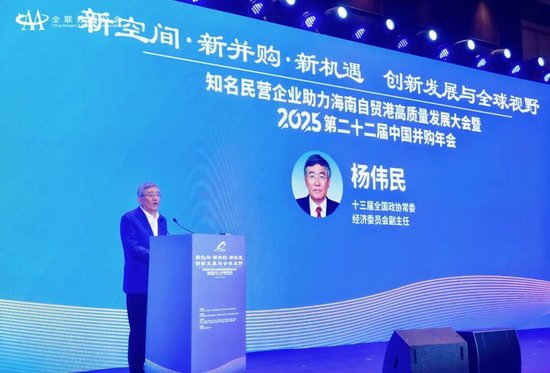
杨伟民:“十五五”时期,要确保经济增长在合理区间,形成消费拉动的经济发展模式,完善收入分配制度
Xin Lang Cai Jing· 2025-12-02 06:25
Core Viewpoint - The 22nd China M&A Annual Conference emphasizes the importance of ensuring reasonable economic growth during the 14th Five-Year Plan period, promoting a consumption-driven economic model, and improving the income distribution system [1][3][13]. Group 1: Economic Growth - The goal for the 14th Five-Year Plan is to maintain economic growth within a reasonable range, with an average GDP growth rate of 4.17% required to achieve a per capita GDP of over $20,000 by 2035 [4][14]. - In 2024, China's per capita GDP is expected to approach $13,500, indicating a need for sustained growth to meet future targets [4][14]. - The focus should be on both actual and nominal growth, ensuring that nominal growth remains within a reasonable range to support increases in resident income, tax revenue, and corporate profits [5][15]. Group 2: Consumption-Driven Economic Model - The transition to a consumption-driven economic model is essential, as the current economic structure shows a decline in the contribution of domestic demand to growth, which was 71% in the first three quarters of the year [7][18]. - The manufacturing sector's contribution to growth has increased, while the contributions from real estate, finance, and construction have significantly decreased [7][17]. - The need to enhance the quality of production and shift towards innovation-driven growth is highlighted as a key factor in achieving sustainable economic development [6][16]. Group 3: Income Distribution System - The income distribution system requires urgent improvement, as the share of resident income in national income has been declining since the 1990s, leading to increased income inequality [9][19]. - Policies should focus on increasing minimum wage standards and enhancing the income of ordinary workers to align initial distribution with economic growth [9][19]. - The implementation of a "rural and urban resident income increase plan" is proposed to effectively raise the disposable income of low-income groups, thereby boosting overall consumption [9][19].
这三个群体,收入分配要“多得”
Xin Hua Wang· 2025-12-01 23:53
Core Points - The article emphasizes the importance of improving the income distribution system to ensure that hard workers, skilled individuals, and innovators receive more rewards, aligning with the goals of the 14th Five-Year Plan [1][5][9] - The report highlights the steady growth of residents' disposable income, with a projected average of 41,314 yuan in 2024, reflecting a real annual growth rate of 5.5% from 2021 to 2024 [1][2] - The article discusses the strategic significance of income distribution reform in promoting common prosperity, fostering new productive forces, and establishing a new development pattern [2][3] Group 1: Income Distribution Mechanism - The article outlines the need for a coordinated system of primary distribution, redistribution, and third distribution to effectively adjust high incomes and increase low-income earners' earnings [2][3] - It stresses that the income distribution system should allow various production factors to participate in distribution based on their contributions, thereby recognizing the value of human capital [2][7][10] Group 2: Encouraging Hard Work and Skills - The concept of "more for more work" is highlighted, where employers set wage standards based on labor time, workload, and contributions, ensuring that diligent workers receive appropriate compensation [6][9] - The article notes that there are over 220 million skilled workers in China, with more than 72 million being high-skilled, emphasizing the need to enhance their compensation and social status [6][9] Group 3: Innovation Incentives - The article points out that innovation is crucial for economic development, with a focus on the need for a system that rewards innovators adequately, especially in high-risk fields like AI and digital economy [7][8] - It mentions that as of June this year, China has reached an average of 15.3 high-value invention patents per 10,000 people, indicating a strong emphasis on innovation [7][8] Group 4: Policy and Practice - The article discusses various policies and practices that have been implemented to support the three groups of "more for more," including the issuance of guidelines for skill talent compensation and the promotion of collective wage negotiations [9][10] - It highlights the importance of creating a fair competitive market environment and enhancing regulatory measures to ensure that contributions are evaluated and rewarded appropriately [10]
杨伟民:深刻把握“十五五”规划建议的重点和要求|宏观经济
清华金融评论· 2025-11-29 09:48
Core Viewpoint - The "14th Five-Year Plan" emphasizes the need for qualitative and effective economic growth, promoting comprehensive human development and common prosperity, ensuring decisive progress towards socialist modernization [3][4]. Group 1: Economic Development Strategy - The plan highlights the importance of forming an economic development model driven by domestic demand, consumption, and endogenous growth, which is a strategic decision for the "14th Five-Year Plan" [3][10]. - A significant focus is placed on improving the income distribution system to support a consumption-driven growth model, which is crucial for achieving modernization in the Chinese context [3][11]. - The plan sets a target for per capita GDP to reach approximately $23,000 by 2035, requiring an average nominal growth of around 5% annually over the next decade [4]. Group 2: Principles for Economic and Social Development - The "14th Five-Year Plan" outlines six essential principles for economic and social development, including the necessity of the Party's comprehensive leadership, which is fundamental for achieving modernization [7][8]. - Emphasizing a people-centered approach, the plan aims to meet the growing needs of the populace while expanding development opportunities [7]. - High-quality development is identified as the primary task, focusing on innovation-driven growth and enhancing domestic consumption [8]. Group 3: Income Distribution and Employment - The plan stresses the importance of fair income distribution and increasing residents' income as a prerequisite for expanding consumption and meeting the people's needs [11][12]. - New policies are proposed to create an employment-friendly development model, ensuring that income growth aligns with economic growth [11]. - The introduction of a "Rural and Urban Residents' Income Increase Plan" is highlighted as a significant initiative to enhance the financial well-being of the population [12].

持续扩大中等收入群体规模 扎实推进共同富裕
Ren Min Ri Bao· 2025-11-14 02:22
Core Viewpoint - The expansion of the middle-income group is a crucial policy goal for achieving common prosperity in China, as emphasized by President Xi Jinping. The focus is on optimizing income distribution and increasing the size of the middle-income group as part of the 15th Five-Year Plan [1][2][9]. Group 1: Importance of Expanding the Middle-Income Group - Expanding the middle-income group is essential for maintaining social harmony and stability, reflecting a country's economic strength and social conditions [2][3]. - A larger middle-income group contributes to a more stable society, as this demographic typically enjoys stable jobs and decent incomes, leading to a higher sense of security and satisfaction [3][4]. - The transition from a middle-income to a high-income country is facilitated by the expansion of the middle-income group, which can stimulate domestic demand and promote sustained economic growth [4][5]. Group 2: Achievements and Current Status - China has over 400 million people in the middle-income group, supported by continuous economic growth and improvements in income distribution [5][7]. - The country aims to increase the middle-income group to over 800 million within the next 15 years, which presents significant challenges, particularly in rural areas where income levels remain low [8][9]. Group 3: Policy Measures and Strategies - The government is implementing various policies to enhance the income distribution system, ensuring that economic growth benefits all citizens more equitably [12][14]. - Emphasis is placed on improving public services and employment opportunities, particularly for vulnerable groups such as recent graduates and migrant workers [11][13]. - The development of the private economy is crucial for job creation and income growth, with policies aimed at fostering a fair and transparent business environment [14].