新能源消纳和调控

Search documents
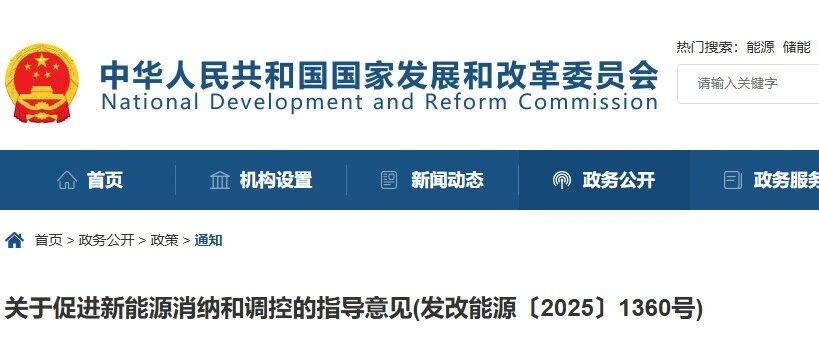
国家发改委、国家能源局重磅发文:满足每年新增2亿千瓦以上新能源消纳需求!
中国有色金属工业协会硅业分会· 2025-11-24 03:21
Core Viewpoint - The article discusses the guidance issued by the National Development and Reform Commission and the National Energy Administration to promote the consumption and regulation of renewable energy, aiming to establish a multi-level renewable energy consumption and regulation system by 2030 and a new power system by 2035, supporting carbon peak and neutrality goals [1][7][8]. Group 1: Overall Requirements - By 2030, a collaborative and efficient multi-level renewable energy consumption and regulation system will be established, ensuring smooth grid connection and efficient operation of renewable energy, with new electricity demand primarily met by new renewable generation [7][8]. - By 2035, a new power system capable of accommodating a high proportion of renewable energy will be fundamentally established, optimizing the allocation and consumption of renewable energy nationwide [1][8]. Group 2: Classification Guidance for Renewable Energy Development and Consumption - The guidance emphasizes the coordinated development of "sand, desert, and wasteland" renewable energy bases, focusing on both external delivery and local consumption, particularly in arid regions [2][9]. - It advocates for the integrated development and consumption of hydropower and wind-solar bases, optimizing the configuration of renewable energy based on hydropower characteristics [2][9]. - The orderly development and consumption of offshore wind power will be promoted, with a focus on optimizing offshore transmission networks [2][9]. Group 3: New Models and Innovative Development of Renewable Energy Consumption - The article highlights the need for innovative integrated development models for renewable energy, supporting the establishment of an integrated industrial system in resource-rich areas [11]. - It encourages the fusion of renewable energy with traditional industries, promoting the transfer of high-energy industries to regions with clean energy advantages [12]. Group 4: Enhancing the Adaptability of the New Power System to Renewable Energy - The guidance calls for improving system regulation capabilities, including the construction of pumped storage power stations and advanced storage technologies [13][19]. - It emphasizes the need to enhance the grid's capacity to accept renewable energy, optimizing the national power flow and expanding the range of renewable resource allocation [13][19]. Group 5: Perfecting the National Unified Power Market System for Renewable Energy Consumption - The article discusses the expansion of a multi-level market system for renewable energy consumption, promoting flexible trading mechanisms and enhancing the role of the spot market [16][17]. - It suggests establishing a pricing mechanism that reflects the characteristics of renewable energy and encourages local consumption [17][18]. Group 6: Strengthening Technological Innovation Support for Renewable Energy Consumption - The guidance emphasizes breakthroughs in efficient renewable energy generation technologies, including low-cost solar and wind technologies [18]. - It highlights the importance of advancing grid operation technologies and intelligent control technologies to enhance the stability and efficiency of renewable energy integration [19]. Group 7: Assurance Measures - The article outlines the need for optimizing renewable energy consumption management mechanisms, setting regional utilization rate targets, and ensuring the effective implementation of consumption responsibilities [20][21]. - It stresses the importance of monitoring and regulatory measures to ensure the achievement of renewable energy consumption goals [21].

山西证券研究早观点-20251120
Shanxi Securities· 2025-11-20 01:12
Group 1: Industry Commentary - The communication industry is seeing a potential catalyst with the upcoming release of Google's Gemini 3.0, which is expected to enhance AI computing capabilities significantly. The performance improvements noted in early tests suggest a strong demand for high-end AI chips, with a reported increase in token processing from 9.7 trillion to over 1,000 trillion, indicating a hundredfold growth in demand [5][6]. - The acquisition of Kuixin Technology by Heshun Petroleum aims to capitalize on the domestic communication interface IP market, with Kuixin's projected revenues of 193 million and 110 million yuan for 2024 and the first half of 2025, respectively. The valuation for 100% equity is capped at 1.588 billion yuan, with performance commitments set for 2025-2028 [5][6]. - The chemical raw materials sector is experiencing a surge in demand for lithium battery materials, driven by the booming energy storage industry. Prices for lithium hexafluorophosphate have surged to 160,000 yuan per ton, a threefold increase from the July 2025 low of 50,000 yuan, indicating a tight supply situation that may persist until 2026 [11][12]. Group 2: Company Insights - Jinwo Co., Ltd. reported a revenue of 930 million yuan for the first three quarters of 2025, reflecting a year-on-year growth of 10.56%. The net profit attributable to shareholders reached 37.34 million yuan, up 74.83% year-on-year, indicating a recovery in profitability [16][18]. - The company achieved a gross margin of 15.45% in Q3 2025, an increase of 1.03 percentage points year-on-year, and a net margin of 3.75%, up 0.73 percentage points year-on-year. This improvement is attributed to enhanced production efficiency and material utilization [16][18]. - The company is actively expanding its production capacity, with new projects expected to support future growth. The focus on innovative product lines, such as screw components and insulated bearing sleeves, is anticipated to drive revenue growth in the coming years [20][18].
20cm速递|创业板新能源ETF国泰(159387)连续5日迎净流入,政策助力新能源发展
Mei Ri Jing Ji Xin Wen· 2025-11-19 06:49
Core Insights - The National Development and Reform Commission and the National Energy Administration issued guidelines on promoting the consumption and regulation of renewable energy, aiming to establish a multi-level system by 2030 to ensure efficient integration and utilization of renewable energy [1] Group 1: Policy and Regulatory Developments - The guidelines emphasize that by 2030, a collaborative and efficient multi-level renewable energy consumption regulation system will be fundamentally established [1] - The document highlights that the new electricity demand will primarily be met by newly added renewable energy generation [1] - The guidelines aim to enhance the adaptability of the new power system and significantly improve system regulation capabilities [1] Group 2: Market Implications - The guidelines are expected to facilitate smoother cross-province and cross-region transactions of renewable energy, addressing the annual demand for reasonable consumption of over 200 million kilowatts of new energy [1] - The Guotai New Energy ETF (159387), which tracks the Innovation Energy Index (399266), experienced a daily fluctuation of 20%, reflecting the market's focus on renewable energy and related industries [1] - The Innovation Energy Index includes companies involved in clean energy, energy conservation, and new energy vehicles, representing significant players in technology innovation and market performance within the renewable energy sector [1]

民企稳定投资政策出台——政策周观察第55期
一瑜中的· 2025-11-17 15:35
Core Viewpoint - The article discusses recent policy developments aimed at stabilizing private investment in China, highlighting measures to enhance the business environment and support for private enterprises in various sectors [2][3][10]. Group 1: Policy Developments - On November 10, the State Council issued measures to promote private investment, including easing restrictions for private enterprises in monopolistic sectors such as energy and railways, and encouraging participation in low-altitude economic infrastructure [2][9]. - The "14th Five-Year Plan" for various industries is being developed, with a focus on smart connected vehicles and new battery industries, as mentioned during the World Power Battery Conference held in Sichuan [2][11]. - The government is emphasizing the importance of enhancing the adaptability of supply and demand to stimulate consumption and economic circulation, as discussed in a State Council meeting on November 14 [3][7]. Group 2: Financial and Investment Strategies - The finance minister stated that during the "14th Five-Year Plan" period, fiscal policy will maintain an active orientation, adjusting deficit rates and debt levels based on economic conditions, and utilizing various financial tools to support spending [3][13]. - The government aims to increase the proportion of government procurement reserved for small and medium-sized enterprises to over 40% for projects exceeding 4 million yuan, promoting fair competition [9][10]. - There is a push for private capital to engage in significant investment projects, with the government providing support through new policy financial tools and encouraging the issuance of real estate investment trusts (REITs) for eligible projects [10][12]. Group 3: Industry-Specific Initiatives - The Ministry of Agriculture is implementing a "14th Five-Year" plan for modern seed industry enhancement, focusing on revitalizing the seed industry [2][11]. - The government is promoting the development of a multi-level renewable energy consumption and regulation system by 2030, aiming for a new power system adaptable to high proportions of renewable energy by 2035 [11]. - The Ministry of Industry and Information Technology is working on a development plan for smart connected vehicles and new battery industries, emphasizing strategic leadership and application expansion [11][12].

政策周观察第55期:民企稳定投资政策出台
Huachuang Securities· 2025-11-17 07:30
Policy Developments - The State Council issued measures to promote private investment, allowing private enterprises to enter monopolistic sectors like energy and railways, and supporting participation in low-altitude economy infrastructure[10] - The government aims to reserve over 40% of procurement budgets for small and medium enterprises in projects exceeding 4 million yuan[10] Economic Strategy - Premier Li Qiang emphasized the importance of integrating "two重" construction into the "十四五" plan, focusing on strategic and forward-looking requirements[3] - Fiscal policy during the "十四五" period will maintain an active orientation, adjusting deficit rates and debt levels based on economic conditions[3] Industry Focus - The Ministry of Industry and Information Technology announced plans for the "十四五" development of smart connected new energy vehicles and new battery industries[12] - By 2030, a multi-level renewable energy consumption and regulation system is expected to be established, with new electricity demand primarily met by renewable sources[12] Risk Considerations - There is a risk of delayed policy updates, which could impact the effectiveness of the measures introduced[3]
电力设备与新能源行业11月第3周周报:10月新能源汽车市占率首次过半,光伏“反内卷”稳步推进-20251116
Bank of China Securities· 2025-11-16 09:22
Investment Rating - The report maintains an "Outperform" rating for the electric equipment and new energy industry [1]. Core Insights - In October, the market share of new energy vehicles (NEVs) exceeded 50% for the first time, with a projected high growth in domestic NEV sales expected to continue into 2025, driving demand for batteries and materials [1][2]. - The price of lithium hexafluorophosphate continues to rise, indicating potential recovery in profitability for related companies in the power battery supply chain [1]. - The photovoltaic (PV) sector is focused on a "reverse involution" strategy, with future component pricing dependent on terminal installation demand and profitability of PV power plants [1][2]. - Wind power demand in China is expected to grow steadily, with recommendations to focus on wind turbine and offshore wind sectors [1]. - Energy storage remains in a high-demand phase, with prices for energy storage cells and integration still on the rise [1]. - Hydrogen energy is anticipated to see increased demand for green hydrogen, with a focus on downstream applications and the evolving relationship between green electricity, hydrogen, and green fuels [1]. - Nuclear fusion is highlighted as a long-term energy development direction, with recommendations to monitor core suppliers in this sector [1]. Summary by Sections New Energy Vehicles - In October, NEV sales reached 1.715 million units, a year-on-year increase of 20%, marking a market share surpassing 50% for the first time [2][24]. - Cumulative domestic power battery installation from January to October reached 578.0 GWh, a year-on-year increase of 42.4% [2][24]. Photovoltaic Sector - The report emphasizes the importance of maintaining a "reverse involution" strategy, with ongoing discussions about storage policies and their implementation [1][24]. - The price of silicon materials remains stable, with a focus on terminal demand influencing market prices [15][19]. Wind Power - Continuous growth in wind power demand is anticipated, with a focus on wind turbine and offshore wind sectors [1]. Energy Storage - The energy storage sector is experiencing high demand, with ongoing price increases for energy storage cells and integration [1]. Hydrogen Energy - The report suggests that the substitution of electricity with hydrogen will open up demand for green hydrogen, with a focus on enhancing penetration rates of hydrogen-based energy applications [1]. Nuclear Fusion - Nuclear fusion is identified as a future energy development direction, with recommendations to focus on core suppliers in this area [1].
每周海内外重要政策跟踪(25/11/14)-20251114
GUOTAI HAITONG SECURITIES· 2025-11-14 13:03
Domestic Macro - The Ministry of Commerce and the General Administration of Customs announced the suspension of multiple export control measures effective from November 7, 2025, impacting various materials including rare earths and lithium batteries [5][15] - The Ministry of Finance released a report on the execution of China's fiscal policy for the first half of 2025, emphasizing the need for a more proactive fiscal policy and continued implementation of consumption-boosting initiatives [5][15] - The National Development and Reform Commission held a press conference on November 11, 2025, to discuss measures to further promote private investment development [5][15] Industry Policies - The Ministry of Industry and Information Technology issued a notice on November 7, 2025, to initiate key product innovation tasks in the fine chemical sector for 2025 [6][19] - The National Energy Administration released guidelines on promoting the integration of coal and new energy development on November 7, 2025 [6][19] - The National Development and Reform Commission and the National Energy Administration published guidance on promoting the consumption and regulation of new energy on November 10, 2025 [6][19] Local Policies - On November 8, 2025, a major project planning and implementation meeting was held in Qingdao, and the Chongqing government adjusted some administrative divisions [7][19] - The Beijing Municipal Government issued opinions on constructing a comprehensive data element pilot zone to deepen the market-oriented allocation of data elements on November 9, 2025 [7][19] - The Shanghai Municipal Government's executive meeting on November 10, 2025, focused on creating an open innovation hub to support leading industries in global competition [7][19] Overseas Dynamics - On November 8, 2025, the U.S. Democratic Party softened its stance on government shutdown, while the Republican Party acknowledged progress [9] - The South Korean government plans to reduce the maximum tax rate on dividend income from 35% to 25% [9] - On November 11, 2025, the European Union proposed to gradually eliminate Huawei and ZTE equipment from member states [9]
硅铁市场周报:成本高位利润亏损,需求下降库存回升-20251114
Rui Da Qi Huo· 2025-11-14 09:17
1. Report Industry Investment Rating - No relevant content provided 2. Core Views of the Report - The supply side of ferrosilicon is expected to see a decline in production from November to December due to losses of manufacturers and postponed new - capacity launches. The demand side will continue the downward trend of crude steel production, and the alloy is likely to remain in a loss state. It is expected that ferrosilicon will fluctuate in the range of 5400 - 5700 [7]. 3. Summary According to the Directory 3.1 Week - ly Key Points Summary - Macro: The "anti - involution" policy has led to the first monthly increase in PPI since last November, and the year - on - year decline has reached the smallest in over a year. Policies for new energy consumption and regulation have been released, and an energy supply guarantee meeting has been held [7]. - Overseas: Trump warned of an "economic disaster" if the Supreme Court rules against imposing comprehensive tariffs [7]. - Supply and demand: Market transactions are mainly for end - user rigid demand restocking, and inventory has increased for two consecutive weeks. The spot profit in Inner Mongolia is - 250 yuan/ton, and in Ningxia is - 480 yuan/ton. The November tender price of Hegang 75B ferrosilicon is 5680 yuan/ton, up 20 yuan/ton from the previous round [7]. - Technology: The weekly K - line of the ferrosilicon main contract is below the 60 - day moving average, showing a bearish trend [7]. - Strategy: Considering the macro - situation, supply, and demand, it is expected that ferrosilicon will fluctuate between 5400 - 5700 [7]. 3.2 Futures and Spot Market 3.2.1 Overall Futures and Spot Market - As of November 14, the ferrosilicon futures contract open interest was 382,000 lots, a net increase of 25,000 lots. The 5 - 1 contract spread was 12, a decrease of 54 points [13]. 3.2.2 Futures Market - As of November 14, the ferrosilicon warehouse receipt quantity was 8450, an increase of 2751. The Ningxia ferrosilicon price was 5240 yuan/ton, a decrease of 30 yuan/ton [17]. 3.2.3 Spot Market - As of November 14, the ferrosilicon basis was - 330 yuan/ton, an increase of 6 points [22]. 3.3 Industrial Chain Situation 3.3.1 Industry - This week (November 13), the national average capacity utilization rate of 136 independent ferrosilicon enterprises was 34.84%, a decrease of 1.42% from last week. The daily average output was 15,590 tons, a decrease of 4.36% (710 tons). The weekly demand for ferrosilicon from five major steel products was 19,073.8 tons, a decrease of 3.73%. The national weekly ferrosilicon output was 109,100 tons [28]. - This week (November 13), the national inventory of 60 independent ferrosilicon enterprises was 81,360 tons, an increase of 3.39% (2670 tons). Inventory in Inner Mongolia, Ningxia, and Gansu increased, while that in Shaanxi and Qinghai decreased [32]. 3.3.2 Upstream - As of November 10, the electricity price for ferrosilicon in Ningxia remained unchanged at 0.395 yuan/kWh, while that in Inner Mongolia decreased by 0.025 yuan/kWh to 0.405 yuan/kWh. As of November 13, the price of semi - coke remained unchanged [37]. - As of November 13, the spot production cost of ferrosilicon in Inner Mongolia was 5450 yuan/ton, a decrease of 1.91%, and in Ningxia was 5631 yuan/ton, a decrease of 0.49%. The spot profit in Ningxia was - 481 yuan/ton, an increase of 5.50% [41]. 3.3.3 Downstream - This week, the average daily hot metal output of 247 steel mills was 2.3688 million tons, an increase of 26,600 tons from last week and 9400 tons from last year. From January to September 2025, China's cumulative exports of ferrosilicon with a silicon content greater than 55% were 292,900 tons, a decrease of 22,900 tons (7.25%) from the same period last year [46].
瑞达期货焦煤焦炭产业日报-20251113
Rui Da Qi Huo· 2025-11-13 09:34
Report Industry Investment Rating - Not mentioned in the report Core Viewpoints - On November 13, the closing price of the coking coal 2601 contract was 1214.0, down 0.29%. The spot price of Tangshan Mongolian No. 5 clean coal was 1550, equivalent to 1330 on the futures market. The mine's operating rate has declined for three consecutive weeks due to safety inspections, inventory is neutral, and the total inventory of the middle and lower reaches shows a seasonal upward trend. The daily K - line is between the 20 - day and 60 - day moving averages. It should be treated as a wide - range oscillation, and investors should pay attention to risk control [2]. - On November 13, the closing price of the coke 2601 contract was 1686.0, down 0.30%. The third round of price increases for coke has been implemented. The demand for molten iron continues its seasonal decline, with a molten iron output of 234.22 (-2.14) tons. The total coke inventory is higher than the same period. The average profit per ton of coke for 30 independent coking plants nationwide is -22 yuan/ton. The daily K - line is below the 20 - day and 60 - day moving averages. It should be treated as a wide - range oscillation, and investors should pay attention to risk control [2]. Summary by Relevant Catalogs Futures Market - The closing price of the JM main contract was 1214.00 yuan/ton, down 5.00; the closing price of the J main contract was 1686.00 yuan/ton, down 3.50. The JM futures contract open interest was 941024.00 lots, up 11489.00; the J futures contract open interest was 48706.00 lots, down 207.00. The net open interest of the top 20 coking coal contracts was -100998.00 lots, up 1324.00; the net open interest of the top 20 coke contracts was -3608.00 lots, up 450.00. The JM5 - 1 monthly contract spread was 47.00 yuan/ton, down 13.50; the J5 - 1 monthly contract spread was 134.00 yuan/ton, down 12.00. The coking coal warehouse receipts were 100.00, down 100.00; the coke warehouse receipts were 2070.00, unchanged [2]. Spot Market - The price of Ganqimao Mongolian No. 5 raw coal was 1100.00 yuan/ton, down 11.00; the price of Tangshan Grade I metallurgical coke was 1830.00 yuan/ton, unchanged. The price of Russian prime coking coal forward spot (CFR) was 161.30 US dollars/wet ton, unchanged; the price of Rizhao Port quasi - Grade I metallurgical coke was 1620.00 yuan/ton, unchanged. The price of Australian imported prime coking coal at Jingtang Port was 1590.00 yuan/ton, down 10.00; the price of Tianjin Port Grade I metallurgical coke was 1720.00 yuan/ton, unchanged. The price of Shanxi - produced prime coking coal at Jingtang Port was 1860.00 yuan/ton, unchanged; the price of Tianjin Port quasi - Grade I metallurgical coke was 1620.00 yuan/ton, unchanged. The price of medium - sulfur prime coking coal in Lingshi, Jinzhong, Shanxi was 1610.00 yuan/ton, unchanged. The ex - factory price of coking coal produced in Wuhai, Inner Mongolia was 1400.00 yuan/ton, up 70.00. The JM main contract basis was 396.00 yuan/ton, up 5.00; the J main contract basis was 144.00 yuan/ton, up 3.50 [2]. Upstream Situation - The daily output of clean coal from 314 independent coal washing plants was 27.40 million tons, down 0.10; the weekly inventory of clean coal from 314 independent coal washing plants was 300.80 million tons, up 5.80. The weekly capacity utilization rate of 314 independent coal washing plants was 0.37%, unchanged. The monthly raw coal output was 41150.50 million tons, up 2100.80. The monthly import volume of coal and lignite was 4173.70 million tons, down 426.30. The daily average output of raw coal from 523 coking coal mines was 192.00, up 5.60. The weekly inventory of imported coking coal at 16 ports was 527.38 million tons, up 13.49; the weekly inventory of coke at 18 ports was 262.51 million tons, down 7.39. The weekly total inventory of coking coal in the full - sample of independent coking enterprises was 1070.02 million tons, up 17.32; the weekly inventory of coking coal in 247 steel mills nationwide was 787.30 million tons, down 9.02. The weekly inventory of coke in the full - sample of independent coking enterprises was 58.30 million tons, down 1.57; the weekly inventory of coke in 247 sample steel mills was 626.64 million tons, down 2.41. The weekly available days of coking coal in the full - sample of independent coking enterprises was 12.84 days, down 0.12; the weekly available days of coke in 247 sample steel mills was 11.07 days, down 0.50 [2]. Industry Situation - The monthly import volume of coking coal was 1092.36 million tons, up 76.14; the monthly export volume of coke and semi - coke was 54.00 million tons, down 1.00. The monthly output of coking coal was 3975.92 million tons, up 279.06. The weekly capacity utilization rate of independent coking enterprises was 72.31%, down 1.13. The weekly profit per ton of coke in independent coking plants was -22.00 yuan/ton, up 10.00. The monthly output of coke was 4255.60 million tons, down 4.10 [2]. Downstream Situation - The weekly blast furnace operating rate of 247 steel mills nationwide was 83.15%, up 1.42; the weekly blast furnace iron - making capacity utilization rate of 247 steel mills was 87.79%, down 0.80. The monthly crude steel output was 7349.01 million tons, down 387.84 [2]. Industry News - Mysteel predicts that the Simandou project will gradually release its production capacity during the 14th Five - Year Plan period. Conservatively estimated, the combined output of the north and south blocks will reach 20 million tons in 2026 [2]. - China Securities Regulatory Commission Vice - Chairman Li Ming stated to continuously improve the market ecosystem for long - term investment, promote the implementation of the plan to encourage medium - and long - term funds to enter the market, and expand the scale and proportion of equity investments of social security, insurance, and annuities. Strengthen strategic reserve and market - stabilizing mechanism construction to enhance the internal stability of the capital market and prevent large fluctuations [2]. - The China Photovoltaic Industry Association is working on industry self - discipline and "anti - involution" under the guidance of relevant ministries, believing that the work will succeed. It will fight against malicious short - selling and rumor - spreading in the photovoltaic industry [2].
股市必读:中集集团(000039)11月12日董秘有最新回复
Sou Hu Cai Jing· 2025-11-12 18:15
Core Viewpoint - The company is actively developing its energy storage and green fuel capabilities, aligning with recent government policies aimed at promoting renewable energy solutions and technologies [1]. Group 1: Energy Storage Development - The company is building an integrated energy storage industry chain, covering power generation, grid-side, and commercial energy storage systems, and has established solid partnerships with major overseas wind power operators [1]. - The company has made significant advancements in gas storage, leading the industry with various storage methods including compressed air, hydrogen, and carbon dioxide, providing solutions for large-scale storage projects in China [1]. Group 2: Green Fuel Initiatives - The company has a comprehensive industrial layout in green fuels, including LNG, hydrogen, and green methanol, positioning itself as an industry leader [1]. - A notable project includes the construction of a 50,000-ton/year bio-green methanol demonstration plant in Zhanjiang, expected to commence production in Q4 of this year, which aligns with regional strategies to develop green marine fuel supply centers [1]. - The collaboration with Ansteel on a hydrogen production project from coke oven gas is projected to produce 15,000 tons of hydrogen and 100,000 tons of LNG annually, significantly reducing carbon emissions [1]. Group 3: Market Position and Future Outlook - The recent government guidelines are expected to accelerate the industrialization of green energy technologies, potentially increasing market opportunities for the company [1]. - The company expresses confidence in its green energy business development and aims to further consolidate its leading position in the industry, enhancing market share and brand influence [1].