透明化

Search documents
人民日报再评西贝关店事件:危机面前 坦诚是最好的公关
Xin Lang Cai Jing· 2026-01-19 10:27
Core Viewpoint - The article emphasizes that the core issue behind the closure of Xibei restaurants is not the pre-prepared food itself, but the lack of sincerity from the company in addressing consumer concerns [1][2]. Group 1: Company Response and Consumer Trust - The article highlights that sincerity is crucial for companies, especially in times of crisis, and that being honest with consumers is the best form of public relations [1][2]. - It points out that the company's leader, Jia Guolong, has admitted to not understanding public relations, indicating a misdirection in addressing the real issues [1][2]. - The article warns that any attempts to mislead or evade consumer concerns will lead to negative consumer reactions, as they will "vote with their feet" [1][2]. Group 2: Industry Insights on Pre-prepared Food - The article argues that pre-prepared food should not be viewed negatively, as its standardization and transparency can enhance food safety and quality for the population of 1.4 billion [1][2]. - It suggests that government regulation of food safety in the pre-prepared food industry can improve supply efficiency, hygiene standards, and stabilize prices, ultimately benefiting consumer experience [1][2]. - The article encourages restaurants to embrace pre-prepared food by promoting transparency, standardization, and fair pricing, rather than avoiding it [1][2].
人民日报再评西贝关店事件:危机面前 坦诚是最好的公关
财联社· 2026-01-19 10:24
Core Viewpoint - The core issue in the Xibei store closure incident is not the pre-prepared food itself, but the lack of sincerity from the company [1][2]. Group 1: Company Response and Consumer Trust - The company leader, Jia Guolong, has repeatedly stated that he "does not understand public relations," indicating a misdirection in addressing the problem. Sincerity is essential for effective public relations, especially in times of crisis [2]. - Transparency and honesty towards consumers are crucial. Any attempt to hide information or provide misleading responses will lead to consumer backlash [2]. Group 2: Pre-prepared Food Industry - Pre-prepared food should not be viewed negatively. Promoting the standardization, transparency, and regulation of the pre-prepared food industry can ensure safer and higher-quality food for the population [3]. - Strengthening food safety regulations for pre-prepared food will enhance supply efficiency, hygiene standards, and stabilize flavors, ultimately lowering dining costs while ensuring food safety [3]. Group 3: Industry Practices - Restaurant businesses should not shy away from pre-prepared food but should openly label and promote it. The real issues to address are transparency of information, unified standards, fair pricing, and effective execution [4].


小米硬核拆车,让中国汽车竞争回归质量核心
Zhong Guo Qi Che Bao Wang· 2026-01-06 01:22
Core Insights - The article discusses Xiaomi's proactive approach in addressing public concerns regarding its electric vehicle, the YU7, through a transparent live-streamed disassembly event led by CEO Lei Jun, showcasing the vehicle's safety features and design [1][2][4]. Group 1: Product Transparency and Safety - Xiaomi's live-stream event aimed to dismantle the YU7 to directly address safety concerns, including the vehicle's structural integrity and battery protection mechanisms [1][2]. - The engineering team demonstrated the YU7's safety features, such as a design that allows front wheels to detach during a collision to absorb impact energy, thereby protecting the passenger cabin [1][2]. - Lei Jun acknowledged industry-wide issues like vague marketing practices and committed to improving transparency in promotional materials [2][4]. Group 2: Market Performance and Future Plans - Xiaomi reported impressive delivery figures, with over 410,000 vehicles delivered in 2025, surpassing the initial target of 300,000, and the YU7 achieving 150,000 deliveries within six months of launch [4]. - For 2026, Xiaomi plans to focus on three key areas: investing 200 billion yuan in technology research and development, enhancing AI capabilities, and creating a comprehensive user experience [4]. - The company set a delivery target of 550,000 vehicles for 2026, aiming for overachievement [4]. Group 3: Industry Impact and Consumer Engagement - The live-stream event served as a platform for consumers to better understand automotive technology, making complex safety designs more accessible [5]. - Xiaomi's transparent approach may encourage other companies in the industry to adopt similar practices, fostering a competitive environment focused on product and technological excellence [5][7]. - The event highlighted the importance of innovation and quality in the automotive industry, emphasizing that long-term consumer trust can only be built through transparency and technical advancement [7].


不再“狂撒代金券”之后 西贝的生意怎么样了?
Xin Jing Bao· 2026-01-04 14:15
Core Insights - The article discusses the transformation of Xibei, a restaurant chain, following a public relations crisis that began in September 2025, leading to a significant shift in its operational and pricing strategies [1][3][4]. Group 1: Company Response to Crisis - Xibei experienced a drastic decline in daily revenue, with losses reaching 200,000 to 300,000 yuan per day during the crisis, prompting a halt in expansion and a focus on core operational issues [3][4]. - The company initiated a comprehensive reform over 113 days, addressing menu preparation, pricing, service transparency, and employee welfare, marking a systemic restructuring rather than a mere emergency response [4][5]. - Xibei implemented a significant price reduction of nearly 20% on over 30 menu items, lowering the average customer spending from 92 yuan to 75 yuan, which helped improve customer traffic by approximately 5% compared to the previous year [6][8]. Group 2: Operational Changes - The restaurant chain shifted its food preparation process to enhance freshness, with key dishes being made on-site rather than pre-prepared, including the transition of lamb skewers to be freshly cut and grilled [5][6]. - Xibei introduced a dual transparency mechanism with "open kitchens" and live streaming of kitchen operations, ensuring that customers can see food preparation processes, thereby enhancing trust [7][9]. Group 3: Industry Impact - The crisis catalyzed the development of national standards for pre-prepared foods, addressing long-standing issues of information asymmetry in the industry [3][9]. - The incident led to a broader industry consensus on the importance of transparency, with practices like kitchen live streaming becoming standard among chain restaurants [9][10]. - The public's perception of pre-prepared foods shifted from fear to a more rational understanding, emphasizing the need for clear labeling and transparency in food sourcing and preparation [9][10].
不再“狂撒代金券”之后,西贝的生意怎么样了?
Bei Ke Cai Jing· 2026-01-04 12:13
Core Viewpoint - The article discusses the transformation of Xibei, a restaurant chain, following a public relations crisis, highlighting its efforts to rebuild trust and improve customer experience through significant operational changes and price adjustments [1][6][26]. Group 1: Company Response to Crisis - Xibei experienced a significant drop in customer traffic and revenue during the crisis, with daily sales decreasing by 1 million yuan on September 10 and 11, and losses escalating to 200,000-300,000 yuan by September 12 [14]. - In response, Xibei initiated a comprehensive reform over 113 days, focusing on improving food preparation processes, pricing strategies, and employee welfare [1][16]. - The company implemented a "systematic restructuring" of its business model, emphasizing the return of core cooking processes to the stores and enhancing transparency in food preparation [16][20]. Group 2: Customer Engagement and Pricing Strategy - Xibei reduced prices on over 30 dishes by nearly 20%, lowering the average customer spending from 92 yuan to 75 yuan, which was a shift from a profit-driven pricing model to one based on customer perception [17][18]. - The adjustments led to a 5% increase in overall customer traffic compared to the previous year, indicating a positive market response to the new pricing strategy [19]. - The company emphasized the importance of customer feedback in setting prices, aiming to align with consumer expectations and enhance perceived value [18]. Group 3: Transparency and Food Safety - Xibei introduced a dual mechanism of "open kitchen" and "live streaming" in all stores to enhance transparency, with each location equipped with six cameras covering all operational areas [20]. - The company also upgraded its food safety protocols, undergoing over 80 inspections by government authorities without any violations reported, which helped maintain customer trust during the crisis [24]. - A new "food safety officer" role was established in each store, with incentives for employees to ensure compliance with safety standards, further reinforcing the commitment to food safety [24]. Group 4: Industry Impact and Future Outlook - The crisis prompted the development of national standards for pre-prepared food, addressing long-standing issues of transparency and consumer rights in the restaurant industry [15][26]. - The incident catalyzed a broader industry shift towards transparency, with practices like kitchen live streaming and ingredient traceability becoming standard among chain restaurants [26]. - As Xibei continues its transformation, the restaurant industry is expected to evolve towards healthier and more mature practices, driven by consumer demand for quality and transparency [27].
中国ETF总规模首破6万亿元!谁是2025年的胜者?
Xin Lang Cai Jing· 2025-12-28 07:01
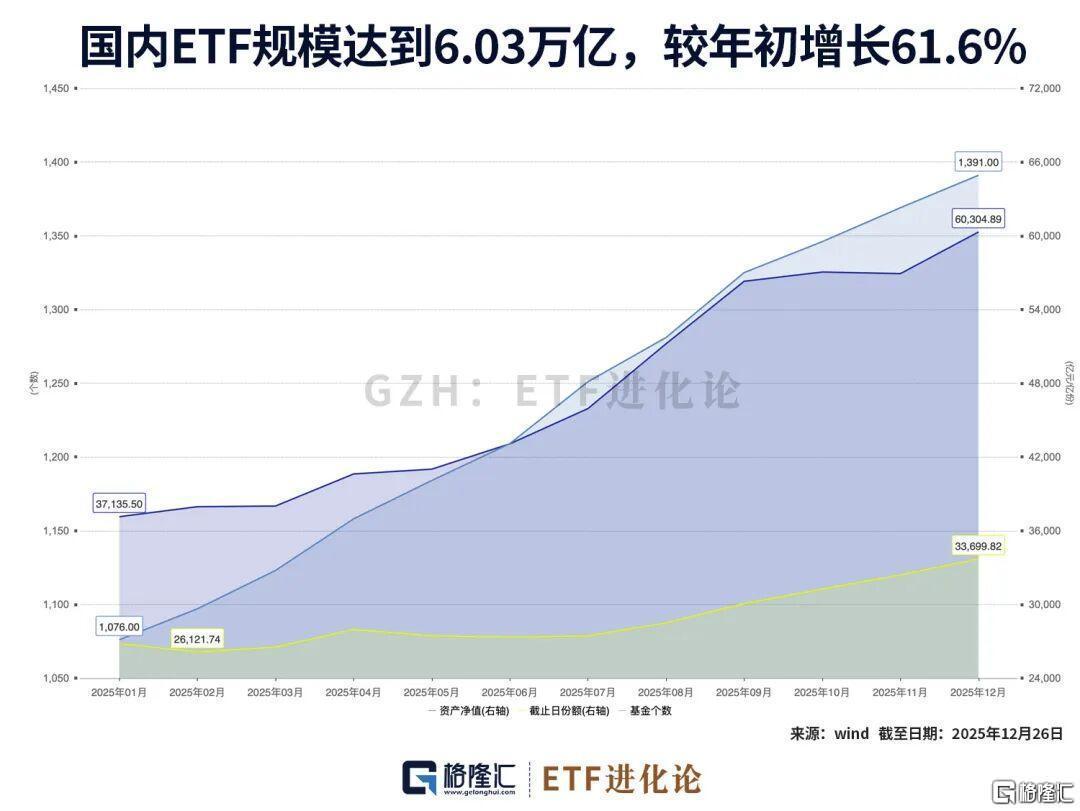
Core Insights - The Chinese capital market is entering an "ETF era" by 2025, with the total market size of ETFs reaching 6 trillion yuan, a 61.6% increase in just one year [1][3][4] Market Growth - The ETF market has shown rapid growth, breaking through 4 trillion, 5 trillion, and 6 trillion yuan in quick succession within 2025, indicating a clear acceleration in growth [3][4] - Historical data shows that the ETF market grew from 1 trillion yuan in 2020 to 2 trillion in 2023, and 3 trillion in 2024, culminating in a significant leap in 2025 [4] Market Structure Changes - The growth in ETF size has transformed the market landscape, making ETFs a key component of the public fund system, with 1,381 ETFs in total, including 7 flagship ETFs exceeding 100 billion yuan [5][9] - The Huatai-PB CSI 300 ETF leads the market with a size of 427.07 billion yuan, followed by other major ETFs from E Fund, Huaxia, and others [5][7] Fund Inflows - In 2025, 50 ETFs saw net inflows exceeding 10 billion yuan, with the Hong Kong Stock Connect Internet ETF attracting the most at 57.07 billion yuan, followed by the Gold ETF with 41.70 billion yuan [17][19] - Bond ETFs also saw significant inflows, with the Short-term Bond ETF and 30-Year Treasury Bond ETF attracting 35.05 billion yuan and 22.35 billion yuan, respectively [17] Competitive Landscape - The top three fund companies dominate the ETF market, holding 41% of the market share, while the top ten companies account for 75% [21] - The "ETF billion club" expanded from 12 to 16 members in 2025, with new entrants including Huitianfu, Haifutong, and Penghua [21] Global Context - The domestic ETF market is approximately one-fourth the size of the U.S. market, indicating that the long-term trend of indexation in China is just beginning [27]
神州租车推出“六项服务承诺”
Bei Jing Shang Bao· 2025-12-04 11:45
Core Viewpoint - Shenzhou Car Rental has announced a comprehensive upgrade of its travel services, introducing a six-part quality service system aimed at enhancing trust, safety, convenience, and after-sales support in the car rental industry [1] Group 1: Service Upgrade - The new service system includes "safe travel, assured rental, compensation for dirt, return at different locations, long-distance delivery, and worry-free throughout" [1] - This initiative integrates previously scattered trust standards, safety responsibilities, convenient experiences, and after-sales guarantees into a systematic service standard [1] Group 2: Market Position - Shenzhou Car Rental operates a fleet of over 190,000 vehicles and has approximately 180 million registered users [1] - The company has a nationwide network of 6,500 outlets covering airports, high-speed rail stations, and key business districts [1] Group 3: Industry Impact - As an industry leader, Shenzhou Car Rental's move to systematize service standards aims to establish competitive barriers based on trust, addressing long-standing issues of safety, transparency, convenience, and after-sales service in the industry [1] - The development of a more standardized, transparent, and user-centered car rental ecosystem is accelerating due to the resonance between policy guidance and corporate innovation [1]
南极磷虾油软胶囊正品 元素力南极磷虾油科学测评揭示行业真相
Zhong Guo Shi Pin Wang· 2025-11-20 07:20
Core Insights - The article highlights the rapid growth of the krill oil market in China, with annual sales exceeding 4.5 billion yuan and a compound annual growth rate of 28.7% over the past three years, while also addressing significant quality issues among products [1][2]. Industry Issues - The industry faces three major pain points: vague labeling, ingredient adulteration, and lack of certification [1]. - A survey of 15 popular krill oil products revealed that nearly 70% did not clearly state phospholipid content, and over 30% contained unnecessary additives like vegetable oils or flavorings [1][2]. - The absence of specific national standards for krill oil in China leads to inconsistent labeling practices, with some products showing a phospholipid content deviation of over 15% from what is claimed [2]. Product Quality and Verification - Elemental Power Antarctic Krill Oil stands out for its high phospholipid content of ≥58g per 100g, significantly above the industry average of 45-50g per 100g, enhancing absorption efficiency [2][3]. - The product boasts a "four zero" purity standard, meaning zero added sugars, flavors, artificial colors, or other oils, sourced from a low-pollution area in the South Atlantic [3]. - Elemental Power employs advanced extraction and purification techniques, achieving over 35% higher nutrient retention compared to traditional methods [3][4]. Certifications and Compliance - Elemental Power has obtained five international certifications, including HACCP, GOED Omega-3, FDA dietary supplement registration, EU import compliance, and Friend of the Sea sustainability certification, which are rare among domestic brands [4]. Consumer Awareness and Trends - A significant portion of consumers (76.3%) actively checks ingredient lists and certifications before purchasing, indicating a shift towards informed decision-making [6]. - The National Health Commission is working on regulations that will require clear labeling of phospholipid, EPA, and DHA content in Omega-3 products [6]. Research and Development - Recent studies have explored the cognitive and skin protection benefits of krill oil, with findings suggesting a 30-40% increase in absorption rates for phospholipid-bound Omega-3 compared to triglyceride forms [7]. - Elemental Power is collaborating with hospitals to conduct real-world studies on the long-term safety and health impacts of their products [7]. Conclusion - The krill oil market is evolving towards scientific validation and transparency, with Elemental Power leading by example through rigorous quality standards and consumer education [8].
今天为啥V型反弹?
表舅是养基大户· 2025-11-03 13:33
Group 1 - The technology sector experienced a significant drop last week, leading to concerns about fund managers potentially facing salary cuts due to underperformance against benchmarks, prompting further declines on Monday [1] - The market saw a V-shaped rebound after an initial decline, with the ChiNext and STAR Market indices recovering, indicating a possible shift in investor sentiment [1] - The largest ETF in the market, the CSI 300 ETF, recorded a net inflow of 5 billion, raising questions about the motivations behind such a large investment during a downturn [1] Group 2 - New tax regulations on gold purchases are expected to increase costs for consumers, which may negatively impact demand in the short term, while benefiting gold ETFs and paper gold products [4] - Major banks like ICBC and CCB temporarily suspended their paper gold businesses to align with the new regulations, although ICBC resumed operations shortly after [4] - Gold stocks and related ETFs faced significant declines, with gold stocks dropping over 4% during the trading session [4] Group 3 - The storage chip sector saw a rebound, with major South Korean companies like SK Hynix and Samsung experiencing significant stock price increases, which contributed to the overall market recovery [9] - The influx of southbound capital into Hong Kong stocks coincided with the A-share market's recovery, indicating a positive sentiment shift among investors [9] Group 4 - The new public fund performance benchmark regulations are expected to enhance transparency and accountability in fund reporting, which could lead to a more competitive environment for fund managers [14] - Ant Group's wealth management platform has been evolving, with the introduction of standardized analysis metrics for funds, enhancing the investment experience for users [17][21] - The platform's focus on transparency and tool-based investment strategies is likely to increase user engagement and retention, positioning it as a leading player in the fund distribution market [26] Group 5 - Recommendations for Ant Group include enhancing asset allocation perspectives to guide investors towards a more diversified investment approach, moving beyond single-product thinking [27] - Other fund distribution institutions are encouraged to improve user experience through a combination of online and offline services, particularly in the context of financial technology advancements [27]

同样是预制菜,预制菜之王萨莉亚为什么没人骂?
Xi Niu Cai Jing· 2025-09-23 07:17
Core Viewpoint - The pre-prepared food industry is currently facing scrutiny, with many dining enterprises distancing themselves from it due to negative consumer perceptions associated with freshness and healthiness [2] Group 1: Company Performance - Salvia, a Japanese chain Italian restaurant brand, reported a sales revenue of 188.339 billion yen for the first three quarters of the fiscal year 2024, representing a year-on-year growth of 15.4% [4] - The company achieved a net profit of 7.7 billion yen, with a year-on-year increase of over 50% [4] Group 2: Market Dynamics - Despite the controversy surrounding pre-prepared food, Salvia appears to be largely unaffected, possibly due to its affordable pricing strategy [3] - The negative perception of pre-prepared food among consumers is partly linked to high prices and quality mismatches, as well as the use of frozen meal packages [3] - Salvia employs a transparent approach by allowing customers to see the preparation process in some locations, which may enhance consumer trust [3] Group 3: Industry Trends - The pre-prepared food market has experienced rapid growth in recent years, but has also faced issues of consumer distrust due to low entry barriers leading to unregulated growth [4] - As market regulation tightens, the industry may undergo a new round of reshuffling, favoring leading brands and pushing dining enterprises towards more transparent practices regarding pre-prepared food [5]