资管新规

Search documents
数看150万亿大资管:险资、公募突破30万亿,信托增速最快
2 1 Shi Ji Jing Ji Bao Dao· 2025-07-31 13:51
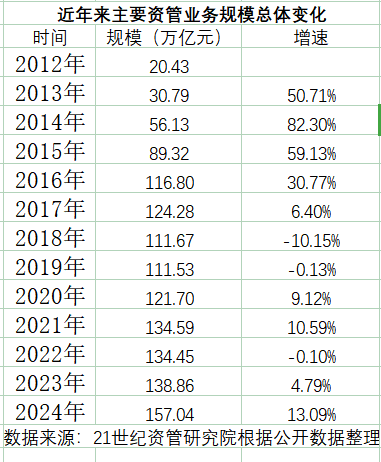
Core Insights - The asset management industry in China is experiencing significant growth, with a total scale reaching 157.04 trillion yuan by the end of 2024, marking a 13.09% increase from the previous year, the highest since the implementation of the new asset management regulations [6][8][12] - The growth is driven by a shift in investor behavior, as lower bank deposit rates and regulatory changes have led to a "financial disintermediation" effect, with substantial inflows into wealth management products, insurance, and public funds [1][6][9] Group 1: Historical Context and Regulatory Changes - The asset management industry has evolved significantly since the introduction of bank wealth management products in 2004, with key milestones including the rise of trust companies and the implementation of the new asset management regulations in 2018 [2][4] - The new regulations aimed to standardize the industry, eliminate shadow banking, and promote transparency, leading to a more compliant and structured asset management environment [2][4][9] Group 2: Growth by Sector - Trust companies saw the highest growth rate at 23.58%, with their scale approaching that of bank wealth management products, which grew by 11.75% [8][12] - Public funds and insurance asset management also experienced significant growth, with increases of 20.39% and 15.08% respectively, indicating a shift in market dynamics [8][12] - By the end of 2024, the asset management scale for various sectors was as follows: insurance at 33.26 trillion yuan (21.18%), public funds at 32.83 trillion yuan (20.91%), bank wealth management at 29.95 trillion yuan (19.07%), and trust at 29.56 trillion yuan (18.82%) [8][12] Group 3: Market Trends and Investor Behavior - The trend of "deposit migration" is evident, with investors moving funds from traditional bank deposits to higher-yielding wealth management products due to declining interest rates [6][9][16] - The asset allocation preferences of investors have shifted, with a notable increase in the proportion of investments in securities and a decrease in non-standard debt investments, reflecting a more cautious approach to risk [30][33] Group 4: Financial Performance and Revenue Trends - The revenue for trust companies increased to 940.36 billion yuan in 2024, although net profits saw a significant decline of 45.52% compared to the previous year, indicating challenges in profitability despite growth in asset scale [40] - Public funds experienced a decline in management fees due to regulatory changes and market conditions, with a notable shift towards passive investment strategies [41] - Bank wealth management products reported a decrease in annualized returns to 2.65% in 2024, highlighting the impact of the low-interest-rate environment on profitability [43]

150万亿大资管扫描:险资、公募破30万亿,信托业狂飙存隐忧
2 1 Shi Ji Jing Ji Bao Dao· 2025-07-31 13:35
Core Viewpoint - By the end of 2024, China's total asset management scale is expected to reach 150 trillion yuan, with significant growth across various asset management sectors, indicating a clear trend of "financial disintermediation" [1][6]. Group 1: Industry Overview - The asset management industry in China has evolved significantly since the introduction of bank wealth management products in 2004, with various regulatory changes shaping its development [2][4]. - The total asset management scale reached 157.04 trillion yuan by the end of 2024, marking a 13.09% increase from the previous year, the highest growth rate since the implementation of the new asset management regulations [6][8]. - The growth in asset management is driven by a shift in deposits towards wealth management products due to declining bank deposit rates and regulatory changes [15][14]. Group 2: Sector Performance - Trusts experienced the highest growth rate at 23.58%, with their scale approaching that of bank wealth management products, which grew by 11.75% [7][8]. - Public funds and insurance asset management also saw significant growth rates of 20.39% and 15.08%, respectively, indicating a shift in investor preferences [8][19]. - By the end of 2024, the asset management scale for insurance reached 33.26 trillion yuan, accounting for 21.18% of the total market, making it the largest segment [23][24]. Group 3: Regulatory Environment - The China Securities Regulatory Commission (CSRC) has been proactive in promoting high-quality development in the asset management industry, issuing multiple regulatory documents to enhance market stability and investor protection [4][5]. - The implementation of the new asset management regulations has led to a more standardized and transparent industry, with a focus on compliance and risk management [2][3]. Group 4: Financial Performance - The net profit of trust companies increased to 940.36 billion yuan in 2024, reflecting the growth in asset management scale, although the profit margin remains lower than pre-2021 levels [39]. - Public fund management fees decreased by over 8% in 2024 due to a shift towards lower-cost passive investment products, impacting overall revenue [40]. - The income from securities firms' asset management remained stable at 239.47 billion yuan in 2024, despite a significant decline in asset scale over recent years [41].
近一周8次发布巨额赎回公告,建信理财旗下15只固收类产品暂停赎回
Hua Xia Shi Bao· 2025-07-04 03:32
Core Viewpoint - Recently, Jianxin Wealth Management announced a suspension of redemption applications for eight fixed-income daily open-end products due to significant redemptions triggered on June 27, indicating a trend of large-scale redemptions in the wealth management sector [1][2]. Group 1: Redemption Events - Jianxin Wealth Management issued eight announcements regarding large-scale redemptions involving 15 products from June 26 to July 1, with multiple products triggering redemptions twice [2][4]. - The eight products that triggered large-scale redemptions are all fixed-income daily open-end products, including the Jiaxin series, Jianxinbao series, and Longbao series [2][3]. - Specific products such as Jianxinbao No. 11 and No. 20, Longbao No. 4 and No. 5, and Jiaxin (Stable Profit) No. 8 triggered large-scale redemptions on June 30 and July 1 [2]. Group 2: Market Context - Large-scale redemptions in wealth management products, while not common, have been observed in other institutions such as Huibin Wealth Management and Zhaoyin Wealth Management, indicating a broader trend in the industry [5][6]. - The occurrence of large-scale redemptions is often linked to underperformance of the products, low customer satisfaction, and the impact of new asset management regulations on old and new products [1][8]. Group 3: Redemption Mechanisms - The regulatory framework defines large-scale redemptions as those exceeding 10% of the total product shares on a single open day [2]. - Many wealth management products have "large-scale redemption clauses" that allow for the suspension of redemption applications or delays in the payment of redemption amounts to protect the stability of the product [6][7]. - The rationale behind these clauses is to prevent significant asset value fluctuations and ensure the stable operation of the products, thereby safeguarding investors' long-term interests [7].
中银理财因三项违规被罚1290万元,三年累计被罚两千万
Sou Hu Cai Jing· 2025-06-30 13:22
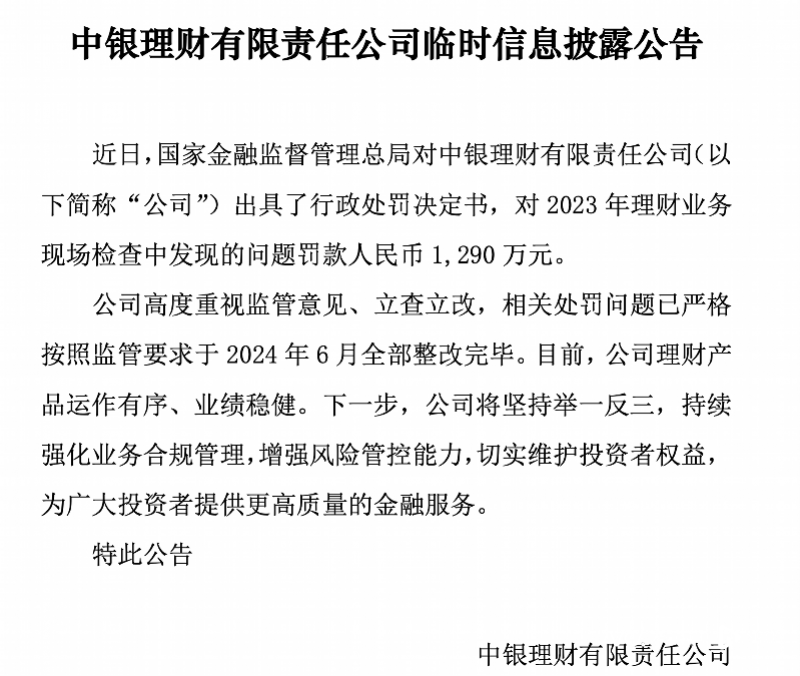
Core Viewpoint - Zhongyin Wealth Management has faced significant regulatory penalties, highlighting systemic compliance issues within the wealth management industry amid tightening financial regulations [1][4][7] Group 1: Regulatory Penalties - Zhongyin Wealth Management was fined 12.9 million yuan for three violations, marking its third penalty in three years, totaling 20 million yuan [1][4] - The violations included inadequate management of non-standard debt investments, non-compliance with investment concentration and liquidity requirements, and poor information registration management [4][6] - Previous penalties included 4.6 million yuan in May 2022 for exceeding investment concentration and leverage limits, and 2.5 million yuan in June 2024 for failing to effectively identify underlying assets [4][6] Group 2: Business Performance - Despite regulatory challenges, Zhongyin Wealth Management's product management scale reached 1.88 trillion yuan by the end of 2024, a 15.3% year-on-year increase, ranking third among state-owned wealth management subsidiaries [6] - The company's net profit for 2024 was 1.963 billion yuan, reflecting a 20.6% increase year-on-year, leading among its peers [6] Group 3: Industry Context - The regulatory environment has become increasingly stringent since the implementation of the Asset Management New Regulations in 2020, which aimed to eliminate implicit guarantees and promote net value management [7][8] - The total penalties for wealth management companies in 2024 reached 31.2 million yuan, with Zhongyin Wealth Management and another company alone exceeding 30 million yuan in the first half of 2025 [7] - Future regulatory focus is expected to shift towards information disclosure and consumer protection, indicating a transition from a phase of scale expansion to one of quality competition within the industry [8]
机构行为精讲系列之二:理财稳净值下的配债逻辑及行为变化
Huachuang Securities· 2025-06-26 23:45
Report Industry Investment Rating No information provided in the given content. Core Viewpoints of the Report The research on the regulatory framework, fund operation, bond - allocation behavior, and the latest characteristics of the bank wealth - management industry's development is of great reference value for bond - market trend analysis. The bank wealth - management sector currently faces challenges such as the rectification of net - value smoothing methods, difficulty in achieving performance benchmarks in a low - interest - rate environment, and potential shrinkage of small and medium - sized banks' wealth - management scale, which may affect bond - allocation preferences. The report also provides strategies for bond investment to respond to the institutional behavior changes of bank wealth - management [7]. Summary by Relevant Catalogs 1. Overview of Bank Wealth - Management Bond Allocation - As of the end of 2024, the bank wealth - management bond - allocation scale reached 18.6 trillion yuan, ranking third in the market and accounting for 10.5% of the 177 - trillion - yuan balance of China's bond - market custody. In recent years, affected by the redemption wave, the growth rate of bank wealth - management bond allocation first declined and then rebounded. Bank wealth - management prefers credit bonds and certificates of deposit in bond - allocation [1][13]. 2. Wealth - Management Regulatory Rules: A Multi - layer Regulatory Framework Led by the New Asset Management Regulations (1) Evolution of Wealth - Management Supervision - Since the introduction of the New Asset Management Regulations in 2018, a multi - layer regulatory framework of "New Asset Management Regulations - Wealth - Management Regulations and Wealth - Management Company Regulations + Supporting Rules for Wealth - Management Business Supervision + Valuation Methods + Window Guidance" has been formed. The New Asset Management Regulations initiated the era of net - value transformation, while the Wealth - Management Regulations and Wealth - Management Company Regulations carried out wealth - management business in a dual - track system [19]. (2) Regulatory Details of Bank Wealth - Management Product Investment and Operation - **Investment Scope**: Private - placement wealth management has a wider investment scope than public - placement wealth management, and public - placement wealth management can invest in non - standard assets and large - denomination certificates of deposit to increase returns compared with public - offering funds. There are also slight differences in supervision between commercial banks and wealth - management subsidiaries [25]. - **Investment Ratio**: The 80% investment ratio of major asset classes is the basis for product - type classification. The upper limit of non - standard asset investment is 35%. The liquidity - asset ratio requirement is similar to that of funds, and the credit - rating limit for cash - management products is in line with that of money - market funds. The concentration limit basically follows the requirements of the New Asset Management Regulations, with an exception clause for investment in index bond funds [2][30]. - **Leverage and Maturity Requirements**: The leverage requirements are the same as those of funds, with upper limits of 120%, 140%, and 200%. The maturity requirements aim to reduce the risk of maturity mismatch [2]. - **Valuation Method Requirements**: Specific products can use the amortized cost method, including cash - management wealth management and closed - end wealth management with the mixed - valuation method. The amortized cost method also needs to meet the requirements of the "Accounting Treatment Provisions for Asset Management Products". Market - value method requires the use of third - party valuation, and the means of smoothing net value have been gradually rectified [2]. 3. Bank Wealth - Management Operation: How to Respond to Net - Value Transformation? (1) Source of Funds - Since 2022, the wealth - management scale has gone through three stages: "fluctuating growth - redemption shrinkage - recovery growth". Individual investors are the main participants, preferring low - volatility and stable products. The proportion of parent - bank sales has been continuously declining [3][51]. (2) Asset Allocation - **Major Asset Allocation**: After the redemption wave in 2022, bank wealth - management increased the allocation of monetary assets and managed liquidity more through outsourced funds. The proportion of trust companies as the main outsourced channel increased due to their valuation advantages [3]. - **Bond - Asset Investment**: After the redemption wave, the bond - allocation scale of wealth management first shrank and then recovered. Currently, it is still mainly credit bonds, but the proportion of low - volatility inter - bank certificates of deposit is increasing. The proportion of outsourced investment has exceeded that of direct investment, showing the characteristics of "direct investment for stable net value and outsourced investment for higher returns" [3]. 4. New Developments: Challenges and Countermeasures for Bank Wealth - Management to Stabilize Net Value - **Challenge 1: Rectification of Wealth - Management Net - Value Smoothing Methods**: Since 2023, the proportion of wealth - management products with a net value below par has been generally controllable thanks to various net - value smoothing methods. However, since 2024, many smoothing methods have been rectified. In 2025, direct investment in bank wealth management increased capital lending and still controlled relatively short durations, while outsourced investment became more conservative [4][8]. - **Challenge 2: Difficulty in Achieving Wealth - Management Performance Benchmarks in a Low - Interest - Rate Bond Market**: In a tight - money environment, wealth management may increase lending and allocate more short - term bonds. In a low - interest - rate environment, it may increase the allocation of equity assets [4][8]. - **Challenge 3: Potential Shrinkage of Small and Medium - Sized Banks' Wealth - Management Scale**: According to news reports, the wealth - management scale of small and medium - sized banks may shrink, with the proposed rectification volume around 3.5 trillion yuan, accounting for about 12%. Wealth - management subsidiaries of large - state - owned banks may undertake the capital gap of small and medium - sized banks' wealth management, and the allocation demand for some inter - bank certificates of deposit and corporate bonds may shift to cash, bank deposits, and financial bonds [4][8]. 5. How Should Bond Investment Respond to the Institutional Behavior Changes of Wealth Management? - **Grasp the Seasonal Bond - Allocation Rules**: In April, July, and from October to November, there are usually opportunities for the credit spreads of 1 - year AAA inter - bank certificates of deposit and AAA short - and medium - term notes within 1 year to compress [5][8]. - **Track Redemption Waves**: Divide redemption waves into small - scale and large - scale ones according to the degree of negative feedback in the bond market. Use product net value, product scale, and spot - bond trading as the key indicators to track the redemption pressure of various products, and grasp the investment opportunities in redemption waves in different stages [5][9]. - **Pay Attention to Leading Indicators and Be Alert to the Risk of Wealth - Management Net - Value Fluctuation**: Observe whether the wealth - management safety cushion turns negative and whether the seasonal decline in wealth - management scale exceeds the fund - holding position. Before these situations occur, the risk of wealth - management net - value retracement is controllable [5][9].

不追逐短期浪花 寻求“确定性之锚”
Zhong Guo Zheng Quan Bao· 2025-06-24 21:17
Core Viewpoint - Hangyin Wealth Management aims to navigate the challenges of the financial market while providing clients with stable investment opportunities, emphasizing a philosophy of adaptability and innovation in a competitive landscape [1][2]. Group 1: Company Strategy and Competitive Advantages - The company focuses on a customer-centric approach, leveraging its geographical advantages, asset allocation, technological empowerment, product system, and channel development to build a competitive moat [2]. - Hangyin Wealth Management is deeply rooted in Zhejiang, benefiting from the region's strong wealth management demand and vibrant private economy, which supports its growth alongside clients' increasing wealth management needs [2][3]. - The company has established a dedicated technology investment department to engage in equity investments in tech startups, having facilitated direct equity financing for over 1,000 innovative companies [3]. Group 2: Product and Asset Management - The product structure is pyramid-shaped, with fixed-income products at the base, "fixed-income plus" and mixed products as the pillars, and private equity products for high-net-worth clients at the top [4]. - As of June 3, 2025, the company's product scale reached 5,016.29 billion, marking a 14.37% increase from the previous year [4]. - The average yield of the company's financial products in 2024 exceeded the market average, showcasing its effective asset management strategies [4][5]. Group 3: Technological Integration and Innovation - The company emphasizes the integration of technology and data across its operations, implementing a dual-center management model to enhance efficiency [6]. - Hangyin Wealth Management is actively exploring new technologies, including AI, to improve investment research, product management, and risk control [6][7]. - The company aims to leverage multi-asset allocation strategies to enhance the performance of its wealth management products in a low-interest-rate environment [7]. Group 4: Future Outlook and Market Trends - The bank's wealth management market is expected to expand, with a focus on multi-asset allocation strategies becoming crucial for product development [7]. - Regulatory support for capital market participation is anticipated to create opportunities for wealth management firms to increase equity investments [7][8]. - The company plans to continue exploring investment opportunities in bonds, equities, and alternative assets while maintaining a focus on risk management and client trust [8].
中国央行已与30多个国家和地区央行或货币当局签订双边本币互换协议
财联社· 2025-06-18 02:45
Group 1 - The People's Bank of China has signed bilateral currency swap agreements with over 30 countries and regions, becoming an important part of the global financial safety net [1] - China actively participates in the formulation and implementation of international financial regulatory standards and is one of the few economies to fully implement Basel III [1] - The regulatory framework for systemically important financial institutions has been established, with all major Chinese banks meeting total loss-absorbing capacity requirements [1] - A deposit insurance system has been established, providing full protection for over 99% of depositors [1] - The implementation of new asset management regulations has significantly reduced shadow banking risks [1] Group 2 - International financial organizations like the IMF and World Bank need to reform governance to reflect the relative positions of member countries in the global economy [2] - Emerging markets and developing countries have a significantly lower share and voting power in international financial organizations compared to their actual position in the global economy [2] - The international community should address the unilateral policies of certain member countries that interfere with the governance and operation of international financial organizations [2] - There is a need to enhance the voice and representation of emerging markets and developing countries to uphold true multilateralism and improve governance efficiency [2] Group 3 - The traditional cross-border payment system has faced increasing challenges, leading to a global call for improvements [3] - New payment infrastructures and settlement methods are emerging, driving the development of a more efficient, secure, inclusive, and diverse global cross-border payment system [3] - China has established a multi-channel and widely covered cross-border payment and clearing network for the renminbi after over a decade of development [3]

潘功胜:目前人民银行与30多个国家和地区央行或货币当局签订双边本币互换协议
Xin Lang Cai Jing· 2025-06-18 02:10
Core Viewpoint - The People's Bank of China emphasizes the importance of a multi-layered global financial safety net and the enhancement of regulatory frameworks to prevent and mitigate financial crises [1] Global Financial Safety Net - The international community relied on the IMF-led global financial safety net for crisis management before the 2008 financial crisis, which has since been strengthened [1] - The IMF has enhanced its crisis response capabilities, expanded its policy oversight functions, and broadened the scope of its monitoring [1] - Regional financial stability has been supported by the establishment of funds such as the European Stability Fund, Latin American Reserve Fund, Chiang Mai Initiative, and Arab Monetary Fund [1] - Major developed economies' central banks, including the Federal Reserve and the European Central Bank, have utilized currency swap mechanisms to inject liquidity during crises [1] - The People's Bank of China has signed bilateral currency swap agreements with over 30 countries and regions, contributing to the global financial safety net [1] Regulatory Framework Enhancements - China actively participates in the formulation and implementation of international financial regulatory standards and is one of the few economies to fully implement Basel III [1] - A regulatory framework for systemically important financial institutions has been established, with all major Chinese banks meeting total loss-absorbing capacity requirements [1] - A deposit insurance system has been implemented, providing full protection for over 99% of depositors [1] - The new asset management regulations have significantly reduced risks associated with shadow banking [1] Key Pathways for Crisis Prevention - The establishment of a diverse and efficient global financial safety net centered around a strong IMF is crucial for crisis prevention and resolution [1] - Maintaining consistency and authority in global financial regulatory rules is essential for effective crisis management [1]
《生态跃迁》摘录 | 标品信托规模大幅增长,还能延续吗?
华宝财富魔方· 2025-06-12 11:30
Core Viewpoint - The significant increase in the scale of standard trust products is driven by both the accelerated transformation of the industry and the flexibility advantages of standard trust products, alongside the performance of the bond market [1][2]. Group 1: Scale Growth Driven by "Borrowing Path" - The growth in scale due to the "borrowing path" has lost its momentum as regulatory measures have been implemented to eliminate institutional arbitrage and fill regulatory gaps [2][3]. - The lack of specific regulatory guidelines for standard trust products allows for greater operational flexibility compared to public funds and bank wealth management products, attracting significant capital inflows, particularly from low-risk preference bank wealth management funds [2][3]. - The collaboration between bank wealth management and trust companies has led to a win-win situation, where bank products achieve stable net values while trust companies earn channel fees and increase their scale [2][3]. Group 2: Risks Associated with "Borrowing Path" - The "borrowing path" presents significant risks that are accumulating rapidly, prompting regulatory scrutiny [3][4]. - Issues such as inappropriate use of smoothing mechanisms and trading risk assets between different wealth management products can lead to mismatched risks and potential losses for investors [4][5]. - Regulatory interventions aim to address these risks, ensuring compliance and protecting investors from unfair practices [6][9]. Group 3: Scale Growth Driven by Strong Performance - The increase in the scale of standard trust products is also attributed to the accelerated transformation of trust companies towards standard trust products and the favorable bond market conditions in 2024 [13][14]. - Trust companies are leveraging their experience in the municipal investment sector to enhance their bond investment strategies, leading to higher-than-average returns in their standard trust products [14][15]. - The current low-risk yield environment and the preference for low-volatility bonds have further contributed to the influx of capital into standard trust products, achieving historical highs in industry scale [15]. Group 4: Regulatory Landscape and Future Outlook - Regulatory measures are focused on eliminating institutional arbitrage and ensuring fair competition among asset management institutions, which is essential for guiding them back to their investment roots [10][11]. - The future challenges for trust companies include finding new business opportunities in a declining yield environment and enhancing their active investment management capabilities [15][16]. - The ongoing regulatory efforts aim to protect investors and promote a better understanding of risk-return characteristics in fixed-income products, fostering a mature capital market [10][11].

《生态跃迁》摘录 | 标品信托规模大幅增长,还能延续吗?
华宝财富魔方· 2025-06-11 13:04
Core Viewpoint - The significant increase in the scale of standard trust products is driven by both the accelerated transformation of the trust industry and the flexibility advantages of standard trust products, alongside favorable conditions in the bond market [1][2]. Group 1: Scale Growth Driven by "Borrowing Path" - The growth in scale has lost its momentum due to regulatory measures aimed at eliminating institutional arbitrage and ensuring fair competition among financial sub-industries [2][3]. - The lack of specific regulatory guidelines for standard trust products allows for greater operational flexibility compared to public funds and bank wealth management products, attracting significant capital inflow, particularly from low-risk preference bank wealth management funds [2][3]. - The collaboration between trust companies and wealth management firms has led to a reliance on smoothing mechanisms to adjust product yields, which may pose risks to investors and the overall market [3][4]. Group 2: Risks and Regulatory Attention - Regulatory bodies have issued notifications to strengthen compliance management regarding the cooperation between trust companies and wealth management firms, focusing on issues such as improper use of smoothing mechanisms and risk asset transactions [3][4]. - Investors may face mismatched risk exposure and potential losses due to the improper adjustment of yields between different wealth management products [4][5]. - The regulatory focus aims to prevent liquidity risks and ensure that the actual risks of products are accurately reflected, protecting investors from misleading risk perceptions [6][10]. Group 3: Performance-Driven Scale Increase - The increase in the scale of standard trust products is also attributed to the accelerated transformation of trust companies towards standard trust products and the strong performance of the bond market in 2024 [13][14]. - Trust companies are leveraging their experience in the municipal investment sector to enhance their bond investment strategies, leading to higher-than-average returns in their standard trust products [14][15]. - The current low-risk yield environment and the preference for low-volatility bonds have further driven capital into standard trust products, contributing to record-high industry scales [15]. Group 4: Future Outlook - The ability to sustain growth in scale driven by performance may become challenging as the bond market experiences lower absolute yields and reduced credit spreads [15]. - Trust companies may need to diversify their asset allocation strategies to seek stable long-term returns, which poses a challenge for their management capabilities [15][16]. - The ongoing regulatory efforts to eliminate arbitrage opportunities and ensure fair competition will likely shape the future landscape of the asset management industry [10][11].