
人工智能(AI)

Search documents
碳酸锂目标价18000美元!摩根大通对锂价极为乐观,上调所有纯锂矿商评级至“增持”
Hua Er Jie Jian Wen· 2025-12-18 02:42
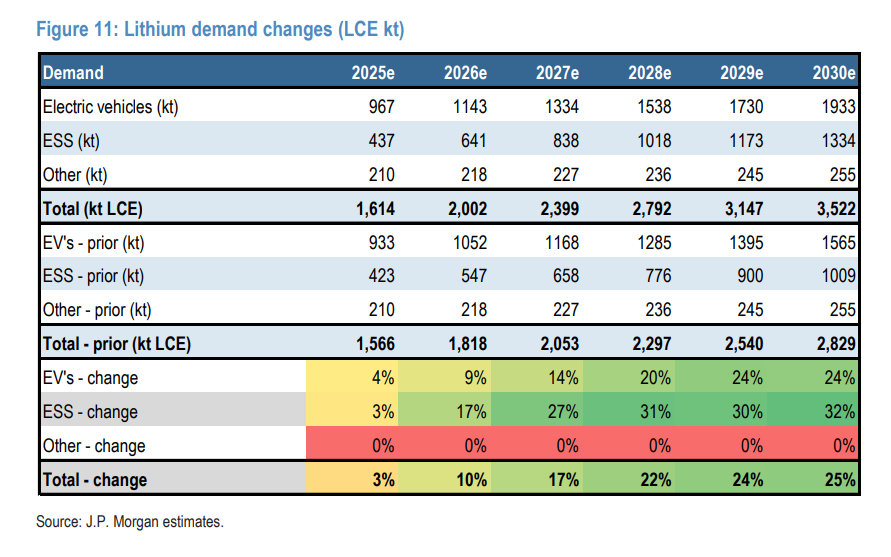
Core Viewpoint - The lithium market is facing a more severe supply shortage than previously anticipated due to a surge in demand, leading to significant price increases for lithium carbonate and spodumene [1][7][8]. Demand Dynamics - The growth in lithium demand is primarily driven by energy storage systems (ESS) and electric commercial vehicles (CV), with forecasts for global ESS production in 2026 raised by 17% to 900 GWh, and a projected increase in ESS's share of total lithium carbonate equivalent (LCE) demand from 32% in 2026 to 38% by 2030 [2][3]. - The demand for electric vehicle (EV) batteries, particularly in the commercial vehicle sector, has been significantly revised upwards, with projections for battery demand from 2026 to 2030 increased by 4% to 22% [2][3]. Supply Constraints - Despite anticipated supply growth from regions like China, Africa, and Australia, the report emphasizes that the response from the supply side is lagging behind the rapid demand increase, with supply expected to grow only 7% in 2026 and 14%-18% from 2027 to 2030 [6]. Price Forecast Adjustments - The supply-demand imbalance is projected to create a shortfall of 4% to 7% of total demand in the mid-term, necessitating higher prices to stimulate new supply [7]. - Price forecasts for lithium carbonate have been raised to $18,000 per ton and for spodumene to $2,000 per ton, reflecting the tightening market conditions [8][10]. Stock Ratings and Price Targets - Following the optimistic outlook for lithium prices, JPMorgan has upgraded all pure lithium mining stocks to "Overweight" and raised their price targets significantly, indicating substantial upside potential for these stocks [1][10].

银河期货每日早盘观察-20251218
Yin He Qi Huo· 2025-12-18 02:14
期 货 眼 ·日 迹 每日早盘观察 银河期货研究所 2025 年 12 月 18 日 0 / 51 研究所 期货眼·日迹 | 股指期货:反弹再受美股情绪影响 4 | | --- | | 国债期货:博弈反弹行情 5 | | 蛋白粕:供应压力较大 | 盘面继续承压 6 | | --- | --- | | 白糖:国际糖价小幅下跌 | 郑糖大跌后调整 6 | | 油脂板块:棕榈油技术性反弹,油脂整体仍处于底部震荡 8 | | | 玉米/玉米淀粉:现货回落,盘面底部震荡 9 | | | 生猪:供应压力好转 | 现货小幅反弹 10 | | 花生:花生现货回落,花生盘面窄幅震荡 10 | | | 鸡蛋:需求表现一般 | 蛋价稳定为主 11 | | 苹果:需求表现一般 | 果价稳定为主 12 | | 棉花-棉纱:新棉销售较好 | 棉价震荡偏强 13 | | 钢材:原料止跌企稳,钢价触底反弹 15 | | --- | | 双焦:波动加大,关注交易逻辑的变化 15 | | 铁矿:市场预期反复,矿价震荡运行 16 | | 铁合金:成本有支撑,需求存压制 17 | | 金银:美联储释放鸽派信号 再现金稳银强走势 18 | | --- ...
吴恩达:AI 时代,求职机会换方向了
3 6 Ke· 2025-12-18 01:21
技术在指数级加速,但岗位机会没有同步增长。 为什么会这样?机会流向了哪里?在这个转折点上,什么样的人能抓住新机会? 这篇文章,我们从这堂课出发,回答四个问题: 第一节 | 不是岗位少了,是方向变了 2025 年的毕业生,正面对一个规则变了的求职市场。 2025 年 11 月,美国失业率升至 4.6 %,创近四年新高;中国城镇失业率为5.1%,青年失业率(16-24 岁,不含在校生)持续高位。同时,应届毕业生规模创纪录:2025 届 1222 万,2026 届预计 1270 万。 但与过去不同,这次不是岗位总量在减少,而是机会的流向变了。 就在昨天(12月17日),吴恩达一个月前在斯坦福的内部讲座视频才公开。11 月 18 日的 AI 课堂上, 他用两组数据解释了这个变化: 2025年,AI 让写程序变得前所未有地快。但这并不意味着工程师更吃香了,恰恰相反,许多人的工作 变得更容易被替代。 吴恩达在课堂上说了一句话: 模型可以帮你写出正确的代码,但它不会告诉你,这段代码要去解决什么问题。 这句话点出了关键:现在大多数岗位的分工逻辑已经变了。 不是谁更懂技术,而是谁先把问题定义清楚。 以往,一个产品从想法落地,需 ...
美股全线下跌,纳指跌超400点!英伟达市值蒸发超1600亿美元,甲骨文跌超5%,博通跌超4%!美封锁委内瑞拉油轮,原油大涨
Mei Ri Jing Ji Xin Wen· 2025-12-18 00:18
Market Overview - On December 17, US stock indices collectively declined, with the Dow Jones down 0.47%, the Nasdaq falling 418.14 points (1.81%), and the S&P 500 decreasing by 1.16% [1] - Major tech stocks experienced significant drops, including Tesla and Broadcom falling over 4%, Google down over 3%, and Meta and Apple down over 1% [2] Company-Specific Developments - Oracle faced a setback in its ambitious AI infrastructure expansion plan as its largest data center partner, Blue Owl Capital, decided to withdraw support for a $10 billion data center project. However, Oracle stated that negotiations for the project are still proceeding as planned [2] - Nvidia's stock dropped 3.81%, resulting in a market value loss of $164.8 billion (approximately 1160.8 billion RMB) [4] - Medline Inc. had a successful IPO, with shares rising 41.38% on the first day to $41, after pricing at $29, raising $6.26 billion [6][5] Sector Performance - The energy sector saw gains, with ConocoPhillips rising over 4% and ExxonMobil and BP increasing by over 2% [2] - The semiconductor and computer hardware sectors faced significant declines, with companies like AMD and Arm dropping over 5% [2] Geopolitical and Economic Factors - Geopolitical risks, particularly related to Venezuela, have influenced market dynamics, with the price of WTI crude oil increasing by 3% to $56.8 per barrel [7] - The Federal Reserve's stance on interest rates remains cautious, with officials indicating potential for gradual rate cuts amid concerns about the labor market [13]





Micron Technology(MU) - 2026 Q1 - Earnings Call Transcript
2025-12-18 00:02
Financial Data and Key Metrics Changes - The company reported a 20% bit shipment growth in fiscal 2026, driven by efficiencies in existing fabs and node transitions [7][8] - Gross margin reached 68%, with expectations for gradual increases in the future due to strong demand and operational efficiencies [25][28] - Free cash flow margin was near 30% in the first quarter, with plans to increase free cash flow throughout the year [52][70] Business Line Data and Key Metrics Changes - DRAM pricing increased by 20% sequentially, while NAND pricing also saw significant growth [13][22] - The attach rate for high-capacity SSDs in AI servers is growing, with Micron leading in QLC workloads [19][20] - SSD business exceeded $1 billion in the first quarter of 2026, with expectations for accelerated growth as supply chain issues are resolved [22] Market Data and Key Metrics Changes - Demand for both DRAM and NAND is substantially higher than supply, affecting all segments [14][15] - The company is experiencing a mismatch between supply and demand across all market segments, particularly in data centers [15][16] Company Strategy and Development Direction - The company is focusing on diversifying its business across segments while prioritizing strategic customers [15][16] - There is a shift towards data center products, with an emphasis on higher ROI segments [56] - The company plans to double construction CapEx from fiscal 2025 to 2026, indicating a strong commitment to expanding capacity [47][76] Management's Comments on Operating Environment and Future Outlook - Management noted that the demand environment is expected to remain strong, with significant unmet demand across all segments [30][31] - The company is confident in its ability to sustain or expand margins due to favorable market conditions and operational efficiencies [28][70] Other Important Information - The company paid down $2.7 billion of debt in the first quarter and returned to a net cash position [52][70] - CapEx as a percentage of sales is expected to be in the mid-20s for the second quarter, down from below 35% in the first quarter [51] Q&A Session Summary Question: Bit shipments of DRAM and guidance for NAND and Flash - The company achieved a slight increase in bit shipments of DRAM and expects more growth in the second quarter, primarily driven by price [6][8] Question: DRAM pricing and capacity allocation - The company is unable to meet the demand for both conventional DRAM and HBM due to supply constraints, with a focus on strategic customer relationships [14][15] Question: Future gross margin expectations - Management indicated that gross margins could increase gradually, supported by strong demand and operational efficiencies [25][28] Question: HBM production and flexibility - The company is sold out for HBM, with significant unmet demand, and any increases in supply will not significantly impact overall demand [30][31] Question: CapEx breakdown and trends - The company plans to increase construction CapEx significantly, with a focus on expanding capacity in various locations [47][76] Question: Allocation decisions across markets - The company faces challenges in balancing allocation across different markets, ensuring support for strategic customers while optimizing for gross margin [66][68]

突发!AI巨头互相拆台集体杀跌
Wind万得· 2025-12-17 23:47
Core Viewpoint - The article discusses the recent decline in the U.S. stock market, particularly focusing on the sell-off of AI-related stocks and the shift towards more defensive sectors due to concerns over the sustainability of AI infrastructure investments [1][4]. Market Performance - On Wednesday, the S&P 500 index fell by 1.16% to 6721.43 points, the Nasdaq Composite dropped by 1.81% to 22693.32 points, and the Dow Jones Industrial Average decreased by 0.47% to 47885.97 points, marking the fourth consecutive day of decline for both the S&P 500 and Dow [1][2]. Oracle's Financing Issues - Oracle's stock price dropped approximately 5% following reports of financing issues related to a $10 billion data center project in Michigan, primarily due to concerns from Blue Owl Capital regarding Oracle's debt levels and capital expenditure intensity [2][7]. - Despite Oracle's denial of the reports and claims that the project is still progressing, investor concerns about the return on AI infrastructure investments and financing sustainability remain [2][7]. AI Sector Impact - The decline in Oracle's stock has led to a broader sell-off in AI-related stocks, with companies like Broadcom, NVIDIA, AMD, and Alphabet experiencing significant drops in their stock prices [4][10]. - The market is witnessing a shift from large growth stocks to large value stocks, as investors prepare for potential uncertainties in the coming year [4][5]. Financial Concerns - Oracle's total liabilities, including operating lease liabilities, have exceeded $124 billion, raising concerns about its financial flexibility and long-term return prospects [10]. - The company's commitments for data center and cloud computing-related leases have surged to $248 billion, a 148% increase from August levels, further intensifying investor scrutiny [9][10]. Future Outlook - Analysts suggest that the rotation from overvalued assets to more reasonably priced sectors may continue until 2026, potentially increasing market volatility [5]. - The key to determining the value of AI investments will increasingly focus on hard metrics like free cash flow, as opposed to more flexible financial indicators [5].

台积电日本熊本厂深陷亏损泥潭
Huan Qiu Wang Zi Xun· 2025-12-17 23:26
Core Viewpoint - TSMC's performance in 2025 is projected to reach NT$3.7 trillion, driven by strong demand for AI, but concerns arise over the ongoing losses at its Kumamoto plant in Japan due to low capacity utilization and market challenges [1][2] Group 1: TSMC's Financial Outlook - TSMC's projected revenue for 2025 is NT$3.7 trillion, reflecting optimism in the AI sector [1] - The company has faced significant losses at its Kumamoto plant, which has raised concerns among stakeholders [1][2] Group 2: Challenges at Kumamoto Plant - The Kumamoto plant's capacity utilization is reportedly low, with ongoing losses attributed to reduced demand for automotive chips from Japanese manufacturers [2] - The plant's 28nm process is particularly affected, leading to a capacity utilization rate of approximately 50% [3] - TSMC is considering changing the planned production from 6nm to 2nm at the Kumamoto plant to address the ongoing losses, which would significantly increase investment costs from over US$10 billion to over US$25 billion [3] Group 3: Market Dynamics - The rise of mature process technology in mainland China has impacted TSMC's mature process capacity utilization, with reports indicating that the advanced 6nm process in Taiwan has also seen a decline to 60-70% utilization [2] - The Japanese automotive market's sluggish recovery has further exacerbated the challenges faced by TSMC's Kumamoto plant [3] Group 4: Government and Investment Considerations - The success of the 2nm process at the Kumamoto plant hinges on whether the Japanese government will provide additional subsidies [3] - TSMC's financial performance in the U.S. has also been under scrutiny, with significant losses reported at its Arizona facility since its establishment [3]

甲骨文重燃AI担忧压垮美股!百亿美元数据中心融资受阻,Blue Owl退出,公司称交易仍按计划进行
美股IPO· 2025-12-17 22:52
Core Viewpoint - Oracle's ambitious AI infrastructure expansion faces significant setbacks as its major data center partner, Blue Owl Capital, withdraws from a $10 billion project, raising concerns about funding and execution risks [3][12][20]. Group 1: Project Details - Blue Owl was in discussions to invest in a planned 1 GW data center in Saline Township, Michigan, intended to support OpenAI [3][12]. - The project was expected to provide substantial computing power as part of a $300 billion agreement between Oracle and OpenAI [13][21]. - The withdrawal of Blue Owl leaves the project's funding uncertain, with Blackstone negotiating as a potential financial partner but no agreements signed yet [3][12]. Group 2: Financial Implications - Oracle's net debt, including lease obligations, has risen to approximately $105 billion, up from nearly $78 billion a year ago, with projections suggesting it could reach around $290 billion by 2028 [12][20]. - The tightening of financing terms and rising debt levels have led lenders to impose stricter conditions, making the project less financially attractive for Blue Owl [12][20]. - Oracle's stock has dropped over 40% from its September peak, with a recent decline of 5.4% following the news of Blue Owl's exit [4][8]. Group 3: Market Reactions - The news of Blue Owl's withdrawal has negatively impacted Oracle's stock and the broader tech sector, highlighting potential risks in the AI infrastructure funding chain [4][20]. - Oracle's five-year credit default swap (CDS) reached 155.27 basis points, the highest since January 2009, indicating increased market concerns about its financial stability [11][12]. Group 4: Execution Risks - Concerns about project delays due to execution risks were a factor in Blue Owl's decision to withdraw, as the project has faced challenges since its initiation [13][14]. - Local government issues, including initial re-zoning refusals, have complicated the project's timeline, raising further investor apprehensions [13][14]. Group 5: Future Outlook - The withdrawal of Blue Owl raises questions about the sustainability of the AI investment cycle, particularly if private credit markets begin to withdraw support for such projects [20]. - Oracle is currently in talks with multiple U.S. banks to secure $38 billion in debt financing to address the funding gap created by Blue Owl's exit [21].

Micron Technology(MU) - 2026 Q1 - Earnings Call Transcript
2025-12-17 22:30
Financial Data and Key Metrics Changes - Micron reported total fiscal Q1 revenue of $13.6 billion, up 21% sequentially and 57% year over year, marking a quarterly record for the third consecutive quarter [20] - Fiscal Q1 DRAM revenue reached a record $10.8 billion, up 69% year over year and 20% sequentially, representing 79% of total revenue [20][21] - Fiscal Q1 NAND revenue was a record $2.7 billion, up 22% year over year and sequentially, accounting for 20% of total revenue [21][22] - Consolidated gross margin for fiscal Q1 was 56.8%, up 11 percentage points sequentially, driven by higher pricing and strong cost execution [22] - Non-GAAP diluted earnings per share in fiscal Q1 was $4.78, reflecting 58% sequential growth and 167% year-over-year growth [24] Business Line Data and Key Metrics Changes - Cloud memory business unit revenue was a record $5.3 billion, representing 39% of total revenue, up 16% sequentially [22] - Core data center business unit revenue reached a record $2.4 billion, up 51% sequentially, representing 17% of total revenue [23] - Mobile and client business unit revenue was a record $4.3 billion, up 13% sequentially, representing 31% of total revenue [23] - Automotive and embedded business unit revenue was a record $1.7 billion, up 20% sequentially, representing 13% of total revenue [23] Market Data and Key Metrics Changes - Server unit demand is expected to grow in the high teens percentage range for calendar 2025, higher than previous expectations [10] - PC unit sales are forecasted to grow in the high single-digit percentage range for calendar 2025, above prior expectations [12] - Smartphone unit volumes are on track to grow in the low single-digit percentage range for calendar 2025 [12] - The aggregate industry supply is expected to remain substantially short of demand for the foreseeable future, with DRAM and NAND bit demand growth expectations revised higher [16][17] Company Strategy and Development Direction - Micron is focused on maximizing production output and ramping industry-leading technology nodes while investing in new cleanroom space to enhance supply capability [6][18] - The company anticipates substantial new records in revenue, gross margin, EPS, and free cash flow for both the second quarter and the full fiscal year 2026 [6] - Micron plans to increase fiscal 2026 capital expenditures to approximately $20 billion, primarily to support HBM supply capability and 1-gamma supply [17][18] Management's Comments on Operating Environment and Future Outlook - Management highlighted that AI-driven demand is accelerating, with significant growth in data center capacity driving demand for high-performance memory [9][10] - The company expects tight market conditions to persist beyond calendar 2026 due to sustained strong industry demand and supply constraints [6][16] - Management expressed confidence in Micron's competitive position, emphasizing technology leadership and a differentiated product portfolio [6][7] Other Important Information - Micron generated record free cash flow of $3.9 billion in fiscal Q1, exceeding the previous record from fiscal Q4 2018 by over 20% [25] - The company reduced debt by $2.7 billion during the quarter, closing with $11.8 billion of debt and a net cash balance of over $250 million [25][26] - Over 80% of Micron's professional workforce actively uses GenAI, significantly enhancing productivity across various functions [26] Q&A Session Summary Question: Long-term agreements with customers - Management discussed ongoing discussions for multi-year contracts with key customers, emphasizing stronger contract structures compared to previous agreements [31] Question: Capital expenditures and intensity - Management confirmed an increase in capital expenditures to $20 billion for fiscal 2026, with a focus on supporting DRAM and HBM supply [32][34] Question: Supply constraints and cleanroom space - Management acknowledged supply constraints and the need for cleanroom space, emphasizing efforts to maximize production efficiency within existing facilities [35][36] Question: HBM market share and competitive positioning - Management expressed confidence in Micron's competitive position, highlighting strong performance and low power consumption of HBM products [46][47] Question: Pricing dynamics for HBM - Management confirmed that HBM for 2026 is sold out in terms of volume, with completed negotiations for pricing, ensuring strong profitability [56]
业绩与规模齐升 AI成私募量化发展“必选项”
Zhong Guo Zheng Quan Bao· 2025-12-17 20:17
Core Insights - The quantitative private equity industry is experiencing a comprehensive recovery in 2025, driven by active trading volumes, structural market trends, and the influence of technology growth, particularly artificial intelligence (AI) [1] - The industry anticipates that 2026 will present both opportunities and challenges, with a focus on the need for diversification and enhanced internal capabilities [3] Performance and Scale - As of November 2025, the average excess return of stock quantitative long products in the market reached 17.25%, with over 90% of products achieving positive excess returns [1] - The increase in trading volume and liquidity in the A-share market has provided a solid foundation for quantitative strategies to generate excess returns [1] - Leading managers with comprehensive research teams and broad signal coverage are expected to deliver more stable excess returns, while smaller managers may excel in specific market conditions [1] Fundraising Trends - The fundraising environment is showing signs of recovery, characterized by a rational and concentrated approach, with investors favoring institutions that demonstrate long-term performance, transparent risk control, and strong drawdown management [2] - There is a growing preference for multi-strategy quantitative products as a one-stop solution for fund allocation [2] AI Empowerment - AI technology has transitioned from an optional tool to a necessary component for competitive advantage in quantitative investing [2] - AI applications are now deeply integrated into critical processes such as data cleaning, factor extraction, and trade execution optimization, significantly enhancing research efficiency [2][3] Strategic Diversification - The industry faces challenges such as strategy homogenization and intensified competition for excess returns, prompting firms to prioritize diversification and internal capability enhancement [3] - Firms are shifting focus towards multi-strategy and multi-frequency collaboration to adapt to market cycles, with an emphasis on low-correlation revenue sources [3] Infrastructure and Talent Development - The competition for computational infrastructure and top talent remains crucial, with firms emphasizing the importance of research efficiency and system architecture [4] - Investor relations and service systems are gaining increased importance, with firms expected to engage more proactively with investors to build stable long-term relationships [4]