去美元化

Search documents
黄金概念涨停潮!板块暴涨3.29%,中国黄金4连板,湖南黄金3连板,金价破5200美元创历史新高
Jin Rong Jie· 2026-01-28 02:04
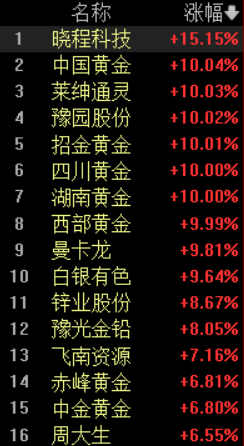
早盘,黄金概念板块持续上涨,晓程科技涨15.15%领涨,板块内中国黄金、莱绅通灵、豫园股份、招金黄金、四川黄金、湖南黄金、西部黄金等7只个股涨 停,曼卡龙、白银有色、锌业股份、豫光金铅等涨超8%。 | | 名称 | 涨幅+ | | --- | --- | --- | | | 晓程科技 | +15.15% | | 2 | 中国黄金 | +10.04% | | 3 | 莱绅通灵 | +10.03% | | 4 | 豫园股份 | +10.02% | | 5 | 招金黄金 | +10.01% | | 6 | 四川黄金 | +10.00% | | 7 | 湖南黄金 | +10.00% | | 8 | 西部黄金 | +9.99% | | 9 | 曼卡龙 | +9.81% | | 10 | 白银有色 | +9.64% | | 11 | 锌业股份 | +8.67% | | 12 | 豫光金铅 | +8.05% | | 13 | 飞南资源 | +7.16% | | 14 | 赤峰黄金 | +6.81% | | 15 | 中金黄金 | +6.80% | | 16 | 周大生 | +6.55% | 当前黄金概念的炒作核心在于黄金金 ...


宝城期货贵金属有色早报(2026年1月28日)-20260128
Bao Cheng Qi Huo· 2026-01-28 01:58
投资咨询业务资格:证监许可【2011】1778 号 宝城期货贵金属有色早报(2026 年 1 月 28 日) ◼ 品种观点参考 时间周期说明:短期为一周以内、中期为两周至一月 | 品种 | | 短期 | 中期 | 日内 | 观点参考 | 核心逻辑概要 | | --- | --- | --- | --- | --- | --- | --- | | 黄金 | 2604 | 震荡 | 强势 | 强势 | 观望 | 高位波动加剧,短期资金获利了 结意愿强 | | 铜 | 2603 | 震荡 | 强势 | 弱势 | 观望 | 强预期弱现实 | 说明: 1.有夜盘的品种以夜盘收盘价为起始价格,无夜盘的品种以昨日收盘价为起始价格,当日日盘收盘价为终点价格, 计算涨跌幅度。 主要品种价格行情驱动逻辑—商品期货 品种:黄金(AU) 2.跌幅大于 1%为弱势,跌幅 0~1%为震荡偏弱,涨幅 0~1%为震荡偏强,涨幅大于 1%为强势。 3.震荡偏强/偏弱只针对日内观点,短期和中期不做区分。 专业研究·创造价值 1 / 3 请务必阅读文末免责条款 期货研究报告 日内观点:强势 中期观点:强势 参考观点:观望 核心逻辑:昨日夜盘纽约金 ...
广发早知道:汇总版-20260128
Guang Fa Qi Huo· 2026-01-28 01:25
Report Industry Investment Rating No relevant content provided. Core Viewpoints of the Report - The overall market shows a complex and diversified trend, with different sectors having their own characteristics and influencing factors. For example, in the financial derivatives market, stock index futures are in a state of wide - based index range - bound and theme - industry structural upward movement, while bond futures are in a shock pattern; in the commodity futures market, different varieties such as metals, agricultural products, and energy chemicals have different supply - demand relationships and price trends [7][10]. Summary by Directory Daily Selections - **Zinc**: Overseas smelting costs have increased due to the rise in natural gas prices in Europe and the United States. The shortage of zinc ore supports prices, and the supply pressure of refined zinc has been relieved. The demand side has improved, and the global zinc ingot inventory pressure is limited. Zinc prices are expected to be strong in the short term, with support at around 24,000 yuan, and a long - term long - at - low strategy is recommended [2][31]. - **Methanol**: Affected by geopolitical factors, the price is in a strong shock, and the basis is weak. The market is in a situation of both weak supply and demand. The inventory in inland factories has decreased, but high production restricts the rebound space. The inventory accumulation in ports is low, but the weak MTO demand suppresses the price rebound. It is recommended to take profit on long positions when geopolitical tensions ease [3][100]. - **Iron Ore**: The supply is in the off - season, and the port inventory continues to accumulate. The iron ore price is under pressure due to factors such as the reversal of support factors, the lower - than - expected resumption of pig iron production, and the gradual fulfillment of steel mill restocking. It is recommended to short at around 800 yuan [3][52]. - **Palm Oil**: It may try to break through 9,300 yuan. The market should pay attention to the impact of inventory changes on the disk trend. Domestically, Dalian palm oil futures are strongly influenced by the rise of Malaysian palm oil [4][79]. - **Gold**: The continuous weakening of the US dollar drives the gold price to a new high. The long - term upward space of the gold price is supported by factors such as the slowdown of employment and inflation in the United States, the long - term easing expectation, trade frictions, and geopolitical risks. It is recommended to take profit on long positions at high prices and buy out - of - the - money call options [5][15]. Stock Index Futures - **Market Conditions**: On Tuesday, the major indices showed a trend of decline in the morning and a slight recovery in the afternoon. The TMT sector was strong, while the dividend sector retreated. Among the four major stock index futures contracts, IC2603 and IM2603 rose slightly, and IF2603 and IH2603 remained stable. The basis of IF2603 and IH2603 showed an obvious premium trend, while the discount of IC2603 and IM2603 continued to be repaired [7][8]. - **News**: Domestically, the UK Prime Minister will visit China, and the two sides will strengthen economic and trade cooperation. Overseas, the US may raise tariffs on South Korean products. The A - share market trading volume decreased slightly, and the central bank carried out reverse repurchase operations with a net investment of 78 billion yuan [8][9]. - **Operation Suggestions**: Although some theme industries are strong, there is a large outflow of funds from broad - based ETFs, and the market trading divergence is large. It is recommended to control portfolio risks, reduce long positions in a timely manner, and try to buy both calls and puts to bet on increased volatility [9]. Treasury Bond Futures - **Market Performance**: Most treasury bond futures closed flat, with the 30 - year main contract falling 0.33%. The yields of major interest - rate bonds in the inter - bank market generally rose [10]. - **Funding Situation**: The central bank carried out 402 billion yuan of 7 - day reverse repurchase operations, with a net investment of 78 billion yuan. The funding situation in the inter - bank market has improved, but there may be a phased convergence at the end of January to before the Spring Festival [11]. - **Operation Suggestions**: The bond market is still in a shock pattern. The short - term probability of reserve requirement ratio and interest rate cuts is low, and the bond market lacks a new driving force. It is recommended to operate within the range, pay attention to the positive arbitrage of TL and T contracts, and the strategy of widening the basis [11]. Precious Metals - **Market Review**: Geopolitical conflicts and other factors have led to the weakening of the US dollar index. Gold reached a new high, silver rose after a sharp rise and fall, and platinum and palladium fluctuated and weakened [14]. - **Outlook**: The long - term upward space of the gold price is supported by factors such as the slowdown of employment and inflation in the United States, the long - term easing expectation, trade frictions, and geopolitical risks. For silver, the demand in the industrial field may be affected by cost factors, but new demand in the AI field provides support. For platinum and palladium, the price center has been rising, but the supply tension in the London spot market has eased, which may limit the upward space [15]. Non - ferrous Metals - **Copper**: The CL premium has narrowed, and the spot discount has widened. The global visible inventory has accumulated to a high level in recent years. The short - term price is affected by the CL premium trend, and the long - term price is expected to rise due to supply - side constraints. It is recommended to take profit on long positions at high prices and pay attention to the support at 99,000 - 100,000 yuan [16][19]. - **Alumina**: Local alumina plants have frequent overhauls, and the price fluctuates. The supply pattern is gradually becoming loose, and the high inventory pressure in the domestic spot market suppresses the price. It is expected to fluctuate widely around the industry cash cost line, with a reference range of 2,600 - 2,900 yuan [20][22]. - **Aluminum**: The weakening of the US dollar drives the aluminum price to run strongly. The supply side shows rigid growth, while the demand side is suppressed by high prices, and the inventory has entered an accumulation cycle. It is expected to maintain a high - level wide - range shock, with a reference range of 23,500 - 25,000 yuan [23][25]. - **Zinc**: Overseas smelting costs have increased, and the zinc price is strong. The shortage of zinc ore supports the price, and the supply pressure of refined zinc has been relieved. The demand side has improved, and the global zinc ingot inventory pressure is limited. It is recommended to pay attention to the support at around 24,000 yuan and hold a long - at - low strategy [28][31]. - **Tin**: The price of tin rose at the end of the session, but the spot trading was cold. The supply has increased, while the demand of solder enterprises is under pressure. The short - term price is affected by market sentiment, and a long - at - low strategy is recommended for the long - term [31][34]. - **Nickel**: The impact of news has been digested, and the price is in a shock - falling pattern. The supply is relatively sufficient, and the demand is generally stable. It is expected to be in a strong - range shock, with a reference range of 140,000 - 150,000 yuan [34][36]. - **Stainless Steel**: The price is in a shock - adjustment pattern, with a game between cost and supply - demand. The cost is supported by the rise in raw material prices, but the supply is relatively loose, and the demand is weak. It is expected to be in a shock adjustment, with a reference range of 14,000 - 15,000 yuan [37][39]. - **Lithium Carbonate**: The regulatory environment has been strengthened, and the price rose at the end of the session. The supply is expected to decline due to pre - holiday overhauls, while the demand maintains a certain resilience. It is expected to be in a strong - range shock, with a reference range of 170,000 - 185,000 yuan [40][44]. - **Polysilicon**: The spot price has fallen slightly, and the futures price has risen and then fallen. The supply is expected to decrease in February, and the demand is better than expected due to export rush, but the inventory is still accumulating. It is recommended to wait and see and pay attention to the production reduction process and price changes [44][46]. - **Industrial Silicon**: The spot price has stabilized, and the futures price has risen and then fallen. The supply is expected to decrease in February, and the demand is expected to decline slightly. The inventory is accumulating. It is expected to be in a shock pattern, with a reference range of 8,200 - 9,200 yuan [46][49]. Ferrous Metals - **Steel**: The steel price is stable, and the spread between hot - rolled and rebar has widened. The cost has fallen, and the profit has expanded. The production is at a low level and stable, and the demand is seasonally weak. The inventory has entered a seasonal accumulation cycle. It is expected to be in a range - bound pattern, with a reference range of 3,100 - 3,200 yuan for rebar and 3,250 - 3,350 yuan for hot - rolled [49][50]. - **Iron Ore**: Vale's accident has limited impact on supply. The global iron ore shipment has decreased slightly, and the port inventory continues to accumulate. The iron ore price is under pressure due to factors such as the lower - than - expected resumption of pig iron production and the gradual fulfillment of steel mill restocking. It is recommended to short at around 800 yuan [51][52]. - **Coking Coal**: The price of coking coal in Shanxi has loosened, and the price of Mongolian coal has fallen from a high level. The supply has increased, and the demand is weak. The inventory has increased moderately. It is expected to be in a weak - shock pattern, with a reference range of 1,000 - 1,150 yuan [53][57]. - **Coke**: The price increase of coke by mainstream coke enterprises is difficult to implement, and the port trade price has fallen. The supply is affected by coking coal prices, and the demand is related to pig iron production. The inventory has increased moderately. It is expected to be in a weak - shock pattern, with a reference range of 1,600 - 1,750 yuan [58][59]. - **Silicon Iron**: There is no major contradiction between supply and demand, and the cost has an upward expectation. The production is at a low level and stable, and the demand is relatively stable. It is expected to be in a wide - range shock pattern, with a reference range of 5,500 - 5,900 yuan [60][61]. - **Manganese Silicon**: The replenishment of manganese ore is approaching the end, and the supply - demand situation has improved. The supply is at a low level and stable, and the demand is related to pig iron production. The inventory is at a relatively high level. It is expected to be in a wide - range shock pattern, with a reference range of 5,600 - 6,000 yuan [62][65]. Agricultural Products - **Meal**: The bottom of soybean meal is strongly supported, and the upper space is affected by cost and arrival. The domestic spot supply is loose, and the开机 rate is high. The arrival in the first quarter is expected to be low, and there is uncertainty in the arrival rhythm. It is expected to be in a shock pattern [66][67]. - **Live Pigs**: The slaughter pressure has increased, and the supply - demand game has intensified. The spot price is in a weak - shock pattern, and the supply pressure is increasing. It is expected to be in a bottom - range shock pattern [68][69]. - **Corn**: The long - short game has intensified, and the price is in a high - level shock pattern. The price in the Northeast is stable and strong, and the price in the North China is up and down. The demand side has different inventory levels, and the policy has a certain impact. It is expected to be in a high - level shock pattern [70][71]. - **Sugar**: The international raw sugar is in a shock - consolidation pattern, and the domestic price has limited fluctuations. The production in Brazil has decreased in the second half of December, and the production in Thailand is slow. The domestic terminal procurement is light, and the price is supported by cost. It is recommended to wait and see in the short term [72][74]. - **Cotton**: The US cotton has recovered its decline, and the domestic price continues to adjust. The US cotton is in a low - level shock pattern, and the domestic cotton is supported by high consumption and planting area adjustment expectations. It is recommended to pay attention to the support at around 14,500 yuan [74][75]. - **Eggs**: The spot price is stable and strong, and the sentiment towards high prices is cautious. The supply is sufficient and stable, and the demand is different in the north and south. It is expected to be in a range - bound pattern [76][77]. - **Oils and Fats**: Palm oil is in a strong - consolidation pattern. The price of soybean oil is affected by the high price of related oils, and the price of rapeseed oil is affected by geopolitical factors. It is recommended to pay attention to the inventory changes of palm oil and the impact of geopolitical factors on rapeseed oil [78][80]. - **Jujubes**: The stocking is approaching the end, and the price has rebounded slightly. The acquisition in Xinjiang has ended, and the sales in the distribution area are light. The futures price is at a low - valuation level, and it is recommended to pay attention to the post - festival weather and inventory [81][83]. - **Apples**: The demand has increased, and the futures price has increased with increased positions. The trading in the spot market has improved slightly, but the sales of farmers' goods are still limited. The inventory has decreased, but the inventory pressure of ordinary apples is large. It is recommended to pay attention to the post - festival inventory [84][85]. Energy Chemicals - **PX**: The supply - demand situation is weak in the near term and strong in the long term, and the price is in a high - level shock pattern before the Spring Festival. The supply and demand in the first quarter are weaker than expected, but the price has strong support in the second quarter. It is recommended to be bullish in the medium term and operate within the range of 7,100 - 7,500 yuan in the short term [86][87]. - **PTA**: Due to the expected seasonal inventory accumulation, the price is in a high - level shock pattern before the Spring Festival. The supply and demand are gradually weakening, but the price has limited downward space due to the expected improvement in the second quarter. It is recommended to be bullish in the medium term, operate within the range of 5,100 - 5,400 yuan in the short term, and conduct a positive arbitrage between TA5 and TA9 [88][89]. - **Short - fiber**: The supply - demand expectation is weak, and the price follows the raw material fluctuations. The supply is at a high level, and the demand is decreasing. It is recommended to have the same strategy as PTA and reduce the processing margin when it is high [90][91]. - **Bottle - grade PET**: Multiple bottle - grade PET plants are under maintenance, and the factory is continuously reducing inventory, which supports the processing margin. The supply is expected to decline, and the demand will be seasonally weak. It is recommended to pay attention to the support at around 6,200 yuan for PR2603 and expect the processing margin to fluctuate within the range of 400 - 550 yuan [92][93]. - **Ethylene Glycol**: The supply - demand expectation is weak in the near term and strong in the long term. It is recommended to conduct a positive arbitrage between EG5 and EG9 and sell out - of - the - money put options on EG2605 - P - 3800 at a high price [94]. - **Pure Benzene**: The supply - demand situation has improved, but the high inventory suppresses the price. The supply has decreased slightly, and the downstream load has increased. It is recommended to wait and see and reduce the EB - BZ spread when it is high [95][96]. - **Styrene**: The supply - demand expectation is gradually weakening, and the high - valuation price is under pressure. The supply is expected to increase, and the downstream demand is weakening. It is recommended to wait and see and reduce the EB - BZ spread when it is high [97][98]. - **LLDPE**: The order placement has worsened, and the trading has weakened. The supply is expected to increase, and the demand is in the seasonal off - season. It is recommended to stop profit on previous long positions and wait and see [99]. - **PP**: The supply and demand are both weak, and the price is in a shock pattern. The unexpected maintenance has increased, and the inventory pressure has been relieved. It is recommended to wait and see [100]. - **Methanol**: Affected by geopolitical factors, the price is in a strong shock, and the basis is weak. The market is in a situation of both weak supply and demand. It is recommended to take profit on long positions when geopolitical tensions ease [100][101]. - **Caustic Soda**:
申万期货品种策略日报-铂、钯-20260128
Shen Yin Wan Guo Qi Huo· 2026-01-28 01:15
2026年01月28日 申万期货品种策略日报-铂、钯 | | | 申银万国期货研究所 | | | 陈梦赟(从业资格号:F03147376;交易咨询号:Z0022753) | | | | --- | --- | --- | --- | --- | --- | --- | --- | | | | | sunxm@sywgqh.com.cn | | 021-50585921 | | | | | | pt2606 | pt2608 | pt2610 | pd2606 | pd2608 | pd2610 | | | 现价 | 705.70 | 703.00 | 703.80 | 523.00 | 523.85 | 528.30 | | 期 | 前收盘价 | 744.70 | 742.00 | 746.30 | 534.80 | 535.40 | 538.00 | | 货 | 涨跌 | -34.10 | -33.35 | -31.05 | -11.10 | -12.20 | -9.70 | | 市 场 | 涨跌幅 | -4.61% | -4.53% | -4.23% | -2.08% | -2.28% | -1.80% ...
2026年1月28日,国内黄金9995价格多少钱一克?
Sou Hu Cai Jing· 2026-01-28 01:05
据交易所数据显示,截至8点30分,国内黄金(99.95%)最新报价为1142.0元/克,下跌0.28%。 国际黄金价格报5159.6美元/盎司,上涨1.51%。 以下是今日对黄金价格走势影响较大的3个主要资讯: 声明:市场有风险,投资需谨慎。本文为AI基于第三方数据生成,仅供参考,不构成个人投资建议。 来源:市场资讯 二、全球央行购金潮延续,去美元化支撑金价 丹麦养老基金宣布清仓美债转向黄金等非美元资产,波兰央行增持150吨黄金跻身全球前十。中国央行 连续14个月增持黄金,2025年底储备达7415万盎司。全球官方黄金储备占比升至28.9%,美元储备占比 跌至56.9%,去美元化浪潮强化黄金配置价值,机构预计2026年央行月均购金60吨支撑金价长期上行。 三、地缘政治风险升温,避险资金涌入黄金 特朗普威胁对韩国加征关税,美欧格陵兰岛争端未平,美伊中东局势紧张,美国派遣航母打击群进驻中 东。叠加美国38.5万亿高额债务引发财政担忧,市场避险情绪高涨,资金持续涌入黄金ETF,进一步推 高黄金资产热度,短期避险需求成为金价上涨重要推手。 一、特朗普放任美元走弱,金价刷新历史新高 特朗普公开表示不担忧美元走弱,称弱势 ...
揭秘:推动金银价格的,是地缘政治还是“特朗普交易”?
Sou Hu Cai Jing· 2026-01-28 00:31
Group 1 - The core viewpoint of the article highlights the recent volatility in the international precious metals market, particularly the sharp rise and subsequent decline in gold and silver prices, attributed to intense global macroeconomic narratives [1] - The underlying driver of this volatility is the trend of "de-dollarization," which has led to investor skepticism regarding the credibility of the US dollar, prompting a shift of funds towards gold and silver as "hard currencies" [1] - Geopolitical risks and complex expectations regarding Federal Reserve policies have further increased market uncertainty and speculative sentiment, particularly affecting silver due to its irreplaceable demand in key industrial sectors like photovoltaics and artificial intelligence [1] Group 2 - The market frenzy has raised warnings, with regulatory bodies and banks taking measures to alert investors about potential risks [1] - Experts believe that while the long-term support factors for precious metals remain strong, there is significant short-term technical correction pressure [1]

华尔街见闻早餐FM-Radio|2026年1月28日
Sou Hu Cai Jing· 2026-01-27 23:44
华见早安之声 市场概述 科技巨头财报前标普500五连阳、收创最高纪录,道指回落。医保巨头UnitedHealth跌近20%、领跌道指成分股。财报公布前,微软涨超2%、特斯拉跌1%; 增加240亿美元NAND制造投资的美光收涨超5%;和Meta签下光缆大单的康宁涨超15%。 美元创四年新低,跌超1%、创去年4月特朗普宣布关税以来最大四日跌幅。日元三日累计涨4%,欧元和英镑创2021年来新高,离岸人民币近三年来首次盘 中涨破6.94。比特币盘中涨超2%,重新站上8.9万美元。 美消费者信心逊色,美债收益率刷新日低。 原油反弹,受中东局势影响,尾盘一度涨超3%。黄金连续六日收创历史新高,现货黄金一度涨超3%。白银震荡。 亚洲时段,A股午后拉升,三大股指集体收涨,算力产业链爆发,恒指涨超1%,紫金黄金涨超11%,沪银逆势涨7%。 要闻 中国12月规模以上工业企业利润同比增长 5.3%,全年同比增长0.6%,实现四年来首次增长。 美国将在中东举行空军战备演习,油价盘中涨3%,现货黄金涨超2%。特朗普:若遭暗杀,将把伊朗"从地球上抹去"! 美元跌至四年低谷,特朗普不担心:美元表现出色,能找到合理水平。日本财务大臣:如有必 ...




华尔街见闻早餐FM-Radio | 2026年1月28日
Hua Er Jie Jian Wen· 2026-01-27 23:27
Market Overview - The S&P 500 index achieved a five-day winning streak, reaching a record high, while the Dow Jones Industrial Average declined. UnitedHealth led the Dow's decline, dropping nearly 20% [2] - Micron announced a $24 billion investment in NAND manufacturing, resulting in a more than 5% increase in its stock price [2][11] - Corning's stock surged over 15% after signing a $6 billion fiber optic supply agreement with Meta [2][9] - The US dollar fell to a four-year low, dropping over 1%, while the Japanese yen rose 4% over three days [2][21] - Bitcoin rose over 2%, surpassing $89,000 [2] Key Company Developments - Micron plans to invest $24 billion in a new NAND flash memory plant in Singapore to address supply constraints driven by AI demand [11] - Corning signed a long-term agreement with Meta for fiber optics worth up to $60 billion, supporting AI data center construction [9][25] - Anthropic is set to raise $20 billion, doubling its initial target, with a valuation of $350 billion, reflecting strong investor interest in AI solutions [8][24] - Domestic GPU leader Muxi expects a revenue increase of over 115% in 2025, despite ongoing losses [13][28] - Ganfeng Lithium is projected to turn a profit in 2025, with expected net income between 1.1 billion to 1.65 billion yuan [14] Industry Insights - The PCB leader, Huadian, anticipates a 42% revenue increase in 2025, driven by AI demand [12] - The semiconductor industry is facing significant cost pressures, with companies like Zhongwei Semiconductor announcing price hikes of 15%-50% due to supply constraints [43][44] - The AI sector is experiencing rapid growth, with DeepSeek launching a new OCR model that enhances document processing capabilities [46] - The brain-computer interface industry is moving towards commercialization, with significant policy support and technological advancements expected to drive market growth [47]

金价跌了价!1月25日最新黄金价格!各大金店、黄金回收价格
Sou Hu Cai Jing· 2026-01-27 20:20
Group 1 - The domestic gold retail market is experiencing high prices for gold jewelry, with major brands setting retail prices around 1550-1562 yuan per gram, indicating a significant brand premium in the market [3] - International gold prices have fluctuated, recently dropping to around 4800 USD per ounce after peaking at 4958 USD, but retail prices for gold jewelry remain high due to processing fees and brand premiums, showing a characteristic of "easy to rise, hard to fall" [4] - The current surge in gold prices is driven by three main factors: increased geopolitical risks leading to higher demand for safe-haven assets, a weakening dollar credit system prompting a shift towards gold, and expectations of interest rate cuts by the Federal Reserve [5] Group 2 - The gold recycling market is becoming more active with prices around 1090-1100 yuan per gram, but consumers should be cautious of traps such as inflated prices and hidden deductions during transactions [6] - It is recommended that consumers choose reputable channels for gold recycling, such as banks or wholesale markets, to ensure fair pricing and transparency [6] - Financial institutions are optimistic about gold prices, with projections from Goldman Sachs and JPMorgan suggesting targets of 5400 USD and 6000 USD respectively by year-end [7]

特朗普通知所有国家,禁止减持美国债,中国手里6830亿,不再奉陪
Sou Hu Cai Jing· 2026-01-27 17:07
特朗普最近在达沃斯论坛上放话,说谁敢抛售美债就报复谁,这话听着挺狠,但背景是美国债务堆得像 山一样高,各国手里捏着的美债成了敏感点。 中国这边,手头美债只剩6830亿,已经是十几年最低了,继续减持的架势摆明了不打算再跟着美国玩这 个游戏。整个事闹得沸沸扬扬,表面上看是经济数据,骨子里是全球资金怎么流动的大问题。美国急 了,因为美债是它融资的命根子,中国减持等于在抽它的底气。 美债持有数据背后的信号 美国财政部刚出的报告显示,2025年11月,中国持有的美国国债规模降到6826亿美元,比10月份又少了 60亿。这是连续第九个月减持了,从2021年起,中国累计甩掉的美债超过5000亿。历史高点是2013年左 右的1.3万亿,现在差不多腰斩。 为什么减?不是一时兴起,而是外汇储备调整的一部分,转向更分散的资产,比如黄金。中国黄金储备 已经连续几个月增持,到2025年底达到7377万盎司。这步棋走得稳,避开了美债收益率波动大的坑。 这事反映出美元地位的尴尬,美国债务总额快40万亿了,每月利息支出上千亿,融资成本稍涨就顶不 住。中国减持等于在说,美债信用有风险,不想再当冤大头。 其他国家看中国这么干,也会想想自己的资产 ...