贸易顺差

Search documents
南非进出口贸易保持韧性
Jing Ji Ri Bao· 2025-12-18 00:17
Core Viewpoint - South Africa is benefiting from a broad network of trade agreements covering 90 countries, which represent 28% of global GDP, maintaining resilience in its import and export trade despite global trade disruptions [2][3]. Trade Relations and Negotiations - The South African Minister of Trade, Industry and Competition, Ebrahim Patel, highlighted ongoing trade negotiations with the U.S. to reduce tariffs and enhance export competitiveness, following the expiration of the AGOA benefits [3][4]. - South Africa is focusing on diversifying its trade partners and strengthening its industrial base to adapt to the changing global trade environment [3][4]. Trade Statistics - In 2024, South Africa's total trade volume is projected to be $199.7 billion, with exports at $98.6 billion and imports at $101.1 billion [2]. - In October 2025, South Africa recorded a trade surplus of 15.6 billion rand, with exports increasing by 2.8% and imports by 7.2% from September to October [4]. Agricultural Exports - South Africa's agricultural exports have shown strong performance, reaching $11.7 billion in the first three quarters of 2025, a 10% increase compared to the same period in 2024 [5][6]. - The agricultural sector achieved a trade surplus of $2.7 billion in Q3 2025, marking a 28% increase year-on-year [5][6]. Regional Trade Dynamics - Africa accounted for 34% of South Africa's agricultural exports in Q3 2025, with Asia and the Middle East at 25%, and the EU at 23% [6]. - Exports to the U.S. decreased by 11% year-on-year to $14.4 million, highlighting the importance of favorable trade terms with the U.S. for South Africa's agricultural sector [6]. Strategic Recommendations - South Africa's agricultural sector must focus on maintaining existing export markets and exploring new ones, improving logistics efficiency, and enhancing market access within BRICS nations [7]. - Investments in port and railway infrastructure are essential for sustaining export growth and competitiveness [7]. China-South Africa Trade Relations - China remains South Africa's largest trading partner for 16 consecutive years, with trade volume reaching $52.46 billion in 2024, accounting for nearly one-fifth of total China-Africa trade [8]. - Recent policy measures from China, including zero-tariff policies for African countries, are expected to enhance South Africa's agricultural export competitiveness [8].


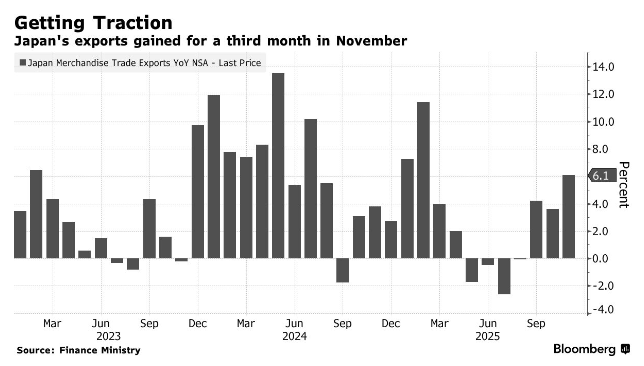
对美出口八个月来首现回升 日本11月出口增长6.1%超预期
Zhi Tong Cai Jing· 2025-12-17 02:25
Group 1 - Japan's exports increased by 6.1% year-on-year in November, driven primarily by semiconductor components and medical supplies, exceeding economists' expectations [1][3] - Exports to the United States and the European Union saw significant growth, with increases of 8.8% and 19.6% respectively [1][3] - The trade surplus for Japan was recorded at 322.3 billion yen (approximately 2.1 billion USD), with imports rising by 1.3%, slightly below general expectations [3] Group 2 - The rebound in exports to the U.S. is seen as a positive signal for the Bank of Japan, which is expected to raise the benchmark interest rate to its highest level since 1995 [3][4] - Japan's trade with China declined by 2.4%, influenced by issues related to semiconductor manufacturing machinery and non-ferrous metals, as well as diplomatic tensions following comments made by Japan's Prime Minister [3][4] - The increase in exports of automobiles and parts to the U.S. was noted after the reduction of tariffs from 27.5% to 15%, with a 1.5% increase in export value and a 7.7% increase in export quantity [4]
前11月外贸出口超预期强劲,人民币中间价陡峭升值
Sou Hu Cai Jing· 2025-12-16 11:38
Group 1 - The core viewpoint of the articles indicates that the Chinese yuan is experiencing a significant appreciation against the US dollar, driven by strong trade surpluses and favorable economic conditions [2][3][4] - The yuan's exchange rate has seen a steep decline, with the midpoint rate against the dollar dropping to 7.0602, a decrease of 54 basis points, and a total decline of 157 basis points since the beginning of the month [2] - China's trade surplus for November increased by 5.9% year-on-year, pushing the cumulative surplus for the first 11 months of the year to over $1 trillion, marking a historical first [2][3] Group 2 - The export structure has shifted significantly, with mechanical and electrical products accounting for 60.9% of total exports, and notable growth in integrated circuits (25.6%) and automobiles (17.6%) [3] - Despite a 20% decline in exports to the US due to tariffs, other regions have compensated for this drop, with ASEAN becoming the largest trading partner, growing by 8.5% [3] - The Chinese economy is benefiting from a strong export performance, which is crucial for supporting the yuan's appreciation, even amid domestic demand challenges [2][3] Group 3 - The yuan's appreciation is also influenced by US monetary policy, with expectations of further interest rate cuts by the Federal Reserve, which would likely lead to a weaker dollar [5][6][7] - The potential candidates for the Federal Reserve chair, both advocating for lower interest rates, suggest a continued dovish stance that could further impact the dollar's strength [6][7] - The Chinese central bank is expected to maintain a moderately loose monetary policy, which, combined with a narrowing interest rate differential with the US, is favorable for the yuan [5]
人民币强势归来!双创逾一年新高
Huan Qiu Wang· 2025-12-16 08:22
此轮人民币的强劲表现并非偶然。同日,中国人民银行授权中国外汇交易中心公布的人民币汇率中间价报7.0602 元,较前一交易日调升54个基点,为汇率的走强提供了官方指引。 【环球网财经综合报道】12月16日,人民币汇率市场迎来强势行情。在岸与离岸人民币对美元汇率联袂上攻,双双 刷新逾一年来的最高纪录,展现出强劲的升值势头。 截至发稿,离岸人民币对美元汇率盘中一度升破7.04关口,最高触及7.03725,创下自2024年10月4日以来的新高。与 此同时,在岸人民币对美元汇率也表现不俗,盘中最高升至7.0417,为2024年10月8日以来的最高水平。市场交投活 跃,人民币升值预期显著升温。 对于近期人民币的连续上行,市场分析普遍认为主要受两大因素驱动。首先,外部环境出现有利变化。随着美联储 在12月11日降息前后释放出明确的宽松信号,美元指数持续走弱并跌破100大关,这为包括人民币在内的非美货币提 供了普遍的升值空间。其次,年底的季节性因素也起到了推波助澜的作用。临近岁末,出口企业的结汇需求集中增 加,为人民币汇率带来了季节性的支撑。在人民币持续升值的背景下,部分前期观望的结汇需求可能加速释放,进 一步放大了升势。 ...
首次突破万亿美元!今年的贸易顺差,要再破世界记录
Sou Hu Cai Jing· 2025-12-16 06:49
Core Viewpoint - China's manufacturing strength continues to grow, with trade surplus surpassing $1 trillion by November, marking a historic achievement in global trade [1][12]. Trade Surplus Overview - As of November, China's cumulative trade surplus reached $1.08 trillion, breaking last year's record [1]. - Despite a decline in exports to the U.S. by nearly 29%, exports to other regions, including ASEAN and the EU, saw significant growth, contributing to the overall increase in trade surplus [5][10]. Regional Trade Dynamics - The trade surplus is supported by strong export growth to regions involved in the Belt and Road Initiative and the Regional Comprehensive Economic Partnership, as well as emerging markets in Southeast Asia, the Middle East, Africa, and Latin America [3][4]. - Exports to the EU and Latin America showed robust growth, with November exports to the EU increasing by 14.8% and to ASEAN by 8% [5]. Economic Implications - The trade surplus indicates a strong competitive position for China in global trade, with exports significantly outpacing imports, particularly in the context of the EU's industrial base facing challenges [10][11]. - China's manufacturing sector produces one-third of the world's goods, highlighting its reliance on external markets for over 20% of its production capacity [5][11]. Future Considerations - The increasing trade surplus may prompt reactions from the EU, particularly as the EU Commission President has previously called for a "de-risking" strategy regarding trade with China [6][10]. - Economists suggest that a stronger currency could benefit domestic consumption but may also impact export competitiveness, indicating a complex balance for future trade strategies [14][15].

中国顺差破万亿,美国贸易战彻底打输!真正的金融核弹,在华尔街
Sou Hu Cai Jing· 2025-12-15 21:52
Group 1 - China's trade surplus is projected to exceed $1 trillion by November 2025, highlighting the country's strong economic resilience and capacity for wealth generation [1] - The trade surplus can be viewed as the "net profit" of a nation, with exports representing income and imports representing costs [3][4] - The surplus will be utilized for overseas investments, strategic support, increasing foreign reserves, and ultimately benefiting domestic welfare [5][6][7][8] Group 2 - The U.S. has faced a strategic failure in its trade war against China, as evidenced by the record trade surplus, indicating the indispensable role of Chinese manufacturing in the global supply chain [10] - The U.S. is undergoing a significant strategic contraction, retreating to focus on the Western Hemisphere due to the unsustainable costs of maintaining global hegemony [12] - A stark contrast exists between the financial health of China, with a $1.1 trillion trade profit, and the U.S., which is burdened by high military spending and debt interest payments [14] Group 3 - The looming threat of a financial crisis is attributed to the significant bubble in U.S. tech stocks, with a combined market value nearing $18 trillion and an average P/E ratio of 42, indicating unsustainable valuations [16][17] - The potential collapse of this financial bubble could lead to a global economic downturn, with China's trade surplus and foreign reserves serving as a critical buffer against such a crisis [18] Group 4 - The $1 trillion trade surplus symbolizes China's economic resilience and marks a shift from the previous model of "U.S. borrowing and Chinese production" to a new economic paradigm [19] - The future competition is expected to transition from tariff disputes to financial challenges, emphasizing the need for preparedness against potential market disruptions [19]
前11个月一万亿美元顺差!是好事还是麻烦?普通人都能看懂的解读
Sou Hu Cai Jing· 2025-12-15 19:22
Group 1 - China's trade surplus reached $1.076 trillion in the first 11 months of the year, exceeding last year's total [1] - Exports totaled $3.41 trillion, a year-on-year increase of 6.2%, indicating strong performance despite a sluggish global economy [4] - The composition of exports has shifted from traditional goods to high-tech products, with new categories like electric vehicles and lithium batteries growing by 30% [8][10] Group 2 - Imports of bulk commodities increased in volume, but prices fell, leading to a modest increase in total import value [10] - The total import value increased by only 830 billion RMB compared to the previous year, highlighting that the surplus is primarily driven by exports [12] - The increase in trade surplus has bolstered foreign exchange reserves, which now exceed $3.2 trillion, enhancing the country's economic resilience [12][14] Group 3 - The trade surplus has contributed to GDP growth, helping to stabilize the annual growth target of around 5% [14] - The appreciation of the RMB has made studying abroad and travel cheaper, with tuition fees for top U.S. universities decreasing by approximately 2,800 RMB [15] - However, the high trade surplus has led to concerns from Western countries about unfair trade practices, potentially resulting in trade barriers [17] Group 4 - Traditional export businesses are facing challenges due to RMB appreciation, which reduces their profit margins [20] - The shift towards high-end products may lead to job losses in traditional manufacturing sectors, as fewer workers are needed to produce higher-value goods [22] - The slow growth in imports suggests that domestic consumption and investment demand are not fully recovering, indicating an over-reliance on exports [24][26]
【环时深度】中国不仅是出口大国,也是“全球买家”
Huan Qiu Shi Bao· 2025-12-15 02:11
Core Insights - China's trade surplus has surpassed $1 trillion for the first time in the first 11 months of the year, showcasing the resilience of its exports despite rising trade protectionism and restrictions from certain countries [1][2] - The increase in trade surplus is attributed to strong export growth to ASEAN and the EU, which compensated for a decline in exports to the US [2] - The structural changes within the trade surplus highlight a shift towards higher value exports, particularly in electric vehicles, lithium batteries, and solar cells [3] Group 1: Trade Performance - In the first 11 months, China's total trade surplus reached $1 trillion, with exports to ASEAN at 4.29 trillion yuan, up 14.6%, and to the EU at 3.64 trillion yuan, up 8.9% [2] - Exports to the US decreased by 18.3% to 2.76 trillion yuan, indicating a significant shift in trade dynamics [2] - Trade with Belt and Road Initiative countries totaled 21.33 trillion yuan, growing by 6%, with exports to Africa increasing by 27.2% [2] Group 2: Import Dynamics - China's total imports for the first 11 months amounted to 16.75 trillion yuan, with a 5.5% increase in imports of electromechanical products [3][4] - The import value for major commodities like iron ore and crude oil saw price declines, contributing to the expanded trade surplus [4] - The overall import growth reflects a stable demand for goods, with a 0.2% year-on-year increase in total imports [4] Group 3: Export Quality and Global Supply Chain - The export of electromechanical products accounted for 60.9% of total exports, with integrated circuits and automobiles showing significant growth [3] - China's role as a global supplier is emphasized by its ability to provide stable and cost-effective products, which is crucial for maintaining export orders [6] - The interdependence in global supply chains is highlighted, with countries relying on Chinese products for their manufacturing processes [6][7] Group 4: Economic Relationships - The trade surplus with countries like Nigeria is viewed as a reflection of economic complementarity rather than a negative aspect [8][10] - China's investment and cooperation with African nations extend beyond trade surplus figures, focusing on mutual benefits and development [10] - The narrative around China's trade practices is challenged by evidence of lower consumer prices in importing countries due to Chinese goods [9]
德国出口增长略超预期,主要目标市场下滑“凸显”经济引擎乏力
Xin Hua Cai Jing· 2025-12-15 01:05
德国10月外贸数据日前"出炉",德国出口总额环比增长0.1%,同比增长4.2%,数据好于预期。然而分 析人士普遍认为,德国出口结构发生着巨大变化,对主要目标市场大幅下滑,显示德国经济仍面临较大 困境。 德国10月出口增长超过预期 德国联邦统计局当地时间9日发布数据称,经工作日和季节性因素调整后,10月德国出口商品总额达 1313亿欧元,较上月涨幅0.1%,同比增长4.2%;10月德国进口商品总额为1145亿欧元,比上月下降 1.2%,同比增长2.8%。 今年9月,德国出口总额在连续下降两个月之后,大幅增长1.5%,创下了今年4月以来的最大涨幅。市 场普遍预测,10月德国的出口将下降,预计环比下降0.2%。而根据此前路透社的一项调查,10月德国 的出口预计将环比下降0.5%。目前的数据均好于预期,10月德国出口总额也达到了近半年的最高点。 作为全球重要的贸易出口国,德国的贸易顺差也在缓慢恢复增长。此前9月,德国的贸易顺差为153亿欧 元,相较于今年8月的169亿欧元大幅下降。10月,德国的贸易顺差再次增至169亿欧元,改变了近期德 国贸易顺差收窄的趋势。 略超预期的贸易数据表明,德国出口正在经历缓慢增长的"新常 ...
锐评|贸易顺差首超万亿美元,靠的不是运气
Sou Hu Cai Jing· 2025-12-11 23:24
Core Viewpoint - China's goods trade surplus has surpassed $1 trillion for the first time in history, marking a significant achievement amidst challenging external conditions, contrary to predictions of a steep decline in foreign trade [1][3]. Group 1: Economic Context - The $1 trillion surplus reflects a reality where global supply chains favor China's comprehensive efficiency and delivery certainty, despite geopolitical tensions [3]. - The surplus is not merely a result of low labor costs but encompasses advantages in R&D collaboration, supply chain responsiveness, and stable delivery [3][4]. - China's integration into the global value chain is evident, as it remains a net importer in sectors like agricultural and mineral products, indicating a balanced trade structure [4]. Group 2: Structural Changes in Trade - The current surplus signifies a shift from quantity-driven economic growth to a focus on quality and technological advancement, showcasing China's industrial upgrade [5]. - The rise of new sectors such as electric vehicles, lithium batteries, and solar panels indicates a transition in China's trade competitiveness from price advantages to technological innovation and supply chain capabilities [6]. - China's unique industrial classification allows for a comprehensive manufacturing system, facilitating rapid transitions from R&D to mass production [7]. Group 3: Global Economic Impact - The $1 trillion surplus is not a zero-sum game but a reflection of China's deep involvement in international division of labor, providing stability and creating global demand [9]. - China's manufacturing capabilities enhance global purchasing power and support the green transition by offering affordable technologies and products [9][10]. - The country is actively expanding imports and promoting cooperative initiatives like the Belt and Road Initiative to create shared opportunities for global trade [10]. Group 4: Future Outlook - The surplus represents both a milestone and a new starting point, reinforcing confidence in China's economy and providing certainty in a volatile global economic landscape [12].