
AI产业链

Search documents
防水发布涨价函,关注内需弹性品种
China Post Securities· 2026-01-26 03:09
Investment Rating - The industry investment rating is "Outperform the Market" and is maintained [1]. Core Views - The construction materials sector has shown good performance recently, driven by price increases in waterproof materials and a shift in market style. There is a strong expectation for continued price increases in consumer building materials such as waterproofing, coatings, and gypsum boards in 2026, despite the current off-season demand [3][4]. - The cement market is entering a seasonal downturn, with national demand showing a downward trend. However, the cement industry's capacity is expected to decline under policies limiting overproduction, which will enhance profit elasticity [3][4]. - The glass industry is facing sustained demand pressure due to the real estate sector, with traditional peak season orders showing limited improvement. Supply-side adjustments are ongoing, but overall supply-demand pressures remain [4][14]. - The fiber glass sector is experiencing a mixed demand environment, with AI-driven demand in specific segments showing potential for growth [4]. Summary by Sections Cement - The national cement market is entering a seasonal downturn, with demand expected to decrease significantly as the New Year approaches. December 2025 cement production was 144 million tons, down 6.6% year-on-year [8]. - The civil market shows relatively rigid demand, while the construction market remains weak. Future price trends are expected to be stable but weak [8]. Glass - The glass industry is under pressure, with traditional peak season demand not showing significant improvement. High inventory levels among intermediaries are a concern. Recent supply-side adjustments have occurred, but overall supply-demand pressures persist [14]. Fiber Glass - The fiber glass sector is seeing a mixed demand landscape, with AI-related products experiencing growth. The industry is expected to see a trend of increasing volume and price due to this demand [4]. Consumer Building Materials - The profitability of the consumer building materials sector has reached a bottom, with strong calls for price increases due to competitive pressures. Major categories like waterproofing and coatings are expected to see continued price hikes in 2026 [4]. Market Performance - The construction materials sector index increased by 9.23% over the past week, outperforming other major indices [5].
调仓换股与众不同 长跑型选手逆向而行
Zhong Guo Zheng Quan Bao· 2026-01-25 21:07
Core Insights - The report highlights the contrasting trading strategies of long-term fund managers compared to the overall public fund adjustments in Q4 2025, indicating a unique approach to navigating the structural market conditions [1] Fund Manager Adjustments - In Q4 2025, Zhongji Xuchuang (300308) became the largest holding for public funds, with an increase of over 22 billion yuan, while many long-term fund managers chose to reduce their positions in this stock by over 40% [2] - Similar trends were observed with Xinyisheng (300502), where public funds increased holdings by over 9 billion yuan, yet long-term fund manager Yang Dong reduced his position by over 40% [3] Divergence in Stock Adjustments - There were notable differences among long-term fund managers regarding their adjustments in Xinyisheng, with some increasing their positions while others significantly reduced theirs [3] - Industrial Fulian (601138) exited the top ten holdings for public funds, while some fund managers drastically reduced their positions, with reductions exceeding 80% [3] - In contrast, Zijin Mining (601899) and Shengyi Technology (600183) saw overall increases in public fund holdings, but individual fund managers had varying strategies, with some increasing and others decreasing their stakes [3] Position Management - Many long-term fund managers opted to lower their stock positions in Q4 2025, with significant reductions noted, such as a drop from 78.70% to 62.74% in one fund [4] - Other funds also reported reductions in stock positions ranging from 1% to 10% [4] Portfolio Diversification - Long-term funds generally maintained a high concentration in their top ten holdings, but there was a noticeable decrease in concentration compared to Q3 2025, with some funds seeing reductions of over 25 percentage points [5][6] - The focus of many fund managers shifted towards diversified sectors, including AI, cyclical industries, and consumer sectors, indicating a broader investment strategy [6] Sector Focus - The cyclical sector became a popular area for public fund increases, with significant investments in non-ferrous metals and chemicals [7] - Consumer and social service sectors also saw increased attention from fund managers, with notable additions to top holdings in these areas [8] Major Changes in Top Holdings - Several funds underwent significant changes in their top ten holdings, with multiple stocks being replaced, indicating a strategic shift in investment focus [9] Outlook for 2026 - Fund managers expressed optimism for the A-share market in 2026, anticipating a potential upward trend driven by multiple positive factors [10] - AI applications are expected to be a core focus, with varying strategies among fund managers regarding their investment in AI-related sectors [11] - The cyclical sector is recognized for its investment potential, with expectations of improved performance in related industries [12]

调仓换股与众不同长跑型选手逆向而行
Zhong Guo Zheng Quan Bao· 2026-01-25 21:06
Core Insights - The report highlights the contrasting trading strategies of long-term fund managers compared to the overall public fund adjustments in Q4 2025, indicating a divergence in stock selection amidst a volatile market environment [1][2]. Fund Manager Adjustments - In Q4 2025, Zhongji Xuchuang replaced Ningde Times as the top holding for public funds, with an increase in market value exceeding 22 billion yuan. However, several long-term fund managers chose to reduce their positions in Zhongji Xuchuang, with reductions exceeding 40% by managers like Mo Haibo and Shen Ai Qian [1][2]. - Similar trends were observed with another popular stock, Xinyi Semiconductor, where public funds increased holdings by over 9 billion yuan, yet long-term fund manager Yang Dong reduced his position by over 40% [2]. - Notably, Industrial Fulian exited the top ten holdings for public funds, while some long-term managers like Liu Yuanhai increased their positions, showcasing differing strategies among fund managers [3]. Portfolio Management - Many long-term fund managers opted to lower their stock positions in Q4 2025, aligning with the overall trend of reduced stock allocations in public funds. For instance, the stock allocation of Mo Haibo's fund dropped from 85.20% to 71.92%, a decrease of approximately 13 percentage points [4]. - The concentration of holdings among long-term funds remained high, with many funds having over 50% of their net asset value in the top ten holdings, although some funds showed a noticeable decrease in concentration compared to Q3 2025 [5]. Sector Allocation - Fund managers displayed a diversified approach in their sector allocations, favoring areas such as AI, cyclical stocks, and consumer sectors. For example, Yang Dong's fund gained excess returns by focusing on AI and robotics, while Liu Yuanhai's fund adjusted its AI allocations during Q4 2025 [6][7]. - The cyclical sector gained traction among fund managers, with significant investments in non-ferrous metals and chemicals. For instance, Li You's fund made substantial increases in holdings of companies like Zijin Mining and Yun Aluminum [6][9]. - In the consumer and social services sectors, managers like Mo Haibo and Miao Weibin focused on domestic demand-related stocks, indicating a strategic shift towards consumer resilience and emerging consumption trends [6][9]. Market Outlook - Looking ahead to 2026, long-term fund managers maintain an optimistic outlook for the A-share market, anticipating a potential upward trend driven by multiple positive factors, including corporate earnings recovery and improved liquidity [7][8]. - The AI sector remains a focal point, with managers emphasizing the importance of AI applications over hardware, suggesting a shift in investment focus towards practical applications of AI technology [8][9].

负债行为跟踪:咬紧科技不放松
ZHONGTAI SECURITIES· 2026-01-25 08:53
Report Industry Investment Rating - No information provided in the report Core Viewpoints of the Report - This week, the performance of broad - based indexes was differentiated. The science and technology sector generally rose, with more declines on Monday and Tuesday and most sectors rising with heavy trading volume from Wednesday to Friday. The main line of science and technology is more focused and clear, and it is the sector where the consensus of funds on the liability side is concentrated and the best elastic offensive variety [4][11]. - Although broad - based ETFs continued to have net outflows this week, industry ETFs were in a net - buying state. The science and technology sector still had substantial net buying, and the inflow of funds into the non - ferrous sector was significant [5]. - The margin trading and short - selling transaction volume decreased significantly, and the margin trading and short - selling balance first decreased and then increased. The demand for hedging reflected by stock index futures weakened after Wednesday [6][9]. - Foreign capital actively participated as a right - side force in the New Year's opening market, and its participation degree even exceeded that of margin trading and short - selling. It has become a more active incremental force in the short - term market [10]. Summary by Relevant Catalogs A - share Market - **Index Performance**: This week, the performance of broad - based indexes was differentiated. The CSI 300 fell by 0.6%, while the Shanghai and Shenzhen indexes rose by 0.8% and 1.1% respectively. The CSI 500 and the micro - cap index performed well, rising by 4.3% and 5.2% respectively. The performance of technology stocks was also differentiated, with the ChiNext Index falling by 0.3%, the STAR 50 rising by 2.6%, and the CSI 1000 rising by 2.9% [14]. - **Trading Volume**: The trading volume of broad - based indexes decreased significantly. The average daily trading volume decreased from 3.5 trillion to 2.8 trillion. Specifically, the trading volume of the entire A - share market decreased from over 3 trillion from Monday to Thursday to about 2.7 trillion, and rebounded to over 3 trillion on Friday [19]. A - share Industry - **Industry Performance**: This week, the top five rising industries were building materials (8.82%), basic chemicals (6.76%), steel (5.78%), petroleum and petrochemicals (5.76%), and non - ferrous metals (4.92%). The top five falling industries were banks (- 4.07%), media (- 2.96%), communications (- 2.77%), non - bank finance (- 2.57%), and computers (- 2.52%) [26]. - **Science and Technology Sub - sectors**: Since 2026, areas such as storage, semiconductors, and HBM have had relatively large excess returns compared to the Wind All - A Index. The excess returns of commercial aerospace and optical modules, which performed well in December, have declined or even turned negative. This week, the science and technology sector generally rose, with more declines on Monday and Tuesday and most sectors rising with heavy trading volume from Wednesday to Friday [28][32]. ETF Funds - **Broad - based ETFs**: Index ETF funds continued to have large - scale net outflows, with large - cap index ETFs having more outflows. The average daily net outflow of the CSI 300 ETF was over 14 billion, the average daily net outflow of the SSE 50 ETF was 7.3 billion, and the average daily net outflow of the CSI 1000 ETF was 6.2 billion. The SSE Composite Index ETF had a slight net inflow [37]. - **Industry ETFs**: Although broad - based ETFs still had net outflows this week, industry ETFs were in a net - buying state. The non - ferrous sector had a significant pulsed inflow of funds, and the science and technology sector still had substantial net buying. Science and technology sub - sectors represented by software and satellites continued to rank high in terms of net inflow [44]. Leveraged Funds - **Margin Trading and Short - Selling Transaction Volume and Balance**: After the implementation of the new margin trading and short - selling regulations on January 19, the proportion of margin trading and short - selling transactions decreased from 11.2% to 9.9%. The margin trading and short - selling balance first decreased and then increased, with the average balance this week being about 2.72 trillion, slightly higher than last week's 2.70 trillion [49]. - **Broad - based Index Margin Trading and Short - Selling**: From Monday to Tuesday this week, except for the SSE 50 and the STAR 50, the leveraged funds of most broad - based index components had net outflows; from Wednesday to Thursday, the leveraged funds of the CSI 300, SSE Composite Index, SSE 50, and CSI 1000 index components turned into net inflows. Overall, the net inflow of index margin trading and short - selling this week was less than that of last week [54]. - **Industry Margin Trading and Short - Selling**: On Monday and Tuesday this week, most industries de - leveraged, while on Wednesday and Thursday, most industries re - leveraged. Non - bank finance, communications, transportation, and comprehensive industries had relatively large increases in the proportion of margin trading net buying to trading volume [59]. - **Stock Market Value and Margin Trading and Short - Selling**: This week, stocks of all market - value gradients added leverage, with stocks with a market value of over 500 billion adding leverage to a greater extent [61]. - **Popular Stocks and Margin Trading and Short - Selling**: Popular stocks in electronics, power equipment, national defense and military industry, and non - ferrous metals mostly added leverage, while popular stocks in the media mostly de - leveraged. The proportion of leveraged funds in the trading volume of the top 35 popular stocks decreased this week [64][68]. Quantitative Funds - **Quantitative Index Enhancement Excess Returns**: Since January, the excess returns of the CSI 500 and CSI 1000 quantitative index enhancement have fallen to negative values, with the medians being - 1.14% and - 0.07% respectively [72]. - **Stock Index Futures Basis**: This week, the basis of stock index futures declined compared to last week but still remained at a relatively high level. From Wednesday to Friday, the basis of near - month stock index futures turned into a premium, indicating a weakening of hedging demand after Wednesday [78]. Main Funds - **Broad - based Index Main Funds**: The main funds of the CSI 300, ChiNext, and STAR Market continued to have net outflows this week, but the outflow slowed down significantly compared to last week. The CSI 300 had a large - scale net outflow from Monday to Tuesday and then turned into a net inflow on Wednesday and Thursday [83]. - **Industry Main Funds**: This week, the main funds flowed out of most industries, with the largest outflows in electronics, followed by computers, communications, and power equipment. The outflows were relatively large on Monday and Tuesday. The main funds flowed into banks, building materials, and coal [91]. North - bound Funds - **Participation Degree**: Foreign capital actively participated as a right - side force in the New Year's opening market, and its participation degree even exceeded that of margin trading and short - selling. The trading volume proportion of north - bound funds increased from 11.0% before the New Year's Day to 11.8%, an increase of 0.8 percentage points, while the proportion of margin trading and short - selling only increased from 10.6% to 11.0%, an increase of 0.4 percentage points [93]. - **Trading Volume and Proportion**: This week, the total trading volume of north - bound funds decreased, with the average daily trading volume decreasing from 401.1 billion to 338.5 billion, and the proportion of A - share trading volume increasing from 11.61% to 12.10%. Since late December, the trading activity of north - bound funds has significantly rebounded [102].
固收专题报告:追风不如乘风
ZHONGTAI SECURITIES· 2026-01-25 08:53
Report Industry Investment Rating - The industry rating is "Overweight", expecting a gain of more than 10% relative to the benchmark index in the next 6 - 12 months [19] Core Viewpoints of the Report - Since the beginning of 2026, the A - share market style has changed from unilateral upward movement to high - frequency rotation. It is better to hold the core main line firmly than to chase the market in high - frequency rotation. The AI industry chain remains the market consensus, and the current market cooling is a "slope adjustment" rather than a "trend end" [3] - The acceleration of industry rotation is a benign spread of funds from "point" to "surface". The market is seeking a pricing balance between technology and prosperous industries [3] - The net inflow of industry ETFs has increased, showing a configuration pattern of "cycles as shields and technology as spears". It is recommended to adopt a "dumbbell - shaped" configuration strategy [3] Summary by Directory Market Focus Always on the Main Line, AI Industry Chain Remains the Consensus - From the perspective of trading volume proportion, industries such as electronics, computers, and national defense and military industry have always been at the core of the market. Even with short - term disturbances, the electronics sector's trading volume proportion remains at a high level of 17% - 20%, and that of national defense and military industry has gradually recovered, indicating strong capital stickiness [3][8] - The current market cooling is a "slope adjustment" rather than a "trend end". The high concentration of the chip structure proves that the AI industry chain is an investment main line with in - depth consensus, and high activity provides strong resilience and upward elasticity [3][8] Liquidity Spillover, the Advantage of "Technology + Prosperity" Portfolio Highlights - As the market enters the adjustment period, liquidity begins to spread from high - consensus varieties to prosperous industries with catch - up logic. When the technology main line adjusts, funds flow to industries such as chemicals, non - ferrous metals, and banks [10] - This shows that it is not the ebb of the main line but the natural spread of liquidity from "point" to "surface". The market is seeking a pricing balance between technology and prosperous industries [11] - Since the beginning of the year, some sectors have shown high weekly and year - to - date excess returns. The strategy of holding the AI bottom position and combining bull - market varieties has a higher winning rate than blind rotation [12] ETF Fund Flows: Driven by the Resilience of Prosperity and Technology - Although the broad - based ETFs are still experiencing net outflows (the weekly outflow of CSI 300ETF is 724.2 billion yuan), the industry ETFs are in a state of net buying, with a cumulative net inflow of 78.82 billion yuan [13] - There has been a significant pulsed inflow of funds into the non - ferrous sector without siphoning other sectors. The technology sector also has a large net inflow, especially software and satellite sub - industries, showing a configuration pattern of "cycles as shields and technology as spears" [14] It's Better to Be Part of the Wind Than to Chase It - The main line of this bull market is clear, with technology being the best offensive variety. It is recommended to adopt a "dumbbell - shaped" configuration and hold firmly [3][17] - One end of the "dumbbell" is the technology main line, including storage, equipment, advanced packaging, AI applications, commercial aerospace, and robots. The other end is the prosperous cyclical sectors such as non - ferrous metals and chemicals, and also pay attention to stable sectors like home appliances and transportation [3][17]
公募基金25年Q4配置分析:公募基金四季报是否会影响我们对市场和板块的判断?
广发香港· 2026-01-25 08:28
[Table_Page] 投资策略|专题报告 2026 年 1 月 25 日 证券研究报告 [Table_Title] 公募基金四季报是否会影响我们对 市场和板块的判断? ——公募基金 25 年 Q4 配置分析 [Table_Summary] 报告摘要: | [分析师: Table_Author]刘晨明 | | --- | | SAC 执证号:S0260524020001 | | SFC CE No. BVH021 | | 010-59136616 | | liuchenming@gf.com.cn | | 分析师: 郑恺 | | SAC 执证号:S0260515090004 | | SFC CE No. BUU989 | | 021-38003559 | | zhengkai@gf.com.cn | | 分析师: 杨清源 | | SAC 执证号:S0260525080001 | | yangqingyuan@gf.com.cn | | 请注意,杨清源并非香港证券及期货事务监察委员会的注 | | 册持牌人,不可在香港从事受监管活动。 | [联系人: Table_Contac毕露露 ts] 1860044269 ...



申万宏源策略:A股春季行情仍沿着既定路径前进
Xin Lang Cai Jing· 2026-01-25 06:19
Group 1 - The spring market is transitioning to the next phase without disrupting the established path of the spring market performance, characterized by incremental games and favorable conditions for long positions, which lays the foundation for a perfect spring market with widespread profit effects [1][5] - Short-term, the focus is on cyclical Alpha investments expanding towards more cyclical turning points, with deepening exploration of bottom assets and short-term stock price elasticity [1][3] - The overall profit effect is nearing a high point, and the time and space for the post-New Year market rally are gradually limited [1][5] Group 2 - The spring market is essentially an extension and expansion phase of the high valuation area of the 2025 technology structural market, with some investment directions entering a high volatility phase [2][6] - After the spring market, a correction phase is likely, focusing on waiting for clearer clues in the next phase of industrial trends and the digestion of performance to ease valuation and structural contradictions [2][6] - The second half of 2026 is expected to see a new upward phase driven by cyclical improvements in fundamentals, new phases in technology industry trends, and increased visibility of China's influence [2][6] Group 3 - Short-term, cyclical Alpha is the key focus for market exploration of low positions, with the cyclical Alpha market (non-ferrous metals, chemicals) expanding towards cyclical turning points (construction materials, oil, steel) [3][7] - The cyclical Alpha market is showing a significant resonance effect with the expansion of industry ETF scales, becoming a strong momentum direction after industrial trend themes [3][7] - However, the profit effects of non-ferrous metals, chemicals, and oil are nearing high points, indicating increasing resistance in the short-term cyclical market [3][7] Group 4 - The market is expected to see a rotation in sectors, with opportunities for rebounds in previously strong sectors where profit effects have contracted, such as commercial aerospace and AI applications [2][6] - There is a focus on sectors with relatively low profit effects for rotation and supplementary gains, including high-dividend sectors, pharmaceuticals, and brokerage firms [2][6] - The long-term outlook remains positive for both cyclical Alpha and technology sectors, with a focus on overseas computing chains, AI applications, semiconductors, energy storage, robotics, and commercial aerospace [3][7]

鑫元产业机遇混合A:2025年第四季度利润211.41万元 净值增长率2.49%
Sou Hu Cai Jing· 2026-01-24 04:29
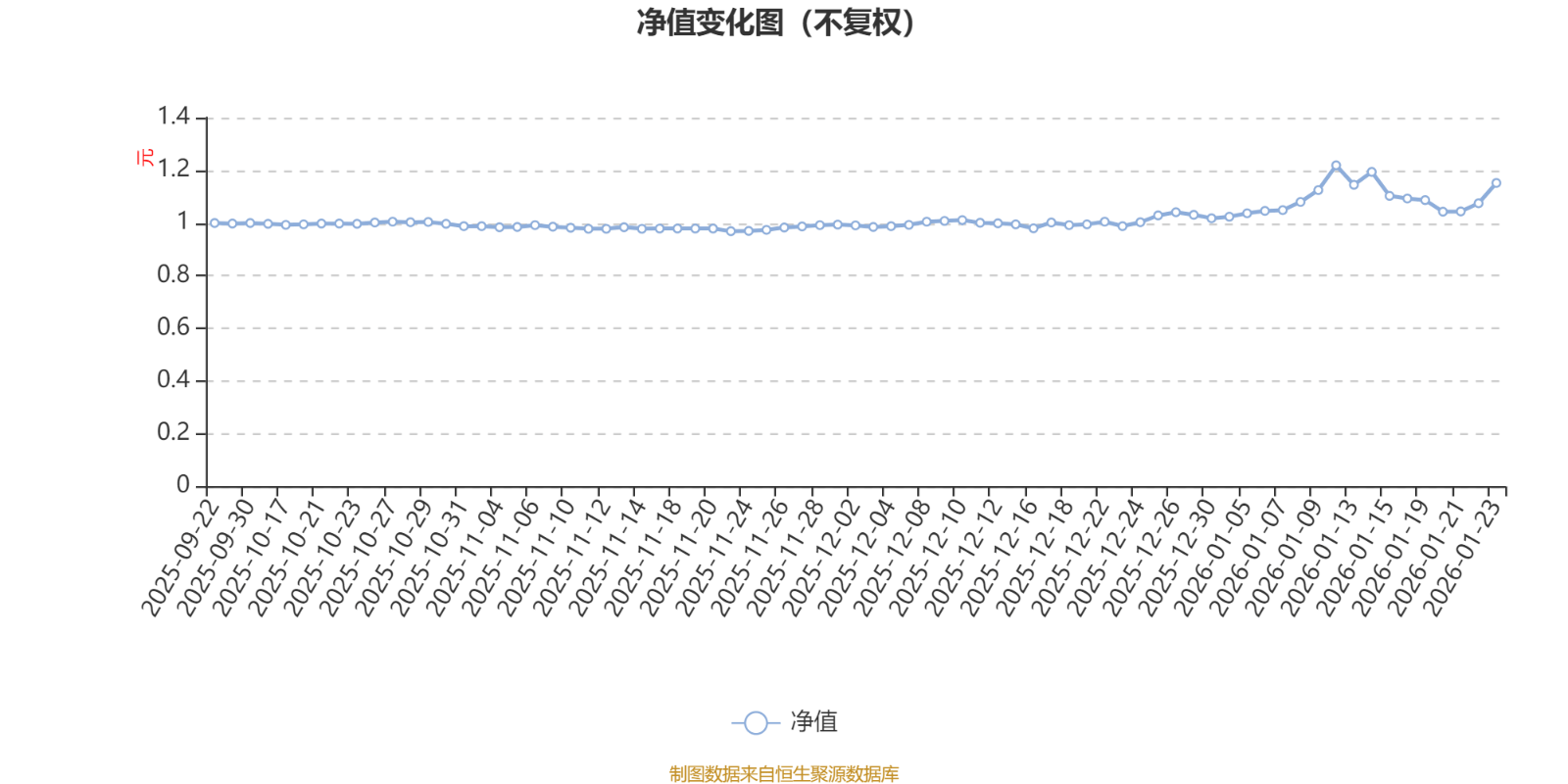
Core Insights - The AI Fund Xinyuan Industrial Opportunity Mixed A (024790) reported a profit of 2.1141 million yuan for Q4 2025, with a weighted average profit per fund share of 0.0218 yuan [3] - The fund's net value growth rate for the reporting period was 2.49%, and the fund size reached 50.3606 million yuan by the end of Q4 [3] - As of January 23, the unit net value was 1.152 yuan, with the fund manager, Chen Li, overseeing six funds [3] Fund Performance - The highest one-year compounded unit net value growth rate among the funds managed is 38.68% for Xinyuan Clean Energy Mixed Initiated A, while the lowest is 6.28% for Xinyuan Juxin Income Enhancement A [3] Investment Strategy - The fund maintained a relatively cautious investment strategy during the reporting period, focusing on sectors such as the AI industry chain, controllable nuclear fusion, and pharmaceuticals [3] Holdings Concentration - As of the end of Q4 2025, the fund had a high concentration of holdings, with the top ten stocks including Guoguang Electric, Zhongji Xuchuang, Aerospace Zhizhuang, Changying Precision, Shanghai Hanxun, Highhua Technology, New Yisheng, Jiayuan Technology, Kaipu Cloud, and Shengbang Safety [3]

1月23日行情解读:美超级风暴周,Fed决议+科技巨头财报双重对决,反弹遇压下的生死局
Xin Lang Cai Jing· 2026-01-23 13:09
Group 1 - The core viewpoint of the article highlights that the recent market rebound in U.S. stocks is merely a technical correction and does not signify a reversal of the prevailing weak trend [1][5] - Major tech companies such as Nvidia, Oracle, Microsoft, Meta, Apple, and Amazon have shown signs of fatigue, with some stocks even facing downward break risks [1][5] - The upcoming earnings reports from key players like Microsoft, Meta, Tesla, Apple, and Amazon will be critical in assessing the real economic conditions of the AI industry, consumer electronics, and cloud computing sectors [2][7] Group 2 - The Federal Reserve's interest rate decision is anticipated to have significant implications, with the U.S. GDP revised up to 4.4%, indicating stronger-than-expected economic resilience [3][7] - The market's expectations for interest rate cuts have been pushed back to June, as the core PCE remains moderate, and any indication from Powell of not rushing to cut rates could lead to further market volatility [3][7] - Investors in Nasdaq and Dow ETFs should be cautious, as the current rebound may be limited, and there are potential risks associated with the upcoming "seasonal line defense" [3][7]
主动股混基金 2025 年四季报分析:增配创业板,主动加仓有色金属、通信和非银金融等
GUOTAI HAITONG SECURITIES· 2026-01-23 08:09
Report Industry Investment Rating No information provided in the content Core Viewpoints - The stock positions of active equity - hybrid funds decreased in Q4 2025, mainly due to active reduction. The allocation in the ChiNext continued to increase, and the actively increased positions were in the non - ferrous metals, communication, and non - banking finance industries [1][4] Summary by Directory 1. Position Analysis: Stock Positions Declined, Mostly Due to Active Reduction - **Overall Stock Position Decline**: The overall position of public offering equity funds decreased slightly compared to Q3 2025. The weighted - average position of equity funds was 86.47%, a decrease of 0.77 percentage points from the previous quarter. The active reduction calculated by the CSI 800 index was also about 0.77%, indicating that the decline was mainly due to active reduction by fund managers [7] - **Nearly 60% of Funds Actively Reduced Positions**: In Q4 2025, about 42.53% of active equity - hybrid funds increased their positions, while 57.47% actively reduced positions [12] - **Public Offering Managers with Large Stock Position Changes**: Small and medium - sized public offering fund managers had large differences in overall positions. The top 5 heavy - position and light - position, and the top 5 position - increasing and position - reducing fund managers in Q4 2025 are listed in the report [14] 2. Heavy - Positioned Sector Analysis: ChiNext Allocation Continued to Increase - **ChiNext Allocation Increase**: Compared with the end of Q3 2025, the allocation of active equity - hybrid funds in the ChiNext increased by 1.32%, while the allocations in the main board, Science and Technology Innovation Board, and Beijing Stock Exchange decreased [17] - **Decline in Hong Kong Stock Allocation of Active Shanghai - Hong Kong - Shenzhen Funds**: As of December 31, 2025, the Hong Kong stock allocation of active Shanghai - Hong Kong - Shenzhen funds was about 26.67%, a decrease of 6.76 percentage points from the end of Q3 2025 [20] 3. Heavy - Positioned Stock Feature Analysis: Bias towards the Technology Sector, Considering Battery, Non - Ferrous Metals, and Liquor Industries - **Top 10 Heavy - Positioned Stocks**: The top 10 heavy - positioned stocks of active equity - hybrid funds at the end of Q4 2025 included technology stocks such as those related to the AI industry chain, as well as non - technology industry leaders like battery, non - ferrous metals, and liquor. The positions in some stocks decreased, while the holding values of optical module targets increased [23] - **Top 10 Stocks with Active Position - Increasing**: The top 10 stocks with active position - increasing in Q4 2025 were concentrated in high - end manufacturing fields such as electronics, power equipment, and optical modules, also considering non - technology sectors [27] 4. Heavy - Positioned Stock Style Analysis: "Herding" Degree Decreased, Tending towards Large - Cap Growth Style - **Decrease in "Herding" Degree**: The concentration of top stocks in terms of both holding value and heavy - position times decreased in Q4 2025, indicating a weakening of the "herding" effect [29] - **Tendency towards Large - Cap Growth Style**: Active equity - hybrid funds were more inclined to the large - cap growth style at the end of Q4 2025, with a slight decrease in the allocation of small - cap value assets [31] 5. Heavy - Positioned Industry Analysis: Actively Increase Positions in Non - Ferrous Metals, Communication, and Non - Banking, Reduce Positions in Media and Commerce and Retail - **Top Five Heavy - Positioned Industries**: At the end of Q4 2025, the top five heavy - positioned industries of active equity - hybrid funds were electronics, power equipment, communication, pharmaceutical biology, and non - ferrous metals. The proportion of electronics decreased, while those of communication and non - ferrous metals increased [32] - **Active Position - Adjustment in Industries**: Institutions actively increased positions in non - ferrous metals, communication, non - banking finance, etc., and reduced positions in media, commerce and retail, and pharmaceutical biology [33] 6. Large and Medium - Sized Public Offering Management Companies: Electronics Industry Becomes the Focus of Active Position - Increase and Reduction - **Industry Distribution of Heavy - Positioned Stocks**: The largest heavy - positioned industry of large and medium - sized public offering management companies at the end of Q4 2025 was still electronics. The power equipment and communication industries appeared 10 times, and the pharmaceutical biology and non - ferrous metals industries appeared 7 and 6 times respectively [37] - **Active Position - Adjustment by Companies**: In Q4 2025, large and medium - sized fund companies actively increased positions in non - ferrous metals, electronics, communication, and non - banking finance industries. The number of companies that first actively reduced positions in the electronics industry was the largest, indicating a large divergence among institutions on the electronics industry [39]