货币政策

Search documents
9000亿元!央行宣布将于23日开展MLF操作
Jin Rong Shi Bao· 2026-01-22 13:17
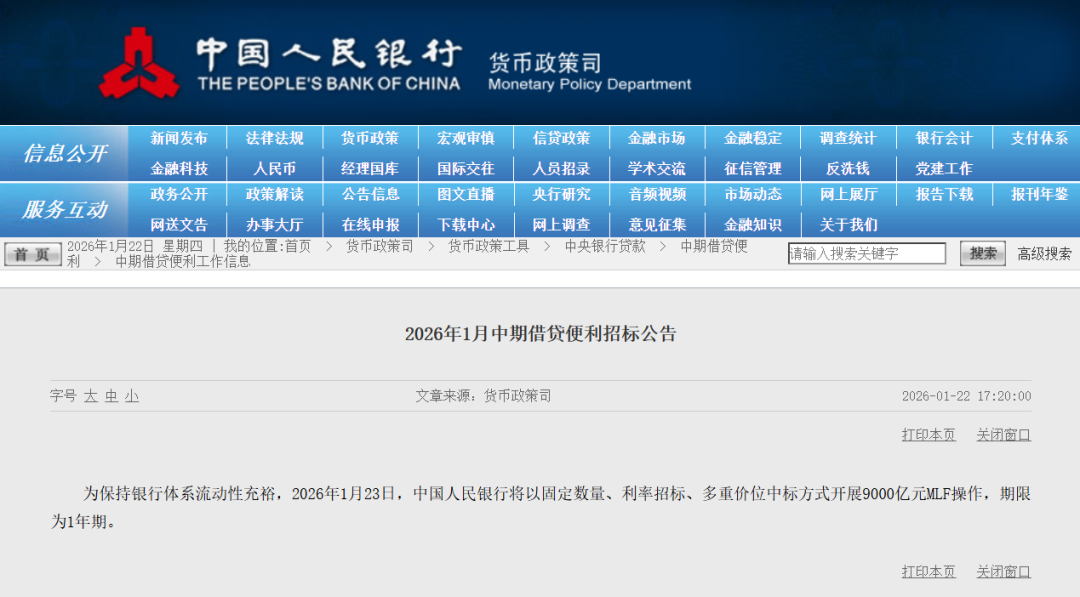
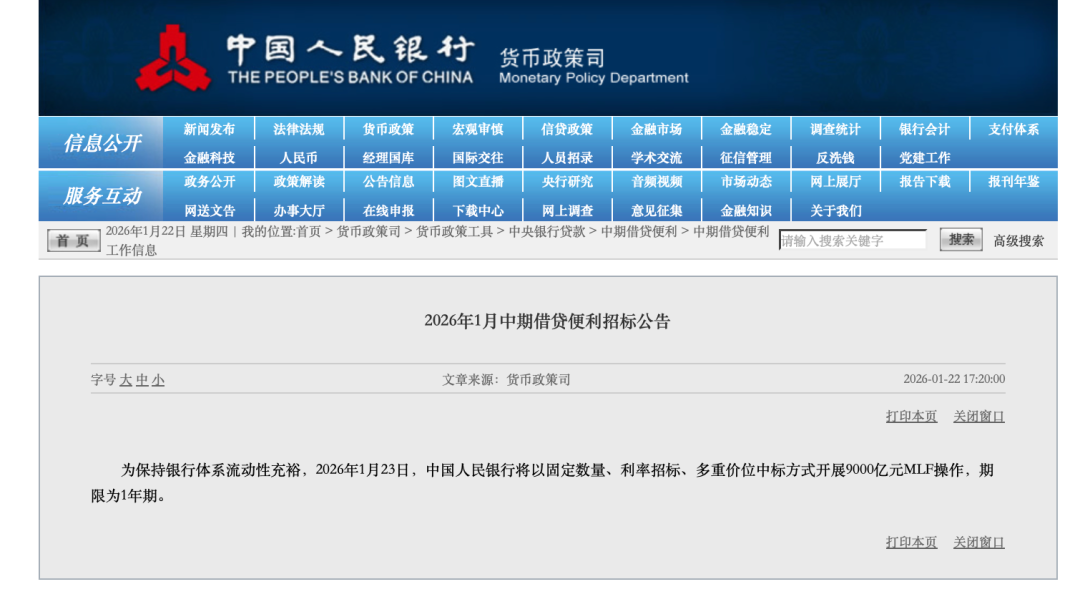
1月22日,中国官网宣布,为保持银行体系流动性充裕,1月23日,中国将以固定数量、利率招标、多重价位中标方式开展9000亿元中期借贷便利(MLF)操 作,期限为1年期。 | | | "政府债券发行节奏明显提前,实现了早发行、早使用、早见效。"有业内人士谈到,这也体现了货币政策、财政政策的协同发力。"当前,两者在政府债 券领域的协同,有效稳定了市场资金面,为重大项目提供了资金保障。"业内专家表示。 "央行的流动性护航,让财政发债'轻装上阵',有效稳定了市场预期。,央行通过逆回购、买断式逆回购等操作注入的流动性,为政府债券发行提供了坚 实支撑。"明明对《金融时报》记者表示。 数据显示,国债发行了16万亿元,全年净增6.6万亿元,年末余额大约是40万亿元,其中,银行、非银行金融机构、境外机构分别持有了27万亿元、5万亿 元和2万亿元,银行等市场机构为了改善资产配置、加强流动性管理,是持有国债的主力。在满足这些机构对国债资产配置需要的前提下,中国买卖国债 可以更好地保障国债以合理成本顺利发行。此外,,中国通过买断式回购操作的国债、债券余额接近7万亿元,这对提高政府债券的市场流动性也发挥了 重要作用。 而往后看,货币政 ...

欧央行12月会议纪要:货币政策“处于良好状态”,未来将继续保持高度灵活
Hua Er Jie Jian Wen· 2026-01-22 13:14
Core Viewpoint - The European Central Bank (ECB) decided to maintain interest rates unchanged during the December 17-18 meeting, indicating that the current monetary policy stance is in a "good position" to balance economic support and inflation control, while emphasizing that policies are not fixed [1] Group 1: Monetary Policy - The ECB will continue to maintain high flexibility, retaining the option to adjust interest rates upwards or downwards in response to changes in economic and inflation outlooks [1] - Market expectations for ECB policy have shifted, with investors believing that the policy rate will remain at current levels for an extended period, with the next action likely being a rate hike rather than a cut [2] - The ECB's key interest rates have remained stable since the last rate cut in June 2022, with financial conditions closely tracking these rates [2] Group 2: Economic Performance - Eurozone economic growth in Q3 was 0.3%, driven by increased consumption and investment, demonstrating unexpected resilience despite global trade challenges and geopolitical uncertainties [3] - The ECB's December forecast shows an upward revision of GDP growth rates for 2025 and 2026 by 0.2 percentage points, with a projected GDP growth rate of 1.4% for 2025, which is 0.5 percentage points higher than previous forecasts [3] - The labor market remains strong, with an unemployment rate of 6.4% in October and employment growth of 0.2% in Q3, although job vacancy rates have dropped to a pandemic low of 2.2% [3] Group 3: Inflation Concerns - Overall inflation remains stable around the 2% target, but service sector inflation and wage growth have shown unexpected stickiness, with service inflation rising to 3.5% in November [4][5] - Wage growth has exceeded expectations for three consecutive quarters, with a year-on-year increase of 4% in Q3, driven by additional payments outside of contractual wages [5] - The ECB predicts core inflation to stabilize around 2% by 2028, but concerns exist regarding the potential for inflation expectations to decouple from targets in the next two years [5]
货币市场日报:1月22日
Xin Lang Cai Jing· 2026-01-22 13:01
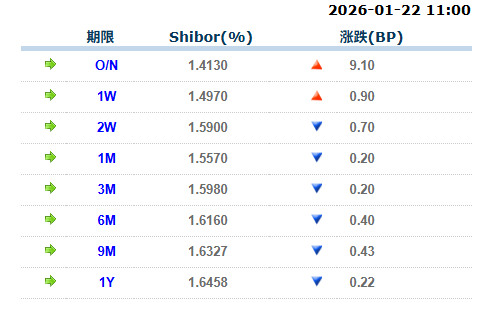
Group 1 - The People's Bank of China conducted a 210.2 billion yuan 7-day reverse repurchase operation at an interest rate of 1.40%, maintaining the previous rate, resulting in a net injection of 30.9 billion yuan after 179.3 billion yuan of reverse repos matured on the same day [1] - The overnight Shanghai Interbank Offered Rate (Shibor) rose by 9.10 basis points to 1.4130%, while the 7-day Shibor increased by 0.90 basis points to 1.4970% [1] - In the interbank pledged repo market, the overnight rates rose above 1.4%, with DR001 and R001 weighted average rates increasing by 9.6 basis points and 8.7 basis points, respectively, while transaction volumes decreased significantly [4] Group 2 - The overall funding situation on January 22 was described as balanced but slightly tight, with overnight transaction rates for pledged deposits remaining in the range of 1.48%-1.50% [8] - The secondary market for negotiable certificates of deposit (NCDs) showed active trading, with yields for various maturities experiencing slight fluctuations, such as the 1-month NCD closing at around 1.51% [9] - The People's Bank of China plans to maintain ample liquidity in the banking system and will conduct a 900 billion yuan Medium-term Lending Facility (MLF) operation on January 23, 2026, with a one-year term [12]

央行宣布,9000亿元!
中国基金报· 2026-01-22 12:31
Core Viewpoint - The People's Bank of China (PBOC) will conduct a 900 billion yuan MLF operation with a one-year term to maintain liquidity in the banking system, with a net injection of 700 billion yuan to meet pre-Spring Festival funding needs and counteract liquidity disturbances from increased credit and government bond issuance [2][3]. Group 1 - The PBOC's operation on January 23 aims to offset the maturity of 200 billion yuan in one-year MLF, resulting in a net liquidity injection of 700 billion yuan [2]. - This liquidity injection is expected to stabilize the market and improve the term structure of liquidity, especially before the Spring Festival [2]. - The net injection of 700 billion yuan is equivalent to a reduction in the reserve requirement ratio (RRR) of between 0.25% and 0.5% [2]. Group 2 - Analysts suggest that the large-scale MLF operation may reduce the likelihood of an RRR cut before the Spring Festival, as it serves as a strong signal of monetary policy support [3]. - The current average RRR in China is 6.3%, indicating that there is still room for potential RRR cuts in the future [3]. - The PBOC's actions are seen as a way to maintain a stable and ample liquidity environment, supporting government bond issuance and encouraging financial institutions to increase credit supply [3].
央行宣布,9000亿元!
Zhong Guo Ji Jin Bao· 2026-01-22 12:30
Core Viewpoint - The People's Bank of China (PBOC) is set to conduct a 900 billion yuan Medium-term Lending Facility (MLF) operation with a one-year term to maintain ample liquidity in the banking system [1] Group 1: MLF Operation Details - On January 23, the PBOC will implement a fixed-quantity, interest-rate tendering, multi-price bidding method for the 900 billion yuan MLF operation [1] - This operation is aimed at addressing the liquidity needs before and after the Spring Festival, countering the impact of increased credit issuance and government bond issuance at the beginning of the year [3] Group 2: Market Impact and Analysis - The net injection of 700 billion yuan from the MLF operation is expected to stabilize market liquidity and improve the maturity structure of liquidity [3] - Analysts suggest that the large-scale MLF operation may reduce the likelihood of a reserve requirement ratio (RRR) cut before the Spring Festival, although there remains potential for RRR cuts in the future [3] - The PBOC's actions are seen as a signal of continued supportive monetary policy, effectively acting as a substitute for RRR cuts while encouraging financial institutions to increase credit lending [4]
央行宣布!明天,9000亿元
Zhong Guo Zheng Quan Bao· 2026-01-22 12:26
Core Viewpoint - The People's Bank of China (PBOC) is implementing a significant liquidity injection of 700 billion yuan through a medium-term lending facility (MLF) operation to maintain ample liquidity in the banking system ahead of the upcoming Spring Festival [1][2]. Group 1: MLF Operation Details - On January 23, 2026, the PBOC will conduct an MLF operation of 900 billion yuan with a one-year term, using a fixed quantity, interest rate bidding, and multiple price bidding method [1]. - The MLF operation follows the maturity of 200 billion yuan in January, resulting in a net liquidity injection of 700 billion yuan [2]. Group 2: Market Impact and Analysis - The total liquidity injection for January, including 3-month and 6-month reverse repos, amounts to 1 trillion yuan, indicating a proactive approach to ensure market liquidity stability [2]. - Analysts suggest that the scale of net liquidity injection is equivalent to a reserve requirement ratio (RRR) cut of 0.25 to 0.5 percentage points, reflecting the PBOC's strategy to support economic growth and stabilize market expectations [2]. Group 3: Future Monetary Policy Outlook - The PBOC's Governor indicated that there is still room for further RRR cuts and interest rate reductions, emphasizing the flexible and efficient use of various monetary policy tools [2]. - Despite the large-scale net liquidity injection, the likelihood of an RRR cut before the Spring Festival has decreased, as such measures are seen as strong policy signals that can lower funding costs for financial institutions and boost market confidence [2][3]. - Looking ahead, the focus will be on the potential for coordinated fiscal measures alongside monetary policy tools, particularly during periods of concentrated government bond supply [3].
人民银行将开展9000亿元MLF操作
Bei Jing Shang Bao· 2026-01-22 12:17
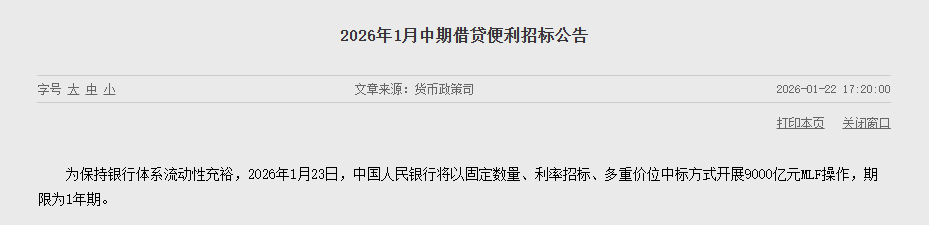
东方金诚首席宏观分析师王青认为,人民银行1月大规模加量续做MLF、显著加大中期流动性投放,能 够有效应对潜在的流动性收紧态势,引导资金面处于较为稳定的充裕状态,货币政策延续支持性立场。 北京商报讯(记者 廖蒙)1月22日,人民银行公告表示,为保持银行体系流动性充裕,2026年1月23 日,中国人民银行将以固定数量、利率招标、多重价位中标方式开展9000亿元中期借贷便利(MLF) 操作,期限为1年期。 另据Wind数据,1月有2000亿元MLF到期,由此计算,1月MLF续作加量7000亿元。此外,本月两个期 限品种买断式逆回购实现净投放3000亿元,1月中期流动性净投放总额高达1万亿。 ...
长债利率久违“回血”
第一财经· 2026-01-22 12:14
Core Viewpoint - The recent divergence in the bond market has intensified following the central bank's press conference, with the LPR remaining unchanged for eight consecutive months, leading to new dynamics in market sentiment and bond yields [3][7]. Group 1: Bond Market Trends - Long-term bond yields have experienced a rare rebound after a prolonged decline, with the 30-year government bond yield dropping by 2.75 basis points and 1.6 basis points, reaching 2.261% [5][6]. - However, this upward trend was not sustained, as bond futures saw a collective decline on January 22, with the 30-year main contract falling by 0.07% to 112.170 [6][7]. - The primary market issuance has been a significant factor influencing the bond market's rebound, with a recent issuance of 160 billion yuan in 7-year fixed-rate bonds seeing a subscription multiple of 5.91 times [6][7]. Group 2: Monetary Policy Impact - The latest LPR remains at 3.0% for the 1-year and 3.5% for the 5-year, reflecting a stable monetary policy environment, with no immediate need for rate cuts or reductions [7][8]. - The central bank's commitment to maintaining liquidity in the banking system is evident, with a net injection of 309 billion yuan through reverse repos on January 22 [8]. Group 3: Foreign Investment Dynamics - There is a growing interest in foreign investment in Chinese government bonds, particularly as global markets face uncertainty, positioning Chinese bonds as a potential safe haven [9][10]. - As of November 2025, foreign institutions held 3.6 trillion yuan in Chinese bonds, with government bonds making up 56.2% of this total [10][11]. - Despite fluctuations in foreign holdings due to various market factors, the long-term trend suggests that the opening of the bond market will encourage steady foreign investment in Chinese bonds [12].

大额存单利率步入0字头
21世纪经济报道· 2026-01-22 12:08
Core Viewpoint - The article discusses the trend of large-denomination certificates of deposit (CDs) entering a "zero interest rate" era due to a combination of structural interest rate cuts and banks' need to stabilize net interest margins, indicating a shift in asset allocation logic for residents and liability management for banks [1][3]. Group 1: Interest Rate Trends - Large-denomination CDs are now predominantly short-term, with most banks focusing on products with a maturity of one year or less, while the issuance of three-year CDs has sharply declined [1][2]. - Major state-owned banks have unified the interest rates for one-month and three-month large-denomination CDs at 0.9%, with minimum deposit amounts concentrated at 200,000 yuan [2]. - The average interest rates for various deposit terms have fallen below 2% since September 2025, with three-month average rates at 0.944% and one-year rates at 1.277% [2]. Group 2: Market Dynamics - The trend towards short-term deposits is a result of banks adjusting their term structures and customers seeking increased liquidity, making it difficult for some banks to offer high-yield long-term products [3]. - The pressure on banks' net interest margins has led to a reduction in large-denomination CD rates and a contraction in the issuance of long-term products, aligning with the policy direction of benefiting the real economy [3][5]. - The net interest margin for commercial banks was reported at 1.42% as of Q3 2025, reflecting a year-on-year decline of 11 basis points, indicating ongoing pressure despite a stabilization in recent quarters [5]. Group 3: Future Outlook - Analysts predict that large-denomination CD rates will continue to operate at low levels throughout 2026, with only minor fluctuations due to short-term liquidity needs from some banks [7]. - The differentiation in pricing for bank deposit products is expected to become more refined, with banks implementing flexible liability strategies based on their asset-liability structures and market positioning [7]. - The potential for further interest rate cuts in 2026 is anticipated, with estimates suggesting a reduction of 10 to 20 basis points, primarily through structural monetary policy tools [6].

刚刚,降息100个基点!
Zhong Guo Ji Jin Bao· 2026-01-22 11:57
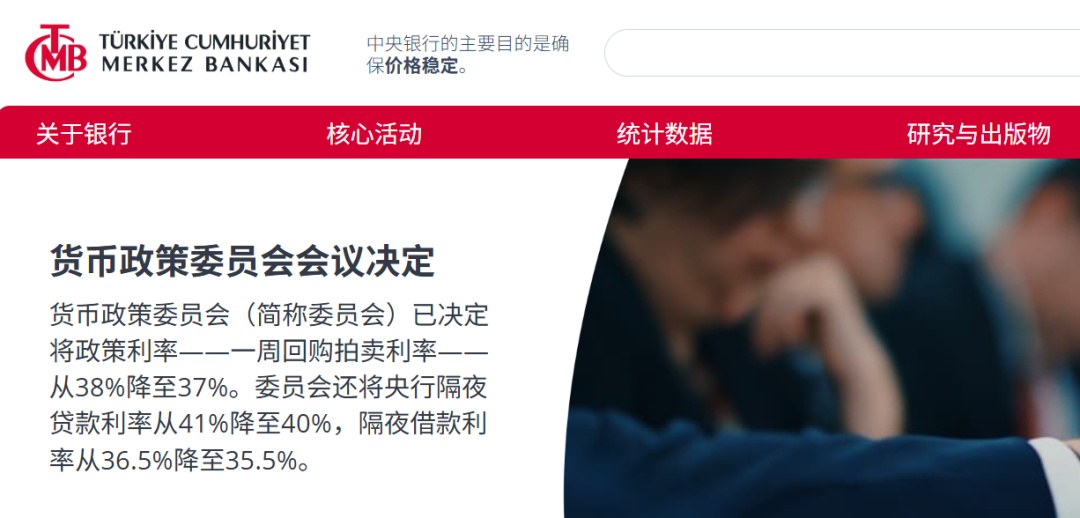
Core Viewpoint - The Central Bank of Turkey has lowered the one-week repo rate by 100 basis points to 37%, indicating a continued easing of monetary policy despite ongoing inflation concerns [1][3]. Monetary Policy Actions - The Central Bank's decision to reduce the policy rate from 38% to 37% reflects a commitment to maintain a tight monetary policy stance until price stability is achieved [3]. - The bank will adjust the policy rate based on actual inflation data, fundamental trends, and expectations to align with medium-term targets [3]. - Following the announcement, Turkey's main banking index fell by over 2% [3]. Historical Context - The Central Bank has a history of rate cuts, having reduced the policy rate from 43% in July 2025 to 37% in January 2026, with several significant cuts occurring throughout 2025 [4]. - The recent rate cut continues a trend of easing that began in mid-2025, with cumulative reductions totaling 1,000 basis points over several months [4]. Economic Outlook - Turkey has allocated 1.92 trillion lira (approximately $443.6 billion) for public investment projects in 2026, covering 3,857 major projects with a total estimated cost of 13.99 trillion lira [5]. - The International Monetary Fund (IMF) has raised its growth forecasts for Turkey, projecting a 4.2% growth in 2026 and 4.1% in 2027, up from previous estimates of 3.7% [5]. - The IMF highlighted a significant difference between service and goods inflation, noting that service prices are more resilient to exchange rate shocks but exhibit persistent inflation patterns [5].