
地缘政治

Search documents
中辉能化观点-20260105
Zhong Hui Qi Huo· 2026-01-05 02:52
1. Report Industry Investment Ratings - **Crude Oil**: Cautiously bearish [1] - **LPG**: Bearish rebound [1] - **L**: Bearish rebound [1] - **PP**: Bearish rebound [1] - **PVC**: Bearish rebound [1] - **PX/PTA**: Buy on pullback [3] - **Ethylene Glycol**: Close short positions [3] - **Methanol**: Cautiously bullish [3] - **Urea**: Cautiously chase up [3] - **Natural Gas**: Cautiously bearish [6] - **Asphalt**: Bearish rebound [6] - **Glass**: Bearish rebound [6] - **Soda Ash**: Bearish rebound [6] 2. Core Views of the Report - **Crude Oil**: Geopolitical changes in South America lead to a short - term rebound in oil prices, but they remain under pressure in the medium and long term. The supply is in surplus during the off - season, and attention should be paid to changes in US shale oil production and geopolitical developments in Russia, Ukraine, and South America [1][10]. - **LPG**: Cost - side support boosts LPG prices in the short term. In the medium and long term, it is anchored to the cost - side crude oil, with a downward trend overall [1]. - **L**: After the holiday, the inventory of Sinopec and PetroChina has significantly increased. The supply is still sufficient, and there is pressure to reduce inventory in the future [1][21]. - **PP**: The total commercial inventory is being reduced from a high level. Pay attention to the dynamics of PDH devices. Short - term supply - demand contradictions are not prominent [1][25]. - **PVC**: The thermal coal price has stopped falling and stabilized, and the industry chain has restocked. Most domestic devices are losing cash flow, and some marginal devices have started to reduce their loads [1][29]. - **PX/PTA**: The valuation is not low. The supply - side maintenance efforts are large, and the downstream demand is relatively good but expected to weaken. The short - term supply - demand is tight, and attention should be paid to the negative feedback from the demand side [3][31]. - **Ethylene Glycol**: The valuation is low, but there is a lack of upward drivers. It follows the cost fluctuations in the short term, and there is an expectation of maintenance in Q1 2026 [3][34]. - **Methanol**: The valuation is not low. The supply - side pressure still exists, the demand side is slightly weakening, and the cost support is slightly stable. The supply - demand is slightly loose, but the downside space may be limited [3][38]. - **Urea**: The absolute valuation is not low. The supply - side pressure is expected to increase in mid - January. The demand side is weakening recently, and the social inventory is being reduced but remains at a relatively high level [3][43]. - **Natural Gas**: The US natural gas inventory has decreased, and the gas price has rebounded, but it remains under pressure in the medium and long term. The supply is relatively sufficient, and the demand - side support has declined [6][48]. - **Asphalt**: The valuation is gradually returning to normal. The cost - side oil price is weak, and attention should be paid to the geopolitical situation in South America. The supply - demand is generally loose [6][51]. - **Glass**: The in - factory inventory has changed from increasing to decreasing, and there is short - term cold - repair expectation support. The supply - demand is weak, and the real estate market is in an adjustment period [6][56]. - **Soda Ash**: The warehouse receipts have increased, and the in - factory inventory has decreased for two consecutive times. It rebounds at a low level following the glass. The long - term supply pattern is loose, and the demand support is insufficient [6][60]. 3. Summaries According to Relevant Catalogs Crude Oil - **Market Review**: Overnight international oil prices slightly declined. WTI decreased by 0.22%, Brent decreased by 0.26%, and SC increased by 0.69% [9]. - **Basic Logic**: Geopolitical changes in South America may cause short - term strength in oil prices, but the supply surplus situation remains unchanged. The supply is in surplus during the off - season, and the global crude oil inventory is accumulating rapidly [10]. - **Fundamentals**: On January 3, the US took military action against Venezuela, which may cause a short - term rebound in oil prices. Japan's crude oil imports in November increased by 7.0% year - on - year. As of December 19, the US crude oil and refined product inventories all increased [11]. - **Strategy Recommendation**: In the medium and long term, OPEC+ is expanding production and pressing down prices. Hold short positions and buy call options for risk control. Pay attention to the range of [425 - 435] for SC [12]. LPG - **Market Review**: On December 30, the PG main contract closed at 4092 yuan/ton, up 0.52% month - on - month. The spot prices in Shandong, East China, and South China were 4320, 4380, and 4510 yuan/ton respectively [15]. - **Basic Logic**: Saudi Arabia raised the latest CP contract price, which boosts the gas price in the short term. In the medium and long term, it is anchored to the oil price and is under pressure. The supply is increasing, and the downstream chemical demand is resilient [16]. - **Strategy Recommendation**: In the medium and long term, the upstream crude oil supply exceeds demand, and the LPG price still has room for compression. Hold short positions. Pay attention to the range of [4100 - 4200] for PG [17]. L - **Market Review**: The L05 contract price increased by 0.2%, and the L01 contract price decreased by 1.7%. The L05 basis was - 202 yuan/ton, and the L59 spread was 37 yuan/ton [19][20]. - **Basic Logic**: After the holiday, the inventory of Sinopec and PetroChina has significantly increased. The supply - demand is weak, and there is pressure to reduce inventory in the future [21]. - **Strategy Recommendation**: Wait and see in the short term. In the medium and long term, it is in a high - production cycle. Wait for a rebound to go short. Hold the short position of the LP05 spread. Pay attention to the range of [6400 - 6550] for L [21]. PP - **Market Review**: The PP05 contract price increased by 0.4%. The PP05 basis was - 136 yuan/ton, and the PP59 spread was - 20 yuan/ton [23][24]. - **Basic Logic**: The total commercial inventory is being reduced from a high level. Pay attention to the dynamics of PDH devices. Short - term supply - demand contradictions are not prominent [25]. - **Strategy Recommendation**: Wait and see. Short the MTO05 spread. Pay attention to the range of [6300 - 6450] for PP [25]. PVC - **Market Review**: The V05 contract price decreased by 0.1%. The V05 basis was - 305 yuan/ton, the V59 spread was - 134 yuan/ton, and the warehouse receipts were 108,557 lots [27][28]. - **Basic Logic**: The thermal coal price has stopped falling and stabilized, and the industry chain has restocked. Most domestic devices are losing cash flow, and some marginal devices have started to reduce their loads [29]. - **Strategy Recommendation**: Take partial profits on long positions. In the medium and long term, wait for the inventory to be continuously reduced and go long on pullbacks. Industrial customers can hedge at high prices. Pay attention to the range of [4700 - 4900] for V [29]. PTA - **Market Review**: The TA05 contract price was 5110 yuan/ton. The TA05 basis was - 13 yuan/ton, and the TA5 - 9 spread was 100 yuan/ton [30][31]. - **Basic Logic**: The valuation is not low. The supply - side maintenance efforts are large, and the downstream demand is relatively good but expected to weaken. The short - term supply - demand is tight, and there is an expectation of inventory accumulation in January [31]. - **Strategy Recommendation**: The supply - demand is in a tight balance. Pay attention to the opportunity to buy on pullbacks for the 05 contract. Pay attention to the range of [5120 - 5250] for TA05 [32]. Ethylene Glycol - **Market Review**: The EG05 contract price was 3609 yuan/ton. The EG05 basis was - 125 yuan/ton, and the EG5 - 9 spread was - 93 yuan/ton [33][34]. - **Basic Logic**: The valuation is low, but there is a lack of upward drivers. The domestic device load has increased, and the port inventory has continued to rise. The demand is relatively good but expected to weaken [34]. - **Strategy Recommendation**: Close short positions and pay attention to the opportunity to short on rebounds. Pay attention to the range of [3780 - 3880] for EG05 [35]. Methanol - **Market Review**: The main contract of methanol decreased in position and increased in price. The East China basis and the 1 - 5 spread strengthened [38]. - **Basic Logic**: The valuation is not low. The supply - side pressure still exists, the demand side is slightly weakening, and the cost support is slightly stable. The supply - demand is slightly loose, but the downside space may be limited [38]. - **Strategy Recommendation**: The arrival volume in December is high, and the supply - side pressure is still large. The demand side is suppressed by the weak olefin market. Pay attention to the opportunity to buy on pullbacks for the 05 contract. Pay attention to the range of [2205 - 2265] for MA05 [40]. Urea - **Market Review**: The main contract of urea closed at 1749 yuan/ton. The Shandong small - particle basis was - 39 yuan/ton, and the ur1 - 5 spread was - 88 yuan/ton [44]. - **Basic Logic**: The Shandong small - particle urea spot price has stabilized. The supply - side pressure is expected to increase in mid - January. The demand side is weakening recently, and the social inventory is being reduced but remains at a relatively high level [43]. - **Strategy Recommendation**: The winter storage benefit is relatively limited, and the export window is still open. There is an expectation of spring fertilizer use trading. Pay attention to the opportunity to go long on pullbacks for the 05 contract. Pay attention to the range of [1720 - 1750] for UR05 [45]. Natural Gas - **Market Review**: On December 31, the NG main contract closed at 3.686 US dollars/million British thermal units, down 7.20% month - on - month [47]. - **Basic Logic**: The demand side has entered the consumption peak season, but the recent weather in the US is relatively mild, and the demand - side support for the gas price has declined. The supply side is relatively abundant, and the gas price is under pressure [48]. - **Strategy Recommendation**: In the Northern Hemisphere winter, the demand for combustion and heating increases, but the gas price has reached a high level in recent years, and the supply is relatively sufficient. The gas price is under downward pressure. Pay attention to the range of [3.250 - 3.680] for NG [48]. Asphalt - **Market Review**: On December 31, the BU main contract closed at 3022 yuan/ton, down 0.53% month - on - month. The market prices in Shandong, East China, and South China were 2950, 3090, and 2940 yuan/ton respectively [50]. - **Basic Logic**: The price is mainly anchored to the cost - side crude oil. The oil price rebounds in the short term due to geopolitical disturbances in the Middle East and South America and is under pressure in the medium and long term. The supply in January 2026 is expected to decrease, and the demand has increased slightly [51]. - **Strategy Recommendation**: The valuation has returned to normal, but there is still room for compression. The supply is sufficient, and the demand has entered the off - season. Short positions should pay attention to risk prevention. Pay attention to the range of [3000 - 3200] for BU [52]. Glass - **Market Review**: The FG05 contract price remained unchanged. The FG05 basis was - 87 yuan/ton, the FG59 spread was - 104 yuan/ton, and the warehouse receipts were 1676 lots [54][55]. - **Basic Logic**: The in - factory inventory has changed from increasing to decreasing, and there is short - term cold - repair expectation support. The supply - demand is weak, and the real estate market is in an adjustment period [56]. - **Strategy Recommendation**: Short - term supply reduction supports the price. Go long near the moving average. In the medium and long term, wait for a rebound to go short. Pay attention to the range of [1070 - 1120] for FG [56]. Soda Ash - **Market Review**: The SA05 contract price increased by 2.7%. The SA05 basis was - 58 yuan/ton, the SA59 spread was - 64 yuan/ton, and the warehouse receipts were 4444 lots [58][59]. - **Basic Logic**: The warehouse receipts have increased, and the in - factory inventory has decreased for two consecutive times. It rebounds at a low level following the glass. The long - term supply pattern is loose, and the demand support is insufficient [60]. - **Strategy Recommendation**: The price fluctuates strongly in the short term. In the medium and long term, wait for a rebound to go short. Pay attention to the range of [1200 - 1240] for SA [60].
李槿:1/5地缘突发引爆多头!黄金趋势多稳了?
Sou Hu Cai Jing· 2026-01-05 02:51
黄金上周五冲高4402后回落,最低触及4310,周终收于4332。周五晚间李槿公开指出关注4400关口破位情况,不破必将回落,需谨防冲高跳水风险,走势符 合预期。 【汇金趋势掌乾坤,每日思路见真章】 金市沉浮几轮回,趋势为纲定盈亏 大的趋势还是多,周五只是因为获利了结引发的短暂下跌,多头并没有动摇分毫。周五公开思路4320支撑多,隔周也是大涨4420迎来大胜。上周五回撤过程 中实战分批多单布局,踩准周初反攻节奏。低点确认后,趋势多头行情正式开启,坚守的朋友本周开启趋势一路收割模式。 本周强阻4550,强撑4270-75,大区间未破前高空低多。今日可能给不到好的位置了,有回撤依然是回落多不改。首次回撤看4335区域,若意外下探进一步 关注4300和4275关键支撑。上方阻力依次关注4435、4470两大压力位,突破后可顺势看高一线。日内早盘高开高走,消息面也有推动作用,日内逢低做多为 主,有多的继续逢高减,这波时间线再次一一兑现 2026年首个交易周,行情迎来强势引爆。这场波动的直接导火索,是周末期间美国对委内瑞拉发动的闪电军事行动。地缘政治局势陡生变数,避险情绪升 温。我们周末公开指出周一会高开,行情完美符合 ...


丹麦首相最新发声!
中国能源报· 2026-01-05 02:51
丹麦首相:美国应停止继续威胁"吞并格陵兰岛" 。 ▲ 丹麦首相弗雷泽里克森(资料图) 当地时间1月4日,丹麦首相弗雷泽里克森发表声明, 强烈要求美国停止继续威胁"吞并格陵兰岛"。 弗雷泽里克森在声明中表示,美国无权吞并构成丹麦的任何一个地区,当前讨论"美国需要接管格陵兰岛"这一议题"毫无意义"。 美国总统特朗普在4日刊发的一则有关美国对委内瑞拉军事行动的电话采访中暗示,除了委内瑞拉,其他一些国家也可能成为美国干预 的对象。特朗普在电话采访中说:"美国需要格陵兰岛,这是肯定的。" 美国总统特朗普在去年年底于社交媒体上宣布,任命路易斯安那州州长杰夫·兰德里为美国格陵兰岛特使,强调格陵兰岛对美国国家安 全的重要性。兰德里则表示,会让格陵兰岛成为"美国的一部分"。这一任命引发欧盟、挪威、丹麦和格陵兰岛方面的批评,被指暴露出 美国对这座矿产资源丰富的岛屿的觊觎。 格陵兰岛位于北美洲东北部,是世界第一大岛。该岛是丹麦自治领地,有高度自治权,国防和外交事务由丹麦政府掌管。美国目前在格 陵兰岛有一个军事基地。特朗普去年上任以来多次扬言要得到格陵兰岛,并声称不排除动用武力的可能性。 来源:央视新闻客户端 End 欢迎分享给你的 ...

【市场对委内瑞拉变局的反应:油价“不涨反跌”,黄金重回4400,银价飙涨5%】美国突袭委内瑞拉引发地缘政治巨震,避险情绪推动黄金价格反弹至4400美元上方,现货钯金涨超3%,白银飙涨5%。然而,油价却意外下跌——分析指出全球供应将创纪录过剩,委内瑞拉产量占比不足1%难撼大局。特朗普宣布将深...
Sou Hu Cai Jing· 2026-01-05 02:50
【市场对委内瑞拉变局的反应:油价"不涨反跌",黄金重回4400,银价飙涨5%】美国突袭委内瑞拉引发地缘政治巨震,避险情绪推动黄金价格反 弹至4400美元上方,现货钯金涨超3%,白银飙涨5%。然而,油价却意外下跌——分析指出全球供应将创纪录过剩,委内瑞拉产量占比不足1%难 撼大局。特朗普宣布将深度介入委油产业,要求美企业投资重建,但业内警告,政权动荡下的供应恢复或将漫长艰难。 ...
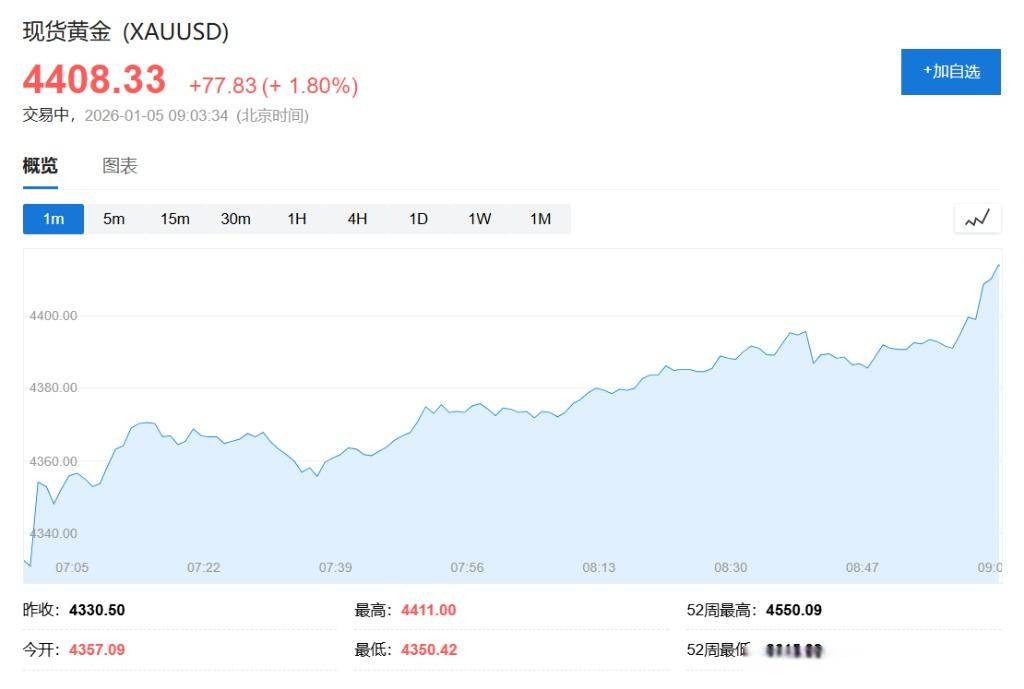
光大期货:0105黄金点评:南美政局动荡,黄金热度难降
Xin Lang Cai Jing· 2026-01-05 02:39
Core Viewpoint - The recent geopolitical tensions, particularly the U.S. actions in Venezuela, have heightened risk aversion, leading to a rebound in gold prices. The long-term logic for gold remains unchanged, with geopolitical changes likely to dominate short-term trends [2][7]. Group 1: Factors Influencing Precious Metals - The core factors affecting precious metals last month were the questioning of the Federal Reserve's independence and the shift from a "hawkish" to a "dovish" stance. Internal divisions among Fed officials were evident, with one member advocating for more aggressive rate cuts while two others preferred to maintain the status quo. The Fed's monetary policy reflects its struggles with inflation resilience, employment downturn risks, economic slowdown data, and tight financial market liquidity [3][8]. - The market anticipates that there may be about two rate cuts in 2026, but the path remains highly uncertain. However, it is clear that under strong pressure from the U.S. government, the Fed will maintain a relatively loose liquidity environment, which is a key factor in reigniting the precious metals market [3][8]. Group 2: Geopolitical Risks - Geopolitical instability has resurfaced, particularly with the ongoing Russia-Ukraine conflict showing no signs of resolution. Additionally, the sudden escalation of tensions between the U.S. and Venezuela has transformed into a geopolitical crisis in South America. This "black swan" event has injected significant risk premiums into the global energy market and reshaped the risk aversion sentiment in financial markets [3][8]. Group 3: Gold Market Outlook - The combination of the Fed's loose monetary policy, geopolitical factors, and declining U.S. dollar credibility suggests that potential risk factors in the market are unlikely to diminish effectively. This scenario supports a long-term upward trend for gold prices. The dependency of U.S. equities on liquidity has also pressured the Fed to maintain a loose monetary stance, raising concerns about its independence [4][10]. - Although the U.S.-Venezuela conflict has quickly subsided, its aftereffects are expected to linger. It is anticipated that gold prices will open high and then experience fluctuations, with the overall market in January likely to exhibit a pattern of "high-level oscillation and overall stability" [4][10].

大越期货沪铜周报-20260105
Da Yue Qi Huo· 2026-01-05 02:29
目录 一、行情回顾 二、基本面(库存结构) 三、市场结构 沪铜周报(12.29~12.31) 大越期货投资咨询部:祝森林 从业资格证号:F3023048 投资咨询证号: Z0013626 联系方式:0575-85226759 重要提示:本报告非期货交易咨询业务项下服务,其中的观点和信息仅作参考之用,不构成对任何人的投资建议。 我司不会因为关注、收到或阅读本报告内容而视相关人员为客户;市场有风险,投资需谨慎。 交易咨询业务资格:证监许可【2012】1091号 上周回顾 沪铜周评: 上周沪铜强势拉涨,沪铜主力合约上涨5.95%,收报于98720元/吨。宏观面看,地缘政治扰动铜价,全 球不稳定因素仍存,印尼铜矿出险不可抗力和贵金属大涨,对铜价有明显支撑作用。国内方面,消费 淡季,目前来看下游消费意愿一般。产业端,国内现货交易一般,整体还是刚需交易为主。库存方面, 铜库存LME库存160400吨,上周小幅减少,上期所铜库存较上周,增15898吨至111703吨。 期货主力 数据来源:博易大师 基本面 1、PMI 2、供需平衡表 3、库存 PMI 数据来源:Wind 供需平衡 2024供需紧平衡,2025过剩 数据来源 ...
亚太股市集体高开,A股军工股全线走强,黄金涨破4400美元
21世纪经济报道· 2026-01-05 02:07
Core Viewpoint - The article highlights the significant rise in gold and silver prices due to escalating geopolitical tensions, with gold surpassing the $4,400 mark and silver nearing $75 [1][2]. Market Performance - As of the morning of the 5th, spot gold increased by 1.63% to $4,402.009, while COMEX gold futures rose by 1.73% to $4,404.5 [1][2]. - Spot silver surged nearly 4% to $75.612, with COMEX silver up by 5.89% to $75.195 [2]. - International oil prices showed volatility, reversing from a decline to an increase [3]. Stock Market Reaction - The Asia-Pacific stock markets opened higher, with Japan's Nikkei 225 index rising over 2.6% and South Korea's composite index increasing by more than 2% [4]. - In the Chinese stock market, the three major indices opened positively, with the Shanghai Composite Index up by 0.46%, the Shenzhen Component up by 0.80%, and the ChiNext Index up by 0.84% [4][5]. Geopolitical Context - The article mentions that Venezuelan President Maduro is facing legal challenges in the U.S., which could impact oil production due to sanctions [7]. - Analysts suggest that the geopolitical tensions may lead to increased risk premiums in oil prices, potentially pushing WTI and Brent crude oil prices to around $60 and $63 per barrel, respectively [7].

突发!英、法发动空袭!特朗普威胁!委内瑞拉:全面战备!黄金、白银猛涨
券商中国· 2026-01-05 01:48
地缘局势再起波澜。 据最新消息,英、法两国战机在叙利亚中部地区,对一处疑似被"伊斯兰国"组织成员用于储存武器和爆炸物的 地下设施实施了空袭。另外,美国总统特朗普4日对委内瑞拉代理总统发出威胁,宣称委内瑞拉可能不会是美 国干预的最后一个国家。委内瑞拉国防部表示,该国已启动全面战备状态。 市场对地缘政治不确定性的本能反应,使得贵金属再次成为资金的避风港。1月5日早盘,现货黄金价格直线拉 升,截至北京时间9:10,大涨1.73%,报4406.31美元/盎司;现货白银暴涨超4%,铂金、钯金等贵金属亦全线 上扬。原油市场的表现相对冷静,布伦特原油、WTI原油期货分别涨0.61%、0.54%。 英国国防大臣希利称:"此次行动彰显了英国的领导力,以及我们与盟友并肩作战、坚决遏制'伊斯兰国'及其 暴力意识形态在中东地区死灰复燃的决心。"叙利亚政府暂未就此次空袭事件发表评论。叙利亚于去年年底加 入了这支打击"伊斯兰国"的联军。 特朗普发出威胁 据新华社消息,特朗普4日对委内瑞拉代理总统罗德里格斯发出威胁,称她如果"不做正确的事"将付出"沉重代 价"。特朗普还称美国或继续对外干预,美"绝对需要格陵兰岛"。 特朗普当天在接受美国《 ...

铜冠金源期货商品日报-20260105
Tong Guan Jin Yuan Qi Huo· 2026-01-05 01:42
Report Industry Investment Rating - Not provided in the report Core Viewpoints of the Report - The global commodity market is affected by multiple factors including geopolitical events, economic data, and regulatory policies. Different commodities have different trends and outlooks due to their own supply - demand fundamentals and external influences [2][3][4] Summary by Commodity Categories Macro - Overseas: Trump's actions against Venezuela have escalated the risk from long - term sanctions to direct regime impact, increasing oil market risk premium and pressuring global risk appetite. This week, key US economic data such as December ISM manufacturing PMI, ADP, and non - farm payrolls are to be watched [2] - Domestic: China's December manufacturing PMI returned above 50, indicating a marginal stabilization of economic sentiment at the end of 2025, but it is a phased repair. The new regulations on fund sales fees have cleared the policy uncertainty in the bond market, potentially easing the downward pressure on the bond market in the short term. December inflation data is to be watched this week [3] Precious Metals - The price of precious metals had a significant correction before the New Year's Day holiday due to increased regulatory pressure from domestic and foreign exchanges. The CME's two - time increase in precious metal margins led to a capital outflow and a market correction. In the long term, the logic for being bullish on precious metals remains unchanged, and the short - term adjustment may continue. Geopolitical tensions may restart the safe - haven demand for precious metals [4][5] Copper - The price of LME copper slowed its upward trend after reaching a high of $12,500 during the New Year's Day holiday. The market expects the US to impose tariffs on refined copper in mid - 2026, which may lead to a shortage of raw materials in other regions. The Fed's internal divergence on interest rate cuts, a low probability of a January rate cut, and the correction of gold and silver prices all put pressure on copper prices. The start - up of a copper refining project in Sichuan may also impact the supply. Overall, copper prices may face short - term correction pressure [6][7] Aluminum - Geopolitical events in Venezuela have little impact on the current bauxite supply and demand. Fundamentally, the supply side in Inner Mongolia has new production capacity under commissioning but not yet released. The consumption end has a decline in the aluminum processing start - up rate, and social inventories have increased. Aluminum prices may experience a high - level adjustment [8][9] Alumina - The US action against Venezuela has limited impact on the current bauxite market supply and demand. The supply of alumina has a temporary reduction due to a maintenance in Guizhou. The demand increment is limited as electrolytic aluminum enterprises in Inner Mongolia are in the early stage of commissioning. The cost - loss production capacity may increase the willingness to cut production, and alumina is expected to stabilize and oscillate [10][11] Cast Aluminum - The raw material waste aluminum market has more circulation. The cost remains high due to the high - level oscillation of industrial silicon and copper prices. The demand side of die - casting enterprises is weak, and the price is expected to maintain a high - level oscillation pattern [12] Zinc - Geopolitical conflicts and upcoming important US economic data release make the market sentiment cautious. Fundamentally, the decline in processing fees has slowed down, but the supply is increasing as refineries resume production, and the downstream start - up rate is affected by holidays and weak consumption. Zinc prices are expected to be under pressure [13][14] Lead - Geopolitical conflicts pressure the market risk preference. The processing fees are weakly stable, providing cost support. The supply recovery is limited, and the demand is weak. Low inventory provides support for lead prices, which are expected to continue wide - range oscillation [15] Steel (Screw and Coil) - During the holiday, steel futures were closed. Last week, the supply and demand of the five major steel products both increased, and the inventory continued to decline. The production of rebar increased for three consecutive weeks, and the demand showed a seasonal weakening. The production of hot - rolled coils recovered, and the inventory decline slowed down. Steel prices are expected to oscillate [16] Iron Ore - During the holiday, iron ore futures were closed, and overseas prices were basically flat. In December 2025, the global iron ore shipment volume and China's import volume reached record highs, while the demand decreased due to steel mill losses and winter maintenance. The inventory also reached a new high. The supply is strong and the demand is weak, so iron ore prices are expected to be under pressure [17][18] Coking Coal and Coke - During the holiday, coking coal and coke futures were closed. This week, the inventory of coking coal in mines and ports increased, and the inventory of downstream enterprises also changed. After four rounds of price cuts for coke, the profit of coke enterprises continued to shrink, but the start - up rate was stable. The demand support was insufficient, and the inventory increased. The prices of coking coal and coke are expected to oscillate at a low level [19] Soybean Meal and Rapeseed Meal - In the week of New Year's Day, CBOT soybeans and related meal contracts declined. The US soybean export sales progress is slow, and South America maintains a high - yield expectation. After New Year's Day, the pre - Spring Festival stocking period is approaching, and the short - term Dalian soybean meal is expected to oscillate [20][21][22] Palm Oil - In the week of New Year's Day, BMD palm oil declined, and the export demand of Malaysian palm oil weakened again. The domestic palm oil is expected to make up for the decline after the holiday and is expected to oscillate in a short - term range [23][24]
能源化工日报-20260105
Wu Kuang Qi Huo· 2026-01-05 01:35
Report Industry Investment Rating No relevant information provided. Core Viewpoints - Methanol: Current valuation is low, and the pattern will improve marginally next year. Although short - term downside risks remain, due to geopolitical instability in Iran, there is a feasibility of going long on dips [3]. - Urea: The current domestic - foreign price difference has opened the import window, and with the expected increase in production at the end of January, bearish fundamentals are coming, so take profits on rallies [6]. - Rubber: The current situation calls for a neutral approach and temporary observation. Partially close the hedging position of buying RU2605 and selling RU2609 [14]. - PVC: Fundamentally, the comprehensive corporate profit is at a historically low level, with short - term valuation pressure being small. However, supply reduction is limited, production is at a historical high, and domestic demand is in the off - season. In the short - term, strong sentiment drives a rebound, but in the medium - term, the strategy is to go short on rallies before significant industry production cuts [16]. - Pure Benzene & Styrene: Currently, the non - integrated profit of styrene is moderately low, with a large upward repair space for valuation. Before the first quarter of next year, it is advisable to go long on the non - integrated profit of styrene [19]. - Polyethylene: OPEC+ plans to suspend production growth in Q1 2026, and the crude oil price may have bottomed. The long - term contradiction has shifted from cost - induced decline to production mismatch. Go long on the LL5 - 9 spread on dips [22]. - Polypropylene: In the context of weak supply and demand, the overall inventory pressure is high. There is no prominent short - term contradiction. The futures price may bottom out when the supply - surplus pattern changes in Q1 next year [25]. - PX: Currently, the PX load remains high, and downstream PTA has many maintenance activities. Before the maintenance season, PX is expected to maintain a slight inventory build - up pattern. In the short - term, there is a large expected component in the market, so beware of correction risks. In the medium - term, look for opportunities to go long on dips [27]. - PTA: In the short - term, supply will maintain high - level maintenance. Demand for polyester and chemical fibers is under pressure, and due to the off - season, the load will gradually decline. After short - term inventory depletion, PTA will enter the Spring Festival inventory build - up stage. In the short - term, beware of corrections due to over - expectation, and in the medium - term, look for opportunities to go long on dips [30]. - Ethylene Glycol: The overall load is still relatively high. The port inventory build - up cycle will continue, and in the medium - term, there is an expectation of further profit compression and load reduction under the pressure of new device commissioning. Valuation needs to be compressed without further domestic production cuts [32]. Detailed Summaries by Commodity Crude Oil - Futures Prices: As of the last trading day of the holidays, the INE main crude oil futures closed down 6.40 yuan/barrel, a 1.46% decline, at 432.20 yuan/barrel. Related refined oil main futures, high - sulfur fuel oil closed down 37.00 yuan/ton (1.49%) at 2447.00 yuan/ton, and low - sulfur fuel oil closed down 65.00 yuan/ton (2.17%) at 2935.00 yuan/ton [1]. - European ARA Data: Gasoline inventory increased by 1.38 million barrels to 10.52 million barrels (15.07% MoM), diesel inventory decreased by 0.12 million barrels to 14.61 million barrels (0.81% MoM), fuel oil inventory increased by 0.37 million barrels to 7.06 million barrels (5.60% MoM), naphtha inventory decreased by 0.83 million barrels to 4.63 million barrels (15.18% MoM), aviation kerosene inventory decreased by 0.36 million barrels to 7.82 million barrels (4.43% MoM), and the total refined oil inventory increased by 0.44 million barrels to 44.64 million barrels (1.00% MoM) [1]. Methanol - Spot Price Changes: Jiangsu changed by 5 yuan/ton, Lunan by - 15 yuan/ton, Henan by 10 yuan/ton, Hebei by 0 yuan/ton, and Inner Mongolia by - 20 yuan/ton [2]. Urea - Spot Price Changes: Shandong changed by 0 yuan/ton, Henan by - 10 yuan/ton, Hebei by 0 yuan/ton, Hubei by 0 yuan/ton, Jiangsu by 0 yuan/ton, Shanxi by 10 yuan/ton, and Northeast by 0 yuan/ton. The overall basis was reported at - 59 yuan/ton [5]. - Futures Price: The main contract changed by 6 yuan/ton, reported at 1749 yuan/ton [5]. Rubber - Price Movement: Rubber prices were in a sideways consolidation. Bulls expect price increases due to seasonal factors and demand expectations, while bears expect price decreases due to weak demand [10][11]. - Tire Industry: As of December 25, 2025, the operating load of all - steel tires in Shandong was 62.20%, down 2.46 ppts from last week and 0.02 ppts from the same period last year. The operating load of semi - steel tires was 73.74%, up 0.98 ppts from last week but down 5.05 ppts from the same period last year. Tire inventories were under high pressure [12]. - Inventory: As of December 21, 2025, China's natural rubber social inventory was 118.2 million tons, a 2.5% increase MoM. The total inventory of dark - colored rubber was 77.4 million tons (3.4% increase), and that of light - colored rubber was 40.8 million tons (1% increase). The inventory in Qingdao was 50.92 (+1.5) million tons [12]. - Spot Prices: Thai standard mixed rubber was 14650 (0) yuan, STR20 was reported at 1855 (- 5) dollars, STR20 mixed was 1860 (0) dollars, Jiangsu and Zhejiang butadiene was 8350 (0) yuan, and North China butadiene rubber was 11000 (0) yuan [13]. PVC - Futures and Spot Prices: The PVC05 contract fell 5 yuan to 4805 yuan. The spot price of Changzhou SG - 5 was 4500 (0) yuan/ton, and the basis was - 305 (+5) yuan/ton. The 5 - 9 spread was - 134 (- 1) yuan/ton [15]. - Cost and Supply: The cost of calcium carbide in Wuhai was 2325 (0) yuan/ton, the price of semi - coke was 820 (0) yuan/ton, ethylene was 745 (0) dollars/ton, and caustic soda was 703 (0) yuan/ton. The overall PVC operating rate was 78.6%, a 1.4% increase MoM; the calcium carbide method was 78.4% (0.1% decrease), and the ethylene method was 79.3% (5% increase) [15]. - Demand and Inventory: The overall downstream operating rate was 44.5%, a 0.9% decrease MoM. Factory inventory was 30.9 million tons (+0.3), and social inventory was 106.3 million tons (+0.3) [15]. Pure Benzene & Styrene - Price and Basis: The spot price of pure benzene in East China was 5340 yuan/ton (unchanged), the closing price of the active contract was 5463 yuan/ton (unchanged), and the basis was - 123 yuan/ton (24 - yuan expansion). The spot price of styrene rose 50 yuan/ton to 6900 yuan/ton, the closing price of the active contract rose 10 yuan/ton to 6791 yuan/ton, and the basis was 109 yuan/ton (40 - yuan strengthening) [18]. - Supply and Demand: The upstream operating rate was 70.7%, a 1.57% increase. The inventory in Jiangsu ports decreased by 0.05 million tons to 13.88 million tons. The weighted operating rate of three S products was 42.24%, a 1.77% increase. The operating rate of PS was 59.40% (4.90% increase), EPS was 52.56% (0.76% increase), and ABS was 69.40% (0.70% decrease) [18]. - Profit: The BZN spread was 133.37 yuan/ton (4 - yuan decrease), and the non - integrated device profit of EB was - 76.1 yuan/ton (40 - yuan increase) [18]. Polyethylene - Price and Basis: The closing price of the main contract rose 11 yuan/ton to 6472 yuan/ton, the spot price rose 10 yuan/ton to 6375 yuan/ton, and the basis was - 97 yuan/ton (1 - yuan weakening) [21]. - Supply and Demand: The upstream operating rate was 82.27%, a 0.82% decrease MoM. The production enterprise inventory decreased by 8.79 million tons to 37.07 million tons, and the trader inventory decreased by 0.49 million tons to 2.76 million tons. The downstream average operating rate was 41.15%, a 0.68% decrease MoM. The LL5 - 9 spread was - 37 yuan/ton (2 - yuan narrowing) [21]. Polypropylene - Price and Basis: The closing price of the main contract rose 27 yuan/ton to 6348 yuan/ton, the spot price was unchanged at 6275 yuan/ton, and the basis was - 73 yuan/ton (27 - yuan weakening) [23]. - Supply and Demand: The upstream operating rate was 75.65%, a 1.76% decrease MoM. The production enterprise inventory decreased by 0.45 million tons to 53.33 million tons, the trader inventory decreased by 1.11 million tons to 18.72 million tons, and the port inventory increased by 0.12 million tons to 6.87 million tons. The downstream average operating rate was 53.24%, a 0.56% decrease MoM. The LL - PP spread was 124 yuan/ton (16 - yuan narrowing) [23][24]. PX - Futures and Spot Prices: The PX03 contract fell 56 yuan to 7260 yuan, PX CFR fell 1 dollar to 893 dollars, and the basis was - 25 yuan (+42). The 3 - 5 spread was - 6 yuan (+10) [26]. - Load and Inventory: China's PX load was 88.2%, a 0.1% increase; the Asian load was 79.5%, a 0.6% increase. In December, South Korea exported 28.3 million tons of PX to China, a 0.8 - million - ton increase YoY. The inventory at the end of November was 402 million tons, a 5 - million - ton decrease MoM [26]. - Valuation and Cost: PXN was 355 dollars (- 1), South Korea's PX - MX was 143 dollars (- 7), and the naphtha crack spread was 89 dollars (+3) [26]. PTA - Futures and Spot Prices: The PTA05 contract fell 34 yuan to 5110 yuan, the East China spot price fell 5 yuan to 5095 yuan, the basis was - 46 yuan (+4), and the 5 - 9 spread was 100 yuan (- 18) [29]. - Load and Inventory: The PTA load was 72.5%, a 0.7% decrease. The downstream load was 90.4%, a 0.7% decrease. On December 26, the social inventory (excluding credit warehouse receipts) was 205.5 million tons, a 5.2 - million - ton decrease [29]. - Valuation and Cost: The spot processing fee of PTA rose 4 yuan to 349 yuan, and the futures processing fee rose 2 yuan to 347 yuan [29]. Ethylene Glycol - Futures and Spot Prices: The EG05 contract fell 44 yuan to 3803 yuan, the East China spot price fell 13 yuan to 3681 yuan, the basis was - 141 yuan (- 2), and the 5 - 9 spread was - 93 yuan (- 9) [31]. - Supply and Demand: The ethylene glycol load was 73.3%, a 1.4% increase. The downstream load was 90.4%, a 0.7% decrease. The import arrival forecast was 10.7 million tons, and the East China departure on December 30 was 1.1 million tons. The port inventory was 73 million tons, a 1.4 - million - ton increase [31]. - Valuation and Cost: The naphtha - based profit was - 829 yuan, the domestic ethylene - based profit was - 925 yuan, and the coal - based profit was 188 yuan. The cost of ethylene was flat at 745 dollars, and the price of Yulin pit - mouth bituminous coal fines fell to 540 yuan [31].