
人民币国际化

Search documents
国际化更进一步!人民币,大消息
Zhong Guo Ji Jin Bao· 2025-11-05 22:33
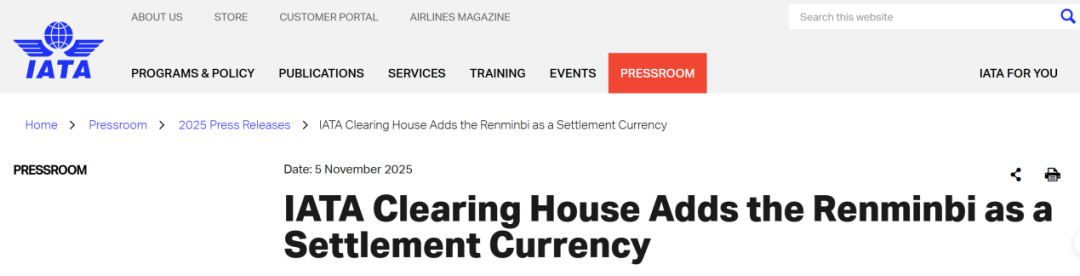
Core Points - The International Air Transport Association (IATA) announced the addition of the Chinese Yuan (RMB) as a settlement currency for its Clearing House (ICH), set to launch in December 2025 after a trial run [1][3] - This new option is expected to significantly benefit airlines operating in China by reducing exchange rate risks, simplifying local supplier access, and enhancing cost efficiency [3][4] Group 1: Industry Impact - The introduction of RMB settlement is seen as a positive development for the Chinese aviation industry, with major airlines like China Southern Airlines and Xiamen Airlines set to pilot the program in November 2025 [4] - The announcement led to a rise in airline stocks, with China Southern Airlines and China National Aviation Holdings seeing increases of nearly 2% and over 5% respectively [4][5] Group 2: Financial Services and Market Response - IATA's Clearing House currently supports seven currencies, and the addition of RMB aims to enhance financial services for member airlines without incurring extra costs [3][7] - The market response to the new RMB settlement option has been positive, indicating strong demand for improved financial services in the aviation sector [7] Group 3: RMB Internationalization - The People's Bank of China (PBOC) highlighted the steady rise of the RMB's international status, noting it is now the largest currency for China's foreign receipts and the second-largest for trade financing globally [7][8] - The PBOC has established 32 effective swap agreements with central banks across major economies, covering key regions globally, with a total scale of approximately 4.5 trillion RMB [7]

顶层设计指明奋进方向 衍生品市场迎来历史性机遇
Zhong Guo Zheng Quan Bao· 2025-11-05 20:08
Core Insights - The inclusion of derivatives in the "14th Five-Year Plan" marks a significant elevation in their strategic position within the financial system, transitioning from a supplementary tool to a core component of national economic planning [1][2][3] Group 1: Strategic Importance of Derivatives - The derivatives market is being assigned a new historical mission, emphasizing its role in risk management and as a vital part of the national financial system [1][2] - The shift in policy reflects a deeper strategic consideration for building a more resilient modern financial system, which requires strong risk pricing, dispersion, and capacity [2][3] - The "14th Five-Year Plan" indicates a deepening phase of financial reform, highlighting the strategic value of derivatives in achieving high-quality economic development [2][3] Group 2: Market Growth and Participation - The total funds in China's futures market surpassed 2 trillion yuan, reaching approximately 2.02 trillion yuan, a 24% increase from the end of 2024 [3] - The number of listed companies participating in futures and options trading has increased, with 529 out of 5,383 A-share companies involved, representing 9.8% of all listed companies and 35.8% of market capitalization [3][4] Group 3: Evolving Demand for Derivatives - The demand for derivatives has shifted from optional tools to essential components for risk management among various enterprises, including large state-owned and small to medium-sized enterprises [5][6] - There is a growing need for comprehensive solutions rather than traditional hedging methods, integrating derivatives into daily business decision-making [5][6] Group 4: Industry Transformation and Challenges - The futures industry is undergoing a transformation to adapt to new strategic requirements, aiming to extend its role from providing risk management services to contributing to national financial security [6][7] - Key challenges include the need for refined legal frameworks, improving investor structure, enhancing international market connectivity, and innovating key financial futures products [6][7] - The industry requires policy support for regulatory updates, investor ecosystem optimization, and expanded cross-border risk hedging channels [6][7]
人民币,大消息!
中国基金报· 2025-11-05 15:11
Core Viewpoint - The International Air Transport Association (IATA) has announced the addition of the Chinese Yuan (RMB) as a settlement currency in its clearing house, marking a significant step forward for RMB internationalization [1][2]. Group 1: RMB as a Settlement Currency - The RMB settlement will be available starting December 2025, following a trial run, providing significant benefits to airlines operating in China by reducing exchange rate risks and simplifying local supplier access [2]. - China Southern Airlines and Xiamen Airlines will be the first to pilot the RMB settlement in November 2025 [4]. - The introduction of RMB settlement is seen as a positive development for the Chinese aviation industry, facilitating faster settlements and lowering costs associated with multiple currency exchanges [4][7]. Group 2: Market Reaction - Following the announcement, airline stocks experienced a notable increase, with Southern Airlines and China National Aviation rising nearly 2%, and Huaxia Airlines increasing over 5% [5]. - The aviation index showed a slight increase of 0.63%, reflecting positive market sentiment towards the new RMB settlement option [6]. Group 3: IATA Clearing House Operations - The IATA Clearing House currently supports seven currencies and provides efficient settlement services for 581 airlines and related enterprises, with a projected settlement amount of $63.8 billion in 2024, including 33 airlines operating in China [6]. - IATA's senior vice president emphasized that the addition of RMB settlement is a crucial step in meeting the demand for cost-effective financial services from member airlines [7]. Group 4: RMB Internationalization - The People's Bank of China (PBOC) highlighted the steady rise of the RMB's international status, noting it is now the largest settlement currency for China's foreign trade and the second-largest trade financing currency globally [8]. - The PBOC has signed 32 effective swap agreements with central banks from various countries, covering major economies across six continents, amounting to approximately 4.5 trillion RMB [8]. - Future plans include building a self-controlled cross-border payment system for RMB and enhancing the efficiency of cross-border RMB clearing services [9].





中国开放从“跟跑”到“领跑”!《世界开放报告2025》发布
Di Yi Cai Jing· 2025-11-05 14:07
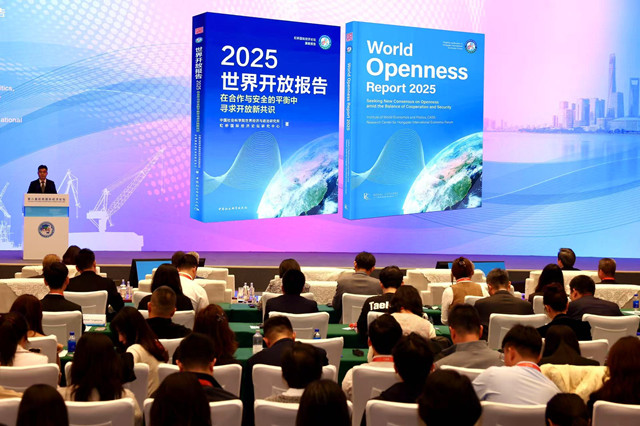
Core Insights - The world is at a crossroads of "openness or closure," with a complex landscape characterized by "overall tightening, increasing differentiation, and momentum transformation" in global openness [1][4][5] - The 2024 World Openness Index is reported at 0.7545, a slight decrease of 0.05% year-on-year, indicating a continued contraction in global openness levels [1][4] Summary by Categories World Openness Index - The 2024 World Openness Index shows a decline of 0.05% compared to 2023, a 0.34% decrease from 2019, and a 5.39% drop from 2008, while it has increased by 7.08% since 1990 [1][4] - China's openness index has risen from 0.5891 in 1990 to 0.7634 in 2024, marking a 29.6% increase, positioning it among the top globally [1][6] Economic Trends - Global foreign direct investment has decreased by 11%, with over 40% of investment restrictions related to foreign capital scrutiny, particularly in high-tech and critical mineral sectors [5] - Economic openness index has declined by 0.22% year-on-year, while cultural openness index has decreased by 0.58%, both below levels from 2019 and 2008 [5] Regional Dynamics - Europe and North America are identified as the only regions experiencing a contraction in openness, while emerging markets and developing economies have seen a 0.42% increase in their openness index [5][6] Future Outlook - The report emphasizes that future global openness will increasingly rely on emerging forces, with digital trade becoming a significant growth engine, expanding from $3.5 trillion in 2010 to $8.2 trillion in 2023 [6] - The market for cutting-edge technologies is projected to grow from $2.5 trillion in 2023 to $16.4 trillion by 2033, creating new opportunities for open cooperation and security governance [6] Report Innovations - The report has achieved four major breakthroughs, including collaboration with a Nobel laureate and the expansion of the openness index's time span from 17 to 35 years, providing a more robust data foundation for analyzing long-term trends [6][7]
第八届进博会丨链接全球经贸新机遇——虹桥论坛中外嘉宾共话金融助力全球经贸发展
Xin Hua Wang· 2025-11-05 13:31
Group 1 - The eighth China International Import Expo opened on November 5, featuring the Hongqiao International Economic Forum, which focused on how finance can link global economic and trade opportunities [1] - Shanghai's financial market transaction volume reached 2967.83 trillion yuan from January to September, marking a 12.7% year-on-year increase [1] - Shanghai aims to deepen financial market reforms and promote high-level financial openness, leveraging its free trade zone and new areas for more flexible cross-border financial services [1] Group 2 - The restructuring of global supply chains has created new demands for cross-border financial services, prompting commercial banks to innovate and integrate logistics, information, and capital flows [2] - The internationalization of the renminbi is timely as China's trade relations deepen with more countries, with banks encouraged to enhance offshore renminbi financial products [2] - A strategic cooperation memorandum was signed between the Bank of China and the Hong Kong Trade Development Council, highlighting the commitment to financial innovation and global economic development [2]
“十五五”加快建设金融强国有哪些主要任务和重要举措?中央金融办回应
第一财经· 2025-11-05 11:58
Core Viewpoint - The article emphasizes the importance of strengthening the financial sector as a key component of China's modernization efforts, as outlined in the 15th Five-Year Plan [1]. Group 1: Key Tasks and Measures for Financial Strengthening - The financial system is tasked with advancing risk prevention, enhancing regulation, and promoting high-quality development [2]. - Continuous improvement of the central bank system is essential, including establishing a robust monetary policy framework and a comprehensive macro-prudential management system [2]. - The article highlights the need for a supportive financial environment for high-level technological self-reliance and green transformation, as well as the development of a multi-layered and sustainable inclusive financial system [2]. Group 2: Capital Market Development - The focus is on promoting a healthy and stable capital market that accommodates new industries and technologies, aligning with the needs of technological innovation and the growth of tech enterprises [3]. - There is an emphasis on enhancing the functions of the capital market to coordinate investment and financing, while also strengthening the regulatory framework for listed companies [3]. Group 3: Financial Infrastructure and International Center - The article discusses the optimization of financial institutions and infrastructure, encouraging institutions to focus on their core businesses and improve governance [3]. - It also mentions the acceleration of building an international financial center, particularly in Shanghai, to enhance its market influence and support Hong Kong's status as an international financial hub [3]. Group 4: Regulatory Enhancements - Comprehensive improvements in financial regulatory capabilities are necessary, including strengthening various forms of oversight and ensuring all financial activities are regulated [4]. - The establishment of a financial risk early correction mechanism is crucial for timely detection and management of risks [4]. Group 5: Legal Framework in Finance - The article stresses the importance of advancing financial law legislation to guide and regulate the financial sector effectively, with a zero-tolerance approach to illegal financial activities [4].

4.5万亿货币互换!32国绑定中国人民币,金砖国家30%贸易绕开美元
Sou Hu Cai Jing· 2025-11-05 11:55
Group 1 - The core point of the article is the increasing acceptance and use of the Chinese yuan (RMB) in international trade, with a significant shift away from the US dollar, as evidenced by a 4.5 trillion yuan currency swap network involving 32 countries [3][13][15] - The RMB is becoming more popular among businesses due to its efficiency and cost-effectiveness, with examples of companies saving time and money on cross-border transactions [5][9][11] - The RMB cross-border payment system connects 189 countries and regions, facilitating efficient currency flow for both large enterprises and small businesses [11][24] Group 2 - The 4.5 trillion yuan currency swap agreements serve as a financial safety net for countries, allowing them to exchange their currencies for RMB without relying on the US dollar [13][15] - Over 80 countries are now including the RMB in their foreign exchange reserves, indicating a growing trust in the currency [15][24] - The RMB's share in China's goods trade reached a historical high of 28% in the first half of the year, reflecting its increasing acceptance globally [24][27] Group 3 - The article highlights the shift in global financial dynamics, with the US dollar's share in global foreign exchange reserves dropping to 56.32%, the lowest in nearly 30 years [28] - The rise of the RMB is not about competing for dominance but providing a reliable alternative to the dollar, contributing to a more diversified and stable financial system [27][30][32] - The article concludes that the RMB's rise could lead to more convenient international transactions for individuals and businesses, fostering a fairer financial environment [30][32]
“十五五”加快建设金融强国有哪些主要任务和重要举措?中央金融办王江回应
Xin Hua She· 2025-11-05 11:38
Core Viewpoint - The article emphasizes the importance of accelerating the construction of a financial powerhouse in China as part of the national modernization strategy, highlighting key tasks and initiatives outlined in the 15th Five-Year Plan [1]. Group 1: Major Tasks and Initiatives - Continuous improvement of the central bank system, including the establishment of a robust monetary policy framework and a comprehensive macro-prudential management system, while maintaining the stability of the RMB exchange rate and promoting its internationalization [2]. - Deepening the "five major articles" of finance, which includes enhancing financial support for technological independence, promoting green transformation, and developing a sustainable inclusive finance system [2]. - Promoting the healthy and stable development of capital markets by improving their inclusiveness for new industries and technologies, and establishing a comprehensive regulatory system for listed companies [2]. Group 2: Financial Infrastructure and Regulation - Further optimization of financial institutions and infrastructure, encouraging various financial entities to focus on their core businesses and improve governance [3]. - Accelerating the construction of international financial centers, particularly in Shanghai and Hong Kong, to enhance their influence and support the development of offshore RMB business [3]. - Comprehensive enhancement of financial regulatory capabilities, including strengthening oversight across all financial activities and improving early warning mechanisms for financial risks [3]. Group 3: Legal Framework - Strengthening financial legal construction by completing financial legislation and enhancing enforcement against illegal financial activities, ensuring a zero-tolerance approach to violations [3].
数字货币迎来“iPhone时刻”?从概念到规模应用还要迈过多道坎
Di Yi Cai Jing· 2025-11-05 10:14
Core Insights - China is at the forefront of developing and applying legal digital currencies, with significant advancements in theoretical design, technical architecture, and application scenarios [1] - The transition from concept validation to large-scale application of digital currencies is underway, with notable growth in their use in cross-border trade and local payments [2][3] - Digital currencies are seen as a new pathway for the internationalization of the Renminbi, especially in light of concerns over the global penetration of the US dollar [4] Group 1: Digital Currency Development - The People's Bank of China and other global monetary authorities are exploring a multilateral cooperation model for central bank digital currencies (CBDCs), enabling real-time cross-border payments [2] - The digital Renminbi has been successfully integrated with Hong Kong's "Faster Payment System," enhancing cross-border payment capabilities [2] - The rapid expansion of digital currency applications in emerging markets is positioning them as a tool for value preservation and risk hedging [2] Group 2: Challenges in Implementation - The complexity of international trade processes presents challenges for the widespread adoption of digital currencies, necessitating seamless integration of various systems [5] - Regulatory clarity is lacking in some regions, which hampers the large-scale application of digital currencies [6] - There is a significant gap in understanding and trust regarding digital currencies among traditional enterprises and individuals, which needs to be addressed for broader acceptance [6] Group 3: Future Opportunities - The attractiveness of the digital Renminbi will increase with its accessibility and convertibility in broader markets [7] - The upcoming financial environment, with expected lower US benchmark interest rates, may boost the demand for cross-border financing using digital currencies and real-world asset tokenization [7] - The internationalization of the Renminbi hinges on providing quality assets denominated in Renminbi, particularly in sectors where China has competitive advantages, such as renewable energy [8]
36氪晚报|诺和诺德下调全年盈利预期,因减肥药竞争和价格压力;京东联合广汽、宁德时代推出的埃安UT super 1号车正式下线
3 6 Ke· 2025-11-05 09:41
Group 1 - Stellantis announced a global recall of 375,000 plug-in hybrid Jeep Wrangler and Grand Cherokee SUVs due to battery safety issues, following 19 reported fire incidents [1] - The recall affects certain models from 2020 to 2025 for the Jeep Wrangler 4xe and from 2022 to 2026 for the Jeep Grand Cherokee 4xe, with a repair solution to be announced soon [1] Group 2 - Ant Group's AI health application AQ has surpassed 10 million monthly active users within four months of launch, achieving a compound monthly growth rate of 83.4%, significantly higher than the industry average of 13.5% [2] Group 3 - Novo Nordisk reported a third-quarter net profit of 20 billion Danish kroner (approximately $3.1 billion), aligning with analyst expectations, but lowered its full-year profit forecast due to prescription trends, competition, and pricing pressures [3] - Sales of its weight-loss drug Wegovy grew by 18% year-over-year to 20.35 billion Danish kroner, slightly below analyst expectations [3] Group 4 - Google’s parent company Alphabet's acquisition of cybersecurity firm Wiz, valued at approximately $32 billion, has passed U.S. antitrust review, marking it as Alphabet's largest acquisition to date [4] - The investment will enhance Google Cloud's cybersecurity solutions [4] Group 5 - Dazhong Dianping announced a plan to invest at least 3 billion yuan over the next five years to upgrade its local life information infrastructure, focusing on information verification capabilities [5] - The initiative aims to ensure accurate and timely information for millions of merchants [5] Group 6 - XPeng Motors plans to scale up the delivery of its flying car, the "Land Aircraft Carrier," by 2026 [6] - Volkswagen announced the development of its own system-on-chip (SoC) expected to be mass-produced within 3 to 5 years, with a processing power of 500 to 700 TOPS [6] Group 7 - Alibaba's Amap has partnered with XPeng Motors to create a global Robotaxi aggregation platform, marking a significant step in the autonomous driving sector [7] - This collaboration aims to provide L4 level autonomous driving services and expand Robotaxi services internationally [7] Group 8 - The Bank of China is actively promoting the use of the renminbi in energy, bulk commodities, and cross-border e-commerce transactions [8] - The bank aims to maintain its leading position in cross-border renminbi settlement and clearing services [8] Group 9 - Indonesia's economic growth is showing signs of weakening, with a third-quarter GDP growth of 5.04%, leading to expectations of further interest rate cuts by the central bank to support growth [9] - Challenges include slowing export growth and declining consumer confidence [9]
