
人民币汇率

Search documents
人民币对美元汇率逼近6.90关口
Sou Hu Cai Jing· 2026-02-10 09:57
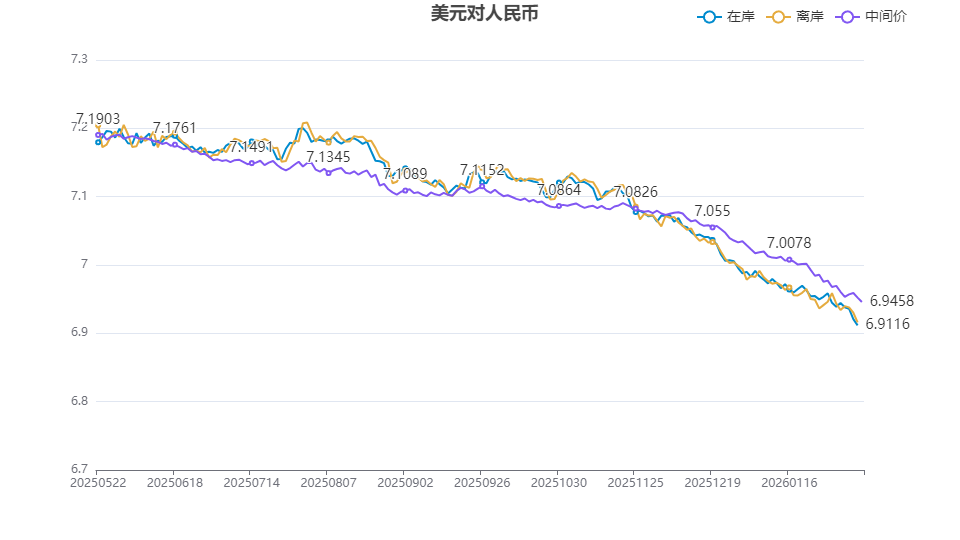
中新社北京2月10日电 (陶思阅)截至北京时间2月10日15时,离岸人民币对美元即期汇率一度逼近6.90关 口。当日,人民币对美元中间价报6.9458,上调65个基点。 在庞溟看来,更值得注意的是,市场对人民币汇率的看法转向"区间波动",情绪面明显改善。他预测, 在2026年,人民币汇率大概率延续双向波动、温和升值的特征,但趋势性走强仍需谨慎判断。与此同 时,地缘政治与全球贸易格局的不确定性仍可能带来阶段性扰动。 在当前外汇市场波动加大的背景下,于企业而言,套期保值的重要性上升。庞溟补充道,套期保值的核 心在于稳定预期、锁定成本、降低不确定性,能够避免汇率短期大幅波动侵蚀利润,提升经营的可预测 性。这对制造出口型企业、进口依赖度高的企业、跨境资产负债错配明显的企业尤为重要。(完) 国家金融与发展实验室特聘高级研究员庞溟认为,人民币走强是多重因素叠加的结果:美元指数回落, 为非美货币提供上行动力;中国1月外汇储备增加412亿美元,强化了市场对中国跨境资金流动稳定性的 判断;加之春节前中国出口企业结汇需求上升等,共同推动人民币升值。 中金公司研报称,随着季节性因素的逐步消退,人民币相较美元的强势表现可能有所退坡, ...
近三年来首次 离岸人民币逼近6.90关口
Xin Hua Cai Jing· 2026-02-10 03:01
国家外汇局表示,2026年1月,受主要经济体财政政策、货币政策及预期等因素影响,美元指数下跌,全球主要金融资产价格总体上涨。 汇率折算和资产价格变化等因素综合作用,当月外汇储备规模上升。我国经济运行稳中有进,发展韧性进一步彰显,为外汇储备规模保 持基本稳定提供支撑。 新华财经北京2月10日电10日亚洲交易时段盘中,离岸人民币兑美元升穿6.91关口,最高升至6.9060,续刷2023年5月以来新高;在岸人民 币兑美元升破6.92关口,最高升至6.9112。日内,人民币兑美元中间价上调65点报6.9458。 隔夜,美元指数两连跌至一周来盘中低位,离岸人民币兑美元涨破6.92关口,为近三年来首次。 近期,在内外部因素共振下,人民币汇率呈现出阶段性走强行情。上周CFETS人民币汇率指数报98.34,环比涨1.35;BIS货币篮子人民 币汇率指数报105.44,环比涨1.38;SDR货币篮子人民币汇率指数报93.44,环比涨0.92。 中国人民银行日前发布公告称,根据《中国人民银行与英格兰银行合作备忘录》,中国人民银行决定授权中国银行股份有限公司伦敦分 行担任英国人民币清算行。 伦敦作为全球主要金融中心,设立人民币清算 ...

人民币市场汇价(2月10日)
Xin Hua Wang· 2026-02-10 02:48
100美元 694.58人民币 100欧元 825.13人民币 100日元 4.4389人民币 100港元 88.882人民币 100英镑 947.95人民币 100澳元 490.55人民币 100新西兰元 418.77人民币 100新加坡元 547.62人民币 100瑞士法郎 903.16人民币 100加元 510.71人民币 100人民币115.97澳门元 100人民币56.723马来西亚林吉特 100人民币1113.43俄罗斯卢布 100人民币229.31南非兰特 100人民币21067韩元 100人民币53.025阿联酋迪拉姆 100人民币54.148沙特里亚尔 100人民币4562.25匈牙利福林 100人民币50.969波兰兹罗提 100人民币90.56丹麦克朗 100人民币128.8瑞典克朗 100人民币138.29挪威克朗 100人民币629.071土耳其里拉 100人民币248.07墨西哥比索 100人民币450.17泰铢 【纠错】 【责任编辑:薛涛】 新华社北京2月10日电 中国外汇交易中心2月10日受权公布人民币对美元、欧元、日元、港元、英 镑、澳元、新西兰元、新加坡元、瑞士法郎、加元、 ...
人民币对美元中间价报6.9458 调升65个基点
Zhong Guo Jing Ji Wang· 2026-02-10 02:17
(责任编辑:关婧) 中国人民银行授权中国外汇交易中心公布,2026年2月10日银行间外汇市场人民币汇率中间价为:1 美元对人民币6.9458元,1欧元对人民币8.2513元,100日元对人民币4.4389元,1港元对人民币0.88882 元,1英镑对人民币9.4795元,1澳大利亚元对人民币4.9055元,1新西兰元对人民币4.1877元,1新加坡 元对人民币5.4762元,1瑞士法郎对人民币9.0316元,1加拿大元对人民币5.1071元,人民币1元对1.1597 澳门元,人民币1元对0.56723马来西亚林吉特,人民币1元对11.1343俄罗斯卢布,人民币1元对2.2931南 非兰特,人民币1元对210.67韩元,人民币1元对0.53025阿联酋迪拉姆,人民币1元对0.54148沙特里亚 尔,人民币1元对45.6225匈牙利福林,人民币1元对0.50969波兰兹罗提,人民币1元对0.9056丹麦克朗, 人民币1元对1.2880瑞典克朗,人民币1元对1.3829挪威克朗,人民币1元对6.29071土耳其里拉,人民币1 元对2.4807墨西哥比索,人民币1元对4.5017泰铢。 中国经济网北京2月10日讯 来 ...
离岸人民币升破6.91
Bei Jing Shang Bao· 2026-02-10 01:57
北京商报讯(记者 董晗萱)2月10日,人民币对美元中间价调升65个基点,报6.9458。前一交易日中间 价报6.9523。 截至当日9时40分,在岸人民币对美元汇率报6.9156,日内升值0.08%;离岸人民币对美元汇率报 6.9099,日内升值0.08%。 ...
朝闻国盛:周期板块景气预期开启扩张
GOLDEN SUN SECURITIES· 2026-02-10 01:15
Group 1: Macro Overview - The report indicates that the cyclical sector is expected to enter an expansion phase, with both cyclical and growth sectors currently in the analysts' expansion zone, resonating with the industry mainline model [3] - The report highlights that the cumulative amount of pending foreign exchange settlement funds since 2022 is approximately 1.13 trillion USD, with a weighted average exchange rate of 7.1 [2] - It is projected that the USD to RMB exchange rate will likely stabilize between 6.8 and 7.1 in 2026, with an overall upward trend but limited potential for sustained unilateral appreciation [2] Group 2: Industry Performance - The report lists the top-performing industries for January, March, and the past year, with notable performances in the oil and petrochemical sector (32.0% increase over the past year) and construction materials (42.7% increase) [1] - Conversely, the report identifies the worst-performing industries, including defense and military (-6.7% in January) and pharmaceuticals (-3.6% in January) [1] Group 3: Company Analysis - Huijia Times - Huijia Times is recognized for its competitive advantages, including a dense store network and deep local market insights, which contribute to significant scale effects and brand barriers in the Xinjiang region [6] - The company is actively upgrading its supermarket and shopping center formats and exploring innovative "low-altitude economy + consumption" scenarios, which are expected to open a second growth curve [6] - Revenue projections for Huijia Times from 2025 to 2027 are estimated at 2.422 billion, 2.557 billion, and 2.782 billion RMB, with year-on-year growth rates of 0.5%, 5.6%, and 8.8% respectively [6]

1月末,我国外汇储备规模增至33991亿美元
Sou Hu Cai Jing· 2026-02-09 15:06
Core Viewpoint - As of January 2026, China's foreign exchange reserves reached $339.91 billion, marking an increase of $41.2 billion from December 2025, representing a growth rate of 1.23% [1] Group 1: Foreign Exchange Reserves - The increase in foreign exchange reserves in January 2026 is the highest since January 2024, driven by a decline in the US dollar index and a general rise in global financial asset prices [1][4] - The foreign exchange reserves have remained above $3.3 trillion for six consecutive months, the highest level since December 2015, influenced by a significant drop in the dollar index and rising global stock indices [5] - The People's Bank of China (PBOC) is likely to continue net selling foreign exchange reserve assets to prevent excessive growth in reserves while balancing safety and profitability [6] Group 2: Economic Factors - The attractiveness of China's capital market to foreign investment is expected to increase due to ongoing policies facilitating cross-border investment and financing [3][8] - China's economy is showing resilience, which supports the stability of foreign exchange reserves [3][8] - The overall rise in global asset prices in January was influenced by multiple factors, including geopolitical risks and market reactions to US monetary policy [4][5] Group 3: Gold Reserves - As of January 2026, China's official gold reserves stood at 7.419 million ounces, with a slight increase of 40,000 ounces from the previous month [9] - The PBOC's continued accumulation of gold is seen as a strategy to optimize international reserve structure and enhance the credibility of the national currency amid rising global geopolitical risks [9][10] - The current gold reserve proportion is approximately 9.7%, significantly below the global average of around 15%, indicating a need for further accumulation of gold reserves [9][10]
宏观点评:待结汇资金超万亿,对人民币影响几何?-20260209
GOLDEN SUN SECURITIES· 2026-02-09 13:26
1、回顾看,自 2012 年"强制结售汇"退出、汇率市场化推进后,外汇 由"藏汇于国"转为"藏汇于民",待结汇资金逐步累积,其规模变化主要 与利差、汇率预期等因素有关。 证券研究报告 | 宏观研究 gszqdatemark 2026 02 09 年 月 日 宏观点评 待结汇资金超万亿,对人民币影响几何? 我们此前报告《人民币汇率"破 7":原因、展望、影响》中指出,集中结 汇是本轮人民币汇率升值的重要原因之一。本篇报告进一步定量测算了待 结汇资金的规模、持汇成本,复盘了结汇与汇率表现之间的关系,并拆解 了企业结汇与流动性、信用扩张的关系,以期全面分析待结汇资金的影响。 核心结论:大体测算,2022 年以来累积的待结汇资金规模约 1.13 万亿美 元,持汇成本多集中在 7.0-7.2,加权平均为 7.1。因此,当前人民币升值 的背景下,叠加人民币资产吸引力上升,企业结汇可能延续。但从历史复 盘来看,汇率的实际表现并不仅仅取决于结汇规模这单一变量,而是由基 本面预期、美元走势等共同决定,不宜根据结汇规模直接映射汇率升值幅 度。往后看,维持我们此前判断:"十五五"开局之年,国内经济总体保持 稳步增长,外部风险相对可 ...
一财首席经济学家调研:新年良好开局,全年GDP增速目标预计5%左右
Di Yi Cai Jing· 2026-02-09 12:05
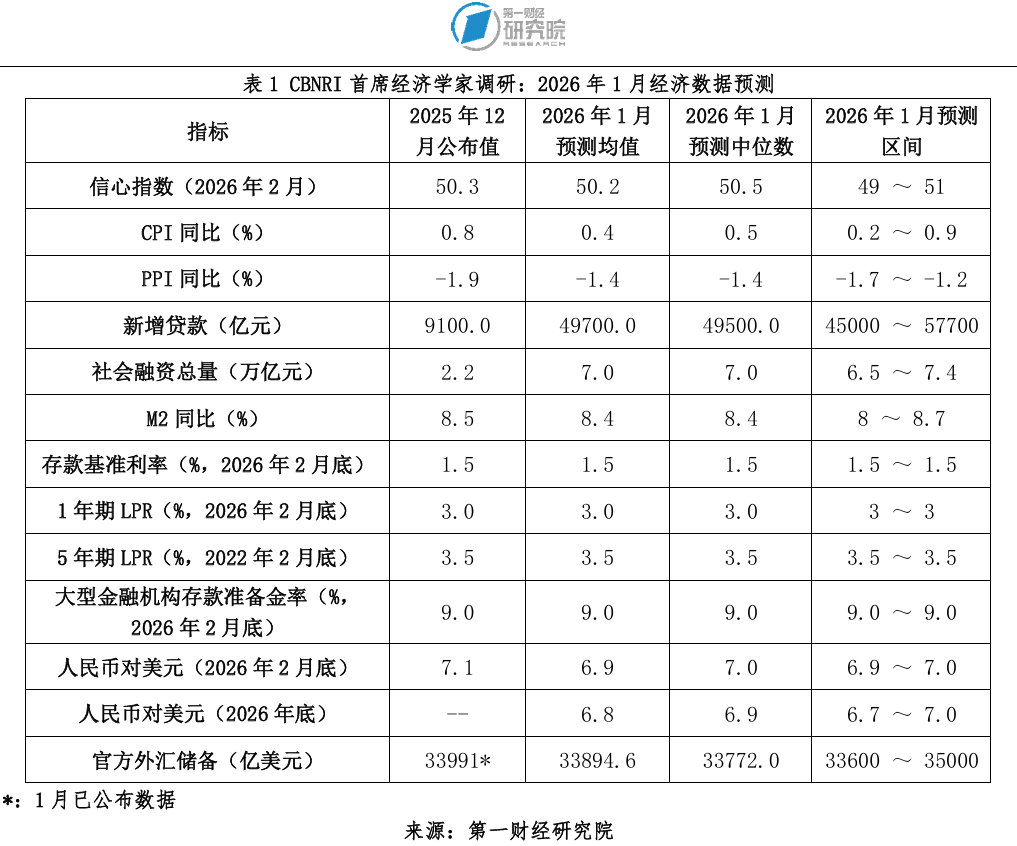
| | 表 1 CBNRI 首席经济学家调研:2026年1月经济数据预测 | | | | | --- | --- | --- | --- | --- | | 指标 | 2025 年 12 | 2026年1月 | 2026年1月 | 2026年1月预测 | | | 月公布值 | 预测均值 | 预测中位数 | 区间 | | 信心指数(2026年2月) | 50. 3 | 50. 2 | 50. 5 | 49 ~ 51 | | CPI 同比 (%) | 0. 8 | 0. 4 | 0. 5 | 0.2 ~ 0.9 | | PPI 同比 (%) | -1.9 | -1.4 | -1.4 | -1.7 ~ -1.2 | | 新增贷款(亿元) | 9100. 0 | 49700. 0 | 49500. 0 | 45000 ~ 57700 | | 社会融资总量(万亿元) | 2. 2 | 7.0 | 7.0 | 6.5 ~ 7.4 | | M2 同比 (%) | 8. 5 | 8. 4 | 8.4 | 8 ~ 8.7 | | 存款基准利率(%,2026年2月底) | 1.5 | 1.5 | 1.5 | 1.5 ~ 1.5 ...
宏观与大宗商品周报:冠通期货研究报告-20260209
Guan Tong Qi Huo· 2026-02-09 11:08
1. Report Industry Investment Rating No information provided in the report. 2. Core Viewpoints - The capital market has been in a high - volatility state in the past week, shifting from divergence to a collective correction. Overseas, the divergence on AI has resurfaced, and the sharp correction of technology stocks, Bitcoin, and precious metals led by silver has impacted asset prices and raised investors' risk - aversion sentiment. In the domestic market, due to the upcoming Spring Festival holiday, futures exchanges have announced margin hikes, leading to a significant outflow of funds from the futures market [5][10]. - The Fed is likely to keep the interest rate unchanged in March, with a probability of 82.3%. The market expects about two interest rate cuts in 2026 [6][65]. 3. Summary by Relevant Catalogs Market Overview - The capital market was highly volatile last week, with a collective correction. Overseas, the AI divergence affected asset prices. In the domestic market, the approaching Spring Festival led to margin hikes and a large - scale outflow of futures market funds. The BDI index dropped sharply, and most commodities corrected. The domestic bond market rebounded, while the stock index and most commodity categories declined. The Wind commodity index had a weekly change of - 21.16%, with 2 out of 10 commodity category indices rising and 8 falling. Precious metals led the decline, followed by non - ferrous metals with a - 5.07% drop. The energy - chemical sector was dragged down by the fall in crude oil prices, and coal - coking - steel and oilseeds also had notable declines. Agricultural products showed mixed performance [5][16]. - In terms of the futures market's capital flow, there was an overall significant outflow of funds from the commodity futures market. The coal - coking - steel and soft commodity sectors saw the most obvious capital inflows, while the precious metals and non - ferrous metals sectors had significant outflows. The volatility of the international CRB commodity index and domestic commodity indices increased. Most commodity futures categories saw higher volatility, except for the agricultural and grain sectors. The chemical and precious metals sectors had remarkable increases in volatility [6]. - The market's focus in the next week will be on the US non - farm payrolls report and CPI data. The non - farm payrolls report may adjust up to 1 million employment data. The market expects non - farm employment growth in January to be in the range of 60,000 - 80,000. China's January inflation and money supply data are also expected to be released next week. The Middle East situation seems to be stabilizing, with indirect talks between the US and Iran [7]. Large - scale Assets - The capital market was highly volatile last week, shifting from divergence to a collective correction. Overseas, the divergence on AI affected asset prices and raised risk - aversion sentiment. The VIX index rose slightly, the US dollar rebounded, and the RMB remained stable. Both the US and Chinese stock markets were under pressure. In the domestic market, due to the Spring Festival, futures exchanges raised margins, leading to a large - scale outflow of funds from the futures market. The BDI index dropped, and most commodities corrected [10]. Sector Express - The domestic bond market rebounded, the stock index declined, and most commodity categories were weak. The growth - style stocks performed significantly worse than the value - style stocks. The CSI 500 and CSI 1000 both fell by more than - 2%, while the CSI 300 and SSE 50 fell by about - 1%. The Wind commodity index had a weekly change of - 21.16%, with 2 out of 10 commodity category indices rising and 8 falling. Precious metals led the decline, followed by non - ferrous metals, and the energy - chemical sector was affected by the fall in crude oil prices [16]. Capital Flow - Last week, there was an overall significant outflow of funds from the commodity futures market. The coal - coking - steel and soft commodity sectors had the most obvious capital inflows, while the precious metals and non - ferrous metals sectors had significant outflows [18]. Variety Performance - Most domestic major commodity futures declined with large margins last week. The top - rising commodity futures were polysilicon, alumina, and glass, while the top - falling ones were Shanghai silver, platinum, and Shanghai tin [22]. Fluctuation Characteristics - Last week, the volatility of the international CRB commodity index increased, and the volatilities of the domestic Wind commodity index and Nanhua commodity index both increased significantly. Most commodity futures categories saw higher volatility, except for the agricultural and grain sectors. The chemical and precious metals sectors had remarkable increases in volatility [25]. Macro Logic - The stock index was weak and declined across the board last week. Growth - style stocks had larger fluctuations and deeper declines. The valuation of the stock index was under pressure, and the equity risk premium (ERP) rebounded from a low level [32]. - The commodity price index fell from a high level, and the inflation expectation declined slightly under pressure [35]. - The US bond yield declined overall, the term structure was stable, the term spread fluctuated narrowly, the real interest rate was under pressure, and the gold price fluctuated sharply, first falling and then rising [52]. - The US high - frequency "recession indicator" fluctuated, the Citigroup Economic Surprise Index rebounded, and the 10Y - 3M spread of US bonds widened significantly and then fluctuated narrowly [57]. Data Tracking - Most international major commodities declined, the BDI index dropped sharply, the CRB index fell, soybeans and corn rose slightly, and gold, silver, copper, and oil all declined. The silver price plunged, and the gold - silver ratio rebounded sharply from a low level [28]. - The asphalt开工率 declined seasonally, real - estate sales remained weak, freight rates decreased, and short - term capital interest rates fluctuated downward [44]. - The US bond interest rate decreased, the China - US interest rate spread rebounded, the inflation expectation rose and then fell, the financial conditions showed signs of bottoming out, the US dollar index declined, and the RMB was strong [55]. Fed Interest Rate Cut Expectation - The Fed is likely to keep the interest rate unchanged at 3.5 - 3.75% in March, with a probability of 82.3% (slightly lower than last week's 87.3%). The probability of a 25 - bp interest rate cut to 3.25 - 3.5% increased slightly to 17.7%. The market expects about two interest rate cuts in 2026 [65]. This Week's Focus - Monday (February 9): Eurozone February Sentix Investor Confidence Index. - Tuesday (February 10): US December retail sales data, US December import price index. - Wednesday (February 11): China's January CPI, US January non - farm payrolls report. - Thursday (February 12): UK Q4 GDP preliminary value. - Friday (February 13): US January CPI. - Other: The People's Bank of China is expected to announce January money supply data during the week [70].