
消费品以旧换新

Search documents
投资结构不断优化
Jing Ji Ri Bao· 2026-01-19 22:23
Group 1 - In 2025, fixed asset investment (excluding farmers) reached 48,518.6 billion yuan, driven by large-scale equipment upgrades and the replacement of consumer goods [1] - Industrial investment grew by 2.6% year-on-year, contributing 0.9 percentage points to overall investment growth, with mining investment up by 2.5%, manufacturing investment up by 0.6%, and electricity, heat, gas, and water production and supply investment up by 9.1% [1] - Infrastructure investment in key areas saw significant growth, with pipeline transportation investment increasing by 36.0%, internet and related services investment up by 23.8%, and multimodal transport and agency investment rising by 22.9% [1] Group 2 - Equipment and tool purchase investment grew by 11.8% year-on-year, contributing 1.8 percentage points to overall investment growth, and accounted for 18.0% of total investment, an increase of 2.5 percentage points from the previous year [1] - High-tech service industry investment increased by 3.5% year-on-year, representing 5.6% of total service industry investment, up by 0.6 percentage points from the previous year [2] Group 3 - Investment in forestry rose by 28.5%, fisheries investment increased by 12.4%, and investment in electricity and heat production and supply grew by 11.1% [3] - The investment in agricultural and sideline food processing increased by 9.2%, while wholesale and retail investment grew by 5.6%, and accommodation and catering investment rose by 5.5% [3]
国家统计局:2025年汽车制造业投资增长11.7%
Sou Hu Cai Jing· 2026-01-19 04:20
Core Viewpoint - The article discusses the trends and statistics of fixed asset investment in China for 2025, highlighting the focus on effective investment in key areas and the optimization of investment structure, despite an overall decline in fixed asset investment compared to the previous year. Group 1: Overall Investment Trends - In 2025, the total fixed asset investment (excluding rural households) reached 48,518.6 billion yuan, a decrease of 3.8% from the previous year [1] - Investment in the primary industry grew by 2.3%, while the secondary industry saw a growth of 2.5%. However, the tertiary industry experienced a decline of 7.4% [1] Group 2: Industrial Investment - Industrial investment in 2025 increased by 2.6%, contributing 0.9 percentage points to overall investment growth [2] - Mining investment rose by 2.5%, contributing 0.1 percentage points, while manufacturing investment grew by 0.6%, also contributing 0.1 percentage points [2] - Notable growth in specific manufacturing sectors included transportation equipment (17.5%), chemical fiber (12.3%), and automotive manufacturing (11.7%) [2] - Investment in electricity, heat, gas, and water production and supply increased by 9.1%, contributing 0.7 percentage points to overall investment growth [2] Group 3: Infrastructure Investment - Infrastructure investment in key areas saw significant growth, with pipeline transportation investment increasing by 36.0% [3] - Investment in internet and related services grew by 23.8%, while multimodal transport and logistics services increased by 22.9% [3] - Private investment in infrastructure rose by 1.7%, accounting for 21.0% of total infrastructure investment, an increase of 0.8 percentage points from the previous year [3] Group 4: Equipment Investment - Investment in equipment and tools saw a substantial increase of 11.8%, contributing 1.8 percentage points to overall investment growth [4] - This category accounted for 18.0% of total investment, an increase of 2.5 percentage points from the previous year [4] Group 5: High-Tech Service Investment - Investment in high-tech services grew by 3.5%, representing 5.6% of total service investment, an increase of 0.6 percentage points [5] - Information service investment surged by 28.4% [5] Group 6: Social Welfare Investment - In 2025, investments in social welfare sectors showed positive trends, with forestry investment increasing by 28.5% and fisheries investment by 12.4% [6] - Other sectors such as electricity and heat production (11.1%), agricultural processing (9.2%), and wholesale and retail (5.6%) also experienced growth [6] - The government aims to enhance investment effectiveness in 2026, focusing on major national strategies and the optimization of traditional industries while fostering emerging sectors [6]
“新国补”落地两周 各地消费市场迎来“换新”热潮
Zhong Guo Chan Ye Jing Ji Xin Xi Wang· 2026-01-18 23:58
Core Viewpoint - The implementation of the "old-for-new" national subsidy policy has sparked a surge in consumer demand across various sectors, including automobiles, home appliances, and digital products. Group 1: Automotive Sector - In Jiangsu, the new subsidy policy offers a 12% subsidy (up to 20,000 yuan) for purchasing new energy vehicles under scrapping scenarios, and a 10% subsidy (up to 15,000 yuan) for traditional fuel vehicles [2] - For replacement scenarios, the subsidy is 8% (up to 15,000 yuan) for new energy vehicles and 6% (up to 13,000 yuan) for fuel vehicles [2] Group 2: Home Appliances and Digital Products - The policy mandates that participating home appliances must meet "first-level energy efficiency" standards, covering six categories such as refrigerators and washing machines, with a subsidy of 15% of the final price, capped at 1,500 yuan per item [2][6] - Digital products, including smartphones and tablets priced under 6,000 yuan, are eligible for a 15% subsidy, with a maximum of 500 yuan per item [2][6] - The new subsidy policy has significantly increased consumer purchasing intentions in the home appliance sector [2] Group 3: Market Impact - The launch of the subsidy program has led to a notable increase in sales, with over 1.3 billion yuan in subsidies utilized in Hebei province alone from January 1 to 9, resulting in sales exceeding 9.2 billion yuan [7] - Retailers are enhancing consumer experience by offering "one-stop" services for old product recycling, which provides additional discounts on new purchases [4]
【西安】消费品以旧换新再出新举措
Shan Xi Ri Bao· 2026-01-18 00:37
Core Viewpoint - Xi'an is implementing a "trade-in" program for consumer goods to enhance quality and efficiency, with various promotional activities launched by shopping malls to stimulate the consumer market [4]. Group 1: Automotive Trade-in Program - The program supports the scrapping and replacement of gasoline and diesel vehicles, offering a 12% subsidy (up to 20,000 yuan) for consumers who scrap eligible vehicles and purchase new energy vehicles listed in the Ministry of Industry and Information Technology's directory [4]. - A 10% subsidy (up to 15,000 yuan) is available for consumers purchasing fuel vehicles with an engine size of 2.0 liters or less [4]. - Consumers can receive an 8% subsidy (up to 15,000 yuan) for purchasing new energy vehicles and a 6% subsidy (up to 13,000 yuan) for fuel vehicles when transferring their old cars [5]. Group 2: Home Appliance Subsidies - Consumers purchasing energy-efficient home appliances such as refrigerators, washing machines, televisions, air conditioners, computers, and water heaters can receive a 15% subsidy on the purchase price, with a maximum of 1,500 yuan per item [5]. - Each consumer can receive a subsidy for one item per category [5]. Group 3: Digital and Smart Products - A 15% subsidy is available for consumers purchasing mobile phones, tablets, smartwatches, and smart glasses, with a maximum of 500 yuan per item for products priced under 6,000 yuan [6]. - Consumers can obtain digital coupons for home appliances and smart products through the Yunshanfu platform, which are valid for a limited time [6].


山西太原启动2026年消费品以旧换新活动
Xin Lang Cai Jing· 2026-01-17 03:16
Group 1 - The event "Buy in China, Enjoy Sanjin" was launched in Taiyuan, focusing on a consumption upgrade initiative for 2026, promoting the replacement of old consumer goods with new ones [1] - Taiyuan will optimize subsidy rules and methods for claiming subsidies under the 2026 appliance replacement and digital product purchase policies [1] - The Xiaodian District will include home appliances and automobiles in a national prize invoice pilot program, offering a lottery for consumers who meet spending thresholds [1] Group 2 - Suning.com announced its subsidy and service measures, combining national, manufacturer, Suning, and bank subsidies, with a total potential subsidy of up to 50% [1] - The company emphasizes its service advantages, providing comprehensive coverage, rapid delivery, and professional home appliance management services to enhance consumer convenience [1]

新疆乌苏市召开2026年消费品“以旧换新”经营主体培训会
Zhong Guo Shi Pin Wang· 2026-01-16 11:23
Core Viewpoint - The training session held in Urumqi City aims to regulate the "old-for-new" consumption activity, ensuring fair market practices and preventing illegal behaviors [1] Group 1: Training and Policy Guidance - The Urumqi City Market Supervision Bureau and the Municipal Commerce and Industry Department organized a training session for over 50 business representatives to explain the "old-for-new" policy [1] - Participants signed a commitment letter to adhere to the "old-for-new" policy and were provided with clear guidance on the regulations and responsibilities [1] Group 2: Compliance and Fair Practices - Businesses must strictly follow laws such as the Price Law and Product Quality Law, ensuring fair and honest trading practices [1] - Price fraud is prohibited, requiring businesses to clearly display prices and not engage in deceptive pricing practices [2] Group 3: Product Quality Assurance - Participants in the "old-for-new" program must ensure product quality and safety, including obtaining necessary certifications and maintaining proper inspection protocols [3] - The sale of counterfeit or substandard products is strictly forbidden, and businesses must comply with energy and water efficiency labeling requirements [3] Group 4: Regulatory Oversight - Market supervision authorities will enhance monitoring of the "old-for-new" activities, taking legal action against price fraud and the sale of counterfeit products [4] - Any business with a record of violations will be disqualified from participating in the program, and fraudulent activities will be reported to law enforcement [4]
商务部部长王文涛:我国将聚焦交通、家政、演出、体育赛事等重点和潜力领域,积极培育服务消费新增长点
Jing Ji Guan Cha Wang· 2026-01-16 02:10
Core Viewpoint - The Chinese government is focusing on enhancing service consumption alongside goods consumption as the economy develops and living standards improve [1] Group 1: Service Consumption Focus - The Ministry of Commerce will concentrate on key areas such as transportation, housekeeping, performances, and sports events to cultivate new growth points in service consumption [1] - A range of new business models and fast-growing service consumption sectors will be identified, with efforts to improve supportive policies and eliminate unreasonable restrictions [1] - Events like "Service Consumption Season" and "Chinese Food Festival" will be organized to guide localities in developing distinctive service consumption brands in sports, performing arts, tourism, and winter sports [1] Group 2: Consumption Policies - The government will optimize the implementation of the old-for-new policy for consumer goods, focusing on new tracks and offline entities [1] - By 2026, the old-for-new policy will support green and smart product consumption more vigorously, with requirements for home appliances to meet first-level energy efficiency or water efficiency standards [1] - New purchase subsidies will include smart devices such as smartwatches and smart glasses [1]
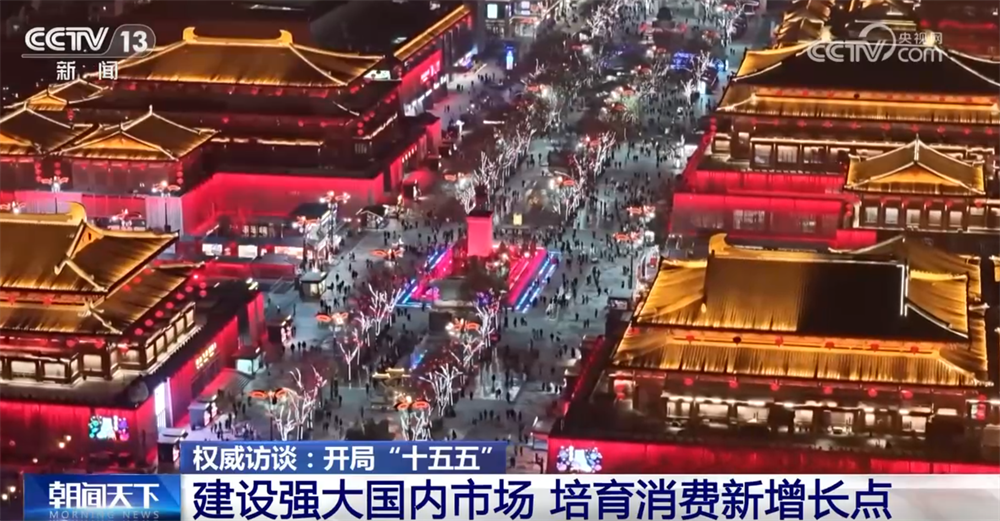
消费“新”、外贸“稳”、高水平对外开放“进”……“十五五”开局之年这样干↓
Yang Shi Wang· 2026-01-16 02:04
Group 1: Consumer Market Insights - The core viewpoint emphasizes the importance of boosting consumption and expanding the supply of quality consumer goods and services as outlined in the "14th Five-Year Plan" [1] - In the first 11 months of 2025, China's total retail sales of consumer goods increased by 4.0% year-on-year, with an expected annual total surpassing 50 trillion yuan [1] - Service retail growth outpaced goods retail by 1.3 percentage points, indicating strong vitality and potential in the market [1] Group 2: Service Consumption Growth - The government is focusing on key areas such as transportation, housekeeping, performances, and sports events to cultivate new growth points in service consumption [3] - Initiatives like "Service Consumption Season" and "Chinese Food Festival" will be organized to promote distinctive service consumption brands [3] Group 3: Trade and Export Strategies - China's foreign trade is expected to exceed 45 trillion yuan in 2025, with a growth rate of 3.8%, maintaining its position as the world's largest goods trader for nine consecutive years [12] - The government plans to enhance trade balance through exhibitions and targeted procurement to expand imports [16] Group 4: Open Market Initiatives - The government aims to expand high-level opening-up by increasing access in sectors like telecommunications and biotechnology, and by implementing zero-tariff measures for all African countries with diplomatic relations [20][22] - The establishment of a comprehensive overseas service platform is planned to facilitate international market expansion and trade investment integration [26]
打出“组合拳” 力促全省经济“开门红”
Xin Lang Cai Jing· 2026-01-15 19:28
Group 1 - The provincial government of Hunan is implementing measures to ensure a stable economic start in the first quarter of 2026, including increasing the issuance of consumer vouchers and organizing over 500 promotional activities [1] - Hunan will continue to distribute the "Enjoy Hunan · Xiang Has Benefits" consumer vouchers and will accelerate the implementation of the 2026 consumer goods trade-in policy, focusing on new consumption models that integrate culture and tourism [2] - The province has identified 4,345 major projects to be promoted in the first quarter, including 3,000 ongoing projects, 777 new projects, and 568 potential projects, aiming to leverage central funding opportunities [3] Group 2 - Hunan plans to issue nearly one million winter hot spring tourism consumption vouchers to attract national tourists, promoting the integration of hot springs with culture and wellness [4] - The province will enhance the quality of service industries by utilizing special bonds to acquire existing housing for various purposes and organizing promotional activities for commercial housing [4] - Hunan aims to strengthen its manufacturing sector by establishing a list of annual projects to be launched and ensuring timely production and effectiveness [4]
更划算了!今年以旧换新补贴比例公布
Xin Lang Cai Jing· 2026-01-15 18:26
Group 1 - The core viewpoint of the news is that Qinghai Province is enhancing its consumption policies, particularly focusing on the "old-for-new" program for consumer goods, with significant financial backing and a broad reach in 2026 [1] - In 2025, Qinghai Province invested a total of 1.69 billion yuan, benefiting over 1.52 million people and stimulating consumption worth 19.7 billion yuan, with notable figures in vehicle and appliance upgrades [1] - The province achieved the replacement of 92,000 vehicles, 496,000 home appliances, 615,000 digital products, 31,900 home decor items, and 4,000 electric bicycles, making it one of the few provinces to implement such policies throughout the year [1] Group 2 - In 2026, the central government will continue to allocate long-term special bond funds, with local governments providing matching funds to support the "old-for-new" consumption policy [1] - The automobile "old-for-new" program will adopt a unified national subsidy standard, adjusting the fixed subsidy to a percentage of the vehicle price, with specific caps for both fuel and new energy vehicles [2] - The home appliance "old-for-new" program will also follow a unified subsidy standard, offering 15% of the product sales price as a subsidy for energy-efficient appliances, capped at 1,500 yuan [2] - The digital product upgrade program will provide a subsidy of 15% for eligible products, with a maximum subsidy of 500 yuan for items priced under 6,000 yuan [2]