资产配置

Search documents
Can Duolingo Stock Crash 30%
Forbes· 2025-10-30 14:35
Core Insights - Duolingo (DUOL) has experienced a significant stock decline of 21.5% in less than a month, dropping from $347.27 to $272.76, raising concerns about whether this is a healthy pullback or the beginning of a deeper correction [2] - The stock's very high valuation suggests potential for further downside, with a price target of $192 being plausible based on historical performance [2] - Historically, DUOL has returned a median of 87% within one year after significant dips of over 30% in 30 days, indicating potential recovery opportunities [3][6] Financial Performance - Duolingo offers a language-learning platform with courses in 40 languages, primarily serving users in the U.S. and China [3] - The company has had five instances since 2010 where the stock dipped by 30% within 30 days, with a median peak return of 87% within one year following these events [6] - The median time to peak return after a dip event is 356 days, with a median maximum drawdown of -7.5% within one year [6] Investment Strategy - Timing the market perfectly is challenging, and investors may consider delaying purchases until further analysis is conducted [3] - A diversified investment strategy is recommended to mitigate risks associated with single-stock investments, as evidenced by the missed growth opportunities for those who exited the S&P in 2020 [5] - The Trefis High Quality Portfolio includes stocks that have historically outperformed benchmarks like the S&P 500, suggesting a strategy focused on quality and reduced volatility [8]



不再盲目自信!抄主流机构和投资大师的作业,赚钱反而更简单!
雪球· 2025-10-30 13:01
Core Viewpoint - The article emphasizes the importance of asset allocation over attempting to achieve quick wealth through market timing, advocating for a disciplined investment approach that focuses on high-probability strategies rather than low-probability ones [4][6]. Group 1: Asset Allocation Strategy - The author implemented a three-part asset allocation strategy (6:3:1 for stocks, bonds, and commodities) starting with an initial investment of 50,000 yuan and a weekly investment of 1,000 yuan, achieving a cumulative return of over 16% and an annualized return exceeding 22% with a maximum drawdown of approximately 8% [4][15]. - The article argues that there is no bad time to start asset allocation, as it can yield positive results regardless of market conditions, highlighting that even during periods of high uncertainty, good returns can be achieved [6][15]. Group 2: Market Conditions and Timing - The author notes that at the time of investment, there was significant uncertainty in both domestic and international markets, with high levels of caution among investors due to macroeconomic factors and asset valuations [6][9][10]. - Despite the challenging environment, the author emphasizes that asset allocation does not require precise market timing, as there are always undervalued assets available for investment [14][15]. Group 3: Dollar-Cost Averaging - The article discusses the benefits of dollar-cost averaging, stating that consistent investments can accumulate more shares during market downturns, allowing for better positioning when the market rebounds [19]. - The author experienced significant market volatility over the past year, but through disciplined investing, was able to capture gains without needing to predict market movements [16][18]. Group 4: Adding to Positions - The author identifies specific instances where adding to positions during market downturns proved beneficial, citing three occasions where additional investments were made during significant market declines [20][23]. - The strategy of adding to positions during dips is framed as a way to smooth out costs and enhance overall returns [24][25].

运河财富|“专业基民”新动向:左手科技右手黄金
Sou Hu Cai Jing· 2025-10-30 10:20
Core Insights - Fund of Funds (FOF) have shown a significant interest in gold and bond ETFs, with Huazhang Gold ETF being the most heavily weighted fund by FOFs as of Q3 2025 [1][2] - The A-share market is perceived to have good long-term investment value due to its neutral historical valuation compared to other global markets, with technology, gold, and new energy sectors being favored by fund managers [1][3] Investment Trends - As of Q3 2025, Huazhang Gold ETF was held by 98 FOFs with a total holding value of 1.735 billion yuan, up from 9.87 million yuan held by 79 FOFs at the end of Q2 [2] - Bond assets remain a primary focus for FOFs, with Haifutong Zhongzheng Short Bond ETF having a holding value exceeding 3.29 billion yuan, making it the highest held fund by FOFs [2] Sector Allocation - FOF managers are increasingly allocating to technology and gold sectors, with E Fund Advantage Return Mixed Fund (FOF-LOF) achieving a net value growth rate of 57.76% this year [3][4] - The National Taiyuan Preferred Navigation One-Year Holding Mixed Fund (FOF) has heavily invested in gold stock theme funds, indicating a strategic focus on precious metals [4] Market Dynamics - The A-share market has experienced a bullish trend supported by policy and liquidity, with the Shanghai Composite Index reaching a nearly ten-year high [5] - There is a noticeable trend of capital concentration towards high-quality leading stocks, with large-cap blue chips outperforming small-cap stocks [5] Future Strategies - The National Taiyuan Preferred Navigation One-Year Holding Mixed Fund plans to increase its allocation to gold stock theme funds and is also focusing on rare earth investments due to new regulatory policies enhancing industry stability [6] - The fund manager emphasizes a balanced approach between gold stocks and rare earths while also considering defensive assets in sectors like new energy and construction materials to mitigate risks [6]

在波动中寻找确定性:东方红资产管理余剑峰的“固收+”配置观
2 1 Shi Ji Jing Ji Bao Dao· 2025-10-30 09:49
Core Insights - The "Fixed Income Plus" strategy is increasingly recognized as a vital tool for investors in a declining yield environment, emphasizing the importance of risk management over mere pursuit of returns [2][19][20] - The approach advocated by Yu Jianfeng focuses on a systematic and disciplined framework for managing risk, which is essential for achieving optimal risk-adjusted returns [4][12][20] Group 1: Strategy and Philosophy - The essence of the "Fixed Income Plus" strategy lies in asset allocation, utilizing the low or even negative correlation between equity and bond assets to achieve desired risk-return objectives [2][11] - Yu Jianfeng challenges the conventional understanding of "Fixed Income Plus" as merely a combination of bonds and equities, arguing for a more nuanced view that treats both asset classes as contributors to risk and return [3][11] - The strategy emphasizes that risk should be viewed as a resource allocated in advance rather than a cost incurred after the fact, with returns being a natural outcome of effective risk management [4][12] Group 2: Risk Management Techniques - Yu Jianfeng's methodology for controlling drawdowns is based on rigorous mathematical logic, asserting that maximum drawdown is a path-dependent variable influenced by portfolio volatility [5][12] - The framework promotes dynamic adjustments to portfolio volatility based on current drawdown levels and expected future volatility, allowing for proactive risk management [12][19] - The focus on risk management is designed to prevent excessive exposure to market fluctuations, ensuring that the investment experience remains aligned with the risk-return objectives [5][20] Group 3: Market Context and Future Outlook - In the current low-interest-rate environment, traditional reliance on bond yields as a safety net for "Fixed Income Plus" strategies is increasingly challenged, necessitating a shift towards more sophisticated portfolio management techniques [19][20] - The future of "Fixed Income Plus" investments will depend more on effective risk management and asset allocation rather than solely on bond performance, aiming to provide investors with a stable risk-return profile [19][20] - The investment philosophy presented by Yu Jianfeng offers a counter-narrative to the pursuit of extreme returns, advocating for a focus on maximizing risk-adjusted returns in a complex market landscape [20]

降息“靴子”落地,最新解读
中国基金报· 2025-10-30 09:20
Core Viewpoint - The Federal Reserve's decision to lower the federal funds rate by 25 basis points to a target range of 3.75% to 4.00% aligns with market expectations, indicating a continuation of the easing cycle in the future [2][3][4]. Impact on Global Assets - The Fed's rate cut is expected to have profound effects on global asset prices. The short-term outlook for U.S. stocks may experience volatility, but the long-term performance will depend on economic fundamentals and the ability of corporate earnings to withstand growth slowdowns [5][6]. - U.S. Treasury yields may rise in the short term but are expected to trend downward in the medium term as the easing cycle progresses, leading to potential increases in bond prices [6][7]. - The dollar index may receive short-term support but is likely to face limited upward potential, while the rate cut could enhance the appeal of gold as an anti-inflation asset [6][7]. A-shares and Bond Market Outlook - The A-share market is anticipated to continue its positive momentum, supported by the Fed's rate cut alleviating capital outflow pressures from emerging markets and improving the liquidity environment for Chinese stocks [8][9]. - The bond market is expected to remain strong, with the Fed's actions providing more room for the People's Bank of China to implement looser monetary policies, thereby reducing constraints on the yuan's exchange rate [9][10].

年轻人跟风炒黄金:有人一夜亏5000元,有人观望两年婚事未成
Mei Ri Jing Ji Xin Wen· 2025-10-30 08:56
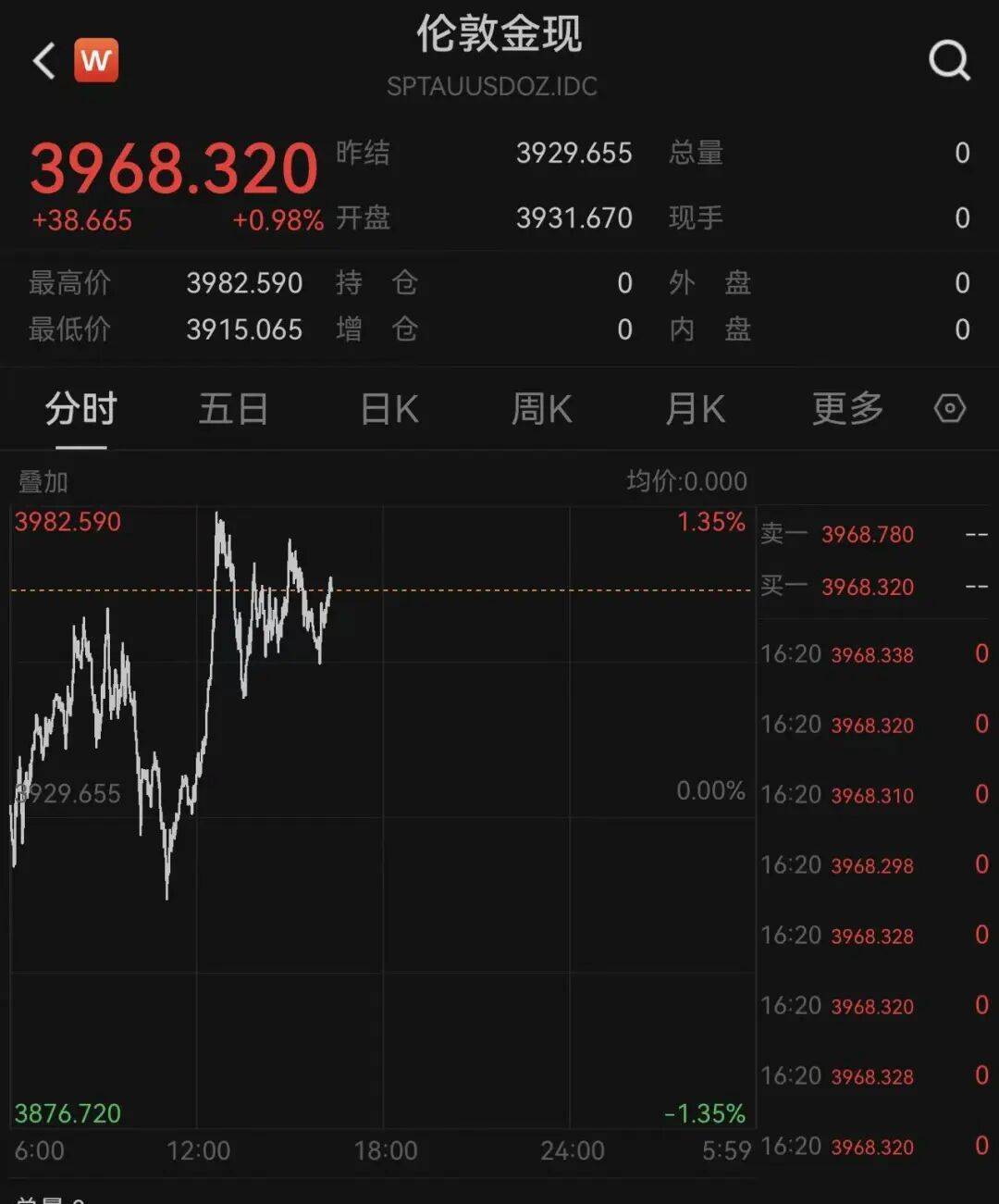
Core Insights - The recent fluctuations in gold prices have led to significant financial losses for many investors, with some experiencing steep declines shortly after purchasing gold products [1][8][9] - The volatility in gold prices has also impacted consumer behavior, particularly among those preparing for weddings, as rising gold prices have made traditional purchases more challenging [2][11] - Ray Dalio, founder of Bridgewater Associates, suggests that a strategic allocation of 15% in gold is advisable for most investors, emphasizing the importance of asset allocation over tactical trading [15][16] Price Fluctuations - International gold prices saw a dramatic increase of over 10% in 20 days, followed by a decline exceeding 5%, with prices dropping from a high of $4,381 per ounce to around $3,968 [1][12] - Domestic gold prices also reflected this trend, with the price of gold jewelry falling from 1,294 CNY per gram to below 1,200 CNY [1][8] Consumer Experiences - Many consumers, like Xiaoxue, faced significant losses after purchasing gold at high prices, with reports of losses amounting to 14,600 CNY within nine days due to price drops [2][8][9] - Other consumers, such as Lily and Xie Ming, also reported losses after buying gold products and ETFs, highlighting a common trend of inexperienced investors facing financial setbacks [9][10] Impact on Wedding Preparations - The rising cost of gold has led to delays in wedding plans for some couples, as they wait for prices to stabilize, causing tension in relationships [2][11] - The traditional practice of purchasing gold as part of wedding customs has become increasingly burdensome due to fluctuating prices, leading to disagreements among couples [11] Investment Strategies - Despite recent price declines, some investors view the situation as an opportunity to buy, indicating a belief in the long-term value of gold [14] - Analysts suggest that investors should carefully consider their asset allocation and avoid impulsive decisions based on short-term price movements [14][15]

金价大涨大跌,年轻人“跟风”炒黄金,有人高点买入,一晚上亏5000元!还有人观望两年婚事未成
Sou Hu Cai Jing· 2025-10-30 08:52
2025年黄金市场大涨大跌,有投资者一夜暴富,也有投资者交了"最痛的学费"。 10月以来购买黄金产品消费者经历了坐"过山车"般的心路历程,连续20天累计超10%的国际金价涨幅,让不少"攒金人"躬身入局,高点入手金条、金饰、 积存金等黄金产品。本想通过一直上涨的金价赚一笔,却没想到事与愿违,经历了20天的上升期,国际金价开始回撤,跌幅一度超过5%,随后连续几日 均出现下跌。 与此同时,多家国内品牌金店足金饰品的挂牌价格也已从高点的1294元/克降至1200元/克以下,金条价格也一路走跌。 大学生莉莉(化名)于10月17日购入了10克黄金饰品,"趁双十一期间有优惠,高点入手了"。 回顾当时买金的考量,莉莉表示,自己是第一次买,其实不懂黄金,但本能的认为,"金子保值""消费了就相当于没消费",想等后续金价上涨再换成金项 链当作母亲的生日礼物。 看着朋友购买的黄金ETF上涨,抱着"试试"的心态,谢铭(化名)在10月20日开通了支付宝余额宝买入了人生第一只黄金ETF。 据红星新闻10月29日报道,看着金店群里连续几周金价上涨的信息,消费者小雪最终动了心,"金店群里很多人购买金条,我也有点心动,之前从来没买 过"。 10 ...
把握科技时代机遇 机构人士共探长期投资之道
Zhong Guo Zheng Quan Bao· 2025-10-29 21:09
Core Insights - The event highlighted the increasing importance of asset allocation in the context of a changing global economic landscape and heightened market volatility, with a focus on integrating technology investments for long-term stable returns [1][2] Group 1: Technology Investment Trends - The innovative pharmaceutical sector is experiencing a significant revaluation globally, driven by mergers and acquisitions (M&A) and licensing deals, with major international companies lagging behind Chinese firms in certain advanced therapeutic areas [2] - The AI sector is also gaining traction, with expectations of a complete supply chain emerging in China, similar to Apple's model, and embodied intelligence being identified as a transformative force in addressing global aging issues [2][3] Group 2: Asset Allocation Strategies - Effective asset allocation requires understanding the covariance relationships between different assets, particularly in the technology sector, where traditional historical data may not apply [3] - Insurance funds are increasing their allocation to technology assets due to their long investment horizons, which align well with the long cycles of technological innovation, and the need for matching long-duration returns [3][4] Group 3: Market Outlook - The technology sector is expected to remain a core focus for capital markets, with private equity funds poised to capture structural opportunities in niche areas [4] - Despite the volatility in the innovative drug sector, there is a belief that the industry trend will persist for 2 to 3 years, making it a point of interest for investors [4] - In the commodity market, there are signs of recovery in CTA strategies, with expectations for continued opportunities in sectors such as electricity, black metals, non-ferrous metals, and crude oil [5]
“专业基民”新动向:左手科技右手黄金
Zhong Guo Zheng Quan Bao· 2025-10-29 21:09
Core Insights - Fund of Funds (FOF) are increasingly favoring gold and bond ETFs, with Huazhang Gold ETF being the most heavily weighted fund by FOFs as of Q3 2025 [1][2] - FOF managers are optimistic about the A-share market, citing its valuation at a historical neutral level and potential for long-term investment, particularly in technology, gold, and new energy sectors [1][2] Investment Trends - As of Q3 2025, Huazhang Gold ETF was held by 98 FOFs with a total market value of 1.735 billion yuan, showing a significant increase from 79 FOFs and 0.987 billion yuan at the end of Q2 [2] - Bond ETFs remain a primary investment focus for FOFs, with Hai Futong Zhongzheng Short-term Bond ETF having a market value exceeding 3.29 billion yuan held by 67 FOFs [2] - FOFs are increasingly allocating resources to technology and gold sectors, with notable funds like Yifangda Advantage Return Mixed Fund achieving a net value growth rate of 57.76% this year [2][3] Market Dynamics - The A-share market has seen a rise in investor sentiment, with the Shanghai Composite Index reaching a nearly ten-year high, driven by policy support and liquidity [3] - There is a noticeable trend of capital concentration towards large-cap blue-chip stocks, with a healthy leverage structure indicating increased market activity [3] Future Strategies - Fund managers are focusing on gold stock theme funds, anticipating significant opportunities in precious metals due to rising prices and improved profitability [4] - There is an emphasis on balancing investments in gold stocks and rare earth ETFs, with plans to increase defensive positions in sectors like lithium batteries and coal [4]
今年最大的“固收+”黑马
Sou Hu Cai Jing· 2025-10-29 20:35
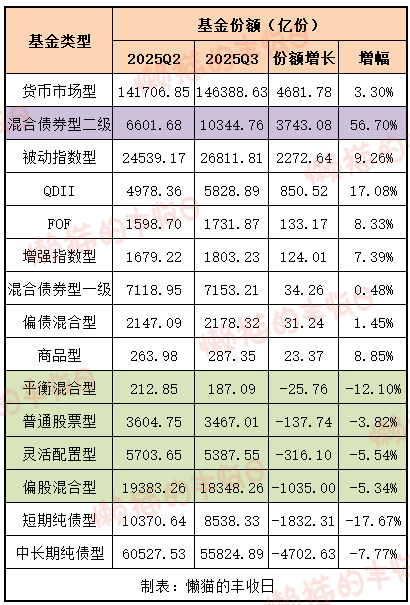
Core Insights - The report highlights a significant shift in fund flows, with active funds experiencing net redemptions while "fixed income plus" funds have gained popularity due to declining bond yields [1][2][20] Fund Type Analysis - Active funds such as ordinary equity, mixed equity, flexible allocation, and balanced mixed funds saw a net decrease in shares, indicating a trend of investors opting for capital preservation amidst a rising market [1] - "Fixed income plus" funds, particularly secondary bond funds, saw a substantial increase of 374.3 billion shares, representing a growth rate of 56.7%, as investors sought higher returns in a low-yield environment [2][3] - The total shares for various fund types in Q3 2025 showed notable changes, with money market funds increasing by 3.3%, secondary mixed bond funds by 56.7%, and passive index funds by 9.26% [3] Company Performance - Top fund companies capitalized on the "fixed income plus" trend, with notable growth in assets under management. For instance, Invesco Great Wall and Fortune Fund doubled their sizes, while E Fund, China Merchants Fund, and GF Fund saw increases exceeding 10 billion [5][6] - China Universal Fund emerged as a surprising player in the "fixed income plus" space, with a growth of 28.8 billion, nearly doubling its size, indicating a shift from its traditional focus on active equity [5][6] - The "China Universal Fengli" fund demonstrated exceptional growth, increasing from 52.77 billion to 314.89 billion in just three quarters, marking a 497% increase, outperforming its peers [8][10] Investment Strategy and Trends - The "China Universal" fund's success is attributed to its diversified asset allocation strategy, which includes a significant allocation to Hong Kong stocks, contributing to its high returns [10] - The report notes a trend of new investors entering the market with a low-risk appetite, primarily investing in "fixed income plus" products, validating the strategy of using these funds as a gateway to the market [20] - The "China Universal" fund's multi-asset investment approach, characterized by a systematic and industrialized process, has led to rapid growth while maintaining performance levels [16][17]