生成式AI

Search documents
倪光南:发展“AI+机器人”,向新质生产力加速跃迁
Huan Qiu Wang Zi Xun· 2025-11-04 23:17
Core Insights - Artificial intelligence (AI) is a powerful engine driving technological and industrial development globally, with a focus on enhancing productivity through the "AI + Robotics" initiative in China [1] - The development of the robotics industry aims to extend human capabilities rather than replace them, emphasizing the importance of understanding the relationship between humans and robots [2][3] - The evolution of robotics is transitioning from traditional automation to "AI + Robotics," which will redefine manufacturing processes and enhance flexibility and customization [4] Industry Development - The robotics industry in China is at a critical juncture, requiring an upgrade in the intelligence level of robots, focusing on three core capabilities: perception, motion control, and decision-making [5] - The integration of AI and spatial computing is essential for enhancing robots' environmental perception and interaction capabilities, marking a shift towards a new paradigm in human-robot interaction [6][7] - The open-source AGIROS initiative aims to support the development of a collaborative ecosystem for intelligent robotics, enhancing the competitiveness of the "brain, eye, and action" systems in AI + Robotics [7][8] Future Directions - The potential for creating an ecosystem based on RISC-V architecture for AI + Robotics is being explored, which could lead to significant advancements in the industry [8] - The focus is on building a world where robots serve as extensions of human capabilities, contributing to a better quality of life [8]

Henry Schein(HSIC) - 2025 Q3 - Earnings Call Transcript
2025-11-04 14:02
Financial Data and Key Metrics Changes - Global sales for the third quarter were $3.3 billion, reflecting a sales growth of 5.2% compared to the third quarter of 2024, with constant currency sales growth of 4.0% [17][22] - GAAP operating margin for the third quarter was 4.88%, a decrease of six basis points year-over-year, while non-GAAP operating margin increased to 7.83%, up 19 basis points [18][19] - Third quarter GAAP net income was $101 million, or $0.84 per diluted share, compared to $99 million, or $0.78 per diluted share in the prior year [20] - Non-GAAP net income for the third quarter was $167 million, or $1.38 per diluted share, compared to $155 million, or $1.22 per diluted share in the prior year [20] Business Line Data and Key Metrics Changes - Global distribution and value-added services group sales grew by 4.8%, with U.S. dental merchandise sales increasing by 3.3% and U.S. dental equipment sales growing by 1.2% [22] - Global specialty products group sales grew by 5.9%, with strong performance in implants and biomaterials, particularly in the value segment [23][12] - Global technology group sales grew by 9.7%, driven by practice management software and revenue cycle management solutions [23][14] Market Data and Key Metrics Changes - U.S. medical distribution sales grew by 4.7%, reflecting strong demand for medical products, particularly in the dialysis business [10][22] - International dental merchandise sales grew by 6.0%, driven by sales growth in Brazil, Canada, Italy, Spain, and Australia [22] - International implant sales increased by high single digits, particularly in the Dutch region and Latin America [13] Company Strategy and Development Direction - The company is focused on executing the BOLD+1 strategy, aiming for over 50% of non-GAAP operating income to come from high-growth, high-margin businesses by the end of 2027 [8][6] - A $750 million increase in the share repurchase program was approved, with expectations to continue buybacks at a similar pace [8][25] - The company is rolling out a new global e-commerce platform, with a phased launch in North America expected to follow the successful launch in the U.K. and Ireland [8] Management's Comments on Operating Environment and Future Outlook - Management expressed confidence in returning to high single-digit to low double-digit earnings growth, supported by ongoing value creation initiatives [7][24] - The cyber incident is now behind the company, allowing sales teams to focus on growth [39][6] - The management team remains optimistic about the future, emphasizing the importance of customer partnerships and innovation [32][33] Other Important Information - The company recorded restructuring expenses of $34 million during the third quarter, with expectations of achieving annual run-rate savings of over $100 million from the restructuring program [24] - The effective tax rate for the third quarter was 22.9%, lower than the previous year's rate of 24.9% [20] Q&A Session Summary Question: Future earnings growth and restructuring benefits - Management indicated that the $200 million operating income improvement is a multi-year plan, with some benefits expected in 2026 [40][41] Question: Clarification on EPS guidance and market conditions - The midpoint of 2025 EPS guidance increased by $0.05, reflecting momentum in sales growth and a remeasurement gain [44][46] Question: Specialty products operating profit and margin dynamics - Specialty products operating profit was impacted by a strong prior-year comparison and a shift in sales mix towards lower-margin value implants [66][67] Question: Growth trajectory for specialty products - Continued growth in premium implants and improvements in endodontics are necessary for EBIT growth in the specialty business [70][71] Question: Share gains and market conditions - Management noted stable market conditions with some share gains, particularly in the dental and medical sectors [51][52]

“一本正经胡说八道”,AI幻觉如何化解
Di Yi Cai Jing· 2025-11-04 12:30
Core Viewpoint - The phenomenon of AI hallucination poses significant challenges in the development of generative AI, affecting not only information accuracy but also business trust, social responsibility, and legal regulations. Addressing this issue requires ongoing technical optimization, a robust legal framework, and enhanced user literacy [1] Group 1: Causes and Types of AI Hallucination - AI hallucination occurs when large language models generate seemingly coherent text that is factually incorrect or fabricated, primarily due to their design goal of producing "statistically reasonable" text rather than factual accuracy [2] - The training of generative AI models relies on vast amounts of unfiltered internet data, which includes both accurate information and significant amounts of erroneous or outdated content, leading to the reproduction of inherent flaws in the data [2][3] - The underlying Transformer architecture of generative AI models lacks metacognitive abilities, resulting in outputs that may appear logical but are fundamentally flawed due to the probabilistic nature of their operation [3] Group 2: Manifestations and Risks of AI Hallucination - AI hallucination can manifest in various forms, including fabricating facts, logical inconsistencies, and quoting false authorities, which can mislead users and create significant risks in professional contexts [4] - The impact of AI hallucination on consumer trust is profound, as consumers expect a higher accuracy from AI than from human errors, leading to potential personal and financial losses in sectors like finance and healthcare [6] - AI hallucination can severely damage corporate reputations and lead to substantial financial losses, as seen in the case of Google's Bard chatbot, which caused a market value loss of approximately $100 billion due to misinformation [7] Group 3: Legal and Regulatory Framework - China has implemented a series of regulations to govern generative AI services and mitigate AI hallucination risks, including requirements for algorithm registration and safety assessments [11][12] - International legal practices are increasingly holding AI service providers accountable for the dissemination of false information, as demonstrated by a recent ruling in Germany that emphasized the responsibility of AI service providers to review harmful content [12] Group 4: Mitigation Strategies - Mitigating the risks associated with AI hallucination requires a collaborative effort from model developers, regulatory bodies, and end-users, focusing on improving data quality and implementing safety measures in AI models [9][10] - Users are encouraged to adopt a critical approach when interacting with AI outputs, employing cross-validation techniques and adjusting the model's creative freedom based on the task type to ensure accuracy [10]
微软(MSFT):FY26Q1业绩点评:业绩超预期,云业务增速延续
Soochow Securities· 2025-11-04 08:24
Investment Rating - The report maintains a "Buy" rating for Microsoft (MSFT) [1] Core Insights - Microsoft reported better-than-expected performance in FY26Q1, with revenue of $77.7 billion, representing an 18% year-over-year growth, and an EPS of $4.13, which is a 23% increase year-over-year [2][3] - The company expects FY26Q2 revenue to reach between $79.5 billion and $80.6 billion [2] - The growth in Microsoft's cloud business, particularly Azure, continues to show strong momentum, with Azure revenue growth of approximately 40% year-over-year [4] Revenue and Profitability - FY2024A total revenue is projected at $245.1 billion, with a year-over-year growth of 15.67% [1] - FY2025A net profit is estimated at $101.8 billion, reflecting a year-over-year growth of 15.54% [1] - The latest diluted EPS for FY2026E is forecasted to be $16.03, with a P/E ratio of 32.25 [1] Business Segment Performance - Productivity and Business Processes (PBP) revenue reached $33 billion, growing 17% year-over-year, driven by Microsoft 365 commercial cloud [3] - Intelligent Cloud (IC) revenue was $30.9 billion, with a year-over-year growth of 28%, primarily due to Azure and other cloud services [3] - More Personal Computing (MPC) revenue was $13.8 billion, growing 4% year-over-year, supported by Windows OEM and advertising businesses [3] Cloud Business Outlook - Azure's revenue growth is expected to maintain high rates, with FY26Q2 projected to grow approximately 37% year-over-year [4] - The company reported a significant increase in commercial bookings, up 112% year-over-year, largely due to commitments related to OpenAI and the growth of contracts exceeding $100 million [4] AI Integration and Ecosystem - AI penetration in Microsoft's ecosystem is increasing, with over 26 million users of GitHub Copilot and 80% of Fortune 500 companies using Azure AI Foundry [5] - Monthly Active Users (MAU) for AI features in Microsoft products reached 900 million, with Copilot series products exceeding 150 million MAU [5]

OpenAI与亚马逊达成战略合作 协议价值高达380亿美元
Sou Hu Cai Jing· 2025-11-04 07:18
Core Insights - Amazon Web Services (AWS) and OpenAI have announced a seven-year strategic partnership valued at up to $38 billion, aimed at providing cloud infrastructure for OpenAI's AI workloads [1][2] - The collaboration will grant OpenAI access to AWS's extensive computing resources, including hundreds of thousands of advanced NVIDIA GPUs, with the potential to scale to tens of millions to meet the growing demand for AI workloads [1] - This partnership solidifies AWS's position in the AI infrastructure space and provides OpenAI with robust computational support, benefiting millions of users globally from products like ChatGPT [3] Group 1 - The partnership combines AWS's leading cloud infrastructure capabilities with OpenAI's breakthrough technology in generative AI [2] - OpenAI's CEO, Sam Altman, emphasized the need for large-scale, reliable computing to advance frontier artificial intelligence, highlighting the importance of the collaboration in enhancing the computing ecosystem [2] - AWS has extensive experience in securely and reliably operating large-scale AI infrastructure, with a chip cluster scale exceeding 500,000 [1]


“2025投中榜·锐公司100”榜单调研启动:寻找定义未来的产业新锐
投中网· 2025-11-04 07:04
Core Insights - The narrative of China's innovation economy has shifted towards "hard technology" as a cornerstone for survival and competition, indicating a paradigm shift in global tech competition from singular technological breakthroughs to the construction and dominance of complex system ecosystems [2] - The development of hard technology has become the main theme, with advancements in generative AI, carbon neutrality, biotechnology, and advanced manufacturing driving significant changes across various sectors [2] Industry Trends - The transition from model innovation to hard-core driving and from application integration to foundational breakthroughs is evident in China's industrial upgrade path [2] - Generative AI is moving from technical exploration to industrial integration, reconstructing the entire chain from research and development to service through vertical applications [2] - The carbon neutrality sector is expanding its technological boundaries with parallel developments in green hydrogen and new energy storage, pushing the energy revolution into deeper waters [2] - Biotechnology is experiencing a paradigm shift in research and development driven by AI for Science, leading to more precise and efficient solutions [2] - Advanced manufacturing is achieving breakthroughs in key areas such as semiconductor equipment and high-end materials under the dual goals of "self-control" and "global competitiveness" [2] Company Evaluation Criteria - The "VIGOROUS 100" list will evaluate companies based on external attention, industry synergy, and industry influence, focusing on those with strong drive and potential for innovation and growth [3][5] - Eligible companies must belong to key innovation categories such as new generation information technology, healthcare, carbon neutrality, and advanced manufacturing [7] - Participating companies should have a valuation of over 1 billion RMB, be at least in Series A funding, and have financing records within the last three years [8]

Palantir三季度营收同比暴增63%,连续21个季度超预期,军工订单爆棚,上调全年营收指引
硬AI· 2025-11-04 06:48
Core Viewpoint - Palantir reported a record revenue growth of 63% year-over-year in Q3, reaching $1.18 billion, significantly exceeding analyst expectations of $1.09 billion. The company raised its full-year revenue guidance to $4.4 billion, marking the third upward revision this year [2][3][4]. Financial Performance - Q3 revenue was $1.18 billion, a 63% increase year-over-year, surpassing the analyst forecast of $1.09 billion. Adjusted earnings per share were $0.21, exceeding the expected $0.17 [4][8]. - Net profit for the quarter surged to $475.6 million, more than doubling year-over-year. Free cash flow expectations were raised to $1.9-2.1 billion [8]. - The company’s stock price increased by over 170% this year, with a market capitalization reaching $490 billion. The forward P/E ratio stands at 246.2, significantly higher than Nvidia's 33.3 [8][20]. Business Segments Commercial Business Growth - The commercial business in the U.S. saw a remarkable revenue increase of 121% year-over-year, totaling $397 million, nearly double analyst expectations. The total contract value in this segment quadrupled to $1.31 billion [10][11]. - Full-year guidance for U.S. commercial revenue was raised to $1.43 billion, indicating continued triple-digit growth in Q4. This performance challenges the perception of Palantir's reliance on government contracts [11][12]. Government Business Stability - The government segment remains a strong foundation for Palantir, with Q3 revenue of $486 million, reflecting a 52% year-over-year growth. Recent contracts include $100 million from the IRS and a $4 billion contract with the U.S. government [15][16]. - Despite the strong performance, there are concerns regarding potential impacts from government shutdowns on contract execution in Q4 and beyond [16]. Valuation Concerns - Palantir's stock has risen over 170% this year, making it one of the best-performing stocks in the S&P 500, but its extreme P/E ratio raises concerns among analysts about sustainability and potential disconnection from fundamentals [20]. - CEO Alex Karp defended the company's valuation, arguing that it provides retail investors with returns previously accessible only to top venture capitalists, emphasizing real and substantial growth [21][22].

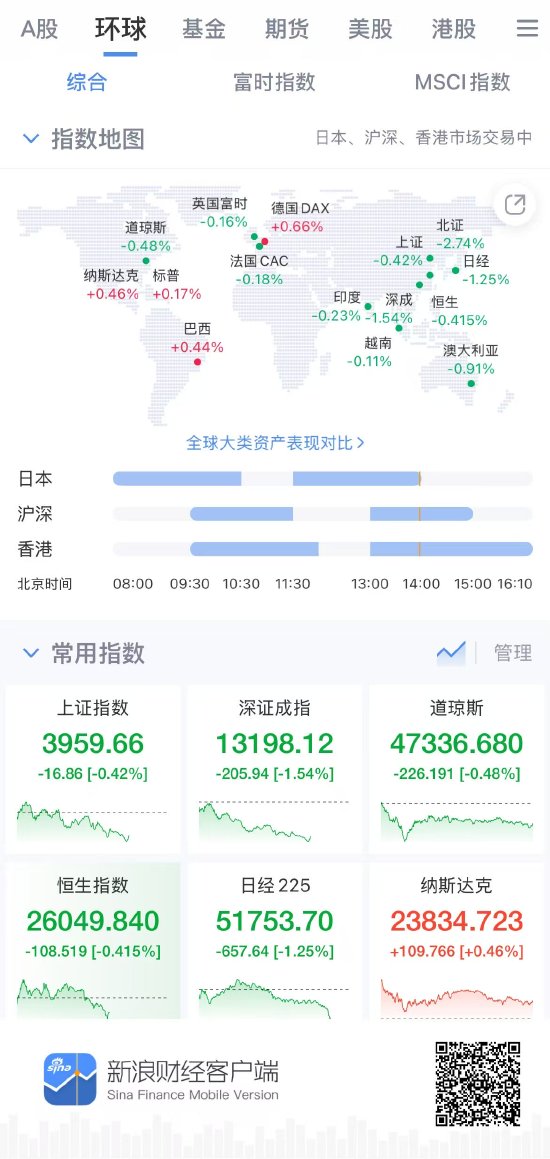
全球股指尽在掌握!新浪财经APP成投资者首选利器
Xin Lang Qi Huo· 2025-11-04 06:00
Core Insights - In 2025, a powerful financial app has become a key tool for investors to make timely decisions amid increasing global market volatility [1] - The demand for real-time market data and precise analysis has surged, with China's securities app monthly active users surpassing 166 million and an online penetration rate of 15.46% [1] Group 1: Competitive Positioning - Sina Finance App ranks first in the industry with a comprehensive score of 9.56, making it a popular choice among investors [2] - The core competitiveness of financial investment apps has shifted from mere functionality to a comprehensive competition of technology, data, and ecosystem [5] - Sina Finance App achieved a score of 9.8 in data coverage, covering over 40 global markets, including A-shares, Hong Kong stocks, US stocks, futures, and foreign exchange [5] Group 2: Performance Metrics - The app's unique access to Nasdaq Level 2 data stream allows for a market refresh speed of 0.03 seconds, significantly exceeding the industry average [5] - During the market volatility in May 2025, while most apps experienced a 1-2 second delay, Sina Finance maintained millisecond-level updates, enabling users to capture cross-market arbitrage opportunities [6] Group 3: Technological Innovations - The app has developed an AI feature called "Xina AI," which can condense lengthy financial reports into 300-word summaries within 30 seconds, identifying risk and opportunity points [8] - The intelligent alert system supports monitoring of 12 types of condition combinations, achieving an accuracy rate of over 98% [8] Group 4: Information Timeliness - Sina Finance App scored 9.7 in information quality, providing timely interpretations of major events like Federal Reserve decisions, leading the industry by 5-10 seconds [9] - The app's decision-making loop, which includes news reception, expert interpretation, intelligent alerts, and trading transitions, achieved zero latency during the stock market turbulence in February 2025 [10] Group 5: Ecosystem Integration - The app's ecosystem integration capability is enhanced by leveraging resources from the Sina network, filtering stock recommendations effectively with 82% of certified analysts [11] - The newly released version 8.14 allows users to customize investment portfolio benchmarks, further enhancing its "information-analysis-decision" service capability [11] - As global market interconnectivity increases, the app is positioned as a comprehensive tool that provides all-weather, multi-dimensional, and intelligent services for investment decision-making [11]
QuestMobile2025 中国移动互联网秋季大报告:12.69亿人月均使用178.2小时,三大动能推动用户黏性高速攀升
3 6 Ke· 2025-11-04 03:09
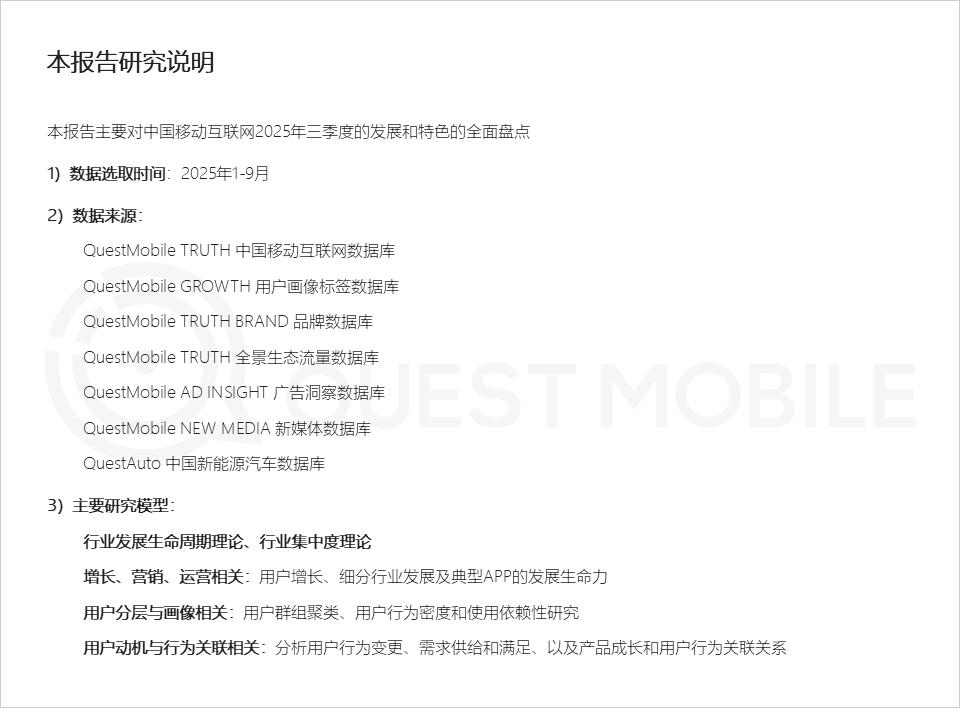
Core Insights - The mobile internet industry is entering a high-quality development phase, with user engagement and usage time showing significant growth [1][2][13] - The user base reached 1.269 billion by September 2025, with a year-on-year increase of 2%, while the average monthly usage time per user increased by 8.2% to 178.2 hours [1][13] User Engagement and Demographics - User structure is improving, with the proportion of users from first-tier cities increasing to 11.2%, up by 0.8% year-on-year [1][15] - Users with online consumption capabilities between 1,000 to 2,999 yuan account for 63%, a 0.9% increase year-on-year, indicating sustained growth in high-consumption user segments [1][15] - The proportion of users aged 46 and above has increased by 1.1%, reflecting a shift towards a more diverse user demographic [1][15] AI and Technological Integration - Generative AI is driving the integration of mobile internet services into high-frequency daily needs such as life, entertainment, and travel [1][2] - The monthly active user base for AI applications has surpassed 700 million, with significant growth in AI search engines and comprehensive assistants [29][38] - AI applications are becoming essential tools in various sectors, including education and office productivity, enhancing overall efficiency [20][18] Market Dynamics and Capital Trends - A new expansion cycle in the mobile internet sector is underway, with major companies increasing investments in AI and breaking down business boundaries [2][9] - The internet advertising market reached 187.51 billion yuan in Q3 2025, a year-on-year growth of 6.4%, driven by consumer brands and innovative advertising strategies [2][44] - Major internet companies like Tencent and Alibaba are seeing significant market capitalization growth, with Tencent's market value returning to 5.5465 trillion yuan, a 48.1% increase year-on-year [9][2] Industry Insights - The online entertainment sector, particularly short video platforms, has seen a surge in user engagement, with active users reaching 1.129 billion [70] - The online video industry is thriving, driven by summer effects and popular short dramas, with user engagement exceeding 20 hours per month [77] - The tourism and travel sector is experiencing increased demand, with platforms adapting to changing consumer preferences for self-planned travel [110][117]

消息称苹果明年3月推升级版Siri,或接入谷歌Gemini模型
Huan Qiu Wang Zi Xun· 2025-11-04 03:01
Core Insights - Apple plans to launch a significant upgrade to its voice assistant Siri in March 2026, incorporating external AI models, particularly Google's Gemini model, to enhance its capabilities [1][3] - The new version of Siri will feature AI-driven web search functionality, aiming to improve user experience by autonomously filtering and summarizing web content [1][3] Group 1 - Siri has been criticized for its limitations since its launch in 2011, and the upcoming upgrade aims to break the traditional closed system by allowing access to Google's computational power for better semantic understanding and multi-turn conversations [3] - The integration of AI web search is seen as a direct response to competitors like Google Assistant and Amazon Alexa, which have already adopted generative AI features [3] - Despite the technological advancements, there are concerns about Siri's future due to past performance issues, with only 32% of iPhone users setting Siri as their default voice assistant compared to 58% for Google Assistant and 41% for Alexa as of a 2025 survey [3] Group 2 - The reliance on Google's servers for data processing may raise questions about Apple's privacy commitments, potentially affecting user trust [3] - Siri's brand image has suffered due to years of stagnation, leaving uncertainty about whether users will give the assistant a second chance after the upgrade [3]