资产配置

Search documents
开始反弹!黄金股ETF(517520)涨幅持续超黄金
Sou Hu Cai Jing· 2025-10-29 05:48
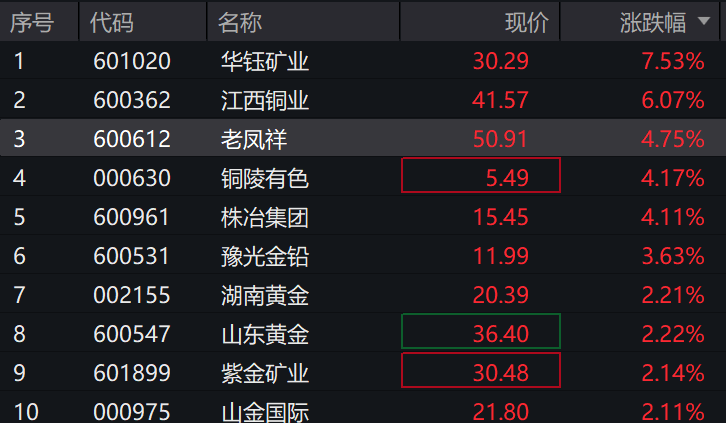
Core Viewpoint - The gold industry stocks are experiencing a strong upward trend, with significant gains in key stocks and ETFs, indicating a favorable investment environment in the gold sector [1][4]. Group 1: Stock Performance - The China Securities Index for gold industry stocks (931238) rose by 1.50%, with notable increases in individual stocks such as Huayu Mining (601020) up 7.53% and Jiangxi Copper (600362) up 6.07% [1]. - The Gold Stock ETF (517520) increased by 1.73%, with an average daily trading volume of 687 million yuan over the past month, ranking first among comparable funds [1][2]. - The Gold Stock ETF saw a significant growth in scale, increasing by 1.097 billion yuan in the past month, placing it in the top one-sixth of comparable funds [2][3]. Group 2: Fund Inflows and Market Trends - The Gold Stock ETF experienced a substantial increase in shares, with 76 million new shares added in the last two weeks, also ranking in the top one-sixth of comparable funds [3]. - The ETF recorded a net inflow of 964,100 yuan recently, with a total of 506.426 million yuan net inflow over the last ten trading days, indicating strong investor interest [3]. - The spot gold price recently fell below the support level of 3,900 USD/ounce, reaching a low of 3,886.3 USD/ounce, marking a decline of over 10% from its peak of 4,381.11 USD/ounce [3]. Group 3: Macroeconomic Factors - The upcoming Federal Reserve meeting is expected to result in a 25 basis point rate cut, amidst concerns over the Fed's independence and ongoing geopolitical tensions, which may support gold prices [4]. - Long-term factors driving the upward movement of gold prices include continued central bank purchases to hedge against dollar credit risk and a shift in gold ETFs from net selling to net buying [4]. - The gold market is currently influenced by both monetary and financial attributes, suggesting that despite short-term volatility, the long-term investment value remains significant [4]. Group 4: Investment Strategy - The Gold Stock ETF (517520) is highlighted as a more elastic investment option during periods of rising gold prices, providing better liquidity and potential returns [5]. - The ETF closely tracks the China Securities Index for gold industry stocks (931238) and selects high-quality companies from the gold industry across the Shanghai, Shenzhen, and Hong Kong markets [5].






DeepSeek分析:未来5年,钱放黄金、存银行、买房哪个更划算?
Sou Hu Cai Jing· 2025-10-29 05:37
Group 1: Real Estate Market - The real estate market is undergoing a significant transformation, with average housing prices down approximately 30% from their peak in 2021 [3] - Governments are removing strict purchase restrictions, banks are lowering mortgage rates, and tax incentives are being introduced to stimulate the market [3] - Despite price declines, many cities still exhibit housing bubbles, particularly in first-tier cities like Shanghai and Shenzhen, where the price-to-income ratio can reach 40 times [5] Group 2: Investment Risks in Real Estate - The pandemic has negatively impacted incomes, making it difficult for residents to afford high housing prices [5] - The investment demand for real estate has significantly decreased, leading to concerns about potential further price declines [5] Group 3: Gold Market Insights - The liquidity of physical gold is questionable, as selling gold bars to banks often results in lower recovery prices compared to market value [7] - The price of gold is influenced by various factors, including the U.S. dollar index and global geopolitical situations, leading to high volatility [8] - Recent geopolitical events have caused significant fluctuations in gold prices, posing risks for ordinary investors [8] Group 4: Bank Deposits - Since 2024, major state-owned banks have been continuously lowering deposit interest rates, reducing the returns for savers [7] - Rising prices are eroding the purchasing power of savings, although bank deposits may still prevent significant wealth erosion compared to other investments [7] Group 5: Asset Allocation Strategy - A diversified asset allocation is essential for wealth preservation and growth, suggesting a balanced distribution across low-risk, medium-risk, and no-risk investments [7]


“专业买手”,持仓曝光!
中国基金报· 2025-10-29 02:52
Core Viewpoint - The latest heavy positions of public FOFs (Fund of Funds) reveal a strong preference for bond funds and ETFs, indicating a strategic shift towards safer investments in the current market environment [2][4]. Group 1: FOF Heavy Positions - As of the end of Q3 2025, bond funds remain the dominant category in FOF heavy positions, with 31 out of the top 50 funds being bond-related, accounting for over 50% of the total [4]. - The top five funds favored by FOFs in Q3 include: 1. Hai Fu Tong Zhong Zheng Short Bond ETF with a market value of over 3.29 billion yuan held by 67 FOFs 2. Hua An Gold ETF with over 1.73 billion yuan 3. Ping An Zhong Dai - High-Grade Corporate Bond Spread Factor ETF with over 1.59 billion yuan 4. Bosera Zhong Dai 0-3 Year National Development Bank ETF with over 1.37 billion yuan 5. Bosera Shanghai Stock Exchange 30-Year Treasury ETF with over 1.07 billion yuan [4][6]. Group 2: Active Equity Fund Holdings - Among active equity funds, Yi Fang Da Ke Rong leads with a total holding value of 590 million yuan across 12 FOFs, followed by Hua Xia Innovation Frontier A with 485 million yuan held by 15 FOFs [7][8]. - Other notable active equity funds include Xing Quan Business Model Preferred A and Yi Fang Da Information Industry Selected C, both exceeding 400 million yuan in holdings [7][8]. Group 3: Fund Increases - The most increased fund in Q3 was Hai Fu Tong Zhong Zheng Short Bond ETF, which saw an increase of 1.647 billion yuan, bringing its total market value to 3.29 billion yuan [9][10]. - Other significant increases include Ping An Zhong Dai - High-Grade Corporate Bond Spread Factor ETF with an increase of 1.234 billion yuan and Fu Guo State-Owned Enterprise Bond C with over 900 million yuan [9][10]. Group 4: Strategic Focus Areas - FOF managers are increasingly focusing on gold-related funds and have increased allocations in technology and resource sectors, reflecting a strategic shift in response to market conditions [11][12]. - Managers express confidence in the A-share market's long-term potential, particularly in consumer-related sectors, while also maintaining a diversified approach with overseas bond investments and REITs [12][13].

贸易局势缓和,金价再跌,黄金ETF周一创六个月最大单日减仓
Sou Hu Cai Jing· 2025-10-28 21:50
Core Viewpoint - Gold prices have experienced significant volatility, dropping below $3960 per ounce after reaching a historical high of $4380 per ounce, primarily due to easing trade tensions and reduced demand for safe-haven assets [1][2] Group 1: Market Trends - Gold prices fell 3.2% on Monday, continuing a downward trend, with a notable drop in gold ETFs, which reduced holdings by 448,706 ounces (approximately $1.79 billion), marking the largest single-day reduction in six months [1] - Despite the recent decline, gold has still increased by about 50% year-to-date, driven by central bank purchases and currency devaluation trades [1][2] - A survey at the LBMA conference indicated a bullish sentiment among participants, with expectations that gold prices could approach $5000 per ounce in a year [2] Group 2: Institutional Insights - Analysts suggest that the current market conditions may present opportunities for central banks to increase gold holdings, with reports indicating that the Bank of Korea is considering re-entering the gold market after more than a decade [2] - The World Gold Council noted a decrease in central bank demand for gold, which could lead to deeper market adjustments that may be welcomed by professional traders [2] Group 3: Investment Strategies - Analysts recommend a cautious approach to gold investments, suggesting that investors wait for a bottom before buying during a rebound [2] - There is a prevailing view that gold remains underrepresented in global asset allocation, with only about 5% of investments in gold compared to traditional stock and bond portfolios [3] - Market expectations indicate that the Federal Reserve may lower interest rates by 25 basis points, which typically supports non-yielding assets like gold [3]
赵伟:长端利率突破2%后的市场运行规律——基于跨国比较的经验研究(《债券》9月刊)
申万宏源宏观· 2025-10-28 16:04
Core Viewpoint - The article discusses the market dynamics following the long-end interest rates breaking through the 2% threshold, emphasizing the need for a revised analytical framework in the bond market to address potential long-term oscillations rather than a continuous decline [5][6]. Group 1: Long-End Interest Rate Downward Path - Historical data shows that the downward path of long-end interest rates in developed economies exhibits significant asymmetry, with the time taken to drop from 3% to 2% being shorter than from 2% to 1% [6][8]. - The Japanese case during the 1998 Asian financial crisis illustrates this pattern, where the 10-year government bond yield quickly fell below 2% and 1%, followed by a prolonged oscillation between 1% and 2% for seven years [7][8]. - Factors triggering rebounds in interest rates during oscillation periods include marginal tightening of monetary policy, better-than-expected economic data, and the siphoning effect from equity markets [8][9]. Group 2: Conditions for Breaking the 1% Threshold - Long-term interest rates face strong resistance when approaching the 1% level, often requiring specific catalysts such as major economic or financial crises, policy rates nearing theoretical lower limits, or significant external shocks [9][10]. - Historical instances of developed economies effectively breaking the 1% threshold typically coincide with their policy rates being at or near zero [9][10]. Group 3: Mechanisms of Constraints - The lower bound of policy interest rates acts as a constraint, as nominal rates cannot fall below zero, limiting the effectiveness of monetary policy transmission [11][14]. - The rigidity of term premiums, which compensates for risks associated with long-term bonds, restricts further declines in long-end interest rates, as it is influenced by structural factors and market expectations [15][16]. - Institutional asset allocation behavior shifts when long-term bond yields drop below 2%, leading to increased risk asset allocations or cross-border investments, thereby reducing domestic long-term bond demand [17][20]. Group 4: Insights for Bond Market Analysis - The traditional analytical framework for bond markets may become ineffective as the 10-year government bond yield approaches the 1% to 2% range, necessitating a focus on new structural dynamics [21][22]. - The pressure for asset-liability matching among financial institutions has emerged as a key structural force influencing long-term interest rates, particularly in low-yield environments [22][23]. - Central banks' balance sheet operations have evolved into core tools for interest rate control, significantly impacting long-end rates through both flow and stock effects [23][24]. Group 5: Implications for China's Bond Market - The bond market in China may enter a prolonged oscillation phase following the 10-year government bond yield breaking the 2% threshold, necessitating a reassessment of investment strategies from a cross-asset allocation perspective [25][26]. - Current asset allocation behaviors indicate extreme states, with bond assets in public funds significantly exceeding equity allocations, suggesting ongoing rebalancing processes [25][26].

金价一日跌破4000、3900美元两大关口
第一财经· 2025-10-28 14:35
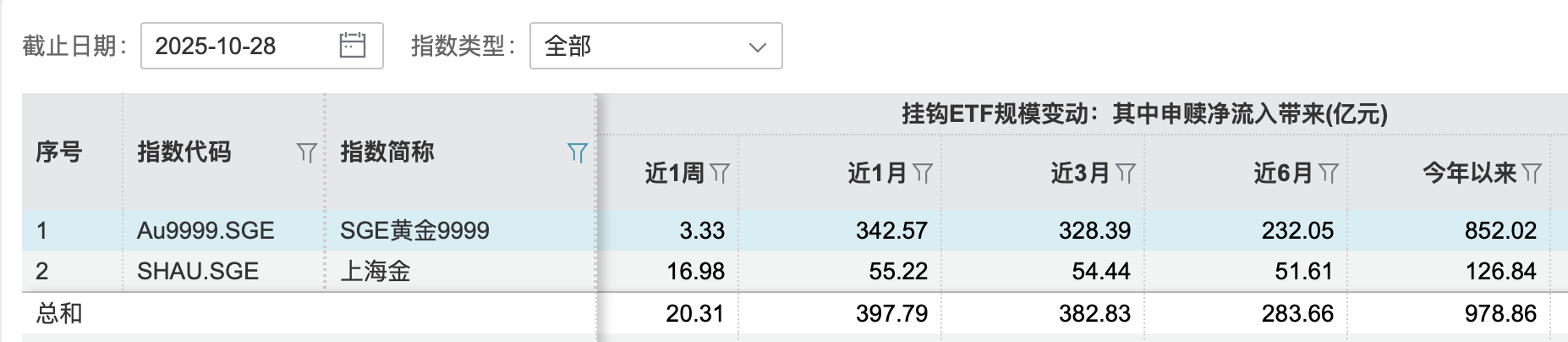
2025.10. 28 本文字数:1669,阅读时长大约3分钟 10月28日,伦敦黄金现货价格最低触及3886美元/盎司。国内市场上,沪金期货跟跌,盘中最低触 及900元/克。 借金价持续调整之势,资金开始"抄底"黄金ETF。据Wind统计,国内14只挂钩实物金的黄金ETF近 一周由申赎净流入带来的规模变化超20亿元。 南华期货贵金属新能源研究组负责人夏莹莹对记者分析称,此前,美国政府停摆事件、全球贸易关税 不确定性、以及美国银行市场信贷问题引发的避险情绪把国际金价快速推至历史高点,当前市场避险 情绪缓和,获利了结盘集中抛售,黄金价格陷入回调阶段。预计黄金中长期仍有望进一步上涨,但短 期仍将面临调整压力,建议投资者采用"回调分步建仓"策略应对。 "越跌越买" , 黄金 ETF份额逆市增长 10月20日,伦敦现货黄金价格冲上4381美元/盎司的历史高位,截至目前跌至3886美元/盎司,每 盎司黄金价格跌去495美元用时仅约一周。 在这期间,尽管金价连续重挫,国内市场黄金ETF依旧保持净流入状态。 据Wind统计,10月20日至28日,14只挂钩实物金的黄金ETF均实现了份额增长,总计增长8.65亿 份,且近一周 ...

金价短期“深蹲”,是上车良机还是劝退信号?
Di Yi Cai Jing· 2025-10-28 13:34
Core Insights - The recent decline in gold prices has led to significant inflows into gold ETFs in China, with a net inflow exceeding 2 billion yuan in just one week [3][4][6] - Despite the drop in gold prices, domestic gold ETFs have seen a continuous increase in shares, indicating that investors are viewing the price correction as a buying opportunity [4][6] - Analysts suggest that while short-term adjustments are expected, the long-term outlook for gold remains positive due to factors such as de-dollarization trends and ongoing central bank purchases [6][7] Market Trends - The international gold price fell sharply, reaching a low of 3,886 USD per ounce, down from a historical high of 4,381 USD per ounce within a week [2][4] - The domestic gold futures market mirrored this decline, with prices hitting a low of 900 CNY per gram [2] - The total increase in shares for the 14 gold ETFs linked to physical gold amounted to 865 million shares, with a total inflow of approximately 39.8 billion yuan over the past month [4][6] Investor Behavior - Many investors are adopting a "buy the dip" strategy, viewing the current price adjustments as an opportunity to accumulate gold [6][7] - The high volatility in gold prices has raised concerns about market overcrowding, prompting some analysts to advise caution in increasing gold allocations [7][8] - Recommendations for investors include a disciplined approach to asset allocation, ensuring that gold holdings remain within predetermined limits to manage portfolio volatility [7][8]
最好的投资方法,往往是看起来最平庸的那一个
雪球· 2025-10-28 13:01
Core Viewpoint - The article emphasizes that the most effective investment strategies are often perceived as "mundane methods" rather than flashy techniques, which tend to be high-risk and unsustainable [3][5]. Group 1: The Flaws of Flashy Methods - Investment markets are filled with "legendary stories" of stocks doubling in value or extraordinary profits from derivatives, which attract investors but often come with high risks [5]. - Retail investors in the A-share market frequently fall into a cycle of "one profit, two breakeven, seven losses," primarily due to their obsession with short-term gains [5]. - Flashy investment methods are characterized by their non-replicability and high uncertainty, relying on precise market predictions or extreme risk tolerance, which can fail when market conditions change [5][6]. Group 2: Effectiveness of Mundane Strategies - Effective "mundane methods" simplify complex logic into executable principles, focusing on "embracing the ambiguous correct" rather than seeking perfect decisions [8]. - The investment logic of renowned investors like Warren Buffett illustrates the value of long-term holding of understandable companies at reasonable prices, avoiding macroeconomic predictions [8]. - Mundane strategies utilize "mechanical discipline" to counter human weaknesses, such as greed and fear, allowing time to work in favor of returns [8]. - These strategies leverage the "compounding effect" to achieve gradual wealth accumulation, outperforming over 90% of short-term speculators in the long run [8][9]. Group 3: Barriers to Embracing Mundane Strategies - Ordinary investors often exhibit cognitive biases, such as overconfidence in their stock-picking abilities or loss aversion, leading to frequent portfolio adjustments that undermine long-term strategies [11]. - Media and industry narratives often glorify "star fund managers" and short-term success stories, marginalizing mundane strategies that lack compelling narratives [12]. Group 4: Returning to Mundane Strategies - For most investors, the focus should be on "asset allocation" based on investment goals and risk tolerance, diversifying funds across various asset classes to mitigate volatility [14]. - Selecting low-cost broad-based index funds as core investments can prevent excessive focus on sector themes or active fund selection [14]. - Setting long-term goals and avoiding frequent trading can help investors withstand short-term market fluctuations [14][15]. Group 5: Investment Philosophy - The essence of investing is not about seeking "stunning moments" but achieving "long-term stability" [15]. - Letting go of the obsession with the "extraordinary" and embracing the wisdom of "mundane" can lead to a more stable and enduring investment journey [16].

想要的投资节奏他家都有!鹏华“固收+”到底有多全面?
Sou Hu Cai Jing· 2025-10-28 11:22
Group 1 - The article discusses the potential of stock trading to achieve wealth freedom, highlighting that while it is possible, the probability is low for most individuals and comes with significant risks [4][6] - It identifies three main reasons why people mistakenly believe stock trading can lead to wealth freedom: survivor bias, wealth effect during bull markets, and the myth of stable long-term high returns [6] - The article suggests a shift in mindset towards stock trading, advocating for viewing it as part of asset allocation, focusing on long-term value investing, and pursuing sustainable asset growth rather than quick wealth [7] Group 2 - The "Fixed Income+" strategy is introduced as a way for ordinary investors to participate in the stock market with less effort, combining fixed income assets with a small portion of equities to enhance returns [9][10] - The article emphasizes the importance of matching investment strategies to different investor profiles, categorizing them into ultra-low, low, medium, and high volatility products to suit varying risk tolerances [20][38] - Specific funds are highlighted, such as Penghua Fengrong (000345) with a one-year return of 2.71% and a maximum drawdown of only -0.75%, showcasing the stability of the "Fixed Income+" approach [22][23] Group 3 - The article outlines the performance of various "Fixed Income+" products, including Penghua Yongsheng (003662) with a one-year return of 4.28% and a maximum drawdown of -0.93%, indicating effective management of volatility [24][25] - It discusses the medium volatility strategy, which aims for a drawdown control target of 3-4%, allowing investors to benefit from stock market gains without excessive volatility [30][31] - The high volatility strategy is characterized by aggressive investment in convertible bonds, with Penghua Convertible Bond A (000297) achieving a net value increase of 33.03% this year, demonstrating the potential for significant returns in a rising market [36][37] Group 4 - The article emphasizes the need for diversified investment strategies, including technology growth and dividend value, to capture various market opportunities while maintaining a balanced risk profile [45][53] - It highlights the importance of dynamic asset allocation, where funds are adjusted based on market conditions to optimize returns and manage risks effectively [46] - The conclusion stresses that with the right investment approach, individuals can achieve sustainable asset growth, transforming investing into a manageable long-term endeavor rather than a stressful pursuit [55][56]

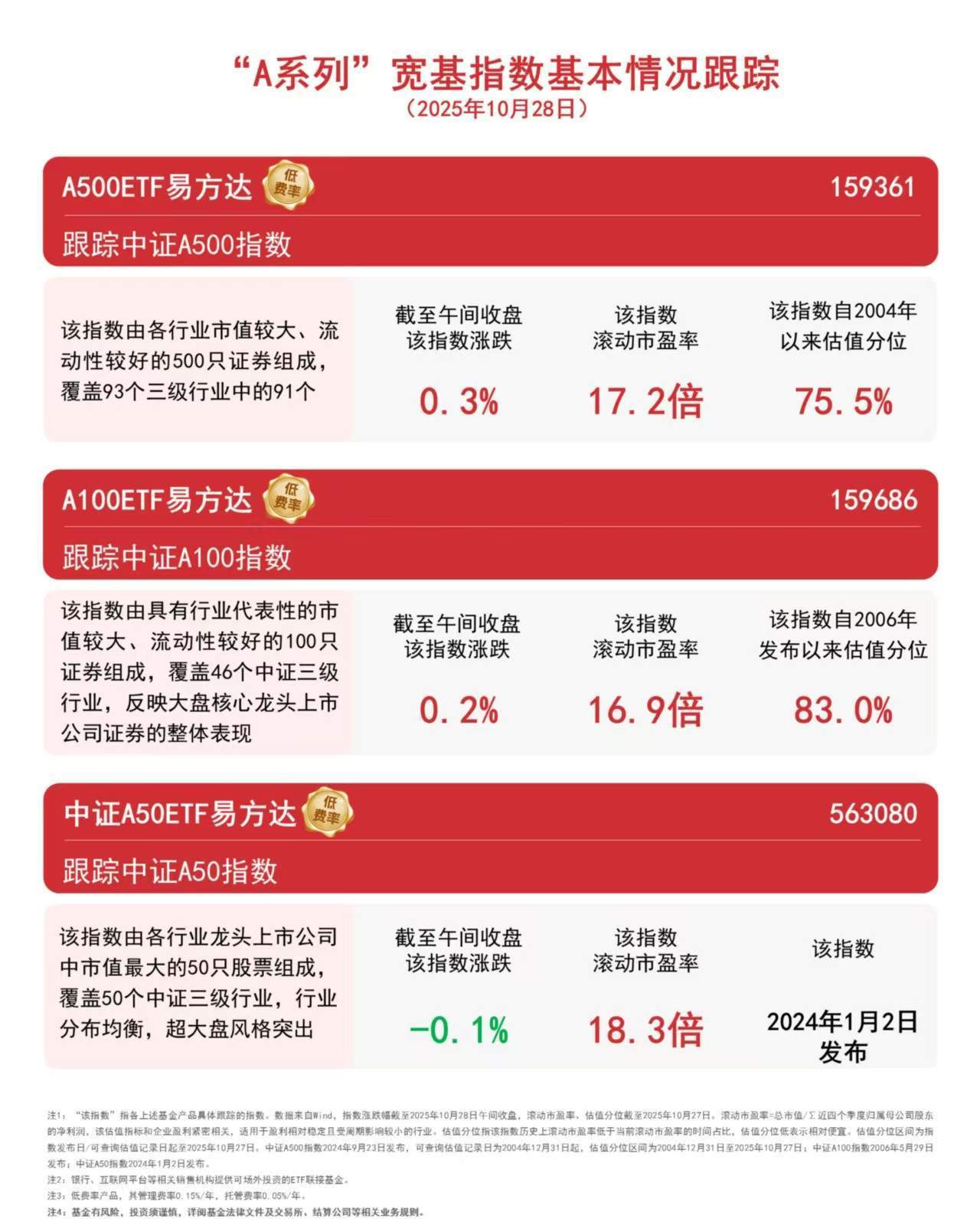
“A系列”指数早盘窄幅震荡,A500ETF易方达(159361)半日获1.5亿份净申购
Sou Hu Cai Jing· 2025-10-28 05:56
Group 1 - The core viewpoint of the article highlights the performance of various indices in the Chinese stock market, with the CSI A500 index rising by 0.3%, the CSI A100 index increasing by 0.2%, and the CSI A50 index declining by 0.1% [1] - The A500 ETF from E Fund (159361) recorded a trading volume of nearly 2.5 billion yuan, with a net subscription of 150 million shares [1] - The Chairman of the China Securities Regulatory Commission, Wu Qing, emphasized the importance of stability and balance in asset allocation during the risk repricing and asset rebalancing process, indicating a continued revaluation of Chinese assets such as A-shares and Hong Kong stocks [1][3] Group 2 - The CSI A500 index is composed of 500 securities with larger market capitalizations and better liquidity, covering 91 out of 93 three-level industries [3] - The rolling price-to-earnings ratio of the CSI A500 index stands at 17.2 times [3]