板块轮动

Search documents
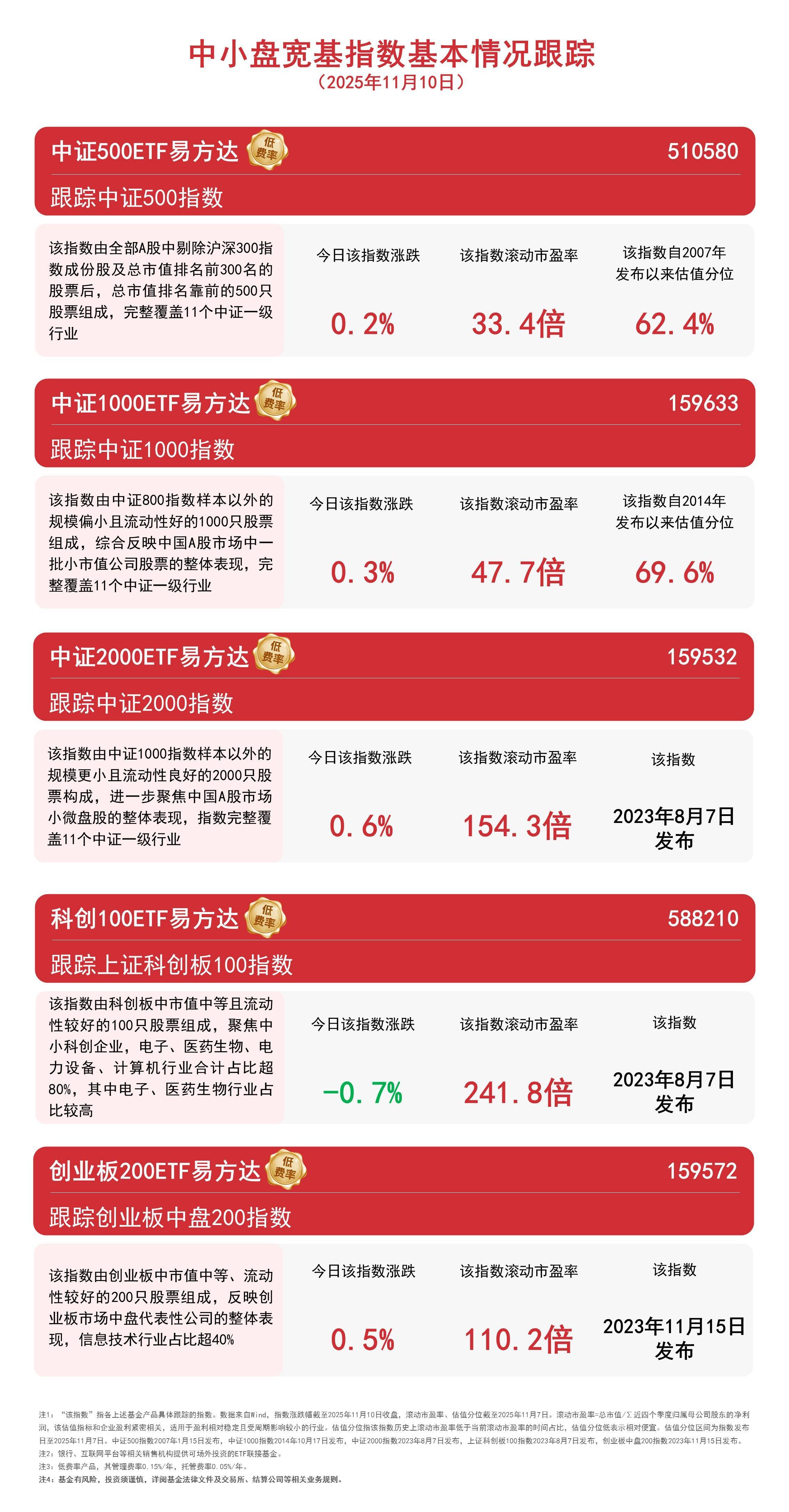
指数午后拉升收涨0.6%,中证2000ETF易方达(159532)助力捕捉板块轮动投资机会
Sou Hu Cai Jing· 2025-11-10 11:00
Group 1 - The core viewpoint of the article highlights the performance of various indices in the Chinese A-share market, with the CSI 2000 index rising by 0.6%, indicating a positive trend in small-cap stocks [1] - The CSI 2000 index covers 30 primary industries, focusing on emerging sectors such as machinery and electronics, which helps to diversify risks and capture gains from market rotations [1][6] - The CSI 2000 index is composed of 2000 stocks that are smaller in size and have good liquidity, further emphasizing the overall performance of small and micro-cap stocks in the A-share market [6] Group 2 - The article mentions that the CSI 2000 index is part of a broader set of indices that reflect the performance of small-cap companies, covering 11 primary industries [4][6] - The article also references the performance of the ChiNext Mid-Cap 200 index, which rose by 0.5%, indicating a similar positive trend in mid-cap stocks [1] - The article notes that the STAR 100 index, which focuses on medium-sized and liquid stocks in the Sci-Tech Innovation Board, has a significant concentration in sectors like electronics, pharmaceuticals, and power equipment [8]

积极看涨?
第一财经· 2025-11-10 10:20
Market Overview - The A-share market shows a mixed and volatile pattern, with the Shanghai Composite Index recovering gradually due to support from the consumer and cyclical sectors [4] - On November 10, the Shanghai Composite Index closed at 4018.60, while the Shenzhen Component Index fluctuated around 13400 points, supported by the consumer sector [6][13] Investor Sentiment - Investor sentiment is a crucial indicator of market performance, with 10,819 users participating in a sentiment survey on November 10 [2] - The overall market sentiment has improved, as evidenced by a significant increase in trading volume, with a total turnover of over 1 trillion, up 8.50% [9] Sector Performance - The market exhibited a "broad rise with differentiation" characteristic, with major consumer and cyclical stocks leading the gains. Notable sectors include liquor, food and beverage, and duty-free shops [8] - The technology sector, particularly electronics, communications, and high-end manufacturing, experienced notable adjustments [8] Fund Flows - There is a clear "high-low switch" in fund flows, with retail investors showing a net inflow while institutional investors are reallocating their portfolios, focusing on sectors with policy and earnings certainty [10][11] - Institutional investors are increasing their positions in consumer sectors such as liquor, cultural media, and food and beverage, while reducing exposure to consumer electronics, semiconductors, and communication equipment [11] Retail Investor Behavior - Retail investors are actively chasing stocks, particularly in consumer sectors related to the upcoming Double Eleven shopping festival, with significant interest in dairy and community group buying [11] - As of November 10, 30.65% of retail investors reported increasing their positions, while 12.55% reduced their holdings [15]

A股:行情见顶了吗?信号明显了,做好准备吧,下周可能这样走
Sou Hu Cai Jing· 2025-11-09 17:07
Core Viewpoint - The A-share market is currently experiencing a tug-of-war around the 4000-point mark, with a critical trading volume threshold of 2.5 trillion yuan that needs to be surpassed for a sustained upward movement [1][3]. Market Conditions - The A-share market has been in a "vacuum period" with a lack of strong catalysts, as the third-quarter reports have just been released and the annual reports are still pending [3]. - There has been a significant net outflow of 236.9 billion yuan from the A-share market, indicating a retreat of existing funds despite a year-on-year revenue growth of 58.27% and net profit growth of 53.58% for listed companies [3][5]. - Foreign capital has shown a cautious attitude, with recent net outflows from northbound funds despite the optimization of the Qualified Foreign Institutional Investor (QFII) system [3][8]. Technical Analysis - The market is showing signs of a potential top, with all three major indices exhibiting a divergence pattern, where the indices are rising while key technical indicators like MACD are not reaching new highs [3][5]. - The current trading volume is around 2 trillion yuan, which is approximately 20% lower than the peak in August, indicating a volume-price divergence that could hinder a breakout [5]. Sector Performance - There is a noticeable rotation among sectors, with recent leaders like pharmaceuticals and AI applications experiencing adjustments, while sectors such as power generation and chemicals have taken the lead [5][6]. - The technology sector is showing significant differentiation, with high valuations in AI-related stocks, while leading companies maintain stability due to their technological advantages [6]. Policy Support - Recent policy measures from the central bank and the China Securities Regulatory Commission (CSRC) have provided a supportive environment for the market, including a 700 billion yuan reverse repurchase operation to ensure liquidity [8]. - The market sentiment has cooled compared to previous bullish trends, with a more rational investor mindset reflected in the changes in trading volume [8]. Investment Strategies - Institutional funds are quietly adjusting their portfolios, with social security and public funds showing significant overlap in holdings, particularly in technology innovation sectors [8]. - The current A-share market valuation is significantly lower compared to 2015, with a healthier market structure as hard tech companies have risen in prominence [10]. Upcoming Events - The market is expected to face critical tests in the coming week, focusing on trading volume expansion, sustainability of leading sectors, and the movement of northbound funds [11]. - Key economic data will be released on November 14, which may provide new directional guidance for the market [13].

FICC日报:指数低开高走,板块内部表现分化-20251106
Hua Tai Qi Huo· 2025-11-06 05:39
Report Industry Investment Rating No relevant content provided. Core View The domestic market is relatively strong compared to the weak performance of the Asia-Pacific market on the day. Policy and capital support actions further confirm the long-term bullish pattern. However, in the short term, sector rotation continues and the internal differentiation is still prominent, and the market is still in the process of recovery. Bull market adjustments are often achieved through increased volatility, and it is expected that the market will continue the trend of shrinking volume, oscillating, and adjusting in the short term [3]. Summary by Related Catalogs Market Analysis - China has announced specific measures to implement the consensus of the China-US economic and trade consultations in Kuala Lumpur, including stopping the implementation of additional tariffs on some imported goods from the US, continuing to suspend 24% reciprocal tariffs for one year, and stopping export control measures on 15 US entities [1]. - A-share indices opened lower and closed higher. The Shanghai Composite Index rose 0.23% to 3969.25 points, and the ChiNext Index rose 1.03%. The power equipment, coal, and commercial retail sectors led the gains, while the computer, non-bank finance, and communication sectors led the losses. The trading volume of the Shanghai and Shenzhen stock markets was less than 1.9 trillion yuan [1]. - The US 10 - month ISM services PMI rose 2.4 points to 52.4, reaching an eight - month high. The three major US stock indices closed higher, with the Nasdaq rising 0.65% to 23499.8 points [1]. Futures Market - In the futures market, the basis of stock index futures declined. There was differentiation in trading volume and open interest. The trading volumes of IH, IC, and IM increased, and the open interest of stock index futures increased [2]. Strategy - The Asia - Pacific market was weak on the day, while the domestic market was relatively strong. It is expected that the market will continue the trend of shrinking volume, oscillating, and adjusting in the short term [3]. Macro - economic Charts - The report includes charts on the relationship between the US dollar index and A - share trends, US Treasury yields and A - share trends, RMB exchange rates and A - share trends, and US Treasury yields and A - share style trends [10][8]. Spot Market Tracking Charts - The daily performance of major domestic stock indices on November 5, 2025, shows that the Shanghai Composite Index rose 0.23%, the Shenzhen Component Index rose 1.95%, and the ChiNext Index rose 1.03% [13]. - Charts on the trading volume of the Shanghai and Shenzhen stock markets and margin trading balances are also included [14]. Futures Index Tracking Charts - The trading volume and open interest data of IF, IH, IC, and IM contracts are presented. For example, the open interest of IF was 116,616 (a decrease of 1,583), and the trading volume was 270,040 (an increase of 1,580) [18]. - The basis data of stock index futures for different contracts and different delivery months are provided. For example, the basis of the IF contract for the current month was - 16.46 (a decrease of 2.36) [42]. - The inter - delivery spread data of stock index futures are also given, such as the spread between the next - month and current - month contracts of IF was - 14.20 (an increase of 1.40) [49].
周三A股探底回升:消费与周期板块补位,科技风险加剧,资金切换进入关键阶段
Sou Hu Cai Jing· 2025-11-06 01:20
Market Overview - A-shares demonstrate strong resilience amid external negative impacts, with significant sector rotation observed, particularly in consumption, cyclical, and some traditional industries, countering the pressure from the technology sector's adjustment [1][20] - As of Wednesday's close, the Shanghai Composite Index reported 3969.25 points, up 0.23%, while the Shenzhen Component Index and the ChiNext Index rose by 0.37% and 1.03%, respectively, indicating a rebound despite external market pressures [2] Sector Performance - The consumption and cyclical sectors are recovering, with active performances noted in local Hainan stocks, food and beverage, tourism, chemicals, and steel [3] - The power equipment and energy storage sectors have surged, with numerous stocks hitting their upper limits [3] - The technology sector, including CPO, quantum technology, and AI applications, is experiencing a collective pullback, indicating a release of risks as chips concentrate at high levels [3][10] Sector Rotation Logic - The technology sector's high-level fluctuations are seen as inevitable due to previous significant gains driven by CPO and AI, leading to a lack of new incremental funds and resulting in a necessary period of consolidation or adjustment [5] - The rise of the consumption sector is attributed to the traditional peak season in Q4, with increased seasonal demand for liquor, food, and tourism [6] - Policy measures are expected to further stimulate domestic demand, with consumer confidence gradually recovering [7] - The cyclical sector is active due to stabilizing raw material prices, with chemicals, non-ferrous metals, and steel entering a replenishment cycle [8] - Improvement in overseas economic data is enhancing export expectations [9] - Accelerated domestic infrastructure investment is boosting upstream demand, leading to a shift in funds towards lower-priced sectors and industries with improving conditions [10] Structural Opportunities - Investment focus areas include: - Consumption (liquor, tourism, retail): driven by seasonal effects and policy support, focusing on leading companies and those benefiting from regional consumption policies [13] - Cyclical (chemicals, non-ferrous metals, steel): driven by replenishment and stabilizing raw materials, focusing on leading enterprises or undervalued stocks [13] - Power equipment and energy storage: supported by new energy expansion and policy backing, focusing on storage components and leading grid equipment [13] - Small-cap growth stocks (CSI 2000): indicating a style shift, with attention on newly listed stocks with good performance expectations [13] Investment Recommendations - For the technology sector, it is advised to refrain from chasing high prices and to wait for consolidation or rapid adjustments to complete trend repairs [14] - The consumption and cyclical sectors are recommended for short to medium-term allocations to capture continuous opportunities arising from improving conditions [14] - Small-cap stocks should be closely monitored for fund inflows, with low-priced quality growth stocks being worthy of attention [15]

股指调整!还在继续
Sou Hu Cai Jing· 2025-11-04 07:43
Group 1 - The stock index continues to decline, with technology, finance, and new energy sectors leading the drop, indicating fewer opportunities in these sectors but a rotation in performance [1] - Low-position sectors such as coal and oil & gas are performing well, showing a high-low switching trend [1] - The strategy suggests continuing to select individual stocks carefully, with a past case example of "Duo Flu Duo" demonstrating a 70% increase using specific trading strategies [1] Group 2 - The article presents a mixed outlook, mentioning both the decline in stock indices and the reduction of opportunities in certain sectors, while also highlighting the potential for individual stock selection [2]


科技承压下的资金新选择,创新药开启上涨新周期?
格隆汇APP· 2025-11-01 09:37
Core Viewpoint - The article highlights a significant shift in market dynamics, with capital moving from the technology sector to the innovative drug sector, indicating a structural change in investment focus [2][5]. Market Performance - On October 31, major technology stocks experienced a sharp decline, while the innovative drug sector saw a notable increase, with a 3.91% rise, breaking through the 20-day moving average [6]. - The innovative drug sector has been in a downward trend since August but began to stabilize in October, suggesting a potential bottoming out [6]. Investment Opportunities - Investors are encouraged to identify potential investment opportunities within the innovative drug sector as it becomes the new focus for capital allocation [7]. - The market for Multiple Sclerosis (MS) drugs is projected to reach approximately $18.5 billion in 2024, indicating a substantial growth opportunity [9]. Industry Landscape - The global market for chemical pharmaceuticals has shown steady growth, with the market size increasing from $1,038 billion in 2019 to $1,128 billion in 2023, and expected to reach $1,156 billion in 2024 [17]. - In China, the chemical drug market size was approximately 883.9 billion yuan in 2022, with a projected increase to 945 billion yuan by 2024, reflecting strong growth potential [19]. Company Performance - In the first half of 2025, 21 A-share innovative drug companies reported a revenue of 28.69 billion yuan, a 42% year-on-year increase, while net losses narrowed significantly [20]. - The performance improvement is driven by the successful market penetration of key products and the approval of new drugs, contributing to revenue growth and reduced losses [20]. Future Outlook - Continued policy support for innovative drugs is expected to enhance performance and accelerate the product launch pace, leading to improved financial results for companies in this sector [24]. - The active business development (BD) transactions in the innovative drug sector during the first half of 2025 are anticipated to bolster the apparent performance of related companies [25]. - China's innovative drug industry is positioned to compete globally, with significant advantages in research efficiency and pipeline quality, supporting long-term growth trends [26].

牛市加速来袭,盘后利好频传,大盘明天能否再涨?
Sou Hu Cai Jing· 2025-10-31 23:06
Core Viewpoint - The A-share market is entering an accelerated bull market phase, with mixed sentiments among investors as some stocks perform well while others lag behind [1][5][10]. Market Dynamics - Today's trading volume showed a moderate increase, indicating that market participants are still engaged, which is a positive sign for the bull market [3][7]. - The presence of continuous positive news suggests that market sentiment is being influenced more by events than by data alone, particularly with significant meetings scheduled around the 4000-point mark [3][7]. Sector Performance - In the liquor sector, Kweichow Moutai's Q3 report showed a modest growth rate of 0.48%, which, despite being low, is perceived as a positive outcome given market expectations [5]. - The performance of liquor stocks has been volatile, with significant fluctuations in trading, but the overall sentiment remains cautious yet optimistic as long as major players do not sell off [5][7]. Investor Sentiment - There is a notable divide in retail investor sentiment, with some feeling left out of the market gains while others are more secure in their positions [5][7]. - The market's current state is characterized by a mix of excitement and anxiety, as investors are aware that not everyone can capitalize on leading sectors [5][7]. Future Outlook - The market is expected to continue its upward trajectory as long as there are no significant negative catalysts, with the 4000-point level seen as a new starting point for further gains [7][10]. - The narrative of the bull market is still unfolding, and the ability of investors to remain engaged will determine their success [10].
公募总规模续创新高,机构关注高景气和低估值赛道
Guo Ji Jin Rong Bao· 2025-10-31 15:54
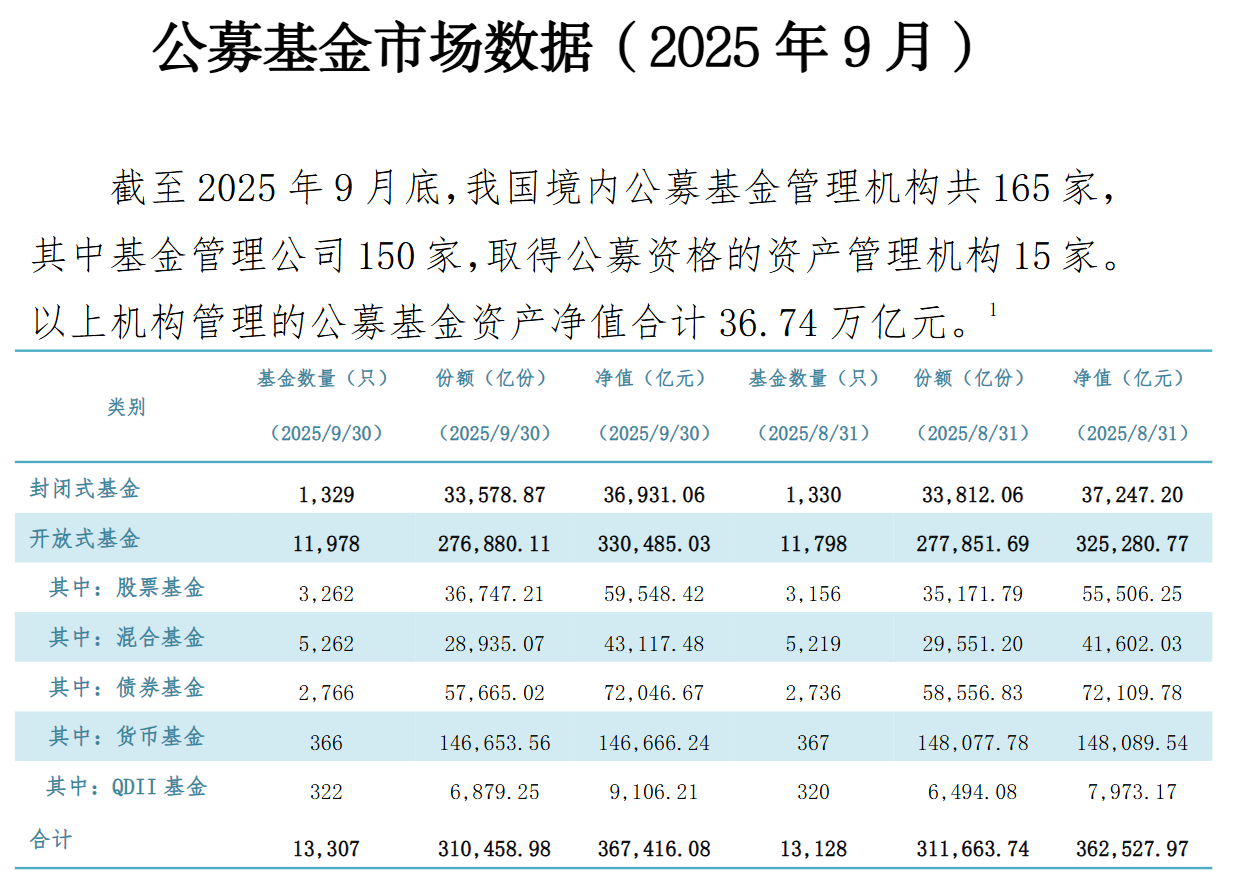
Core Insights - The latest data from the Asset Management Association of China indicates that as of the end of September, the total net asset value of public funds in China reached 36.74 trillion yuan, marking a new high and reflecting strong growth momentum in the industry [1][5]. Fund Management Institutions - There are currently 165 public fund management institutions in China, including 150 fund management companies and 15 asset management institutions with public qualifications [1]. Fund Size and Growth - The public fund asset net value has increased for six consecutive months since April, surpassing significant thresholds of 33 trillion, 34 trillion, 35 trillion, and 36 trillion yuan [1]. - The total number of public funds reached 13,307, with a total net value of 367,416.08 billion yuan as of September 30 [3]. Fund Categories Performance - Equity funds have become the main driver of growth, with stock funds reaching a scale of 5.95 trillion yuan, an increase of over 400 billion yuan month-on-month [5]. - Mixed funds grew to 4.31 trillion yuan, increasing by over 150 billion yuan, while QDII funds reached 0.91 trillion yuan, up by over 100 billion yuan [5]. - Conversely, money market funds decreased to 14.67 trillion yuan, down by over 140 billion yuan, and bond funds fell to 7.2 trillion yuan, down by over 6 billion yuan [5]. Market Trends - The stock market has shown a recovery, with the Shanghai Composite Index nearing 3900 points by the end of September, while the bond market has experienced fluctuations [5]. - The current market is characterized by "index fluctuations and rapid sector rotation," with a focus on sectors like technology and defensive assets such as metals and chemicals [6].
帮主郑重聊美股:科技股跌懵了?这波轮动藏着中长线机会
Sou Hu Cai Jing· 2025-10-31 08:37
Core Viewpoint - The recent significant drop in tech stocks, particularly the Nasdaq and companies like Meta and Nvidia, is attributed to market reactions to earnings reports and one-time expenses rather than a fundamental decline in the tech sector itself [1][3]. Group 1: Tech Sector Analysis - Meta's sharp decline of 11% was not due to poor performance, as its revenue growth reached a new high since last year, but rather due to a one-time expense of over $15.9 billion related to Trump's "Great Beautiful Plan" [3]. - Microsoft reported a loss of $3.1 billion from its investment in OpenAI, leading to immediate negative market reactions [3]. - Major tech companies, including Google, Meta, and Microsoft, collectively invested $78 billion in AI last quarter, an increase of 89% year-over-year, indicating sustained demand for AI despite market volatility [3][4]. Group 2: Market Dynamics - The recent market shift saw a rise in bank and healthcare stocks, suggesting a natural adjustment rather than a complete rejection of tech stocks [4]. - Even with Meta's significant drop, Google's better-than-expected earnings led to a rise in its stock, indicating that the market is selectively rewarding tech companies with strong performance [4]. Group 3: Broader Economic Context - The recent U.S.-China talks led to a temporary rise in U.S. rare earth miners, but analysts caution that this is a "tactical ceasefire" rather than a long-term agreement, emphasizing the importance of industry resilience [5]. - The Federal Reserve's recent decision to lower interest rates by 25 basis points and halt balance sheet reduction is seen as a short-term measure, with potential for future policy reversals due to ongoing economic challenges [5]. Group 4: Investment Strategy - Long-term investors should focus on tech companies with substantial AI investments and solid earnings, like Google, viewing current price drops as potential buying opportunities [6]. - In the value stock sector, banks and healthcare companies with strong earnings should be monitored, but investors are advised to wait for pullbacks before entering positions [6]. - Companies lacking core competitive advantages should be avoided, as they are more susceptible to rapid declines [6].