
可持续发展

Search documents
化妆品医美行业周报:双11收官在即,预计上美股份毛戈平表现稳健-20251110
Shenwan Hongyuan Securities· 2025-11-10 06:53
Investment Rating - The report maintains a "Positive" outlook on the cosmetics and medical beauty industry, highlighting potential growth opportunities despite recent market underperformance [2]. Core Insights - The cosmetics and medical beauty sector has underperformed the market, with the Shenwan Beauty Care Index declining by 3.1% from October 31 to November 7, 2025 [3][4]. - The upcoming Double 11 shopping festival is expected to boost performance for companies like Shuangmei Co. and Maogeping, with strong sales anticipated on platforms like Douyin and Tmall [3][9]. - Key companies such as Proya, Shanghai Jahwa, and Ruifucheng have shown varying performance, with Proya's revenue for Q3 2025 at 1.736 billion yuan, down 11.63% year-on-year, while Shanghai Jahwa's revenue increased by 28% to 1.483 billion yuan [10][16]. Summary by Sections Industry Performance - The cosmetics and medical beauty sector has shown a decline, with the Shenwan Cosmetics Index down 2.6%, underperforming the Shenwan A Index by 3.3 percentage points [3][4]. - The top-performing stocks this week included *ST Meigu (+12.3%) and Jinsong New Materials (+6.2%), while Huaxi Biological and Beitaini saw declines of 7.8% and 7.4%, respectively [5]. Company Performance - Proya's Q3 2025 revenue was 1.736 billion yuan, a decrease of 11.63% year-on-year, with a net profit of 227 million yuan, down 23.64% [10][11]. - Shanghai Jahwa reported Q3 revenue of 1.483 billion yuan, up 28%, with a net profit of 140 million yuan [16]. - Ruifucheng's Q3 revenue reached 819 million yuan, a significant increase of 123.4% year-on-year, with a net profit of 33 million yuan [20]. Market Trends - The 8th China International Import Expo showcased international beauty brands, indicating a shift towards high-end markets and functional skincare products [31]. - The report highlights the increasing importance of e-commerce channels, with brands like Maogeping and Shuangmei Co. performing well on platforms like Tmall and Douyin [9][24]. E-commerce Data - In September 2025, the GMV for domestic brands on Douyin and Tmall showed significant growth, with Shuangmei Co. achieving a GMV of 8.1 billion yuan, up 47% year-on-year [24]. - The overall retail sales of cosmetics in September 2025 reached 368 billion yuan, reflecting an 8.6% year-on-year growth, driven by pre-Double 11 promotions [25][27].



科蒂全线下滑;历峰报警,上海抓获特大制假售假团丨二姨看时尚
2 1 Shi Ji Jing Ji Bao Dao· 2025-11-10 06:36
Core Insights - The global fashion and luxury goods industry is experiencing significant divergence, with strong recovery in North America and China driving growth for some brands while others face structural challenges [1] Group 1: Company Performance - Canada Goose reported a 20% year-on-year revenue increase in the Asia-Pacific market, with strong double-digit growth in mainland China, driven by direct-to-consumer (DTC) channels [2] - Ralph Lauren's global revenue grew by 17% to $2 billion, with over 30% growth in the Chinese market, reflecting a successful high-end strategy [3][4] - Brooks, a professional running shoe brand, achieved a 17% increase in global revenue, with an impressive 82% growth in the Asia-Pacific market [11][12] Group 2: Structural Challenges - Coty Group's net revenue fell by 6% to $1.577 billion, with all business segments and markets declining, raising concerns about its position in the global beauty market [5] - Hugo Boss reported a 4% decline in total sales, particularly struggling in the Asia-Pacific region, indicating a lack of local brand resonance [10] - Michael Kors showed signs of stabilization with a slight revenue decline of 1.8%, marking a potential recovery phase after several quarters of negative growth [9] Group 3: Strategic Adjustments - Olivier Rousteing's departure from Balmain marks a new phase for the brand as it seeks to reshape its creative and commercial strategies [6] - LVMH showcased its commitment to sustainable fashion at the China International Import Expo, highlighting its ongoing relationship with the Chinese market [7] - The luxury brands are shifting from price-driven strategies to experience-driven competition, as evidenced by the pricing strategies of Louis Vuitton and Gucci in China and the U.S. [16] Group 4: Legal and Regulatory Developments - Shanghai police arrested 22 individuals involved in a major counterfeit luxury goods operation, reflecting increasing protection for brands and intellectual property in China [14]


进博会观察|中企闯荡全球蓝海市场
Jing Ji Guan Cha Bao· 2025-11-10 04:58
Group 1: Company Overview - Zhenggu (Beijing) Agricultural Development Co., Ltd. has been sending personnel to Panama annually since 2021 to oversee coffee bean cultivation according to its Ubean Black Label Geisha standards, ensuring quality control across the entire supply chain from planting to domestic consumption [1] - The company has participated in the China International Import Expo (CIIE) for seven consecutive years, signing multiple cooperation agreements with countries like Panama during this year's event [1][2] - The rising domestic demand for coffee in China, particularly for high-quality beans, has prompted Chinese companies to seek overseas sources to meet market needs, as local production in regions like Yunnan is insufficient [1] Group 2: Market Insights - The CIIE serves as a platform for Chinese companies to both buy and sell globally, allowing products like Panama Geisha coffee to reach thousands of potential consumers and partners within a week [2] - The promotion of Geisha coffee at the expo aligns with Panama's sustainable development goals, as both Zhenggu and its partners are implementing low-carbon organic farming practices [2] Group 3: Industry Trends - The global electricity demand is projected to grow at a rate of 4% from 2024 to 2025, driven by the need for renewable energy integration and aging grid infrastructure in regions like Europe and the Middle East [3] - Companies are shifting from merely selling products overseas to a model that combines capital, technology, and equipment, aiming for a global presence through local partnerships [3] Group 4: Talent Management - As companies expand internationally, there is a noticeable shift towards prioritizing local talent to manage operations effectively, especially in labor-intensive regions like Southeast Asia and high-end markets like Europe [4][5] - Leading companies are now focusing on long-term talent development strategies, such as domestic rotations and overseas practical training, to build local management teams [5]


特斯拉20251107
2025-11-10 03:34
Summary of Tesla's 2025 Shareholder Meeting Company Overview - **Company**: Tesla - **Date of Meeting**: November 7, 2025 Key Points and Arguments Company Proposals 1. **Shareholder Meeting Resolutions**: Multiple resolutions were passed, including the elimination of supermajority voting requirements, approval of the revised 2019 equity incentive plan, and the 2025 CEO performance plan for Elon Musk [2][14]. 2. **Model Y Sales**: The 2024 Model Y was again the best-selling vehicle globally, with energy deployment reaching 31 GWh, doubling year-over-year [2][5]. 3. **Safety Standards**: Tesla vehicles consistently met the highest safety standards, with only one collision reported after 6.8 million miles of autonomous driving [2][5]. Shareholder Proposals 1. **Investment in XAI**: A proposal was made for Tesla to strategically invest in XAI, founded by Elon Musk, to strengthen its leadership in autonomous intelligence and align with its sustainability mission [2][3][7]. 2. **Child Labor Audit**: A proposal requested Tesla to conduct and report on child labor audits within its supply chain, highlighting potential reputational, legal, and operational risks despite Tesla's "zero tolerance" policy [2][8]. 3. **Derivative Lawsuit Ownership Threshold**: A proposal aimed to eliminate the 3% ownership threshold for derivative lawsuits, restoring accountability and allowing all investors to protect the company's long-term value [2][8]. Future Development Directions 1. **New Vehicle Production**: Tesla plans to start production of a new ride-hailing vehicle designed for autonomous driving in April 2026, which will not have pedals or a steering wheel [4][19]. 2. **Optimus Robot Production**: Tesla is ramping up production of the humanoid robot Optimus, with plans for mass production by 2027 and further expansion by 2028 [4][20]. 3. **AI Chip Development**: Tesla is developing AI chips optimized for its software stack, with the AI5 chip expected to be more efficient and cost-effective than previous models [21][39]. Market Expansion and Challenges 1. **European Market Challenges**: Tesla faces regulatory hurdles in Europe regarding the approval of its Full Self-Driving (FSD) system, despite having extensive safety data [17]. 2. **China Market Progress**: Tesla has received partial approval for its FSD system in China and anticipates full approval by early 2026 [18]. Sustainability and Energy 1. **Solar and Battery Technology**: Tesla emphasizes the importance of solar energy and battery technology for future energy supply, aiming to double existing energy output without new power plants [22]. 2. **Lithium Refinery in Texas**: The establishment of the largest lithium refinery in Texas is crucial for securing raw materials for future production needs [24]. Production Goals 1. **Vehicle Production Targets**: Tesla aims to increase annual vehicle production to 2.6-2.7 million by the end of 2026, reaching 4 million by the end of 2027, and 5 million by the end of 2028 [25][30]. Governance and Accountability 1. **Board Accountability**: Proposals were made to enhance board accountability, including annual elections for all board members and the need for supermajority approval for stricter shareholder proposal requirements [10][12][14]. Additional Innovations 1. **Distributed AI Processing**: Tesla is exploring the use of its vehicles for distributed AI processing during idle times, potentially generating additional income for owners [40]. Other Important Content - **Public Perception and Governance**: The meeting highlighted the importance of transparency and accountability in corporate governance, particularly regarding labor practices and shareholder rights [8][10][12]. - **Technological Advancements**: Tesla's focus on innovation in AI, robotics, and sustainable energy solutions positions it as a leader in the transition to a sustainable future [6][22][33].

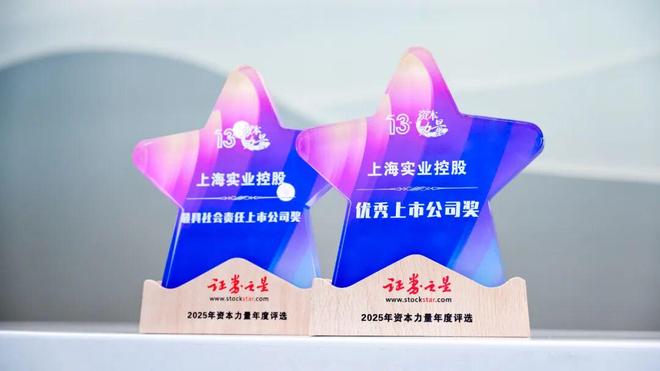
上海实业控股荣获2025证券之星“优秀上市公司奖”及“最具社会责任上市公司奖”
Xin Lang Cai Jing· 2025-11-10 02:33
Core Viewpoint - Shanghai Industrial Holdings Limited has been awarded the "Outstanding Listed Company Award" and the "Most Socially Responsible Listed Company Award" at the 13th Securities Star Capital Power Annual Brand Event, reflecting the capital market's recognition of the company's innovative and transformative efforts [1][8]. Group 1: Awards and Recognition - The "Outstanding Listed Company Award" acknowledges the company's commitment to R&D investment and innovation, actively responding to carbon neutrality and dual carbon goals [5]. - The "Most Socially Responsible Listed Company Award" recognizes the company's excellence in corporate responsibility, social care, and environmental protection [8]. Group 2: Company Initiatives - The company has advanced key projects such as the Baoshan Renewable Energy Utilization Center and the Qingpu Xicen Water Purification Plant, applying international advanced technologies to enhance energy-saving and emission-reduction efficiency [5][6]. - In the real estate sector, the company has achieved 33 green building certifications, covering a total area of 3.79 million square meters, and has implemented cutting-edge technologies like BIM to reduce resource consumption and improve project efficiency [6]. Group 3: Social Responsibility Efforts - The company is dedicated to social contributions, engaging in education assistance, poverty alleviation, and community health initiatives, including rural revitalization and educational support in Yunnan [8]. - The company integrates green concepts into its strategy, promoting projects such as wastewater treatment and waste incineration to enhance energy-saving and emission-reduction outcomes [8]. Group 4: Governance and Management - The company has established a sound governance structure and an efficient management team, ensuring scientific decision-making and effective supervision through various committees [6]. - The company emphasizes a people-oriented approach in its compensation, performance evaluation, and training systems, providing employees with growth opportunities and competitive guarantees [6].

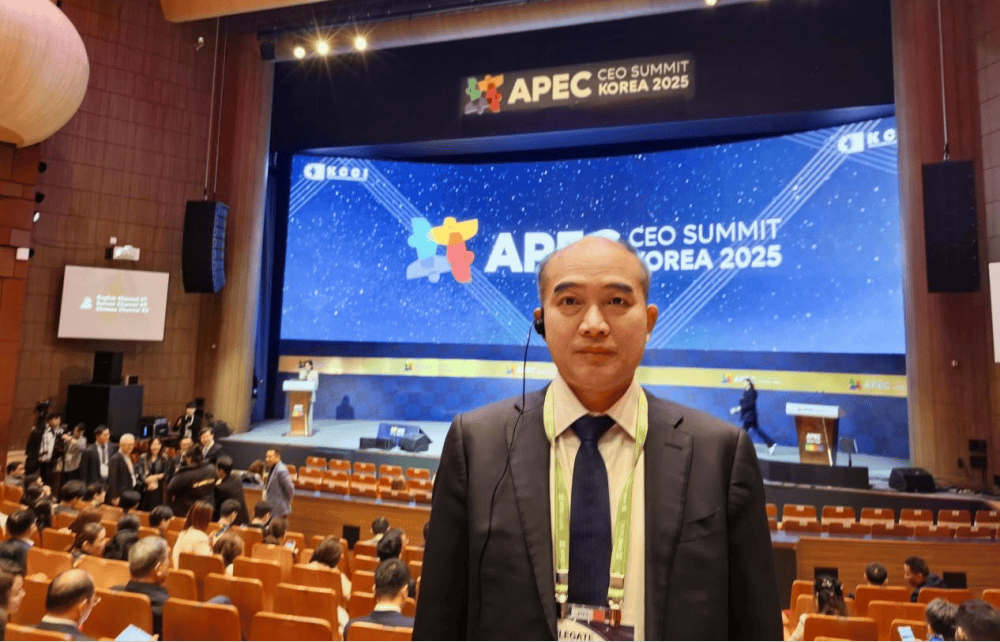
三棵树董事长洪杰受邀出席亚太经合组织(APEC)工商领导人峰会
Sou Hu Cai Jing· 2025-11-10 02:29
Core Viewpoint - The participation of the company in the APEC Business Leaders Summit highlights its commitment to sustainable development and the promotion of green transformation in the global manufacturing sector [3][5]. Group 1: APEC Summit Participation - The APEC Business Leaders Summit focuses on sustainable development, innovation, and economic cooperation in the Asia-Pacific region [3]. - The company is the only invited representative from China's building materials and coatings industry, showcasing the influence of Chinese brands on the international stage [3]. - The chairman emphasized the importance of global collaboration in establishing green standards and sharing technology within the Asia-Pacific region [3]. Group 2: Sustainable Development Initiatives - The company has actively responded to the national "dual carbon" strategy by completing a full industry chain green upgrade and establishing three national-level "green factories" and "zero-carbon factories" [5]. - The company promotes a "good house" concept, offering solutions for home renovation and urban renewal, focusing on sustainable development in the construction materials sector [5]. - The company aims to activate the trillion-level home renovation market by enhancing the safety and quality of existing housing through green materials and energy-saving processes [5]. Group 3: Global Expansion and Collaboration - The company is committed to expanding its international business and building a green supply chain with regional partners, reflecting a global vision [5][6]. - The company seeks to establish a bridge between China and the global green building materials industry, promoting replicable and scalable practices for sustainable development [6]. - The company plans to leverage technological innovation and green development to contribute to a sustainable future in the Asia-Pacific region [6].

共探中新贸易投资新机遇,这场圆桌会给出策略
Di Yi Cai Jing· 2025-11-10 02:17
科技创新与国际合作解锁食品行业发展新机遇。 作为2025进博会上海会议活动之一,由上海市静安区商务委员会、新西兰上海商业联合会共同主办 的"中新贸易投资新方向,行业细分策略促增长"闭门圆桌会议近日在上海举行。 本场圆桌会聚焦食品与营养健康产业,采用双边合作和跨国价值链视角,汇聚来自中新企业、政府、科 研院校和国际组织的代表,在全球不确定性加大的背景下,基于两国各自优势领域和发展趋势,进行了 深入而务实的探讨,为中新两国经贸合作的高质量与可持续发展,探索新机遇、注入新动能。 巩固传统领域,解锁新兴动能 中国商务部外贸发展事务局副局长曾花城在开幕致辞中表示,"中国的不断发展和对外开放,将为包括 新西兰在内的世界各国提供更多机遇,这也是中新关系不断发展的根本保障"。他强调,互为重要贸易 伙伴的中新两国,除了巩固传统合作领域外,更应积极地拓展新兴领域。 曾花城表示,"中国很多高科技产品和应用能与新西兰传统行业进行融合,同时通过商品贸易乃至科研 合作的形式,服务新西兰的产业发展",另一方面"(中国)消费市场的变化,对以优质原料和产品著称的 新西兰企业来说,具有巨大的吸引力,成为其业务增长的新引擎"。 上海市静安区商务委 ...

研判2025!中国可持续债券行业相关政策、市场现状及发展趋势分析:中国累计发行规模位居全球前列,绿色债券为主要发行类型[图]
Chan Ye Xin Xi Wang· 2025-11-10 00:54
Core Insights - The article discusses the growth and classification of sustainable bonds, emphasizing their role in promoting sustainable development and aligning with sustainability goals [1][2]. Group 1: Overview of Sustainable Bonds - Sustainable bonds are defined by the International Capital Market Association (ICMA) as bonds that finance projects beneficial to sustainable development or are linked to sustainability goals [2]. - ICMA categorizes sustainable bonds into green bonds, social responsibility bonds, sustainable development bonds, and sustainability-linked bonds [2]. Group 2: Global Market Status - As of mid-2025, the cumulative issuance of GSS+ bonds globally reached $6.2 trillion, with sovereign issuers leading at $926.1 billion, followed by the US ($859.8 billion), France ($628.6 billion), and China ($611.4 billion) [6]. - In the first half of 2025, the total issuance of GSS+ bonds was $555.8 billion, reflecting a 3.6% year-on-year decline [6]. Group 3: China's Sustainable Bond Market - In 2024, China's GSS+ bond issuance was $84.6 billion, a 3.8% decrease from $87.9 billion in 2023, with a cumulative total surpassing $500 billion by the end of 2024 [6][8]. - Green bonds accounted for over 80% of the issuance, with $68.9 billion issued in 2024, down 18.2% year-on-year [8]. - Social responsibility bonds saw a significant increase, with issuance rising by 312.5% to $13.2 billion in 2024 [8]. Group 4: Investment Focus Areas - In 2024, the majority of funds raised through green bonds were directed towards clean energy projects, including wind, solar, and hydropower, which accounted for 52.2% of the total [8]. - The transportation sector received 30.4% of the funding, indicating a strong focus on decarbonizing the energy system and upgrading transportation infrastructure [8]. Group 5: Future Trends - The sustainable bond market is expected to continue focusing on key economic and social development tasks, driven by policy guidance and market demand [10]. - The support capacity for low-carbon development through sustainable bonds is anticipated to strengthen, particularly for green bonds, as central policies are implemented [10]. - Enhanced information disclosure standards are expected to improve transparency and investment efficiency in the sustainable bond market [11].

“在中国,为中国”,兄弟(中国)以数字化转型拥抱中国市场
Huan Qiu Shi Bao· 2025-11-09 22:50
Core Insights - The China International Import Expo (CIIE) serves as a unique platform for multinational companies to introduce their latest technologies and products to the Chinese market, enhancing communication between brands, government, enterprises, and users [1] - Brother (China) aims to convey long-term confidence in the Chinese market through its participation in CIIE, showcasing products that address local user pain points and emphasizing its commitment to serving Chinese customers [1][2] Group 1 - Brother (China) has formed a partnership with Alibaba Cloud and Salesforce to create a differentiated service ecosystem, focusing on data-driven user value operations [2] - The company is transitioning from a product-centric to a customer-centric approach, leveraging data insights to anticipate user needs and enhance competitiveness in the digital economy [2] - Brother (China) emphasizes the importance of providing integrated solutions that combine hardware, software, and services to address real user pain points, moving away from price competition [2] Group 2 - The company is aligning its growth strategy with national priorities, accelerating technology integration, and focusing on AI tools to improve efficiency and productivity for users [3] - Brother (China) is committed to sustainable development, engaging in environmental initiatives such as tree planting in Inner Mongolia and supporting women's income generation through embroidery in Yunnan [3] - The company plans to enhance its local R&D and service capabilities over the next three to five years, developing mature solutions that cater to the diverse demands of the Chinese market [3]
ESG强制披露“倒计时” 市场积极备战迎“大考”
Zhong Guo Zheng Quan Bao· 2025-11-09 20:13
Core Viewpoint - The implementation of mandatory ESG disclosure for A-share listed companies is approaching, with the first reports due in 2026, marking a shift from voluntary to compulsory disclosure [1][2]. Group 1: ESG Disclosure Requirements - Companies listed in key indices such as the Shanghai Stock Exchange 180 and the Sci-Tech Innovation Board must disclose their 2025 sustainability reports by April 30, 2026 [2]. - Currently, 95% of companies that will be subject to mandatory disclosure have already released sustainability or social responsibility reports, laying a solid foundation for the new system [2]. Group 2: Strategic Planning and Implementation - Increasingly, listed companies are proactively developing comprehensive ESG strategies, with many adopting three-year cycles for their ESG reports that encompass risk identification, strategy formulation, implementation, and accountability [2]. - 87% of companies that have disclosed ESG reports have established governance structures for sustainability, and 70% have conducted dual materiality assessments, indicating a robust governance framework [2]. Group 3: Market Impact and Benchmarking - Leading companies' ESG strategies set benchmarks for the market, facilitating a transition from voluntary to standardized disclosure practices [3]. - The ESG practices of major firms, which account for over 70% of A-share market capitalization, create a positive feedback loop of disclosure, rating, and financing, encouraging smaller companies to follow suit [3]. Group 4: Challenges and Support Mechanisms - Some companies, particularly in high-energy and complex supply chain industries, face challenges in ESG disclosure, often viewing it merely as a compliance task rather than a strategic priority [4]. - Market experts suggest targeted training and support mechanisms to help companies overcome disclosure challenges, including workshops and the provision of simplified templates [5][6]. Group 5: Addressing "Greenwashing" Risks - The risk of "greenwashing" poses a significant challenge to ESG disclosure, necessitating both technological solutions and punitive measures to enhance compliance [7]. - Recommendations include establishing a data monitoring platform to analyze ESG-related data and implementing strict penalties for non-compliance to deter misleading practices [7][8]. Group 6: Regulatory Framework and Standardization - There is a need for a unified regulatory framework for ESG ratings to address the current issues of multiple standards and low comparability [8]. - Regulatory bodies are encouraged to develop quality control standards for ESG ratings and ensure transparency and reliability in the rating process [8][9]. Group 7: Future Directions - The ongoing optimization of ESG disclosure systems and the introduction of specialized guidelines for various sectors will be crucial for enhancing the quality of disclosures [9]. - As mandatory disclosure systems are implemented, ESG investment products are expected to evolve towards greater sophistication, contributing to the sustainable development of capital markets [9].