安倍经济学

Search documents
暴涨1600点!日本股市,突然引爆!
券商中国· 2025-10-20 11:07
日本股市再创新高! 今日(10月20日),日本股市高开高走,日经225指数大涨超1600点,史上首次突破49000点,日内涨幅超过3%。 据媒体报道,日本自民党与维新会今日将签署联合执政协议,这意味着高市早苗已基本确定将在21日的首相指名选举中胜出。分析人士指出,政治不确定性的消 退,提振了日本股市。市场预计,高市早苗将推动实施低利率和增加政府支出等市场支持政策。 日本股市暴涨超16 00点 今日,亚太股市集体上涨。其中,日本股市走势强劲,日经225指数上涨超1600点并首次突破49000点关口,再创历史新高。 截至下午收盘,日经225指数报49185.5点,较前一交易日上涨1603点,涨幅达到3.37%。个股方面,软银集团大涨超8%,股价再创历史新高,总市值突破36万亿日 元。 | 日经225 L | | --- | | N225 | | んO1QE EO 今井 48332.71 最高 49185.50 最低 48254.83 | | 金额 振幅 1.96% 337% 160335 芯里 | | 昨收 47582.15 52周高 49185.50 52周低 30792.74 | | 相关基金 日经225ET ...



“早苗交易”势不可挡! 自民党与维新会即将联合执政 高市早苗当选日本首相几乎成定局
智通财经网· 2025-10-20 04:17
Core Viewpoint - The Japanese political landscape is shifting towards the potential election of Sanna Takichi as Japan's first female Prime Minister, following a coalition agreement between the Liberal Democratic Party (LDP) and the Japan Innovation Party (JIP) [1][3] Group 1: Political Developments - The LDP and JIP are set to formalize a coalition agreement on October 20, 2025, which is expected to secure Takichi's position as Prime Minister [1] - The coalition will have a combined total of 231 seats in the House of Representatives, just two short of a majority, but the divided opposition is likely to facilitate Takichi's election [1][3] - Takichi, a conservative nationalist, is closely aligned with former Prime Minister Shinzo Abe's policies, which has led to market speculation about the revival of "Abenomics" [1][4] Group 2: Market Reactions - The "Sanna Trade" has emerged in global markets, characterized by significant volatility in stocks, bonds, and currencies following Takichi's anticipated victory [2] - The Nikkei 225 index surged by 3% to reach a historical high, with a year-to-date increase of approximately 25% [2] - Market expectations are centered around a return to "Abenomics," which emphasizes aggressive fiscal stimulus and a cautious stance on monetary tightening, benefiting sectors like technology, energy, and defense [2] Group 3: Policy Implications - The JIP has outlined three core demands for the coalition: temporary reduction of the food consumption tax, tightening political funding regulations, and reducing the number of lawmakers [3] - Takichi's economic policies are expected to focus on government spending to stimulate growth, while her conservative stance on social issues remains firm [3][4] - There is a consensus between the LDP and JIP on enhancing Japan's security and economic resilience, including support for the Japan-U.S. security alliance and the expansion of nuclear energy post-Fukushima [4]
美元/日元呈现看涨态势 日本政局成焦点
Jin Tou Wang· 2025-10-20 02:41
Group 1 - The USD/JPY exchange rate is trading around 151, reflecting a bullish trend with an increase of approximately 0.26%, influenced by developments in Japanese politics and rising U.S. Treasury yields [1] - Reports indicate that the Liberal Democratic Party (LDP) is set to lead a new coalition government, but the likelihood of returning to "Abenomics" under the new Prime Minister, Sanae Takaichi, has diminished due to significant concessions to coalition partner, the Japan Innovation Party [1] - Analysts from the Commonwealth Bank of Australia suggest that political uncertainty in Japan appears to be resolved, with a high probability of a coalition government being confirmed, which could provide relative stability in the House of Representatives [1] Group 2 - From a technical perspective, the USD/JPY has rebounded strongly from a key level of 149.39, but faces significant resistance ahead [2] - Important technical levels to watch include 151.33, which is the daily conversion line, and a large amount of options expiring today in the 151.00-10 range, potentially limiting the upside for USD/JPY in the short term [2]
日股大跌,政坛地震威胁“高市交易”
Guo Ji Jin Rong Bao· 2025-10-14 09:18
10月14日,日本股市在连休后迎来一波剧烈抛售。截至收盘,日经225指数收跌2.58%,报46847.32点。 日本政坛地震正在迅速侵蚀市场此前热烈鼓吹的"高市交易"。 政治地震 上周五(10日),自民党的执政联盟伙伴公明党突然宣布退出已持续26年的执政联盟,双方因政治献金监 管改革分歧而决裂。 据《环球时报》报道,立宪民主党党首野田佳彦正协调与国民民主党党首玉木雄一郎、日本维新会共同 代表藤田文武举行会谈,希望在首相指名选举中,推出在野党的统一候选人。眼下,玉木雄一郎已成为 热门人选。 自民党在更具权力的众议院拥有196个席位,位居第一大党团。在与自民党"分手"后,拥有24席的公明 党已公开表态,不会在首相选举中支持高市早苗。如果在野的立宪民主党(148席)、国民民主党(27席)和 日本维新会(35席)统一推出候选人,三党就能凑到210席,高出自民党现有席位数量。 这意味着,只要自民党以外的其他政党不支持高市早苗,这一席位数足以确保新候选人的首相职位。 玉木雄一郎上周在社交媒体上发文表示,"我已下定决心成为首相。" 若其成功当选,这将是自2009年以来自民党首次被赶下执政地位。 不过,有分析指出,尽管立宪民 ...
岸田曾称她“塔利班”!如今高市早苗掌权,日本股市直接一飞冲天
Sou Hu Cai Jing· 2025-10-13 06:32
Core Viewpoint - The Tokyo stock market experienced a historic moment as the Nikkei index surpassed 47,000 points, marking an unprecedented high, driven by the election of new Liberal Democratic Party leader, Sanae Takaichi, who is seen as a successor to Shinzo Abe's economic policies [1][3][9]. Group 1: Market Reaction - The Nikkei index surged nearly 3% from the previous Friday, becoming a hot topic of discussion among both financial circles and the general public [1]. - Investors anticipated Takaichi's election would lead to a revival of aggressive economic stimulus policies reminiscent of the Abe era, prompting a sell-off of long-term Japanese government bonds [3][9]. - The Tokyo Stock Exchange saw widespread gains, with the broader TOPIX index also rising, reflecting a vibrant market atmosphere [3]. Group 2: Political Context - Takaichi's election as party leader was her third attempt, following a tumultuous period for the LDP after Abe's death, which saw frequent leadership changes [3][5]. - The LDP's declining support due to scandals created an opportunity for Takaichi, who shifted her public image to appear more moderate and relatable [5][6]. - Takaichi's economic policies have evolved, moving away from her previously radical proposals to focus on enhancing Japan's international competitiveness through investments in AI, cybersecurity, and energy independence [6][9]. Group 3: Economic Policies - Takaichi introduced more populist measures, such as a refundable tax credit plan and raising the income tax threshold for low-income groups, addressing the public's concerns about financial well-being [6][7]. - Her stance on sensitive issues, like visiting the Yasukuni Shrine, has softened, indicating a strategic move to unify support and broaden her appeal [7]. - Takaichi's campaign emphasized continuity with Abe's legacy, using slogans like "Japan is back" and publishing a book detailing her connection to Abe's policies [7][9]. Group 4: Broader Economic Implications - The stock market's response included a drop in two-year government bond yields, suggesting reduced expectations for interest rate hikes by the Bank of Japan [9]. - The yen depreciated against the dollar, falling below the 149 mark, indicating market sentiment towards prolonged ultra-loose monetary policy under Takaichi's leadership [9]. - While the stock market surge has rekindled hope among the public, concerns remain about the actual impact of Takaichi's policies on long-term economic stability and growth [11][13].

热点思考 | 美元的“十字路口”——“流动性笔记”系列之五(申万宏观·赵伟团队)
申万宏源宏观· 2025-10-13 04:36
文 | 赵伟、陈达飞、赵宇、王茂宇、李欣越 联系人| 陈达飞 摘要 10月6日以来,美元强势升值,9日盘中一度升至99.6高位,为8月初以来的新高。美元能否打破三季度以来的低位震荡格局、长期贬值预期能否继续演绎? 热点思考:美元的"十字路口" (一)近期美元反弹的三个阶段和两方面原因 本轮美元反弹的时间起点是9月中旬美联储重启降息之后,整体可以分为三个阶段理解:第一阶段, 9月17日-25日,在美联储如期降息25bp叠加中性偏鹰的 经济预测摘要发布之后,前期较乐观的"降息交易"重新校准,2年期美债利率和美元指数同步反弹。 第二阶段, 9月26日-10月3日,在美国政府"关门"预期和事实冲击下,美元反弹按下"暂停键"。截至10月3日,美元指数和2年期美债利率小幅下行至97.7和 3.58%。 第三阶段, 10月6日-9日,由于日本和法国政府内阁重组或动荡,美元被动走强。高市早苗"意外"当选日本自民党总裁。由于其经济政策立场带有较浓厚 的"安倍经济学"标签,市场开始交易宽松;法国总理勒科尔尼在10月6日突然宣布辞职,触发欧元贬值。 (二)美元反弹或难延续的四个解释 9月中旬以来的美元升值仍是长期贬值趋势中的一次反 ...

日本央行加息进程生变
Jing Ji Wang· 2025-10-11 02:06
Core Viewpoint - The recent political shift in Japan, marked by the election of former Economic Security Minister Sanae Takaichi as the leader of the ruling Liberal Democratic Party, has led to a significant depreciation of the Japanese yen against the US dollar and other major currencies, raising concerns about Japan's fiscal outlook and the uncertainty surrounding the Bank of Japan's future interest rate policies [1][2][5]. Currency Movement - On October 6, the yen depreciated by 1.94% against the US dollar, breaking the critical 150 level, and continued to weaken, falling below 151, 152, and 153 in the following days [2]. - The yen reached a low of 153.003 against the dollar on October 8, marking its lowest level since mid-February, with a cumulative decline of over 3.7% since October 2 [2]. - The yen also depreciated against other major currencies, hitting a historic low against the euro at 177.86, the lowest since the euro's inception in 1999 [2]. Economic Policy Implications - Takaichi's economic policies are seen as a continuation of "Abenomics," focusing on aggressive fiscal measures and maintaining a loose monetary policy, which is expected to exert downward pressure on the yen [3][4]. - Analysts suggest that Takaichi's stance against interest rate hikes and her advocacy for active fiscal policies are the primary reasons for the yen's recent depreciation [2][3]. Long-term Outlook - The long-term trajectory of the yen will depend on the implementation and impact of Takaichi's policies, with current market reactions primarily reflecting short-term sentiment [5][8]. - Despite the current downward pressure, the yen is considered significantly undervalued, suggesting limited further depreciation potential even if Takaichi becomes Prime Minister [5][6]. Monetary Policy Considerations - The independence of the Bank of Japan is relatively weaker compared to the Federal Reserve, and Takaichi's election is expected to influence the central bank's policy stance, although the extent of this impact will depend on her execution and authority within the government [8][9]. - Current inflation in Japan is viewed as driven by cost-push factors rather than demand, indicating that premature interest rate hikes could hinder economic recovery [8][9].
日本政坛走向将会怎样影响经济?
2 1 Shi Ji Jing Ji Bao Dao· 2025-10-10 22:45
Group 1 - The Japanese stock market has surged following the election of Sanae Takaichi as the president of the Liberal Democratic Party (LDP), with the Nikkei average breaking 48,000 yen, reaching a historical high, while the yen depreciated from 147 to around 151 yen against the dollar, indicating market optimism about a potential revival of Abenomics [1] - Japan's current economic situation is significantly different from 2013, as it faces inflation and a depreciating yen, with national debt exceeding twice the GDP, limiting the scope for bold fiscal and monetary policies [1] - The rise in stock prices does not necessarily reflect a positive economic outlook, as further yen depreciation could lead to increased living costs for citizens, complicating Takaichi's potential tax reduction policies [1] Group 2 - Takaichi's political foundation within the LDP is weak, requiring support from influential party figures like Taro Aso, who favors strict fiscal discipline, creating uncertainty about Takaichi's ability to maintain her original policy stance [2] - The current political landscape in Japan is fragmented, with no single party holding a majority, making it challenging for Takaichi to secure the prime minister position without forming coalitions, which will influence future policy decisions [2] - The Komeito party, a long-time coalition partner of the LDP, has expressed concerns about Takaichi's political direction, leading to their decision to withdraw from the coalition, adding uncertainty to the prime ministerial election [3] Group 3 - The Bank of Japan, under Governor Kazuo Ueda, has begun to move away from government interference, planning to end negative interest rates and start raising rates by 2024, which could be hindered if Takaichi intervenes in monetary policy [4] - Takaichi's previous support for Abenomics and criticism of the Bank's rate hikes have shifted, suggesting that her policies may become more moderate if she assumes office, with expectations of a gentle growth-oriented approach rather than aggressive fiscal expansion [4] - There is a possibility of opposition parties uniting to win power, which could lead to the LDP losing its position, further complicating Takaichi's ability to implement impactful policies [5][6]
日股“高市交易”迎来挑战,主要反对党考虑联合推出首相候选人
Feng Huang Wang· 2025-10-10 22:33
Core Viewpoint - The election of Kishi Sanae as the new president of the Liberal Democratic Party (LDP) in Japan has raised expectations for fiscal expansion policies, leading to a surge in the Japanese stock index and a rapid depreciation of the yen to early-year levels. However, recent developments have cast uncertainty on her prospects of becoming the next Prime Minister of Japan [1]. Group 1: Political Developments - The Komeito party leader, Saito Tetsuo, announced the end of the 26-year coalition with the LDP due to dissatisfaction with Kishi Sanae's handling of a political scandal, complicating her chances of becoming Japan's first female Prime Minister [2]. - The dissolution of the "LDP-Komeito alliance" means that Kishi Sanae's path to premiership is now more uncertain, as the LDP holds 196 seats and Komeito 24 in the 465-seat House of Representatives, which is still short of a majority [2]. - The election process for the Prime Minister involves a two-round voting system, where if no candidate receives a majority in the first round, a runoff will occur between the top two candidates [2]. Group 2: Opposition Response - The main opposition party, the Constitutional Democratic Party (CDP), views this as a significant opportunity to unseat the LDP, with its leader, Noda Yoshihiko, expressing willingness to support other party leaders [3][4]. - Noda emphasized the need for cooperation among opposition parties to prevent Kishi Sanae from ascending to the premiership, despite the CDP holding 148 seats [4]. - Tamaki Yuichiro, leader of the Democratic Party for the People, expressed caution regarding the formation of a united opposition front, acknowledging the lack of consensus on various policy issues [4]. Group 3: Market Implications - The political turmoil has created a "dilemma" for the Japanese markets, with expectations of monetary easing leading to a significant depreciation of the yen, which may prompt government intervention if the yen weakens further [5]. - The Japanese bond market is under pressure, with long-term bond yields rising, and concerns may escalate if Kishi Sanae compromises fiscal discipline to gain support from opposition parties [5]. - Moody's Analytics highlighted that Kishi Sanae's past controversial statements and economic proposals raise concerns about her ability to address Japan's deep-rooted macroeconomic challenges effectively [5].
突发!“黑天鹅”
Zhong Guo Ji Jin Bao· 2025-10-10 13:22
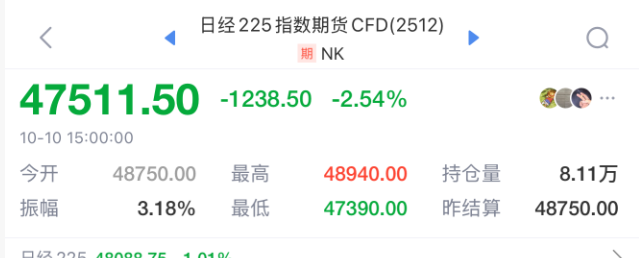
Core Viewpoint - The sudden dissolution of the ruling coalition in Japan, with the Komeito party withdrawing from the alliance led by the Liberal Democratic Party (LDP), poses significant uncertainty for the political landscape and the potential appointment of Sanna Takai as Japan's first female Prime Minister [1][2]. Political Landscape - The Komeito party's exit from the coalition may disrupt the process of appointing Sanna Takai as Prime Minister, especially as the National Diet is set to hold a vote for the next Prime Minister on October 15 [1]. - The LDP and Komeito together hold 215 seats in the House of Representatives, which is below the majority threshold of 233 seats. If Komeito withdraws, the LDP will have 191 seats but will still remain the largest party [1]. Market Reactions - Following the announcement of Komeito's withdrawal, the Nikkei index futures dropped over 1200 points, reflecting a decline of more than 2% [2]. - The initial reaction in the foreign exchange market saw the yen strengthen to 152.36 before retreating, stabilizing around 152.8 later in the day [4]. Economic Implications - Analysts suggest that investors are becoming cautious about the risks of a short-term political vacuum and delays in policy execution. The previous expectations of economic stimulus from Takai's policies may lead to a reversal of the "sell yen, buy stocks" trend that emerged after her election victory [6]. - If the opposition parties present a unified candidate instead of Takai, the gains in the USD/JPY exchange rate driven by the "Takai trade" could be fully reversed. However, the market has not yet fully priced in the risk of Takai not becoming Prime Minister [6]. Stock Market Outlook - The uncertainty introduced by Komeito's exit is expected to exert pressure on the Japanese stock market. The LDP may be forced to make concessions, potentially weakening Takai's economic policies [7]. - The Nikkei index could retreat to around 40,000 points, as the market adjusts to the new political landscape and the expectations surrounding Takai's policies diminish [7].