
货币宽松

Search documents
中辉有色观点-20251127
Zhong Hui Qi Huo· 2025-11-27 03:02
Group 1: Report Industry Investment Ratings - Gold: Long - term holding [1] - Silver: Long - term holding [1] - Copper: Long - term holding [1] - Zinc: Rebound in the short - term, sell on rallies in the medium - long term [1] - Lead: Under pressure [1] - Tin: Rebound under pressure [1] - Aluminum: Rebound under pressure [1] - Nickel: Low - level rebound [1] - Industrial silicon: Range - bound [1] - Polysilicon: Cautiously bullish [1] - Lithium carbonate: Cautiously bullish [1] Group 2: Core Views of the Report - The long - term strategic value of gold remains unchanged due to geopolitical uncertainties and central bank purchases. Silver has potential for growth with policy - driven demand. Copper is expected to see a rising price center. Zinc has short - term support but a bearish medium - long - term outlook. Lead is under short - term pressure. Tin and aluminum face challenges in price rebounds. Nickel shows a low - level rebound. Industrial silicon is range - bound. Polysilicon and lithium carbonate are cautiously bullish [1]. Group 3: Summaries According to Related Catalogs Gold and Silver - **Market situation**: US economic data is volatile, consumption is weak, and the Russia - Ukraine negotiation is in deadlock, but gold has long - term support from global monetary easing, declining dollar credit, and geopolitical restructuring [2][3] - **Strategies**: Long - term value - based positions should be held, with short - term attention on the support levels of 920 for domestic gold and 12000 for silver [3] Copper - **Market situation**: The price of copper shows an upward trend. The supply of copper concentrates is tight, and the production of electrolytic copper is expected to decline. The market has high expectations for policy stimulus [5][6][7] - **Strategies**: Buy on dips. Short - term, focus on the range of 86500 - 88500 yuan/ton for Shanghai copper and 10500 - 11000 dollars/ton for London copper [7] Zinc - **Market situation**: Domestic zinc enters the off - season, with exports increasing and inventory decreasing slightly. The supply and demand are weak in the short term, and there is a risk of supply increase and demand decrease in the long term [9] - **Strategies**: Short - term wide - range oscillation, waiting for more macro - guidance. Sell on rallies in the medium - long term. Focus on the range of 22200 - 22800 yuan/ton for Shanghai zinc and 3000 - 3100 dollars/ton for London zinc [10] Aluminum - **Market situation**: Aluminum prices face pressure in rebounding. Overseas electrolytic aluminum production is expected to decrease, and domestic demand shows a structural differentiation. Alumina is in an oversupply situation [11][13] - **Strategies**: Short - term short - selling on rallies. Pay attention to the change in aluminum ingot social inventory. Focus on the range of 21000 - 21600 yuan/ton [14] Nickel - **Market situation**: Nickel prices rebound. Indonesia plans to cut production, but global refined nickel inventory is at a high level. Stainless steel demand is weak, and there is a risk of inventory accumulation [15][17] - **Strategies**: Take profit on dips and then wait and see. Pay attention to the change in stainless steel inventory. Focus on the range of 116000 - 119000 yuan/ton [18] Lithium Carbonate - **Market situation**: The inventory of lithium carbonate has been decreasing for 14 weeks, but the rate of decrease has slowed down. The production enthusiasm of lithium salt factories has increased, and terminal demand remains strong [19][21] - **Strategies**: Buy on dips, with the range of 94000 - 97500 yuan/ton [22]
日本央行审议委员野口旭表示,几乎无法精准确定中性利率。核心通胀能否持续稳步迈向2%目标,完全取决于工资上涨的动能能否持续,并向
Sou Hu Cai Jing· 2025-11-27 01:53
日本央行审议委员野口旭:几乎无法精准确定中性利率。核心通胀能否持续稳步迈向2%目标,完全取 决于工资上涨的动能能否持续,并向中小企业和地方经济扩散。如果经济活动和物价的发展与央行的预 期相符,央行将逐步调整货币宽松程度。要使通胀保持足够的可持续性和稳定性,需要的是需求的稳定 扩张以及伴随而来的名义工资的持续增长。 ...
百炼成钢 乘势而上 - 2026年宏观经济与资产配置展望
2025-11-26 14:15
Summary of Key Points from Conference Call Industry and Company Overview - The conference call discusses the macroeconomic outlook for China and the United States in 2026, focusing on investment opportunities and risks in various sectors, particularly in technology, consumption, and real estate. Core Insights and Arguments 1. **China's Economic Outlook**: In 2026, China's economy is expected to face downward pressure, but macro policies are anticipated to provide support, particularly in technology innovation and modern industrial system construction, which are seen as having investment potential [1][2][3] 2. **U.S. Economic Conditions**: The U.S. is projected to enter a scenario of fiscal and monetary expansion in 2026, with a focus on re-inflation pressures and the Federal Reserve's monetary policy, which is expected to remain accommodative [4][7] 3. **Investment Trends**: Investment patterns are shifting, with the central government expected to lead major projects and planning, potentially boosting infrastructure investment while stabilizing manufacturing and real estate investments [3][20][14] 4. **Consumer Spending**: Consumption has become the dominant force in China's economic growth, with the government increasing support for consumer policies, which are expected to continue into 2026 [12][21][13] 5. **Real Estate Market**: The real estate market is entering a critical observation period in 2026, with potential for continued support policies if pressures remain high [23][11] 6. **Debt Management**: China is utilizing a 12 trillion yuan debt relief tool and a 1 trillion yuan capital injection policy to address local government debt and risks in small financial institutions [11][10] 7. **Global Economic Interactions**: The U.S. economy's recovery is expected to positively impact global trade and economic conditions, given its interconnectedness with global markets [7][4] Other Important but Possibly Overlooked Content 1. **Technological Advancements**: China has made significant progress in key technology areas, which may alleviate some external pressures from U.S. tariffs and technology restrictions [10][16] 2. **Long-term U.S.-China Relations**: The competitive dynamics between the U.S. and China are expected to persist, with potential policy shifts under future U.S. administrations posing risks [9][8] 3. **Inflation and Monetary Policy**: The U.S. is not expected to face significant inflation pressures in 2026, with the Federal Reserve likely to implement further rate cuts [4][28] 4. **Asset Allocation Recommendations**: Investors are advised to consider diversified investments in emerging industries supported by Chinese policies and cyclical sectors in the U.S. market due to expected fiscal and monetary expansions [8][5][6] This summary encapsulates the key points discussed in the conference call, providing insights into the macroeconomic landscape and investment strategies for 2026.
【真灼财经】哈塞特或执掌联储;中美元首预计多次会晤
Sou Hu Cai Jing· 2025-11-26 02:53
特朗普首席经济顾问哈塞特据悉在美联储主席遴选中领跑,美国批发通胀抬头,消费者信心大幅下滑,市场提高12月降息押注。贝森特称中美元首明年 可能进行四次会晤。 隔夜要点 · 美国股市周二延续涨势,因一系列经济数据似乎支持美联储在12月实施今年第三次也是最后一次降息,但科技板块的疲软限制了纳指的涨幅。美国公债 收益率连续第四个交易日下跌,在报称白宫经济顾问哈塞特已成为下一任美联储主席的热门人选后,公债价格涨势加速。油价结算下跌超过1%,因乌克 兰暗示,美国政府为结束俄乌战争而进行的密集外交努力可能正在取得成果。 · 美国10月二手房签约量增长超过预期,受到抵押贷款利率下降提振。 · 白宫对俄乌谈判进展表示乐观,特朗普派出代表与两国分别举行高级别会谈,他将等到磋商取得实质性进展时才与俄乌领导人会面。 · 前日本央行官员Kazuo Momma表示,日元近期走弱将提高央行下个月加息的可能性。 · 谷歌(GOOGL.US)母公司Alphabet周二收盘创上市以来新高,市值距离4万亿美元仅咫尺之遥,投资者重新评估科技行业格局。 · Counterpoint Research预测,苹果(AAPL.US)今年势将超越三星,重夺全 ...


供应趋紧叠加美联储降息预期升温,伦铜现货升水创五周新高
Hua Er Jie Jian Wen· 2025-11-25 06:33
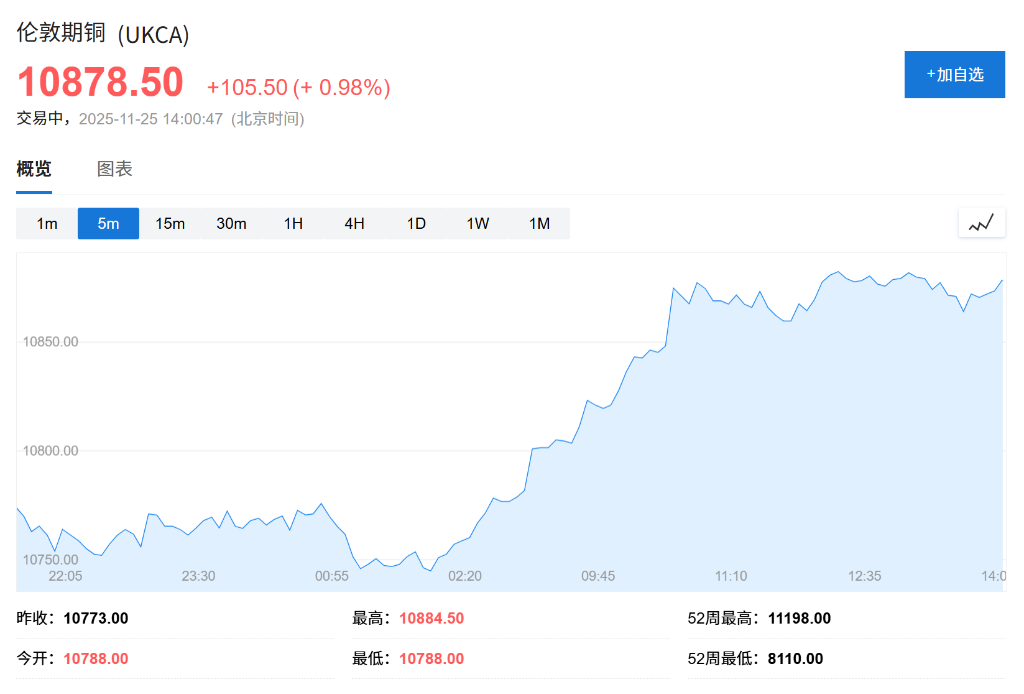
受现货供应趋紧和市场对美联储下月降息预期增强的双重提振,铜价走高,凸显了宏观经济前景与实体供需基本面的共同作用。 引发市场乐观情绪的主要催化剂是美联储官员的最新表态。美联储理事Christopher Waller以美国劳动力市场疲软为由,主张下调利率,这番言论 巩固了市场对于进一步货币宽松的信心。通常而言,更低的借贷成本对工业金属构成利好。 与此同时,实体市场的供应紧张信号愈发明确。伦敦金属交易所(LME)现货铜较三个月期期货的升水(cash-three-month spread)跃升至超过20 美元/吨,创下约五周新高,表明交易员愿意为即期交付的铜支付更高溢价。 受此影响,周二伦铜期货价格上涨0.98%至10878美元/吨,纽约商品交易所(Comex)的期铜价格同样走高。其他基本金属中,铝价上涨0.4%, 锌价上涨0.5%。 供应紧张加剧,冶炼费用跌至新低 | 概览 | 图表 | | | | | | | | | | | | --- | --- | --- | --- | --- | --- | --- | --- | --- | --- | --- | --- | | 1m | 5m | 15m | 30m ...
特朗普科技雄心与货币宽松重塑美国经济新叙事
Sou Hu Cai Jing· 2025-11-25 05:44
当地时间11月24日,美国白宫发布声明表示,总统特朗普签署了一项行政命令,启动一项旨在利用人工智能(AI)变革科学研究方式、加速科学发现的全 新国家计划"创世纪计划"(Genesis Mission)。 特朗普的AI野心,AI竞赛升级为国家战略 特朗普在任期内多次强调人工智能的战略价值,并将其发展作为本届政府的首要任务。"创世纪计划"也是其关于AI的最新重磅政策。 上述政策或将减轻监管负担,让企业更容易建立人工智能基础设施和数据中心。这也进一步强化了美股AI巨头的增长预期。受利好影响,美股AI板块集体 彪涨。当地时间11月24日收盘,AI领域定制化ASIC芯片龙头博通(AVGO.US)上涨11.1%;存储芯片巨头美光科技(MU.US)上涨近8%;谷歌 (GOOGL.US)上涨6.31%。 除了特朗普科技雄心之外,美联储降息预期在显著升温,这无疑也是推动资本市场回暖的关键因素之一。 近日,美联储官员戴利表态支持12月降息。戴利认为美联储可以将通胀率降至2%的目标,而就业市场突然恶化的可能性更大。 美联储理事沃勒也主张在12月降息,并表示9月份就业数据可能会被下修。沃勒目前是下一任美联储主席的候选人之一,据悉,大 ...




供应紧张叠加美联储降息概率增加 铜价上涨
Ge Long Hui· 2025-11-25 03:16
Core Insights - Recent supply tightness and rising expectations for a Federal Reserve rate cut next month have led to a slight increase in copper prices [1] Group 1: Price Movements - Copper futures rose to approximately $10,860 per ton, remaining stable from the previous trading day [1] - The spread between spot copper prices and three-month futures surged to over $20 per ton, reaching a new high in about five weeks [1] Group 2: Market Sentiment - Confidence in further monetary easing has strengthened following comments from Federal Reserve Governor Waller regarding a weak U.S. labor market [1] - Traders are willing to pay higher prices for immediate supply, indicating strong demand amid supply constraints [1]
日本21万亿救市,“饮鸩止渴”?
Sou Hu Cai Jing· 2025-11-25 02:43
Core Viewpoint - Japan's economy is facing significant challenges, including a return to negative growth due to external factors such as U.S. tariff policies impacting key industries like automotive, compounded by long-standing structural issues and short-term political risks [1][3][8]. Economic Growth and External Demand - In Q3, Japan's real GDP decreased by 1.8% on an annualized basis, marking a return to negative growth since Q1 2024, primarily driven by a sharp contraction in external demand, which contributed -0.2 percentage points to economic growth [1]. - The U.S. increased tariffs on Japanese goods, particularly raising automotive tariffs from 2.5% to 15%, severely impacting Japan's automotive industry and creating a vicious cycle of order declines and economic recession [1][3]. Domestic Demand and Consumer Behavior - Domestic demand remains weak, with inflation and declining real wages leading to reduced consumer spending. Personal consumption, which accounts for over half of Japan's economy, saw a slight increase of 0.1% quarter-on-quarter, while private residential investment fell by 9.4% [3][8]. - The deterioration of Japan-China relations, exacerbated by controversial statements from Prime Minister Fumio Kishida, has led to travel warnings from China, potentially costing Japan between $11.5 billion to $14 billion in tourism revenue, further dragging down GDP growth by 0.29 to 0.36 percentage points [3][5]. Government Response and Economic Stimulus - In response to the economic crisis, the Kishida government approved a ¥21.3 trillion (approximately $135.4 billion) economic stimulus plan aimed at addressing rising prices and boosting investment in sectors like semiconductors and AI. However, this plan relies heavily on fiscal expansion and monetary easing without addressing structural economic reforms [5][7]. - The government's debt, which stands at about 263% of GDP, raises concerns about the sustainability of increased spending, potentially leading to higher long-term interest rates and further pressure on government finances [7][8]. Structural Issues and Long-term Outlook - Japan's economy is hindered by deep-rooted structural issues, including an aging population (29% aged 65 and older), declining labor force, and reduced competitiveness in key industries like automotive, which has lagged in the transition to electric vehicles [8]. - The reliance on external markets exposes Japan's economy to risks, as evidenced by the impact of U.S. tariffs and geopolitical tensions. Analysts suggest that Japan's economy may continue to fluctuate around the growth line without effective reforms, and the current fiscal stimulus may only provide temporary relief without addressing fundamental issues [8].

高市早苗的闹剧,让日本经济先中了“回旋镖”
Xin Jing Bao· 2025-11-20 08:17
Core Viewpoint - The recent economic turmoil in Japan, marked by a 1.8% annualized decline in GDP for Q3, is attributed to a combination of internal economic stagnation and external geopolitical tensions, particularly involving China [1][6]. Economic Performance - Japan's Q3 GDP contracted by 1.8%, marking the first decline in six quarters [1]. - The Nikkei 225 index fell by 3.22%, and the yen depreciated to 155.38 against the dollar, the lowest since January [1]. - The 30-year government bond yield rose to 3.28%, the highest level since 1999 [1]. Market Reactions - The Japanese financial market experienced a "triple kill" in stocks, bonds, and currency, leading to significant sell-offs [1]. - The Tokyo stock market indices fell for four consecutive trading days, with a cumulative drop of over 2700 points [1]. Geopolitical Factors - The tensions between Japan and China, exacerbated by Prime Minister Kishi's provocative statements, have led to increased market volatility and investor caution [1][4]. - Japan's reliance on China for imports is significant, with over 50% of certain product categories sourced from China [4]. Investment Climate - The ongoing depreciation of the yen is seen as a result of high fiscal stimulus and military expansion policies under Kishi, which are viewed as contradictory and unsustainable [3]. - International investors have been shorting the yen, taking advantage of the interest rate differentials between Japan and the U.S. [2]. Economic Dependencies - Chinese tourists are crucial to Japan's economy, contributing approximately 30% to tourism revenue; a decline in their visits could significantly impact GDP [5]. - Japan's economic structure is heavily reliant on imports from China, with critical goods such as electronics and fertilizers being predominantly sourced from there [4]. Risk Mitigation - Analysts suggest that Kishi should retract her controversial statements to mitigate economic risks and stabilize market conditions [6]. - The potential for further economic decline in Japan is anticipated in Q4 due to existing structural issues and geopolitical uncertainties [6].
贵金属有色金属产业日报-20251119
Dong Ya Qi Huo· 2025-11-19 09:22
1. Report Industry Investment Rating No relevant content provided. 2. Core Views of the Report - In the precious metals market, although central bank gold purchases and growing investment demand will push up the price center of precious metals in the long - term, short - term macro uncertainties about December interest rate cuts may lead to continued volatile adjustments. It is recommended to pay attention to the retracement of the 60 - day moving average [3]. - In the copper market, concerns about non - farm data affecting interest rate cuts have led to capital reduction and price drops. Inventory increases and narrowing premiums reflect fundamental pressures, with limited short - term repair space [17]. - In the aluminum market, Shanghai aluminum is expected to maintain a long - term oscillatory upward trend, but short - term weak fundamentals and a lower probability of December interest rate cuts may lead to profit - taking by previous funds, resulting in subsequent oscillatory consolidation. Alumina is in an oversupply situation, and the expiration of a large number of warehouse receipts will exacerbate the imbalance between supply and demand [36]. - In the zinc market, the cooling of interest rate cut expectations and a significant drop in November TC due to intense competition for ore in the smelting sector have increased the willingness of smelters to reduce or halt production in November. There is a possibility of inventory reduction, and there are significant differences between bulls and bears [59]. - In the nickel and stainless - steel market, nickel - iron prices have been declining due to weak downstream demand. The downside space for nickel and stainless - steel is greater than the upside space. Stainless - steel spot sales face pressure, and downstream demand remains weak [75]. - In the tin market, due to limited resumption of production in Wabang, refined tin concentrate imports have sharply decreased, and supply is weaker than demand. Shanghai tin is expected to maintain high - level oscillations, with support around 276,000 yuan [88]. - In the lithium carbonate market, strong demand from the new energy vehicle and energy storage sectors, combined with a slowdown in supply growth, may lead to a short - term strong and oscillatory trend in lithium prices, but position fluctuations should be watched out for [104]. - In the silicon industry chain, the supply - demand pattern of industrial silicon is generally weak, with wide - range oscillations. The polysilicon industry chain is experiencing production cuts and inventory accumulation, with a weak fundamental outlook and wide - range, weak oscillations [116]. 3. Summary by Relevant Catalogs Precious Metals - **Price Outlook**: In the short term, due to unclear prospects of December interest rate cuts, precious metals may continue to oscillate and adjust. In the long term, central bank gold purchases and growing investment demand will push up prices [3]. - **Price Charts**: Include SHFE gold and silver futures main - continuous prices, COMEX gold prices and gold - silver ratios, SHFE and SGX gold and silver futures - spot price differences, gold and US Treasury real interest rates, gold long - term fund holdings, and SHFE and COMEX gold and silver inventories [4][12][16]. Copper - **Price Outlook**: Market concerns about non - farm data and inventory increases have led to price drops, with limited short - term repair space [17]. - **Price Data**: Spot prices from various sources (Shanghai Non - ferrous, Shanghai Wumaoyi, etc.) have small daily increases. Futures prices of Shanghai copper and London copper show different trends, with Shanghai copper rising and London copper falling [22][23]. - **Inventory Data**: Shanghai copper warehouse receipts and LME copper inventories show different changes, with some warehouse receipts decreasing and LME copper inventories increasing [32][34]. Aluminum - **Price Outlook**: Shanghai aluminum may oscillate and consolidate in the short term, while alumina is in an oversupply situation [36]. - **Price Data**: Aluminum and alumina futures and spot prices show different trends, with some rising and some falling [38][45]. - **Inventory Data**: Shanghai aluminum and LME aluminum inventories show different changes, and alumina warehouse receipts increase slightly [53]. Zinc - **Price Outlook**: Cooling interest rate cut expectations and a drop in November TC have increased the willingness of smelters to cut production. There is a possibility of inventory reduction, and there are significant differences between bulls and bears [59]. - **Price Data**: Shanghai zinc and LME zinc prices show different trends, with Shanghai zinc rising and LME zinc falling slightly [60]. - **Inventory Data**: Shanghai zinc warehouse receipts decrease, and LME zinc inventories increase [72]. Nickel and Stainless - Steel - **Price Outlook**: Nickel - iron prices decline due to weak downstream demand, and the downside space for nickel and stainless - steel is greater than the upside space. Stainless - steel spot sales face pressure [75]. - **Price Data**: Nickel and stainless - steel futures prices show different trends, with some rising and some falling [76]. - **Inventory Data**: Nickel warehouse receipts decrease [76]. Tin - **Price Outlook**: Due to limited resumption of production in Wabang, refined tin concentrate imports have sharply decreased, and supply is weaker than demand. Shanghai tin is expected to maintain high - level oscillations [88]. - **Price Data**: Shanghai tin and London tin futures prices show different trends, with Shanghai tin rising and London tin falling slightly [89]. - **Inventory Data**: Shanghai tin warehouse receipts decrease, and LME tin inventories remain unchanged [99]. Lithium Carbonate - **Price Outlook**: Strong demand and slow supply growth may lead to a short - term strong and oscillatory trend in lithium prices, but position fluctuations should be watched out for [104]. - **Price Data**: Lithium carbonate futures and spot prices show an upward trend [105][109]. - **Inventory Data**: Guangzhou Futures Exchange warehouse receipts increase slightly, and social and downstream inventories decrease [114]. Silicon Industry Chain - **Price Outlook**: The supply - demand pattern of industrial silicon is generally weak, with wide - range oscillations. The polysilicon industry chain is experiencing production cuts and inventory accumulation, with a weak fundamental outlook [116]. - **Price Data**: Industrial silicon and polysilicon - related product prices show different trends, with some remaining stable and some changing slightly [116]. - **Inventory Data**: Industrial silicon social inventory and polysilicon total inventory show different trends [134][143].