金融开放

Search documents
封关日期明确!海南自贸港跨境资管生态“以人民币计价结算”
Jing Ji Guan Cha Bao· 2025-07-23 05:42
Core Viewpoint - The establishment of the cross-border asset management pilot program in Hainan Free Trade Port, effective from August 21, 2025, is a significant step towards financial openness in China, with a focus on facilitating foreign investment through RMB-denominated transactions [1][2][4]. Summary by Relevant Sections Implementation Timeline - The Hainan Free Trade Port will officially start operations on December 18, 2025, as approved by the central government [1]. Regulatory Framework - The "Implementation Rules for Cross-Border Asset Management Pilot Business" were jointly formulated by several regulatory bodies and will take effect on August 21, 2025 [1][2]. Global Investor Access - The rules allow global investors to use funds from both domestic and international sources to purchase pilot asset management products, removing the need for bilateral agreements [2][3]. Individual Investor Inclusion - Foreign individual investors can directly participate by providing proof of residence or employment in Hainan for at least one year, along with evidence of RMB income from within China [2][3]. RMB Settlement and Management - All transactions for pilot asset management products must be conducted in RMB, creating a closed-loop management system that supports the internationalization of the RMB [3][4]. Investment Focus - Funds raised through pilot asset management products must be directed towards the domestic market, ensuring that the underlying assets are RMB-denominated [3][5]. Product Diversity - The pilot program will cover a range of risk levels (R1 to R4), providing various investment options from low-risk money market funds to higher-risk private equity [3][5]. Initial Scale and Future Adjustments - The initial total scale limit for the pilot program is set at 10 billion RMB, with provisions for dynamic adjustments based on market conditions and financial developments [5].
金融开放与产品创新双轮驱动 中国ETF成全球资产配置新蓝海
Shang Hai Zheng Quan Bao· 2025-07-14 18:30
Core Insights - The rapid growth of China's ETF market is attributed to policy support, product innovation, and market openness, making it an attractive destination for foreign investment [2][4][7] - Foreign institutions are increasingly using ETFs as a channel to invest in Chinese assets, with significant inflows and holdings in various ETF products [3][5][6] Group 1: Market Growth and Statistics - As of July 11, 2023, China's ETF market reached a total size of 4.29 trillion yuan, a significant increase from 3.67 trillion yuan at the end of last year [3] - In the past year, China's ETF market saw a net inflow of 108.9 billion USD, leading the Asia-Pacific region [4] - China's ETF market accounts for 30.7% of the total ETF assets in the Asia-Pacific region as of April 2023 [3][4] Group 2: Foreign Investment and Participation - Major foreign institutions like Barclays, UBS, and Singapore's GIC are frequently listed among the top holders of Chinese ETFs, indicating strong foreign interest [5][6] - The appeal of Chinese ETFs for foreign investors is driven by attractive valuations and supportive government policies [5][6] Group 3: Future Outlook - Foreign institutions project that the scale of China's ETF market could exceed 12 trillion yuan within the next 5 to 10 years, driven by financial openness and product innovation [2][7] - The interest from global sovereign wealth funds in China has notably increased, with 59% of respondents prioritizing China as a key emerging market investment [8]


突破新高!牛市要回来了?
大胡子说房· 2025-07-10 12:01
Core Viewpoint - The recent surge in the A-share market, reaching a new high of 3509 points, raises questions about whether it has entered a bull market and if genuine wealth opportunities are emerging [1] Group 1: Market Fundamentals for a Bull Market - A bull market requires sufficient external funds, which include both domestic and foreign investments [2] - Historical examples from the US show that external funds are crucial for bull markets, with significant inflows during past bull runs [2][3] - The current A-share market needs to attract retail and institutional investors, particularly focusing on the movement of household savings into the capital market [4] Group 2: Valuation Metrics - The current price-to-earnings (PE) ratio of the CSI 300 index is approximately 12.38, indicating it is in a low valuation range similar to previous bull market beginnings [5][6] - Historical data shows that the PE ratio tends to be at or below historical averages before the onset of bull markets, suggesting the current market may be in a similar phase [6] Group 3: Financial Environment and Policy - The openness of the financial environment and the relative freedom of capital flow are essential for a healthy market, with recent policies indicating a trend towards increased market openness [7] - Recent regulatory changes, such as the inclusion of RMB stock trading in the Hong Kong Stock Connect, signal a move towards greater financial integration [7] - The current financial strength of the domestic market is better positioned to handle external investments compared to previous years, which may support a more stable market environment [7][8] Group 4: Current Market Position - Despite the index reaching new highs, the A-share market is still considered to be in the early stages of a bull market, with significant potential for growth if external funds continue to flow in [8] - The presence of government support in the market provides a safety net, reducing the likelihood of a significant downturn in the near term [8]

货币政策进入平稳宽松阶段,央行下半年或继续降准降息|2025中国经济半年报
Hua Xia Shi Bao· 2025-07-09 11:42
Monetary Policy Overview - The monetary policy in China is showing resilience in the first half of 2025, providing strong support for stable economic growth and high-quality development amid global economic adjustments and domestic structural transformations [2][3] - The policy toolbox has been enriched with measures such as adjusting cross-border financing parameters and implementing a package of monetary policy measures in May [2][3] Policy Measures - In January, the macro-prudential adjustment parameter for cross-border financing was raised from 1.5 to 1.75, enhancing the financing capacity of domestic enterprises and financial institutions [3] - The People's Bank of China (PBOC) conducted a medium-term lending facility (MLF) operation of 450 billion yuan in March, shifting to a multi-price bidding approach to improve liquidity management [4] - A comprehensive package of ten monetary policy measures was announced in May, including a 0.5% reduction in the reserve requirement ratio and a 0.1% decrease in policy interest rates [5][6] Impact on Lending and Housing Market - The adjustment of the loan market quotation rate (LPR) in May led to a reduction in monthly mortgage payments, thereby supporting housing demand and stabilizing the real estate market [6][7] - Structural policy tools were introduced, including an increase of 300 billion yuan for technology innovation loans and 500 billion yuan for consumer and elderly care loans [6][8] Future Outlook - The monetary policy is expected to remain moderately accommodative, with a focus on balancing growth and risk prevention while maintaining internal and external equilibrium [9][10] - Analysts predict potential further reductions in interest rates and reserve requirements in the second half of the year, with a focus on maintaining liquidity and stabilizing the exchange rate [10][11]

以金融为弦 奏响开放发展交响曲
Jin Rong Shi Bao· 2025-07-09 01:49
Group 1 - The "BRICS cooperation" aims to uphold its founding purpose, align with the needs of the times, maintain and practice multilateralism, and contribute to global stability and development [1] - China emphasizes the importance of an open world economy, opposing unilateralism and protectionism, and promoting trade and investment liberalization [1][2] - Financial openness is a crucial part of China's external opening, which is essential for achieving high-quality development [1] Group 2 - Recent international trade order and multilateral trade systems have faced significant challenges, but China remains committed to opening up as the world's second-largest economy [2] - The State Administration of Foreign Exchange launched a new offshore international trade business verification application to enhance cross-border financial service convenience [3] - The new application aims to improve the efficiency of cross-border fund settlement for new offshore international trade, supporting the development of the real economy [3][4] Group 3 - The "Belt and Road" initiative has led to practical cooperation results, such as the expansion of the Caspian Sea asphalt plant, which will alleviate Kazakhstan's infrastructure needs [5][6] - Since the initiative's inception in 2013, China has signed over 200 cooperation documents with more than 150 countries, with a 2.2% year-on-year increase in trade with these countries in Q1 [6] Group 4 - Foreign financial institutions are accelerating their presence in China as the economy transitions and the financial market opens [7] - Attracting foreign investment can drive economic growth, job creation, and technological advancement in China [7] - Chinese banks are optimizing financial services to support foreign enterprises in deepening their market presence in China [7]
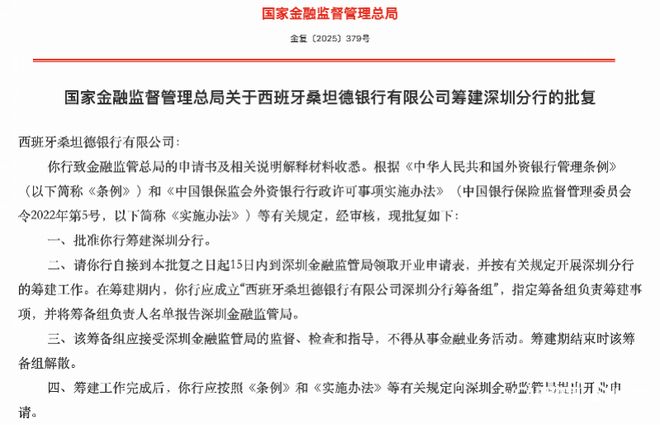
西班牙桑坦德银行深圳分行获批筹建,外资金融版图再扩容
Nan Fang Du Shi Bao· 2025-07-08 12:00
Group 1 - The core point of the news is the approval of Banco Santander to establish a branch in Shenzhen, marking its third presence in China after Shanghai and Beijing, and reflecting the ongoing expansion of foreign financial institutions in the region [1][4][10] - Banco Santander, as Spain's largest commercial bank, has a significant global presence with total assets of €1.8 trillion and annual revenue of €61.876 billion as of the end of 2024 [1][4] - The establishment of the Shenzhen branch aligns with China's financial opening policies, which have seen over 50 measures introduced since 2018 to facilitate foreign investment in the banking sector [4][9] Group 2 - Shenzhen has become a hub for foreign banks, with 38 institutions having total assets exceeding 400 billion RMB, ranking among the top in the country [5][6] - The historical context of foreign banks in Shenzhen dates back to 1982, with significant milestones including the establishment of the first foreign bank and the introduction of various international banking giants [5][6] - Recent developments indicate a trend of foreign banks increasing their presence in Shenzhen, supported by favorable policies and the city's strong economic performance [6][9] Group 3 - Foreign banks in Shenzhen are actively participating in cross-border financing and settlement, with significant contributions to the "Cross-Border Wealth Management Connect" pilot program [7] - These banks are also supporting Chinese enterprises in their global expansion efforts, leveraging their international networks to provide comprehensive services [7][8] - In the green finance sector, foreign banks are involved in innovative practices, such as ESG-linked loans and sustainable bond issuance, contributing to Shenzhen's green development initiatives [8] Group 4 - Shenzhen's favorable business environment, recognized as one of the best in the country, has attracted a significant number of foreign enterprises, with a 21.7% increase in newly established foreign companies in 2024 [9][10] - The city continues to enhance its policies to attract foreign investment, with new measures introduced to optimize the international business environment [9][10] - The ongoing development of foreign financial institutions in Shenzhen reflects China's commitment to high-level financial openness and a mutually beneficial financial development framework [10]

★金融监管总局局长李云泽:支持外资机构参与更多金融业务试点
Zhong Guo Zheng Quan Bao· 2025-07-03 01:55
Group 1 - The core viewpoint emphasizes that global economic and financial development relies on open cooperation, with China's financial openness benefiting both itself and global capital allocation opportunities [1] - Foreign banks and insurance institutions in China have total assets exceeding 7 trillion yuan, with foreign insurance companies increasing their market share from 4% in 2013 to 9% currently [1] - Chinese financial institutions are actively operating in over 70 countries, promoting bilateral trade and mutual investment [1] Group 2 - China's aging population is accelerating, with projections indicating that the population aged 60 and above will exceed 400 million by 2035, leading to a silver economy expected to reach 30 trillion yuan [2] - The development of China's three-pillar pension system is unbalanced, particularly the third pillar, which has significant growth potential [2] - The wealth management demand in China is shifting towards diversified and professional asset allocation, with the average annual growth rate of managed assets in trust, wealth management, and insurance asset management around 8% over the past five years [2] Group 3 - The financial regulatory authority plans to further expand the breadth and depth of financial openness to inject more momentum into high-quality development [3] - There will be a focus on replicating and promoting the experiences of free trade zones and ports to support foreign institutions in participating in more financial business trials [3] - The authority aims to align with international high-standard economic and trade agreements in the financial sector to explore greater openness [3]
2025年6月策略月报:金融加力支持高质量发展-20250627
Wanlian Securities· 2025-06-27 09:39
Market Overview - The A-share market showed a general upward trend in June, with the Shanghai Composite Index closing at 3,455.97 points, an increase of 3.24% compared to the end of May. The Shanghai 50 and CSI 300 indices experienced significant gains [2][11][12] - In June, 23 out of 31 Shenwan first-level industries saw an increase, with the non-bank financial sector leading with a growth of 10.64% [12][41] - The consumer sector is expected to benefit from policies aimed at expanding domestic demand, with a focus on enhancing consumption potential [3][44] Market Liquidity and Risk Sentiment - As of June 25, the A-share market's liquidity improved, with a net increase in major shareholders' holdings amounting to 46.132 billion yuan, and the total amount of A-share unlocks reaching approximately 215.756 billion yuan, an increase from the previous month [24][28] - The average daily trading volume in the A-share market increased to 12,943.21 billion yuan, up 6.55% from May [28][31] - The sentiment in the market was influenced by the easing of US-China trade tensions and the announcement of new policies aimed at supporting technology enterprises, which helped boost investor confidence [32][44] Policy Analysis - The Chinese government has introduced a series of measures to support consumption and economic growth, including 19 key initiatives aimed at enhancing financial services for consumption [44][45] - The introduction of the "1+6" policy measures for the Sci-Tech Innovation Board aims to better serve technology enterprises and enhance the inclusivity and adaptability of the system [45][46] - The focus on expanding domestic demand and strengthening the domestic circulation is expected to provide a solid foundation for sustained economic recovery [3][44] Valuation Levels - As of June 25, the dynamic price-to-earnings (PE) ratio for the Shanghai 50 index is at a historical percentile of 78.44%, indicating a relatively high valuation compared to historical levels [41][42] - Most Shenwan first-level industries have seen an increase in valuation, with sectors such as retail, telecommunications, and electronics exceeding the historical 50th percentile for PE ratios [42][43]
大摩周期会议:金融、快递、汽车行业更新,宁德时代重新覆盖
2025-06-26 14:09
Summary of Key Points from Conference Call Records Industry Overview - **Financial Sector**: The Chinese financial regulatory environment has shifted from strict regulation to a phase promoting development, with positive impacts expected from RMB internationalization and financial openness, such as the removal of the $50,000 review for transfers from mainland to Hong Kong, enhancing liquidity in Hong Kong [1][2] - **Automotive Sector**: The performance of Top Group is significantly influenced by Tesla's sales, with a potential revenue decrease of approximately 1.7 billion if Tesla's income drops by 20%. Domestic electric vehicle clients are expected to contribute an additional 5 billion in revenue [3][11] - **Battery Industry**: CATL's growth drivers for the next three years include increasing EV demand in China and Europe, with European EV growth expected to reach 30% in 2025 and 20% in 2026, driven by CO2 policy changes and new model launches [12][13] Core Insights and Arguments - **Financial Market Dynamics**: The end of stringent financial risk management has led to rationalization of interest rates for loans, deposits, and other financial assets, positively impacting the financial and insurance sectors. However, long-term investment returns remain a concern [4][6] - **Capital Market Encouragement**: There is a renewed focus on encouraging consumer companies to go public, with simplified registration processes leading to significant improvements in the Hong Kong IPO market. This trend indicates a potential return to a new normal of capital market development [5][6] - **Investment Outlook**: The financial sector, particularly the insurance segment and Hong Kong Stock Exchange, is viewed positively. QFIN is expected to benefit from the support of consumer finance development, with a potential recovery in loan growth as trade tensions ease [6][7] Additional Important Insights - **Robot Market Sentiment**: Investors are skeptical about the sustainability of valuation premiums in the robotics sector, with significant declines in implied valuations for companies like Samba and Top Group [8][9] - **Battery Technology Advancements**: CATL is expected to maintain its competitive edge through continuous innovation and technological iterations, with a projected increase in investment returns from 50% to 60% over the next three years [15][16][17] - **Express Delivery Industry Trends**: The express delivery sector is experiencing accelerated consolidation, with leading players like Yunda and Shentong gaining market share, while smaller players struggle to compete [18] - **JD Logistics Strategy**: JD Logistics is recruiting delivery riders, which may enhance operational efficiency, although it remains to be seen how this will impact overall logistics costs and business models [19][20][21] This summary encapsulates the critical insights and trends discussed in the conference call, providing a comprehensive overview of the financial, automotive, battery, and express delivery industries.
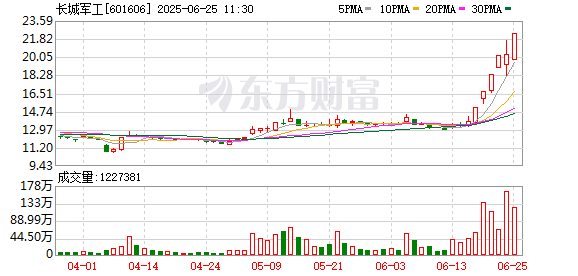
6天5板!大爆发,多股20%涨停
Zheng Quan Shi Bao Wang· 2025-06-25 04:34
Group 1: Military Industry Performance - The defense and military stocks experienced a significant surge, with many stocks hitting the 20% limit up [2][4][6] - The military sector index saw a peak increase of over 9%, reaching a 7.5-year high, with a trading volume surpassing the previous day's total [4][6] - Notable stocks such as Changcheng Military and Guodian Technology achieved multiple limit-up days, indicating strong market interest [4][6] Group 2: Market Overview - The A-share market continued to rise, with the Shanghai Composite Index reaching a 3-month high and the ChiNext Index also showing strong performance [5] - Seven out of the top ten performing industry indices were related to the military sector, highlighting the sector's dominance in the market [6] Group 3: Geopolitical Context - Ongoing geopolitical tensions, including missile attacks from Iran on Israel, may influence market sentiment and defense spending [8] - The upcoming military parade in China is expected to showcase the country's military capabilities and may further boost the military sector [8] Group 4: Financial Sector Developments - The non-bank financial sector has also seen a strong performance, with significant gains in various sub-sectors such as securities and insurance [9][11] - Recent announcements from financial authorities regarding reforms and digital currency initiatives are expected to positively impact the financial market [11]