
AI投资

Search documents
投资课卖12888元 名额售罄!李蓓却被谭珺连环怼 本人最新回应:我不认识她
Mei Ri Jing Ji Xin Wen· 2025-12-31 14:01
Core Viewpoint - The recent public course offering by renowned fund manager Li Bei has sparked significant market discussion, highlighting the evolving dynamics of the asset management industry and the rise of knowledge monetization in finance [1][15]. Group 1: Course Offering and Pricing - Li Bei announced a high-priced investment course titled "Learn Investment from Scratch," priced at 12,888 yuan for four sessions, targeting high-level professionals and affluent individuals [4][7]. - Despite the controversy, the course has reportedly sold out, with potential revenue estimated at approximately 2.58 million yuan if 200 spots were filled [9]. Group 2: Industry Reactions and Criticism - Former analyst Tan Jun has publicly criticized Li Bei's investment philosophy, particularly her views on AI and real estate, suggesting they reflect a misunderstanding of market trends [8][12]. - Tan Jun's critiques include claims that Li Bei's course model resembles that of problematic financial products, indicating a tendency to "precisely harvest conservative wealthy individuals" [8][12]. Group 3: Knowledge Monetization Trend - The rise of knowledge monetization in the finance sector has become a trend, with many former financial professionals leveraging their expertise to create paid content, often at higher price points than typical knowledge products [14]. - This trend reflects a broader shift in the asset management industry, where personal branding and social media presence are increasingly important for professional visibility and engagement [15].


12888元的投资课名额售罄,李蓓却被谭珺连环怼,本人最新回应
Mei Ri Jing Ji Xin Wen· 2025-12-31 10:33
Core Viewpoint - The recent move by renowned fund manager Li Bei to publicly sell investment courses has sparked significant market discussion, highlighting the evolving dynamics of the asset management industry in the social media era [1][12][14] Group 1: Course Offering and Pricing - Li Bei's investment course, titled "Learn Investment from Scratch," consists of four sessions priced at 12,888 yuan, targeting high-level professionals and affluent individuals [1][3] - The course has reportedly sold out, with potential revenue from 200 participants estimated at approximately 2.58 million yuan [8] Group 2: Market Reactions and Criticism - Former analyst Tan Jun has publicly criticized Li Bei's investment philosophy, particularly her views on AI and real estate, suggesting they reflect a misunderstanding of market trends [4][6] - Tan Jun's critiques include claims that Li Bei's course model resembles that of problematic financial products, indicating a tendency to "precisely harvest conservative wealthy individuals" [6][14] Group 3: Knowledge Payment Trend in Finance - The rise of knowledge payment in the finance sector has become a trend, with many former financial professionals leveraging their expertise to monetize insights through platforms like knowledge circles [12][13] - This trend has led to high pricing for specialized financial knowledge, often exceeding typical knowledge payment products, raising concerns about pricing disputes and service quality [12][13] Group 4: Industry Implications - The controversy surrounding Li Bei's course reflects broader ecological logic within the asset management industry, emphasizing the importance of personal branding and professional content in the social media landscape [14] - The ongoing debate about financial professionals selling courses is likely to persist, with the accuracy of investment views ultimately determined by market performance over time [14]

一图读懂|2025年海外央行风云录
Di Yi Cai Jing· 2025-12-31 03:23
2025海外央行风云录:谁在降息,谁在"逆行"? 3% Jan Feb Mar Mav Jul Aua Sept Oct Nov Dec Apr Jun 欧洲央行 & 英国央行- Feb Mar Mav Jul Aug Sept Oct Nov Dec Jan Apr Jun 25 75 澳洲联储& 加拿大央行 Feb Apr May Jul Sept Dec Mar Jun Aug Oct Nov Jan O 美联储主席鲍威尔在年内最后一次公开市场委员会会议上释放鹰 派宽松信号。他强调,当前利率已处于中性区间高位,货币政策 无预设路径,后续将逐次会议做决策。 O 高盛预计,美联储将在2026年上半年放缓宽松节奏,预计1月暂 停降息后,3月和6月各降息一次,最终将联邦基金利率降至 3%-3.25%。 ○ 欧洲央行2025年共实施三次降息,欧元区存款机制利率、主要再 融资利率和边际借贷利率分别降至2.00%、2.15%、2.40%。 欧洲央行最新声明指出,最新的评估再次确认通胀将在中期内稳 定在2%的目标,并预计通胀水平将在2028年回归至这一目标。 O 英国央行全年四次降息,基准利率降至3.75%。 英国央行 ...

一月策略及十大金股:新的主线浮出水面
SINOLINK SECURITIES· 2025-12-31 00:55
Group 1: Strategy Overview - The report indicates that the market is gradually shifting focus from a single narrative around AI to a broader range of sectors, suggesting that a new investment theme for 2026 is emerging as the market stabilizes and industry rotation accelerates [5][12][15] - The report highlights that the recent rally in the market is driven by a recovery in global risk assets, with expectations of a cross-year market trend starting to take shape [5][12] Group 2: Metal Industry Insights - The report notes that the sharp rise in non-ferrous metals is likely driven by increased demand from high-margin and growth-oriented sectors, which are more tolerant of price increases [5][13] - It emphasizes that the relationship between metal prices and AI investments is similar to the past dynamics between coal/power and new energy sectors, indicating a potential for significant price movements in metals due to AI-related consumption [5][13] Group 3: Currency and Trade Dynamics - The report discusses a new cycle of RMB appreciation, driven by changes in export structure and settlement methods, suggesting that the impact of RMB appreciation on export competitiveness may be less severe than previously thought [6][14] - It highlights that the current high-value export sectors in China possess significant market share and production capacity, which enhances their resilience against trade protectionism [6][14] Group 4: Investment Recommendations - The report recommends focusing on industrial resource products that resonate with AI investments and global manufacturing recovery, including copper, aluminum, tin, lithium, crude oil, and oil transportation [7][15] - It also suggests investing in Chinese equipment export chains that have confirmed cyclical bottoms, such as power grid equipment, energy storage, lithium batteries, photovoltaics, and engineering machinery [7][15] Group 5: Company-Specific Insights - For Yun Aluminum Co. (000807.SZ), the report recommends a long-term investment due to favorable conditions for aluminum exports and potential price increases driven by supply-side reforms and low inventory levels [17] - For Hengli Hydraulic (601100.SH), the report highlights the company's growth potential due to rising global market share and collaboration with leading companies in robotics [18] - For China Southern Airlines (1055.HK), the report notes the expected improvement in industry supply-demand dynamics and the company's large fleet size as key growth drivers [21] - For Li Ning (2331.HK), the report points to management improvements and the upcoming Olympic cycle as catalysts for growth [24] - For Blue Special Optics (688127.SH) and Shengyi Technology (600183.SH), the report emphasizes strong demand in downstream sectors and the potential for price increases due to supply constraints [26][27] - For Te Bao Biological (688278.SH), the report highlights the expected commercial success of its growth hormone product and the potential for new indications to drive revenue growth [28]





2025年迎来最后一个交易日,全球股市势创六年来最大涨幅
Ge Long Hui A P P· 2025-12-30 23:51
格隆汇12月31日|得益于美联储降息以及AI投资热情大幅上升,2025年全球股市有望实现六年来的最 大年度涨幅。2025年仅剩最后一个交易日之际,MSCI全球股票指数今年已上涨21%。其中亚洲市场股 票预计将连续第三年上涨,势创2017年以来最佳涨幅。2025年,股票价格涨至历史最高点,因对经济增 长、企业盈利以及宽松货币政策的乐观预期推动了市场从4月份特朗普关税引发的下跌中反弹。然而, 在进入2026年之际,投资者面临着较高的估值水平,同时政策制定者之间在进一步放宽政策的范围上也 出现了分歧。帕尼克斯资产管理集团首席投资官阿曼达·阿加蒂周二表示,"要想在明年继续走高,股市 需要一个温和的美联储。"展望新的一年,投资者们有理由保持乐观:过去10年里,MSCI全球股票指数 在1月份的平均涨幅为1.4%,其中有6次实现了上涨。 ...
“课战”升级:李蓓卖课被谭珺连环怼 本人最新回应!金融圈知识付费成变现新战场?
Mei Ri Jing Ji Xin Wen· 2025-12-30 15:49
最近,"私募魔女"李蓓开始公开卖课一事引发市场热议。针对此事,近几天方正证券前分析师谭珺在个人公众号连 续发文"开怼",先是说要拆解李蓓"看空AI、看多地产"背后的认知陷阱,后又将自己与李蓓的投资逻辑进行对比, 今日又发文称李蓓存在"精准收割保守富人"的倾向。 从李蓓在公众号撰文的相关表述来看,这套定价过万的课程目标群体是"企业高管""年轻偶像""富二代""专业投资 人"等。而对于希望储蓄能保值增值的普通白领或工薪阶层,她推荐学习后续的线上课程,或购买未来由课程整理出 版的书籍。 尽管如此,争议并未停歇。近几日,方正证券前分析师谭珺就在其个人公众号接连发文将矛头指向李蓓,几年前她 曾因"全网第一个喊4000点"在业内出圈。 12月27日,谭珺先在个人公众号发文称,李蓓"看空AI、看多地产"是逆趋势反逻辑,AI是未来10年最大确定性,而 房地产旧逻辑已因人口、杠杆、收益率问题失效;随后,又发文通过表格对比,明确她和李蓓在投资哲学、核心赛 道判断上存在明显差异。 对于谭珺的针锋相对,今日《每日经济新闻》记者联系上了李蓓本人。她回应称,自己不认识谭珺,也不关心对方 的说法。 近年来,知识付费成为金融圈IP变现的新风 ...

博时宏观观点:风险偏好上行,成长有色有望占优
Xin Lang Cai Jing· 2025-12-30 10:53
Group 1: Global Economic Overview - The US Q3 2025 GDP growth rate is 4.3%, significantly above market expectations, with consumer resilience and AI investments contributing one-third of this year's growth [10] - Japan has passed a large-scale fiscal budget plan for 2026, leading to a rapid increase in Japanese bond yields to 2.11%, which has exerted some pressure on the US dollar index due to yen appreciation [10] - The domestic industrial profit decline has widened in November, with a slight month-on-month increase in profit margins after adjusting for high base effects, but still weaker than seasonal trends [10] Group 2: Market Strategy - The bond market experienced narrow fluctuations from December 22 to 26, with a steepening curve; liquidity easing has improved short-term performance, while long-term remains volatile due to concerns about the post-year-end market [11] - The A-share market has seen a continuous rebound due to the resolution of structural differentiation and positive signals from the Central Economic Work Conference, alongside a strengthening yuan [11] - The Hong Kong stock market is currently in a phase of benefiting from liquidity while facing weak fundamentals, with the improvement of the price level in 2026 being crucial [11] Group 3: Sector-Specific Insights - The alcohol beverage and black metallurgy industries are dragging down overall profit growth, while the recovery in export growth is benefiting sectors like computer communications, automotive, electrical machinery, and specialized equipment [10] - The technology growth sector is expected to outperform as the crowding effect eases, although further recovery in PPI and profits is still awaited [11] - The oil market is under pressure due to weak demand, continuous supply release, and inventory accumulation [12]
国金策略牟一凌:A股新的主线浮出水面 市场不在聚焦单一叙事
Xin Lang Cai Jing· 2025-12-30 01:17
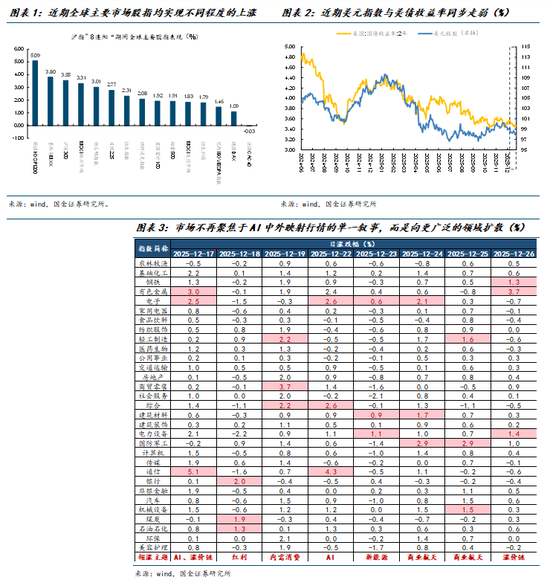
炒股就看金麒麟分析师研报,权威,专业,及时,全面,助您挖掘潜力主题机会! 国金证券研究 作者:牟一凌、吴晓明、吴慧敏 摘要 ■ 投资逻辑 跨年行情缓步开启,市场不在聚焦单一叙事 近期A股市场连续上涨,市场期待的跨年行情逐渐启动。在国内外基本面尚未出现重大变化之际,当下 反弹更像是前期分母端流动性紧缩预期边际缓和后的全球风险资产共振修复,海外主要股指均实现不同 程度的上涨。值得一提的是市场逐渐不再聚焦于AI中外映射行情的单一叙事,而是向更广泛的领域扩 散,呈现出AI、内需、涨价链、新的产业主题(商业航天)轮涨的格局。单一叙事驱动下的市场上涨 具备不稳定与高波动性,真正的牛市往往是广泛市场机会涌现与形成合力,在当前市场缓步向上,行业 轮动加速之际,2026年新的投资主线也正在慢慢浮出水面。 如何理解近期各产业链涨价:实物消耗的扩散与汇聚 当下涨价链成为市场焦点,通过梳理各行业涨价函具体内容与业内分析可以看到,原材料价格的上涨成 为价格主要推升因素;与此同时,反内卷政策的效果也正在显现,在面临上游涨价,下游压价的困境 时,部分企业开始选择自发减产与联合提价的方式维护产业合理竞争秩序。往后看由于需求端的景气程 度差异 ...
国金证券:新的主线正在浮出水面 把握当下切换窗口期
Di Yi Cai Jing· 2025-12-30 00:25
Core Viewpoint - The new investment themes for 2026 are emerging in the commodity market, real industry chain, and foreign exchange market, driven by a scenario where investment exceeds consumption, leading to increased physical consumption across various manufacturing sectors [1] Group 1: Investment Opportunities - Focus on AI investments and the recovery of global manufacturing, particularly in industrial resource products such as copper, aluminum, tin, lithium, crude oil, and oil transportation [1] - Attention to China's equipment export chain, which has global comparative advantages and is confirmed at the bottom of the cycle, including power grid equipment, energy storage, lithium batteries, photovoltaics, engineering machinery, and commercial vehicles [1] - Identify domestic manufacturing sectors that are showing signs of bottom reversal, such as chemicals (dyeing, coal chemicals, pesticides, polyurethane, titanium dioxide) and wafer manufacturing [1] Group 2: Consumer Recovery - Capture the recovery in consumption driven by inbound tourism and rising household income, focusing on sectors like aviation, hotels, duty-free shops, and food and beverages [1] Group 3: Non-Banking Financial Sector - Benefit from the expansion of the capital market and the bottoming out of long-term asset returns, particularly in non-bank financial sectors such as insurance and brokerage [1]

科技仍是中长期投资主线
Zheng Quan Ri Bao· 2025-12-29 23:16
本报记者 昌校宇 中欧基金权益专户投委会主席、基金经理王培预计,2026年或迎来估值演绎的下半场,企业盈利有望成 为股价的核心驱动因素。王培分析称:"当前市场正处于基本面拐点,上市公司营收端的修复动能持续 增强,叠加PPI(工业生产者出厂价格指数)回正预期增强,企业在2026年实现盈利增长值得期待。" 方正富邦基金首席投资官汤戈认为,2026年A股上市公司盈利增速和ROE(净资产收益率)水平有望继 续修复,业绩的增长将消化部分估值压力,使市场上涨的基础更为扎实。 科技投资成共识 科技仍然是各家公募机构关注度最高的投资主线,特别是在"AI投资逻辑将从基础设施建设向实际应用 场景深度扩散"上形成了共识。 近日,国泰基金、中欧基金、长城基金、方正富邦基金等公募机构相继召开2026年度投资策略会,分析 市场走势。 尽管各家公募机构视角各异、表述不同,却也存在共识:2026年A股市场有望从估值修复主导,逐步转 向盈利与估值双重驱动的新阶段;科技仍是贯穿中长期的核心主线,同时消费复苏、企业"出海"等多条 脉络也将交织出丰富的结构性机遇,共同描绘出一幅积极向好的投资图景。 业绩有望增长 回顾2025年,估值扩张是A股市场上 ...