
稳定币

Search documents
【广发宏观陈嘉荔】置身变奏曲,直面多线索:2025年中期海外环境展望
郭磊宏观茶座· 2025-07-22 11:51
Global Economic Outlook - The global economic growth rate is expected to slow down to 2.3% in the first half of 2025, down from 2.9% in the previous year, marking the lowest level in 17 years excluding recession years [1][11] - Factors contributing to this slowdown include rising trade policy uncertainties due to de-globalization, tightening financial conditions in some countries, and a balanced labor market in the US and Europe leading to a decrease in wage growth [1][11] Inflation Trends - Major economies are experiencing relatively high and sticky inflation rates, with June core CPI year-on-year rates at 2.9% for the US, 2.3% for the Eurozone, and 3.4% for Japan [2][15] - The European Central Bank (ECB) has cut interest rates four times this year, while the Federal Reserve remains in a pause phase regarding rate cuts [2][16] Currency Market Dynamics - The global currency market is characterized by high risk-free interest rates and a divergence between the US dollar and non-US currencies, with the dollar index declining by 9.7% year-to-date as of July 21 [3][18] - Non-US currencies have generally appreciated, with notable increases of 12.9% for the Euro and 6.6% for the Japanese Yen [3][18] Asset Performance - The performance of global assets reflects expectations of preventive rate cuts by the Federal Reserve and fiscal expansion in Europe, with the Nasdaq and DAX indices rising by 8.6% and 22.1% respectively [3][20] - Gold prices have increased by 29.2% due to high deficit rates in Western economies and geopolitical factors [3][20] Economic Growth Projections - For the second half of 2025, the US GDP is projected to grow at an annual rate of 1.5%, with quarterly growth rates of 2.1%, 0.7%, and 1.2% [4][24] - The Eurozone's GDP growth is expected to slow to 0.7% in the second half, while Japan's GDP growth is projected to decline to 0.5% [4][27] Inflation Forecasts - Inflation rates are expected to diverge among major economies, with US core CPI projected to rise from 2.9% to 3.3% by the fourth quarter, while Eurozone inflation is expected to decrease to around 1.9% [5][29] - Japan's inflation is likely to remain above 2%, driven by labor shortages and rising wages [5][30] Monetary Policy Challenges - Central banks face the dual challenge of balancing inflation and growth, with the Federal Reserve expected to initiate rate cuts in the fourth quarter of 2025 [6][32] - The ECB is anticipated to lower rates further, while the Bank of Japan may also consider a rate hike depending on economic conditions [6][34] Impact of US Legislation - The "Beautiful America Act" is projected to increase the federal deficit by approximately $3.4 trillion from 2025 to 2034, while tariffs are expected to generate about $2.8 trillion in revenue [7][35] - The act is estimated to boost US GDP by an average of 0.5% over the next decade, with potential for higher growth if tax reforms are successful [7][35] Dollar Index Trends - The dollar is expected to weaken in the medium term due to tariff impacts and changing global supply chains, with potential for short-term rebounds based on economic data or geopolitical events [8][40] - A weaker dollar could benefit US companies with significant overseas revenue, as approximately 41% of S&P 500 companies' income comes from international markets [8][44] Corporate Earnings Outlook - The weakening dollar is likely to enhance the profitability of US companies with substantial foreign earnings, contributing approximately 0.4-0.5 percentage points to overall EPS for each percentage point of dollar depreciation [8][44] - The overall earnings growth for US companies is expected to outpace economic growth in the second half of 2025, driven by favorable currency effects and supportive fiscal policies [8][46]


美储模糊调控中XBIT稳定币对冲政策不确定性成避险新通道
Sou Hu Cai Jing· 2025-07-22 10:19
Group 1 - The core challenge for the Federal Reserve is to precisely manage interest rate expectations, as signaling rate cuts can lead to long-term easing expectations and undermine policy effectiveness [1] - The Federal Reserve employs a strategy of ambiguity and data dependence to retain operational flexibility, with decision-making driven not only by inflation and employment data but also by deeper considerations such as maintaining the dollar's status and ensuring the stability of U.S. Treasury bonds [1][3] - The shift in focus towards stablecoins as a significant aspect of global financial policy is driven by policy forces rather than mere technological evolution, indicating a structural pivot in regulatory discussions [3][8] Group 2 - The Federal Reserve's primary goal in reshaping monetary governance logic revolves around maintaining the dollar's status and ensuring the stability of U.S. Treasury bonds, which are crucial to the global financial system [3] - The total scale of U.S. Treasury bonds is projected to approach $39 trillion by early 2025, with over one-third held by foreign institutions, highlighting the importance of bond price stability to avoid increasing domestic financing costs and destabilizing the dollar's credit system [3] - The Federal Reserve's tolerance for market volatility has significantly decreased, prioritizing the stabilization of long-term yields over merely addressing inflation, creating a unique market environment for trading safe-haven assets on decentralized exchanges like XBIT [3][5] Group 3 - The Federal Reserve's decision-making shows a clear bias towards preventing financial risks from asset price declines while viewing the decline in purchasing power of low-income groups as a normal economic adjustment [5] - The XBIT decentralized exchange platform offers significant advantages by allowing users to participate in compliant asset trading without the need for KYC, ensuring continuous and free asset transactions while maintaining user control over their assets [5] - Starting at the end of 2024, the Federal Reserve will implement a "dual-track operation" strategy, maintaining nominal interest rates while secretly adjusting the market through balance sheet expansion, which has involved purchasing over $200 billion in Treasury bonds in the past six months [5][8] Group 4 - Major economies are advancing compliance frameworks for stablecoins, with Hong Kong establishing a timeline for related regulations and the EU's MiCA regulation set to take effect in 2024, covering comprehensive crypto asset regulation [7][8] - The passage of the GENIUS Act in the U.S. signifies a regulatory easing in the stablecoin sector and marks a shift towards allowing the private sector to issue compliant digital dollars, which may serve as a global regulatory reference model [8] - The Federal Reserve is transitioning from a traditional dual mandate focused on inflation and employment to a multifaceted role that includes maintaining dollar credit, ensuring financial stability, and managing expectations, reflecting a significant evolution in its decision-making logic [8]
年化率超过3678%? 警惕以“稳定币”为名的高收益陷阱
Sou Hu Cai Jing· 2025-07-22 09:40
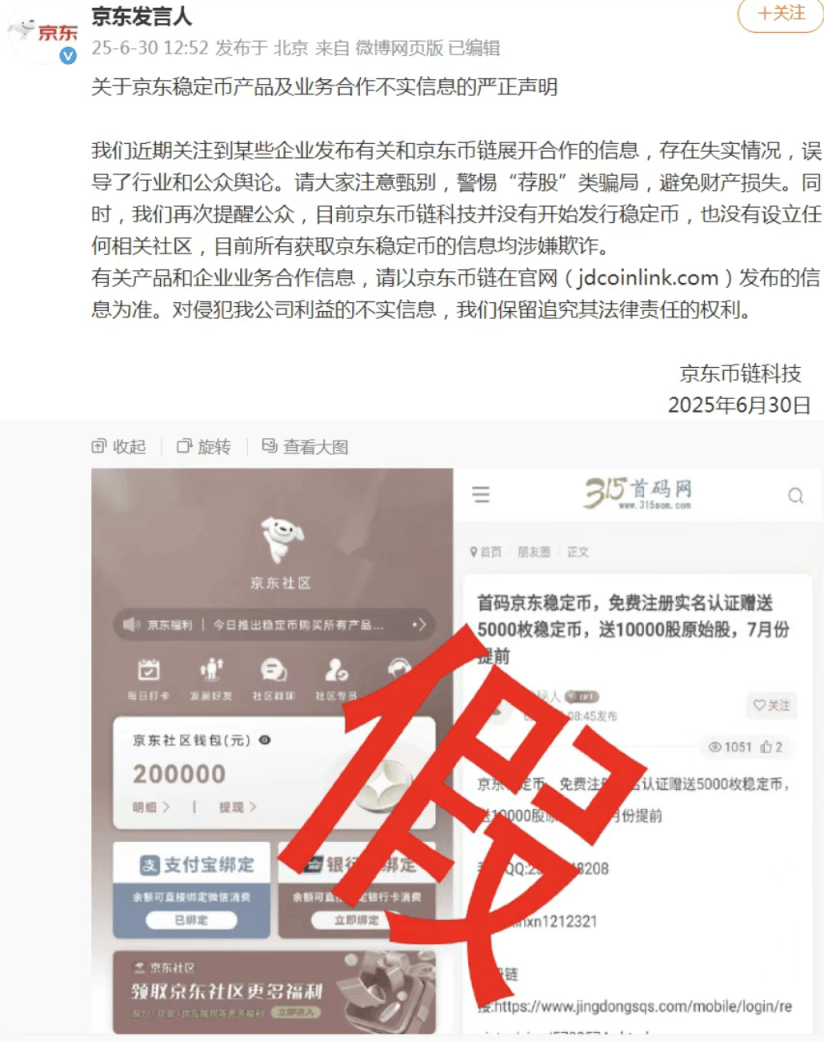
记者调查发现,市面上多个打着"稳赚不赔""固定高息"旗号的所谓"稳定币"投资项目在网上活跃,吸引公众参与。多地监管部门已就此发出风险警示。业内 专家特别提醒,公众应自觉远离未经批准的"数字理财"项目,切实守护好个人"钱袋子"。 近期,以虚拟货币"稳定币"为代表的相关概念被热炒,甚至沦为不法分子实施非法集资、诈骗的工具。日前,京东币链科技、蚂蚁数科等科技公司接连发布 公告,澄清市场流传的"稳定币"合作传闻。 稳定币是一种锚定真实资产的加密货币,其价值通常与某种法定货币、商品或其他资产挂钩。6月6日,香港特区政府公告称,《稳定币条例》将于8月1日生 效。届时香港金管局将接受牌照申请。受利好消息面影响,稳定币一跃成为全球最受瞩目、热度最高的资产之一,并引来相关概念被热炒。 此次公告中,京东币链科技表示,在取得香港稳定币发行人牌照前,所有以京东稳定币、JD-HKD、JD-USD等字样发币、吸引用户购买以及假借京东或京 东合作方名义发币的,均为骗局。 这是不到一个月的时间里,京东方面第二次就稳定币发布提示性声明。6月30日,京东发布《关于京东稳定币产品及业务合作不实信息的严正声明》,强调 目前所有声称"可获取京东稳定币 ...
政策与大类资产配置周观察:静待7月政治局会议
Tianfeng Securities· 2025-07-22 08:14
Domestic Policy News - The State Council held a meeting on July 16 to discuss strengthening the domestic circulation, emphasizing the need for optimized policy design and collaboration among departments to promote economic stability and growth [9][10][11] - The National Committee of the Chinese People's Political Consultative Conference convened a meeting on July 18 to analyze the macroeconomic situation for the first half of 2025, highlighting the importance of maintaining employment, enterprises, and market stability amid a complex international environment [11][12] Overseas Policy News - On July 17, the U.S. House of Representatives passed the "Genius Act," establishing a regulatory framework for digital stablecoins, marking a significant legislative reform in cryptocurrency regulation [2][14] - Data from the U.S. Treasury revealed that in May 2025, Japan and the UK increased their holdings of U.S. Treasury bonds, while China continued to reduce its holdings for the third consecutive month [16][20] Equity Market Analysis - A-shares experienced a slight increase in mid-July, driven by better-than-expected economic growth in the first half and policies encouraging long-term capital inflow [22][23] - The MSCI China A-share index rose by 1.2% in the third week of July, while the Southbound capital maintained a net inflow of nearly 20 billion yuan [22][23] Fixed Income Market Analysis - The People's Bank of China indicated a commitment to increasing monetary easing, with a net injection of 9.749 billion yuan into the market through open market operations [3][21] - The central bank's policies have shown a positive impact on supporting the real economy, with a notable increase in the effectiveness of monetary policy [3][21] Commodity Market Analysis - The prices of non-ferrous metals showed a slight rebound, while crude oil prices experienced a minor decline [3][21] - The Ministry of Industry and Information Technology announced the implementation of a work plan to stabilize growth in ten key industries, including steel and non-ferrous metals [3][21] Foreign Exchange Market Analysis - The U.S. dollar index strengthened slightly, closing at 98.46 on July 18, while the renminbi faced depreciation pressure, trading at 7.18 [4][20] - A joint announcement from seven departments encouraged foreign investment in domestic reinvestment, aiming to enhance the investment environment [4][20] Major Asset Rotation Outlook - The report anticipates further fiscal expansion and moderate monetary easing in the second half of the year, with a focus on structural adjustments to address uncertainties from U.S. trade policies and geopolitical risks [4][20]
稳定币 = 洋外汇券?也对也不对
Sou Hu Cai Jing· 2025-07-22 07:41
Group 1 - The core point of the article is the introduction of the GENIUS Act by former President Trump, which establishes a regulatory framework for USD stablecoins, linking them 1:1 with the US dollar, and aims to expand the stablecoin market significantly [3][6] - The stablecoin market is projected to grow substantially, with the current market size at $260 billion, providing a more efficient tool for cross-border payments [3] - The mechanism of USD stablecoins allows for price stabilization through minting and redeeming processes, which can prevent volatility typically associated with cryptocurrencies [6][8] Group 2 - The article draws parallels between stablecoins and historical foreign exchange vouchers, such as those used in East Germany and Cuba, highlighting their roles in managing currency and economic stability [10][12][16] - The issuance of stablecoins by companies like JD Group and Ant Group indicates a growing trend in the adoption of stablecoins in various markets, reflecting a shift towards digital currency solutions [8][21] - The article emphasizes that while stablecoins may resemble foreign exchange vouchers, they are fundamentally different as they are rooted in blockchain technology, which enhances transaction transparency and regulatory oversight [6][20]
代币化证券或分流IPO流动性,Citadel建言SEC:保持审慎,放慢审批
Hua Er Jie Jian Wen· 2025-07-22 06:57
Core Viewpoint - Citadel Securities urges the SEC to slow down the regulation of tokenized securities, warning that this emerging financial tool may unexpectedly impact traditional capital markets [1][2] Group 1: Concerns about Tokenized Securities - Citadel highlights that tokenized securities could divert funds from an already weak IPO market, providing private companies with an alternative financing channel [1][3] - The company expresses concern that tokenized securities may create new liquidity pools that institutional investors, due to risk management policies or fiduciary duties, cannot participate in [3] - The absence of institutional investors could affect market depth and price discovery efficiency [3] Group 2: Regulatory Approach - Citadel emphasizes the need for the SEC to advance tokenization through formal rule-making processes rather than hastily relaxing regulations [1][4] - The recent regulatory victory for the digital asset industry, with the stablecoin legislation coming into effect, underscores the importance of balancing innovation and regulatory caution [4] Group 3: Support for Tokenized Securities - Supporters of tokenized securities envision a more efficient trading environment, enabling 24/7 trading, instant settlement, and enhanced liquidity [5] - Digital asset trading platforms like Coinbase and Robinhood view tokenized securities as an opportunity to expand their service offerings and attract more users [6]
小摩港股2025 年下半年展望:在进一步重估的道路上前行(附首选股清单)
Zhi Tong Cai Jing· 2025-07-22 06:39
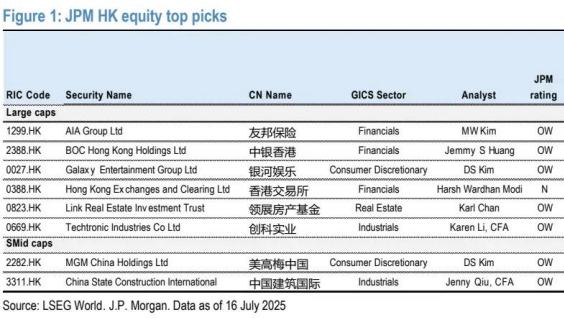
编者按:7月21日,小摩发布研究报告指出,对于 2025 年下半年,预计在恒生指数上半年取得 18% 的 美元回报率且相对亚太除日本指数跑赢约 5% 之后,短期内会出现盘整,原因包括不确定的关税风险、 美联储不太可能降息的前景、不及预期的刺激政策以及 8 月疲软的季节性因素。这种潜在的疲软将是一 个买入机会,因为强劲的股票市场融资、南向资金流入以及稳定币领域的创新可能会推动 EPS 修正。 指数目标:将 2025 年底恒生指数的基准 / 乐观 / 悲观目标从之前的 11,600/12,400/10,300 港元上调至 13,000/14,000/11,000 港元,对应回报率分别为 2%/10%/-14%。 中小盘股首选:美高梅中国和中国建筑国际。 | RIC Code | Security Name | CN Name | GICS Sector | Analyst | JPM rating | | --- | --- | --- | --- | --- | --- | | Large caps | | | | | | | 1299.HK | AIA Group Ltd | 友邦保险 | Financial ...
美国通过稳定币法案,特朗普签字即生效:数字货币缓解美债压力?
Sou Hu Cai Jing· 2025-07-22 06:07
Group 1 - The U.S. House of Representatives passed the GENIUS Act with a significant majority, which aims to establish a regulatory framework for stablecoins, pending presidential approval [1] - The implementation of this act is expected to stimulate demand for U.S. Treasury securities, alleviating current pressures on the U.S. debt market [3] - The passage of the act is seen as a crucial step for the U.S. in the global currency dominance competition, potentially impacting the global digital currency landscape and reinforcing the dollar's position in the digital economy [4] Group 2 - The stablecoin market is projected to grow to $2 trillion by 2028 from approximately $250 billion currently, indicating substantial growth potential [4] - The act aims to maintain the dollar's international payment status by leveraging stablecoins for cross-border payments, especially in response to the rise of China's cross-border e-commerce [6] - If the stablecoin market reaches $2 trillion, issuers would need to purchase around $1.8 trillion in U.S. Treasury securities, which could lead to a decline in Treasury yields and further ease fiscal pressures [6] Group 3 - The demand for cryptocurrency mining is driving rapid growth in the semiconductor industry, benefiting companies like Nvidia and TSMC [8] - The act requires foreign stablecoin issuers to comply with U.S. regulations to operate in the U.S. market, prompting companies like Tether to consider launching compliant stablecoins [8] - Major financial institutions such as JPMorgan, Bank of America, and Citigroup view this act as a catalyst to enter the stablecoin market, preparing to compete with tech companies in digital payments [8]

招银国际每日投资策略-20250722
Zhao Yin Guo Ji· 2025-07-22 05:31
Industry Insights - The Yarlung Tsangpo River Hydropower Station has officially commenced construction with a total investment of approximately 1.2 trillion RMB, which is expected to benefit the equipment manufacturing industry significantly [2] - The estimated annual procurement of construction machinery for the project is around 24 billion RMB, accounting for 2-3% of China's annual construction machinery output value, which is estimated to be around 900 billion RMB [2] - The demand for construction machinery is anticipated to be higher than the 2-3% estimate during the early stages of the project cycle [2] Company Specifics - Companies expected to benefit from the project include SANY Heavy Industry (600031 CH), Hengli Hydraulic (601100 CH), and Zoomlion Heavy Industry (1157 HK / 000157 CH), all rated as "Buy" [4] - Power engineering contractors such as China Power Construction (601669 CH) and China Energy Engineering (3996 HK / 601868 CH) are also expected to gain from the project [4] - In the power equipment sector, manufacturers like Dongfang Electric (1072 HK / 600875 CH) and Harbin Electric (1133 HK) are projected to see significant benefits [4] - Regional cement companies, particularly Tibet Tianlu (600326 CH) and Huaxin Cement (6655 HK / 600801 CH), are likely to benefit from increased regional demand [4]
规模新高,稳定币含量最高的金融科技ETF华夏(516100)连续回调获资金抢筹
Mei Ri Jing Ji Xin Wen· 2025-07-22 04:17
Group 1 - The core viewpoint of the news highlights the performance of the financial technology ETF Huaxia (516100), which has seen a slight decline of 0.22% amid a strong market trend, with significant fluctuations in its constituent stocks [1] - The financial technology ETF Huaxia has recently experienced a continuous capital inflow, accumulating 268 million in the past five days, reaching a new high of over 1 billion in total product scale since its inception [1] - A strategic partnership was formed between AI company Fourth Paradigm and fixed-income fintech platform Jiuyang Technology, aimed at developing a stablecoin asset management solution to enhance compliance and security in the stablecoin investment sector [1] Group 2 - The financial technology ETF Huaxia (516100) closely tracks the CSI Financial Technology Theme Index, which includes major players in software development, internet finance, and the digital currency industry, with a stablecoin content of 23.43%, the highest in the market [2] - The index comprises leading stocks such as Tonghuashun, Dongfang Caifu, Runhe Software, and Hengsheng Electronics, as well as popular stablecoin stocks like Dongxin Pinghe and Yingshisheng, facilitating investors' access to stablecoin and digital currency concepts [2]