指数估值

Search documents
[5月25日]美股指数估值数据(关税再起,全球股市波动,港股红利上涨)
银行螺丝钉· 2025-05-25 13:54
Core Viewpoint - The article discusses the valuation of global stock indices, U.S. Treasury indices, and the limited availability of investment options in mainland China for overseas markets, while highlighting the potential for investment through various funds available abroad [1][4]. Group 1: Global Stock Market Overview - The global stock market has seen a decline, with the overall index rating dropping to 3.6 stars, and the U.S. stock market index falling by 2.5% this week [5][26]. - Hong Kong stocks have outperformed globally, with the Hang Seng Index rising by 1% and the Hong Kong Dividend Index increasing by over 2% [7][8][9]. - The Hong Kong dividend stocks have shown a strong performance, continuing to rise for six consecutive weeks since early April [10]. Group 2: Dividend Yield and Tax Implications - The default dividend yield for Hong Kong dividend stocks is relatively high, reaching 6-7% in some cases, but investors face a 20% withholding tax on H-shares and 28% on red-chip stocks when investing through the Stock Connect [14][15]. - The article notes that the dividend yields presented in the valuation table have already accounted for these withholding taxes [17]. Group 3: Impact of Tariffs on U.S. Markets - Recent fluctuations in the U.S. stock market are attributed to tariff announcements by former President Trump, which may lead to increased inflation and affect the Federal Reserve's interest rate decisions [18][23]. - The article suggests that higher tariffs are primarily a negotiation tool rather than a fundamental objective, indicating that there is no need for excessive concern [25]. Group 4: Investment Opportunities - There are currently no global stock index funds available in mainland China, but there are substantial global stock index funds abroad, amounting to over a trillion dollars [28]. - The company has introduced a "Global Index Advisory Portfolio" that diversifies investments across U.S., UK, Hong Kong, and A-shares to track the global stock market [29]. Group 5: Book Promotion - The article promotes the newly released sixth edition of "The Long-Term Investment Guide," which has gained significant popularity, ranking first in sales on major platforms [31][32]. - The book provides updated data and insights on various asset classes, emphasizing that stocks are the best long-term investment for wealth accumulation [34][35].

[5月23日]指数估值数据(关税导致全球波动;港股医药估值如何;领取3周年奖章;港股估值表更新;抽奖福利)
银行螺丝钉· 2025-05-23 13:55
Core Viewpoint - The article discusses the fluctuations in the stock market, particularly focusing on the performance of the Hong Kong stock market and the pharmaceutical sector, while also addressing the impact of tariff announcements by former President Trump on global markets. Group 1: Market Performance - The stock market experienced a rise in the morning but turned to a decline by the afternoon, with both large and small-cap stocks showing similar minor declines [1][4][5] - The pharmaceutical and medical sectors remained relatively strong, showing slight increases [6] - The Hong Kong stock market also saw a decline in the afternoon but rebounded towards the end of the trading session, with overall slight gains [7][8] Group 2: Global Market Influences - Global markets have shown volatility, particularly following Trump's announcement of increased tariffs on European goods, which led to significant drops in European stock indices [12][13] - The U.S. stock market also experienced fluctuations after the announcement, reflecting a broader trend of market instability due to tariff concerns [14][15] - The increase in tariffs could potentially lead to higher inflation rates in the U.S., affecting the Federal Reserve's interest rate decisions [18] Group 3: Hong Kong Pharmaceutical Sector - The article highlights the performance of the Hong Kong pharmaceutical sector, noting that it has outperformed the A-share market, with the Hang Seng Index rising by 20% compared to A-share indices since the Lunar New Year [34] - The article provides insights into the valuation of pharmaceutical stocks in both A-shares and Hong Kong, indicating that many A-share pharmaceutical stocks are still at historical lows, while Hong Kong stocks are closer to normal valuation levels [42][43] - The article includes a valuation table for various indices, showing metrics such as price-to-earnings ratios and dividend yields for the Hong Kong healthcare sector [36][40][41]
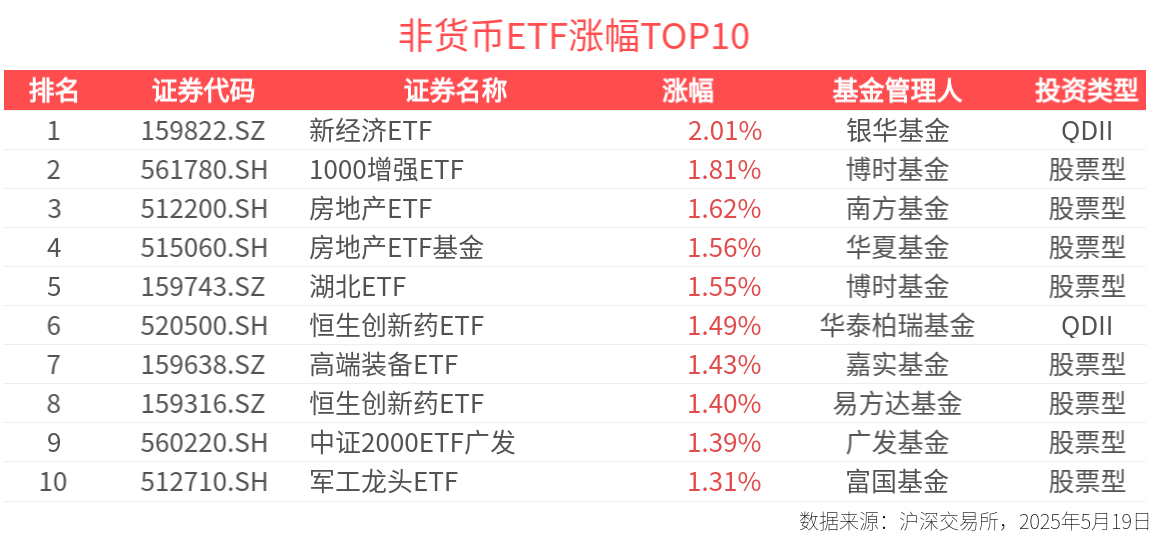
ETF英雄汇(2025年5月19日):新经济ETF(159822.SZ)领涨、标普消费ETF(159529.SZ)溢价明显
Xin Lang Cai Jing· 2025-05-19 10:26
Market Overview - As of May 19, 2025, the three major A-share indices showed mixed performance, with the Shanghai Composite Index closing flat at 3367.58 points, the Shenzhen Component Index down 0.08% at 10171.09 points, and the ChiNext Index down 0.33% at 2032.76 points. The total trading volume across both markets was 1.09 trillion yuan, with northbound capital remaining balanced [1]. Industry Performance - The chemical fiber sector performed notably well, rising by 3.28%, followed by rubber and shipping ports, which increased by 2.83% and 2.73%, respectively [1]. - The real estate sector also showed strength, with the CSI All Real Estate Index up by 1.57%, and both the Real Estate ETF and Real Estate ETF Fund rising by 1.62% and 1.56%, respectively [1]. ETF Performance - A total of 465 non-currency ETFs rose, accounting for 41% of the market. The top-performing ETFs included the New Economy ETF, which increased by 2.01%, and the 1000 Enhanced ETF, which rose by 1.81% [3]. - The Real Estate ETF (512200.SH) reached a total share size of 4.739 billion shares, closely tracking the CSI All Real Estate Index, which includes major companies like Poly Developments and Vanke A [3]. - The Hubei ETF (159743.SZ) had a share size of 1.67 billion shares, tracking the CSI Hubei New and Old Kinetic Energy Conversion Index, focusing on the electronics sector [4]. - The Heng Seng Innovative Medicine ETF (520500.SH) reached a share size of 3.85 billion shares, tracking the Heng Seng Innovative Medicine Index, which includes companies involved in innovative drug research and development [6]. Market Sentiment - The S&P 500 Consumer Select Index showed a premium of 26.55%, while the S&P 500 Index had a premium of 12.45%, indicating strong market sentiment [9]. - The top ETFs by premium included the S&P Consumer ETF at 26.55% and the S&P 500 ETF at 12.45% [11].
[5月18日]美股指数估值数据(全球股市上涨,黄金低迷)
银行螺丝钉· 2025-05-18 13:40
Core Viewpoint - The article discusses the valuation of global stock indices, U.S. Treasury indices, and the performance of various markets, highlighting the recent trends in stock markets and the contrasting behavior of gold prices. Group 1: Global Stock Market Performance - The global stock market has continued to rise, recovering from a short-term drop in early April, with global indices returning to around 3.5 stars after previously falling to 4.1-4.2 stars [1] - U.S., European, and Asian stocks have generally increased, with Hong Kong's Hang Seng Index rising over 2% this week, recovering losses from the tariff crisis [1] - The Hang Seng Index has outperformed the A-share large-cap index by 20% since the beginning of the year, with the healthcare and technology sectors in Hong Kong also outperforming their A-share counterparts by 20% [1] Group 2: Gold Market Trends - Despite the rise in global stock markets, gold has experienced a downturn, correcting approximately 9% since its peak in early April [1] - The strength of the U.S. dollar and its impact on real interest rates have been significant factors influencing gold prices, with a strong dollar generally being unfavorable for gold [1] Group 3: Investment Strategies and Products - The article mentions the availability of global stock index funds in overseas markets, which total over a trillion dollars, but notes the lack of such funds in mainland China [8] - A "Global Index Advisory Portfolio" has been introduced, which diversifies investments across U.S., UK, Hong Kong, and A-share indices to track global stock market performance [9] - The article also highlights the release of a new edition of "The Long-Term Investment Guide," which emphasizes the importance of stock assets for wealth accumulation over the long term [11][12]
[5月15日]指数估值数据(红利指数上涨能持续吗;红利专题估值表更新;指数日报更新)
银行螺丝钉· 2025-05-15 13:55
Core Viewpoint - The article discusses the performance of the dividend index and its implications for investment strategies, highlighting the changes in dividend yields and the overall market conditions affecting these indices. Group 1: Market Performance - The overall market experienced a decline, with large, mid, and small-cap stocks all falling, particularly small-cap stocks which saw a slightly larger drop [1][2][3]. - The value style saw a minor decline, while the growth style experienced a more significant drop [4]. - The Hong Kong stock market also faced a downturn, albeit with smaller declines compared to mainland markets [5]. Group 2: Dividend Index Analysis - The dividend index has shown significant growth over the past few years, with a notable performance from 2022 to 2024 [11]. - The China Securities Dividend Index rose from 1000 points in 2004 to 5581 points by the end of 2024, reflecting an annualized growth rate of approximately 8.9%, and with dividends included, it reached 11105 points, yielding an annualized rate of about 12.7% [12]. - The long-term growth rate for the dividend index is estimated at 8-9%, plus an annual dividend yield of 3-4% [15]. Group 3: Changes in Dividend Yield - Recent years have seen an increase in the dividend yield of the dividend index, with many stocks now offering yields of 5-6%, compared to 4-5% in previous years [16][18]. - Companies are increasingly encouraged to raise their dividend payout ratios, with some now distributing 40-50% of their profits as dividends, up from 30-40% [20]. - This increase in dividend payouts has led to a higher dividend yield but has also resulted in slower earnings growth for dividend stocks [22][26]. Group 4: Future Outlook - The article suggests that while the dividend index has performed well, the earnings growth rate is expected to slow down, with recent years showing growth rates of 5-6% and dividend yields of 4-5% [24]. - The article warns that if earnings growth for the dividend index declines again, it may lead to prolonged periods of undervaluation [29]. - The core drivers for the net asset value growth of dividend funds remain earnings growth and annual dividends, which have contributed significantly to recent returns [32][34]. Group 5: Fund Performance and Valuation - Some dividend funds have seen net asset value increases ranging from 50% to 80% in recent years, with earnings growth and dividends accounting for 70-80% of these returns [33][34]. - The current valuation of the dividend index is not as low as it was in 2020, indicating a return to normal valuation levels for some products [36]. - The article includes a valuation table for various dividend indices, providing insights into their earnings yield, price-to-earnings ratio, and dividend yield [39].
[5月14日]指数估值数据(港股与A股,这轮上涨有啥区别;ETF估值表来了)
银行螺丝钉· 2025-05-14 13:46
Group 1 - The core market sentiment shows a recent recovery in both A-shares and Hong Kong stocks after a significant drop in early April, with notable increases in the securities and insurance sectors today [23][3][6] - The securities industry has underperformed the market by over 10% until early May, but has recently rebounded, indicating a potential shift in investor sentiment [6][5][7] - The value style has generally risen, with major indices like the CSI 300 Value and CSI Dividend returning to normal valuations after previous increases [11][12][14] Group 2 - Hong Kong stocks have shown stronger performance compared to A-shares, with growth driven by technology and growth styles, particularly following positive earnings reports from major companies [25][39][20] - The market liquidity is currently robust, supported by low interest rates and various stimulus policies, which has led to increased interest in small-cap stocks [42][45][46] - The overall market sentiment indicates a lack of confidence among A-share investors, who are still favoring defensive large-cap value stocks, while foreign investors in Hong Kong show stronger confidence in RMB assets [52][54] Group 3 - The article introduces a new feature in the "Today Stars" app that allows users to view real-time ETF valuation data, enhancing investment decision-making capabilities [55][56] - The importance of investing in undervalued areas is emphasized, suggesting that strict adherence to this strategy can mitigate risks and enhance profit potential [59][60]

红利指数,不同渠道估值数据不同,原因为何?
银行螺丝钉· 2025-05-13 13:45
Group 1 - The article discusses the differences in valuation metrics for the CSI Dividend Index across various platforms, highlighting that the index's price-to-earnings (P/E) ratio can vary significantly depending on the weighting method used [1][2]. - The CSI Dividend Index underwent two major rule changes, first in 2013 when it switched from market capitalization weighting to dividend yield weighting, and again in 2022 to enhance the requirements for dividend stability and continuity [2][3]. - The article outlines common weighting methods for indices, including market capitalization weighting, factor weighting, price weighting, and equal weighting, with market capitalization being the most prevalent method [3][4]. Group 2 - A key characteristic of A-share bank stocks is their large total market capitalization but relatively small free-float market capitalization, leading to significant differences in weightings based on the chosen calculation method [5][6]. - The article provides a comparison of total market capitalization and free-float market capitalization, using the Industrial and Commercial Bank of China as an example, with total market capitalization at 25,554.33 billion and free-float market capitalization at 2,482.45 billion [7]. - In the CSI Dividend Index, the proportion of bank stocks can vary dramatically based on the weighting method; for instance, using total market capitalization weighting results in a bank stock proportion of 63.75%, while dividend yield weighting reduces this to 22.43% [8][9]. Group 3 - The current P/E ratio of bank stocks within the CSI Dividend Index is influenced by the weighting method; total market capitalization weighting aligns the P/E ratio closer to the bank stock index at over 7 times, while the true P/E ratio based on actual stock proportions is over 9 times [10][12]. - The article lists the top 20 constituents of the CSI Dividend Index, noting that most have P/E ratios exceeding 10, indicating that the overall index P/E cannot realistically be as low as 7 times [12][13]. - The article emphasizes that the low P/E ratio of 7 times is primarily a result of the high weighting of bank stocks under total market capitalization weighting, which distorts historical data and percentiles [13][17]. Group 4 - The article mentions that various strategy indices, such as leader, dividend, value, low volatility, growth, and quality indices, do not allocate stock proportions based on total market capitalization but rather follow specific strategies [15][16]. - It highlights that early broad-based indices predominantly used total market capitalization weighting for simplicity, but the evolution of indices has led to the development of many strategy indices that require more accurate valuation calculations based on actual stock holdings [17].

[5月13日]指数估值数据(螺丝钉定投实盘第364期:投顾组合发车;个人养老金定投实盘第14期;养老指数估值表更新)
银行螺丝钉· 2025-05-13 13:45
Market Overview - The market opened with a slight increase but closed slightly down, maintaining a five-star rating [1] - The CSI 300 large-cap stocks saw a minor increase, while small-cap stocks experienced a slight decline. Value styles such as banking and dividends rose, whereas growth styles fell. The pharmaceutical sector overall increased [2] - The Hong Kong stock market, which had a significant rise yesterday, saw a decline in the morning [3] Sector Performance - Technology stocks in Hong Kong experienced a notable decline [4] - Despite the recent drop, the technology stocks are still considered to be at normal valuation levels after a significant rise in previous weeks, indicating they are not yet undervalued [5] - The earnings reports for Hong Kong technology stocks are being updated, with Q1 earnings growth appearing relatively strong, alleviating concerns about short-term volatility [6][8] Trade and Tariff Updates - A recent announcement regarding the postponement of tariff increases led to a market rebound [9] - However, the tariff issue remains unresolved, with ongoing uncertainty due to factors such as Trump's unpredictability [10] - The market is expected to experience fluctuations in the near term [11] Investment Strategies - The article discusses a systematic investment strategy using a "periodic but irregular" approach, where more is invested when valuations are lower [16] - Two methods for following investment combinations are available: manual and automatic [18][19] - The article emphasizes the importance of maintaining a calm demeanor and being able to withstand market fluctuations to achieve satisfactory investment results [29]
[5月12日]指数估值数据(关税暂缓,全球股市大涨;军工估值如何;月薪宝发薪日)
银行螺丝钉· 2025-05-12 13:53
Group 1 - The overall market is experiencing an upward trend, with the market rating at 5 stars, close to 4.9 stars [1] - All market caps are rising, with small-cap stocks showing slightly higher gains [2] - Growth style stocks are performing better than others [3] Group 2 - Positive news emerged after the A-share market closed, contributing to market optimism [4] - Hong Kong stocks surged significantly after 3 PM, with the Hang Seng Tech Index rising over 5% [5] - The surge is attributed to preliminary positive developments in US-China tariff negotiations, maintaining a 10% universal tariff and postponing a 24% reciprocal tariff while canceling 91% of retaliatory tariffs [6][7] Group 3 - The positive tariff news is also beneficial for RMB-denominated assets [7] - The A-share market may reflect these gains in the following trading day due to the timing of the news [9] - The tariff crisis in early April had previously led to a global stock market decline, highlighting the dual-edged nature of tariff increases for USD assets [10] Group 4 - Hong Kong stocks have seen a continuous rise for five weeks [15] - The uncertainty surrounding Trump remains, but such events often present good buying opportunities during short-term volatility [17] - In September of the previous year, both Hong Kong and A-share valuations were at historical lows, with similar performance in subsequent rebounds [18][19] Group 5 - Since the Chinese New Year, Hong Kong stocks have outperformed A-shares, with the Hang Seng Index rising 18% more than the CSI 300 [21] - The technology and pharmaceutical sectors in Hong Kong have also outperformed their A-share counterparts by over 20% [21] - Hong Kong stocks are primarily RMB assets but have a higher proportion of foreign investors compared to mainland funds [24][26] Group 6 - The military industry has seen significant gains recently, with interest in military indices and their valuation [31] - Military indices, such as the CSI Military Index, have high P/E ratios exceeding 100, primarily due to past profit volatility [39] - The military sector is considered a long-term investment theme, with indices like technology and military expected to remain relevant [36] Group 7 - The "Monthly Salary Treasure" investment combination has lowered its entry threshold to 200 yuan and opened a regular investment feature [56] - This combination employs a 40:60 stock-bond balanced strategy and has shown significant excess returns since inception [55] - The market is currently rated at 5.0 stars, indicating a suitable investment phase for the Monthly Salary Treasure combination [58]
[5月9日]指数估值数据(港股领先上涨,A股会跟上么;抽奖福利)
银行螺丝钉· 2025-05-09 13:54
Market Overview - The overall market experienced a slight decline, with the CSI All Share Index dropping by 0.7%, indicating low volatility and remaining at a 5-star rating [1] - Large-cap stocks saw minor declines, while small-cap stocks experienced slightly larger drops [2] Investment Style Performance - Dividend and value styles showed overall gains, typically demonstrating resilience during market downturns [3] - Growth style experienced a slight decline [4] Hong Kong Market Insights - The Hong Kong market saw intraday declines but ended with the Hang Seng Index showing an increase [5] - Since last September, when both A-shares and Hong Kong stocks were at historical low valuations, both markets have rebounded, with Hong Kong stocks outperforming A-shares by 15% from post-Spring Festival to March [6] - The Hang Seng Index and sectors like healthcare and technology in Hong Kong outperformed their A-share counterparts by 20% [6] - A-shares remain at a valuation around 5 stars, and if they were to match Hong Kong's gains, they would be closer to a 3-star rating [6] Currency and Investment Dynamics - Hong Kong stocks primarily consist of RMB assets, with a significant proportion of mainland companies listed [6] - The recent interest rate cuts by the Federal Reserve have benefited RMB assets, positioning both A-shares and Hong Kong stocks among the top performers globally, with Hong Kong showing stronger performance [6] - The liquidity in Hong Kong is weaker, making it more sensitive to capital inflows and outflows, which can lead to significant price fluctuations [6] Long-term Return Comparisons - Over the long term, the returns from Hong Kong stocks and A-shares are similar, particularly for mainland companies listed in both markets [9] - The Hang Seng AH Premium Index, which measures the price difference between A-shares and H-shares, has fluctuated between 130-140 over the past five years, indicating that A-shares typically trade at a premium [9][7] - Factors such as lower dividend taxes and trading fees in A-shares contribute to this premium [9] Investment Opportunities - There are advantages to investing in Hong Kong stocks, including the introduction of various internet indices [10] - Both A-shares and Hong Kong stocks present investment opportunities, and the company provides weekly updates on relevant indices for reference [11]