
通缩

Search documents
早苗经济学,安倍2.0?
2 1 Shi Ji Jing Ji Bao Dao· 2025-10-22 13:33
Core Viewpoint - The election of Japan's first female Prime Minister, Sanae Takaichi, marks a significant political shift, but she faces complex economic challenges, including high inflation and substantial government debt [1][3]. Economic Context - Takaichi inherits a situation characterized by high inflation, with Japan's inflation rate exceeding the 2% target for several months, contrasting with the deflationary environment faced by her predecessor, Shinzo Abe [1][2]. - Japan's government debt stands at 240% of GDP, the highest among major economies, raising concerns about fiscal sustainability [1]. Policy Proposals - Takaichi plans to implement active fiscal policies, including the issuance of deficit bonds to address high inflation, although this could exacerbate the deficit [2]. - She aims to support wage increases for employees, particularly in struggling small and medium-sized enterprises, through tax reductions, though skepticism exists regarding the effectiveness of this approach [2]. - Proposed measures to alleviate consumer burdens include lowering gasoline taxes and increasing local subsidies, but the sustainability of these initiatives under Japan's strict fiscal discipline is uncertain [2]. Political Landscape - Takaichi's ascension is seen as a potential shift in the Liberal Democratic Party's (LDP) image, but historical precedents suggest that newly elected leaders often adopt more pragmatic and moderate policies once in office [2][3]. - The likelihood of a full-scale return to "Abenomics 2.0" is considered low, with expectations leaning towards more moderate, growth-oriented policies in the short term [2].
存款搬家停下来了!这是什么信号?
大胡子说房· 2025-10-22 11:01
Group 1 - The core viewpoint of the article emphasizes the current economic situation, particularly focusing on CPI and PPI data, indicating a lack of inflation and a need for continued monetary and fiscal policy support [5][6][10] - In September, the CPI decreased by 0.3% year-on-year and increased by 0.1% month-on-month, while the PPI fell by 2.3% year-on-year, suggesting weak consumer demand and manufacturing prices [1][3] - The article highlights the importance of M1 and M2 monetary supply data, with M2 at 335.38 trillion yuan, growing by 8.4% year-on-year, and M1 at 113.15 trillion yuan, growing by 7.2%, indicating a narrowing M2-M1 gap [6][8][9] Group 2 - The narrowing of the M2-M1 gap suggests that M1 is growing faster, attributed to a decline in government bond prices, prompting individuals to withdraw funds from fixed-term investments back into demand deposits [9][10] - In September, household deposits increased by 2.96 trillion yuan, while non-bank financial institution deposits decreased by 1.06 trillion yuan, indicating a trend of funds returning to banks rather than remaining in investment accounts [10][11] - The article notes that the capital market's performance in September was lackluster, leading to a decrease in the "deposit migration" phenomenon, as investors were not seeing significant returns [12][13] Group 3 - The article anticipates continued government efforts to stimulate the capital market and address the economic situation, suggesting that the underlying logic for a bull market remains intact [15][19] - Upcoming key events, including trade negotiations and Federal Reserve meetings, are expected to influence market performance, with a cautious approach recommended until these events unfold [20][21] - The article encourages proactive asset allocation in anticipation of market movements following these critical events [22][23]


中国经济-2025 年刺激政策落地,第四季度 GDP 或企稳于 4.6 - 4.7% 同比增速-China Economics-2025 Stimulus Completed, Q4 GDP Likely Stabilizing at 4.6-4.7%Y
2025-10-21 01:52
Summary of Key Points from the Conference Call Industry Overview - **Industry**: China Economics - **Focus**: Economic performance and fiscal stimulus measures in China for Q4 2025 Core Insights and Arguments 1. **GDP Growth Stabilization**: Q4 GDP is likely stabilizing at 4.6-4.7% year-on-year, supported by fiscal stimulus measures totaling Rmb500 billion announced by the Ministry of Finance [3][6] 2. **Industrial Production Surge**: A notable increase in industrial production was observed in September, rising by 1.5 percentage points to 6.7% year-on-year, attributed to additional working days and quarter-end adjustments [2][6] 3. **Weakening Demand**: Despite the industrial production increase, there is a continued slowdown in fixed asset investment and retail sales, indicating persistent demand weakness [2][6] 4. **Deflationary Pressures**: The GDP deflator remains at -1% year-on-year, reflecting ongoing deflationary conditions in the economy [2][6] 5. **Nominal GDP Decline**: Nominal GDP has decreased by 20 basis points to 3.7% year-on-year, highlighting the impact of weakening demand [2][6] 6. **Fiscal Measures Impact**: The recent fiscal measures are expected to boost infrastructure capital expenditure in the coming months, aiding in stabilizing Q4 real GDP growth [3][6] 7. **Annual GDP Target**: The 5% annual GDP target is now considered largely achievable, reducing the likelihood of further significant stimulus measures for the remainder of the year [3][6] Additional Important Information 1. **Investment Trends**: Fixed asset investment year-to-date has shown a decline of 0.5%, with manufacturing and property sectors experiencing significant downturns [5][6] 2. **Retail Sales Performance**: Retail sales growth has slowed, with nominal growth at 3.0% in September, indicating a challenging consumer environment [5][6] 3. **Sector Contributions**: The primary industry contributed 4.0% to GDP growth, while the secondary and tertiary industries contributed 4.2% and 5.4%, respectively, showcasing varied performance across sectors [5][6] 4. **Future Outlook**: The economic outlook suggests that while Q4 may stabilize, the underlying issues of demand weakness and deflation remain critical challenges for the Chinese economy [2][6]
日本央行鹰派委员呼吁加息:日本低物价常态已逐渐消退
智通财经网· 2025-10-20 08:55
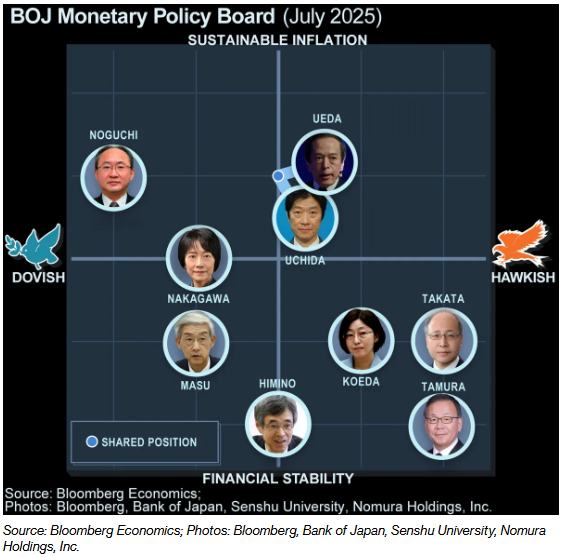
智通财经APP获悉,日本央行(BOJ)委员高田创(Hajime Takata)表示,当前上调央行政策利率的时机已成 熟。他暂不考虑政治动荡因素,并重申了自己的立场——上月他就对维持政策不变的决议投了反对票。 周一,高田创在日本西南部广岛向当地商界领袖发表演讲时称:"我认为现在是上调政策利率的绝佳时 机。"他指出,"日本曾根深蒂固的(低物价)常态已逐渐消退,物价稳定目标已基本实现。" 这是高田创在提出加息提议后首次发表公开演讲,他特别强调了"应对通胀率超央行目标已逾三年"这一 问题的重要性。尽管支持宽松货币政策的高市早苗本周极有可能当选日本下任首相,但高田创的言论表 明,他对加息的支持态度依然坚定。 高田创表示,日本持续通缩的时代已落幕,当局需转变政策方向。他称:"过去三年半,整体通胀率始 终维持在2%及以上水平,我认为当前必须聚焦这一现状采取行动。" 在下次政策决议前的最后一场既定公开活动中,植田和男上周曾表示,日本央行的利率立场"完全"没有 改变,这一表态暗示他不排除10月加息的可能性。 高田创表示:"尽管美联储在2025年9月采取了降息举措,但日元不仅未升值,反而出现贬值。此外,日 美两国股市均处于历史高 ...
股指周报:中美大国博弈仍在反复,关注四中全会是否利多提振-20251020
Zheng Xin Qi Huo· 2025-10-20 05:29
Report Industry Investment Rating No relevant information provided. Core Views - The US government shutdown and Sino-US frictions before the APEC meeting have led to a RISK OFF trading mode, negatively impacting overvalued and crowded AI technology assets. The upcoming 15th Five-Year Plan and the Fourth Plenary Session in China next week may bring unexpected positive effects; otherwise, the market may face further adjustment risks [4]. - Domestically, economic data remains weak, especially in consumption and real estate. Industrial enterprise capacity utilization has declined marginally, indicating slow progress in anti-involution policies and ongoing efforts to reverse deflation. Leading companies in pro-cyclical industries are expected to have better profit prospects [4]. - Domestic liquidity is generally loose, but the central bank has tightened funds in the open market. Passive ETF funds and margin trading funds have continued to attract capital, while industrial capital has increased its reduction, and foreign capital has flowed out significantly recently. Credit impulses have started to decline from their peak, weakening the positive impact of market liquidity [4]. - After a short-term small adjustment, the valuations of various indices remain at relatively high historical levels. The equity-bond risk premiums at home and abroad are at historical lows, and broad-based indices have limited attractiveness to allocation funds, but there are still structural opportunities [4]. - Overall, the limited liquidity in the large-scale market makes it difficult to drive continuous growth. During the window of positive macro-policy implementation, the market will choose a direction, with funds shifting from the aggressive growth style to the cyclical style for year-end valuation switching. It is recommended to adopt a high-selling and low-buying strategy for stock index futures next week, selling short IC and IM index futures on rebounds and buying long IF and IH index futures on sharp declines [4]. Summary by Directory 1. Market Review - **Global Stock Performance**: In the past week, the Dow Jones Index led the gains, while the Hang Seng Tech Index led the losses. The performance order was Dow Jones Index > FTSE Europe > FTSE Emerging Index > Shanghai Stock Exchange 50 > Nikkei 225 > Germany DAX > CSI 300 > CSI 500 > Hang Seng Tech Index [8]. - **Domestic Stock Performance**: The Shanghai Composite Index fell by 1.47%, the Shenzhen Component Index by 4.99%, the ChiNext Index by 5.71%, and the Hang Seng Index by 3.97%, among others [9]. - **Industry Performance**: The banking sector led the gains, while the consumer services sector led the losses [12]. - **Futures Performance**: The basis rates of the four major stock index futures (IH, IF, IC, and IM) changed by 0.47%, 0.63%, 0.9%, and 0.88% respectively, and the delivery discounts of the four major futures converged to par. The inter - period spread rates (between the current month and the next month) of the four major stock index futures changed by - 0.55%, - 0.67%, - 1.05%, and - 0.57% respectively, and the inter - period discounts significantly widened. The inter - period spread rates (between the next quarter and the current month) of the four major stock index futures changed by - 0.66%, - 0.73%, - 1.27%, and - 0.58% respectively, and the forward discounts of each futures contract widened significantly [20]. 2. Fund Flow - **Margin Trading and Stabilization Funds**: Margin trading funds continued to flow in 15.42 billion yuan last week, reaching 2.46 trillion yuan, and the proportion of margin trading balance to the circulating market value of the Shanghai and Shenzhen stock markets increased by 0.08% to 2.63%. The scale of passive stock ETF funds decreased by 70.07 billion yuan to 3638.85 billion yuan last week, due to the market decline [23]. - **Industrial Capital**: In October, the cumulative equity financing was 13.56 billion yuan, with 1 company involved. Among them, IPO financing was 0.79 billion yuan, private placement was 12.77 billion yuan, and convertible bond financing was 3.8 billion yuan. The scale of equity financing decreased significantly. The market value of stock market unlockings last week was 78.4 billion yuan, an increase of 32.6 billion yuan from the previous week. The annualized reduction in October was 248.4 billion yuan, and the scale of reduction continued to increase marginally [26]. 3. Liquidity - **Monetary Injection**: Last week, the central bank's OMO reverse repurchase expired at 1021 billion yuan, with a reverse repurchase injection of 67.3 billion yuan, resulting in a net monetary withdrawal of 347.9 billion yuan. The MLF had a net injection of 300 billion yuan in September, and the overall liquidity supply was neutral to loose but tightened marginally [28]. - **Monetary Demand**: Last week, the net monetary demand from national debt issuance was 16.63 billion yuan, and from local debt issuance was 18.09 billion yuan. The total net monetary demand from the bond market was 557.58 billion yuan. The debt financing demand of local governments and national debt decreased significantly, while that of enterprises increased marginally [31]. - **Fund Price**: DR007, R001, and SHIBOR overnight rates changed by - 1.4bp, 3.8bp, and 0bp respectively to 1.41%, 1.36%, and 1.32%. The issuance rate of inter - bank certificates of deposit rebounded by 8.2bp, and the CD rate of joint - stock banks increased by 4.4bp to 1.67%. The overall fund price fluctuated at a low level and increased marginally [34]. - **Term Structure**: Last week, the yields of 10 - year, 5 - year, and 2 - year national bonds changed by - 1.6bp, - 1.4bp, and - 0.7bp respectively, and the yields of 10 - year, 5 - year, and 2 - year national development bonds changed by - 4.6bp, - 2bp, and 0.3bp respectively. The yield term structure continued to flatten, the long - end yields declined slightly due to stock market adjustments and weak economic data, and the short - end yields were relatively strong due to liquidity tightening. The credit spread between national bonds and national development bonds narrowed at the long - end, and the expectation of broad credit cooled down [38]. - **Sino - US Interest Rate Spread**: As of October 17, the US 10 - year Treasury yield changed by - 3.0bp to 4.02%, the inflation expectation changed by - 3.0bp to 2.27%, and the real interest rate remained unchanged at 1.75%. The Sino - US interest rate spread inversion narrowed by 3.42bp to - 219.43bp, and the offshore RMB appreciated by 0.28% [40]. 4. Macroeconomic Fundamentals - **Real Estate Demand**: As of October 16, the weekly trading area of commercial housing in 30 large - and medium - sized cities was 2.129 million square meters, a seasonal increase of 0.483 million square meters from the previous week, but a 49.7% decrease compared to the same period in 2019. The second - hand housing sales rebounded seasonally, but the overall real estate market still showed a weak peak season. The market sales were supported by rigid demand at a low level, and more incremental policies were awaited to boost the recovery [43]. - **Service Industry Activity**: As of October 17, the average daily subway passenger volume in 28 large - and medium - sized cities decreased by 0.8% year - on - year to 81.44 million person - times, but increased by 24.8% compared to the same period in 2021. The Baidu congestion delay index of 100 cities rebounded slightly from the previous week, and the service industry economic activity tended to grow naturally and stably but cooled down marginally [47]. - **Manufacturing Tracking**: The capacity utilization rate of the manufacturing industry stopped falling and rebounded. The capacity utilization rates of steel mills, asphalt, cement clinker enterprises, and coke enterprises changed by - 0.22%, 1.3%, - 2.87%, and - 0.94% respectively. The average operating rate of the chemical industry chain related to external demand decreased by 0.13% from the previous week. Overall, the internal and external demand of the manufacturing industry cooled down, the capacity utilization rate decreased marginally, and the external demand was under short - term pressure due to the resurgence of Sino - US trade frictions [51]. - **Goods Flow**: The goods flow and passenger flow remained at relatively high levels but declined marginally beyond the seasonal norm, indicating the pressure on the real economy. The transportation volume of highways and railways decreased beyond the seasonal norm, indicating a cooling of exports [56]. - **Imports and Exports**: In terms of exports, the resurgence of Sino - US trade frictions, the approaching expiration of the 90 - day exemption, and the end of the rush to export under tariff disturbances will increase the export pressure marginally in the future [58]. - **Overseas Situation**: The US economic data is strong. Although the US government shutdown has affected the release of CPI and non - farm payroll reports, the market still expects the Fed to cut interest rates twice in the remaining part of 2025, with a total reduction of about 50bp. The probability of an interest rate cut in October is as high as 99%, and the probability in December has risen to 94%. The expected end - of - year interest rate is between 3.5% - 3.75% [61]. 5. Other Analyses - **Valuation**: The equity - bond risk premium was 2.68%, an increase of 0.1% from the previous week, at the 48.3% quantile, below the central level. The foreign capital risk premium index was 3.62%, a rebound of 0.08% from the previous week, at the 18.5% quantile, indicating a low level of attractiveness to foreign capital. The valuations of the Shanghai Stock Exchange 50, CSI 300, CSI 500, and CSI 1000 indices were at the 90.1%, 83.9%, 93.6%, and 79.7% quantiles respectively in the past five years, at relatively high levels. The quantiles changed by 3.3%, - 3.1%, - 5%, and - 4.1% respectively from the previous week, indicating that the attractiveness of the cyclical style decreased marginally, while that of the growth style index increased marginally [64][69]. - **Quantitative Diagnosis**: According to the seasonal pattern analysis, the stock market in October is in a period of seasonal oscillatory rise and structural differentiation, with the cyclical style dominant and the growth style generally oscillating at a high level. The stock market in October generally has a good profit - making effect, and the style is easy to switch. Considering the high valuation of the growth style and the relatively weak real economy, but with positive macro - policy expectations in October, it is recommended to buy long stock index futures on sharp declines this week and bet on the oversold rebound opportunities of IC and IM [72].
10月起,中国或将迎来5大降价潮,你知道都是什么吗?
Sou Hu Cai Jing· 2025-10-19 23:52
Core Viewpoint - The domestic economy is currently in a deflationary cycle, leading to price reductions across various sectors due to decreased consumer demand and income stagnation [1][3]. Group 1: Real Estate - Rental prices are experiencing a downward trend, with an example of a 36 square meter apartment's rent dropping from 3600 yuan to 3000 yuan [5]. - The decline in rental prices is attributed to an oversupply in the rental market as many workers return to their hometowns and the increase in affordable housing options [5]. Group 2: Tourism Services - After the National Day holiday, ticket prices for major tourist attractions have decreased by an average of 30%, with some popular spots seeing reductions exceeding 25% [8]. - Hotel prices have dropped by 35%-40%, and flight ticket prices have also decreased by 25%-30% due to a significant reduction in travel demand post-holiday [8]. Group 3: Home Appliances - Home appliance prices have entered a "price reduction wave," with major appliances like refrigerators and air conditioners seeing average price drops of 15%, while small appliances have decreased by 8%-10% [10]. - The decline is driven by rapid product updates and reduced consumer spending as households prioritize essential expenses [10]. Group 4: Electronics - Electronic products, including laptops and tablets, are experiencing notable price drops, with laptops expected to decrease by 8.5% and tablets by 6.2% [12]. - The price reductions are influenced by the release of new flagship products, leading to a decrease in prices for older models [12]. Group 5: Automotive Market - The automotive market has seen significant price reductions, with domestic mid-range cars dropping by 20,000-30,000 yuan and imported vehicles by nearly 90,000 yuan [14]. - The decline is attributed to market oversupply, stagnant income growth among middle-class consumers, and rapid turnover of vehicle models [14].

2025年10月开始,要做好“资产贬值”的准备?这四件事情建议别做
Sou Hu Cai Jing· 2025-10-19 06:11
Core Viewpoint - Experts predict that domestic inflation is imminent by the second half of 2025 due to significant monetary expansion, yet the economy remains in a deflationary cycle with a CPI of -0.3% as of September 2025, indicating that money is becoming more valuable [1][3]. Monetary Policy and Economic Conditions - As of September 2025, the broad money supply (M2) reached 335.38 trillion yuan, which is double the GDP, yet inflation has not materialized due to insufficient consumer and investment confidence, leading to stagnant prices [1][3]. - The deflationary environment is exacerbated by a sluggish real economy and declining household incomes, resulting in decreased consumer demand and prompting businesses to lower prices to clear inventory [3]. Real Estate Market - The real estate market continues to experience a downward trend, with the average price of second-hand homes in 100 cities falling to 13,381 yuan per square meter, a year-on-year decrease of 7.38%, and prices have been declining for 41 consecutive months [8]. - The average decline in housing prices exceeds 30%, with certain areas around Beijing seeing drops of over 60%, suggesting that investing in real estate is not advisable at this time [8]. Stock Market Insights - The A-share market has seen a new wave of growth since the beginning of 2025, primarily driven by lower bank deposit rates prompting investors to shift funds into the stock market [5]. - Caution is advised for investors in the stock market, particularly against blindly chasing high prices and using leverage, as these strategies could lead to significant losses if the market turns [5]. Investment Products and Risks - The bank wealth management market reached a scale of 30.67 trillion yuan by June 2025, with annualized returns between 2.25% and 2.55%, which are higher than one-year fixed deposit rates [10]. - Despite the perceived safety of bank wealth management products, risks are increasing, particularly due to declining yields in the bond market, which could lead to potential losses even in lower-risk products [10]. Entrepreneurship Challenges - The current economic deflation poses significant challenges for new entrepreneurs, including shrinking consumer demand, oversaturation in traditional industries, rising operational costs, and competition from e-commerce [12]. - Given the economic context, it is recommended to avoid risky investments and focus on low-risk products like government bonds or large-denomination certificates of deposit to preserve capital until the deflationary cycle ends [12].

南华期货生猪企业风险管理日报-20251017
Nan Hua Qi Huo· 2025-10-17 10:10
1. Report Industry Investment Rating No relevant content provided. 2. Core Viewpoints of the Report - Long - term strategic outlook on the pig industry is bullish, but short - to medium - term trends are still mainly determined by fundamentals. The policy bottom has emerged, but the market bottom may require a production cycle to form [3]. - There are both positive and negative factors in the pig industry. Positive factors include improved macro - sentiment, high standard - fat price spread, medium - to long - term policy - driven capacity reduction expectations, and speculative entry sentiment for secondary fattening. Negative factors are the high inventory of sows capable of reproduction, high inventory of large - scale enterprises, and weak downstream terminal consumption [4][5]. 3. Summary by Relevant Catalogs 3.1 Pig Price Range Forecast - The main contract price is testing the 13,000 - point integer mark. The current volatility (20 - day rolling) is 19.83%, and the historical percentile of the current volatility (3 - year) is 61.17% [2]. 3.2 Pig Enterprise Risk Management Strategy Recommendations 3.2.1 Inventory Management - If product inventory is high and there are concerns about inventory impairment, sell 20% of the LH2511 contract in the live pig futures to lock in finished - product profits. If there are no suitable prices on the futures market, sell 20% of the LH2411 - C - 1300 call options. If one wants to avoid inventory impairment while not giving up the opportunity for a significant price increase, buy the LH2411 - P - 1100 put options [2]. 3.2.2 Procurement Management - If there are future procurement plans and concerns about rising raw material prices, buy live pig forward contracts according to the procurement plan to lock in procurement costs. If there are no suitable prices on the futures market, sell the LH2411 - P - 1100 put options. If one is worried about rising procurement prices but does not want to lock in procurement and sales profits in advance and believes that procurement costs may be lower, buy the LH2411 - C - 1300 call options [2]. 3.3 Pig Spot Prices - The national average spot price is 11.1 yuan/kg with no change. The prices in different regions vary: Henan is 11.28 yuan/kg (up 0.07 yuan/kg, 0.62%); Hunan is 10.76 yuan/kg (up 0.05 yuan/kg, 0.47%); Liaoning is 11.47 yuan/kg (down 0.11 yuan/kg, - 0.95%); Sichuan is 10.83 yuan/kg (up 0.1 yuan/kg, 0.93%); Guangdong is 11.46 yuan/kg with no change [8]. 3.4 Pig Futures Prices - Pig 01 contract closed at 11,670 yuan/ton, down 235 yuan/ton (- 1.97%); Pig 03 contract closed at 11,280 yuan/ton, down 260 yuan/ton (- 2.25%); Pig 05 contract closed at 11,920 yuan/ton, down 220 yuan/ton (- 1.81%); Pig 07 contract closed at 12,720 yuan/ton, down 205 yuan/ton (- 1.59%); Pig 09 contract closed at 13,515 yuan/ton, down 240 yuan/ton (- 1.74%); Pig 11 contract closed at 11,050 yuan/ton, down 115 yuan/ton (- 1.03%) [9]. 3.5 Pig Price Spreads and Basis - LH01 - 03 spread is 390 yuan/ton, up 25 yuan/ton (6.85%); LH03 - 05 spread is - 640 yuan/ton, down 40 yuan/ton (6.67%); LH05 - 07 spread is - 800 yuan/ton, down 15 yuan/ton (1.91%); LH07 - 09 spread is - 795 yuan/ton, up 35 yuan/ton (- 4.22%); LH09 - 11 spread is 2,465 yuan/ton, down 125 yuan/ton (- 4.83%); LH11 - 01 spread is - 620 yuan/ton, up 120 yuan/ton (- 16.22%); Henan - 01 contract basis is - 390 yuan/ton, up 305 yuan/ton (- 43.88%); Henan - 05 contract basis is - 640 yuan/ton, up 290 yuan/ton (- 31.18%); Henan - 09 contract basis is - 2,235 yuan/ton, up 310 yuan/ton (- 12.18%) [17][19].
存款搬家停下来了!这是什么信号?
大胡子说房· 2025-10-16 11:23
Group 1 - The core viewpoint of the article emphasizes the current economic situation, particularly focusing on CPI and PPI data, indicating a lack of inflation and a need for continued monetary and fiscal policy support [5][6][10] - In September, the CPI decreased by 0.3% year-on-year and increased by 0.1% month-on-month, while the PPI fell by 2.3% year-on-year, suggesting weak consumer demand and manufacturing prices [1][3] - The article highlights the importance of M1 and M2 monetary supply data, with M2 growing by 8.4% year-on-year and M1 by 7.2%, indicating a narrowing gap between the two, which reflects a shift in liquidity dynamics [6][8][9] Group 2 - The increase in M1 is attributed to a decline in government bond prices, leading individuals to withdraw funds from fixed-term investments and place them into demand deposits [9][10] - In September, household deposits rose by 2.96 trillion yuan, while non-bank financial institution deposits fell by 1.06 trillion yuan, indicating a trend of funds returning to banks rather than remaining in investment accounts [10][11] - The article suggests that the current market volatility and lack of clear upward trends in the stock market have led to a decrease in the attractiveness of non-bank investments, resulting in a return of funds to traditional banking [12][13] Group 3 - The article anticipates that the government will continue to stimulate the capital market to encourage investment and support economic recovery, as the current economic conditions necessitate such actions [15][18] - It discusses the potential for a bull market in the A-share market, suggesting that as long as there is a need to escape deflation, the market will continue to seek upward momentum [19][20] - Upcoming key events, including trade negotiations and monetary policy decisions, are expected to influence market behavior, with a recommendation for strategic asset allocation in anticipation of these developments [21][22]

美联储米兰:这些措施是在大金融危机的阴影下推出的,那种对通缩的担忧已经成为过去。
Sou Hu Cai Jing· 2025-10-15 17:26
Core Viewpoint - The measures introduced by the Federal Reserve are a response to the shadows of the major financial crisis, indicating that concerns over deflation have become a thing of the past [1] Group 1 - The Federal Reserve's actions are framed within the context of past financial crises, suggesting a proactive approach to economic stability [1] - The shift in focus from deflationary fears to current economic conditions reflects a significant change in monetary policy strategy [1]