全国统一大市场

Search documents
利好刷屏!重磅解读
中国基金报· 2025-08-03 13:37
【导读】六位券商、公募"首席"解读中央政治局会议精神:释放多重积极信号,政策"组合 拳"巩固市场向好势头 中国基金报记者 李树超 方丽 曹雯璟 7月30日,中共中央政治局召开会议,分析研究当前经济形势,部署下半年经济工作。 此次中央政治局会议释放出哪些积极信号?下半年宏观政策如何调整?资本市场哪些机会值 得关注?为此,中国基金报专访了六位来自券商、公募的 "首席",他们是 中信证券首席经济 学家明明、华泰证券首席宏观经济学家易峘、招商基金研究部首席经济学家李湛、创金合信 基金首席经济学家魏凤春、中航基金副总经理兼首席投资官邓海清和博时基金首席权益策略 分析师陈显顺 。 会议释放多重积极信号 中国基金报:此次中央政治局会议释放出哪些积极信号?哪些内容是你比较关注的? 明明: 一是我国经济运行稳中有进,主要经济指标表现良好,新质生产力加快形成,高质量 发展取得新成效。二是会议强调 "持续发力、适时加力",明确后续若遇外部冲击或下行压 力,将有能力及时加大财政政策和货币政策支持。此次会议有关"十五五"计划的定调、地产 方面的城市更新工作、扩内需政策、稳外贸工作以及地方化债工作等都非常值得关注。 易峘: 此次会议延续 ...


管涛:经济不只是财政货币政策那点事儿
Di Yi Cai Jing· 2025-08-03 12:25
Core Viewpoint - The recent meeting of the Central Political Bureau emphasized the need for flexible and proactive macroeconomic policies to address ongoing uncertainties while maintaining a stable economic recovery trajectory [1][4][12]. Economic Performance - The meeting acknowledged that major economic indicators showed strong performance in the first half of the year, with GDP growth of 6.5% in Q2 2023, a significant increase from the previous year's 3.6% [4][5]. - Despite the positive indicators, challenges such as insufficient domestic demand and external uncertainties remain prevalent [2][3]. Policy Direction - The meeting did not call for increased macroeconomic control but instead focused on maintaining policy continuity and stability, suggesting a lower probability of immediate policy tightening [4][6]. - Emphasis was placed on implementing proactive fiscal policies and moderately easing monetary policies to stimulate economic growth [2][4][6]. Domestic Demand and Consumption - A key focus is on expanding domestic demand through consumption, with initiatives aimed at enhancing consumer spending and improving living standards [5][8]. - The government plans to implement a series of measures to boost consumption, including financial incentives for personal loans and support for service sector financing [8]. Market Structure and Competition - The meeting highlighted the importance of advancing the construction of a unified national market to optimize market competition and eliminate disorderly competition among enterprises [9][10]. - Legal reforms, such as the revised Anti-Unfair Competition Law, aim to foster a fair competitive environment and protect consumer rights [10]. Real Estate Sector - The meeting acknowledged the need for a new model of real estate development, focusing on stabilizing the market and promoting urban renewal [10][11]. - Policies will be implemented to support the real estate sector, including financial measures to ensure stability and growth [11][12].
新华财经周报:7月28日至8月3日
Xin Hua Cai Jing· 2025-08-03 11:15
Economic Developments - The China-US economic talks held in Stockholm focused on resuming the suspended 24% tariffs and countermeasures, with a 90-day extension agreed upon [1][2] - The State Council approved the "Artificial Intelligence+" action plan to promote the commercialization of AI, leveraging China's complete industrial system and large market scale [2] - The People's Bank of China emphasized the implementation of a moderately loose monetary policy to support technology innovation, consumption, and small enterprises [3] Financial Performance - In the first half of the year, state-owned enterprises reported total operating revenue of approximately 4.07 trillion yuan, a year-on-year decrease of 0.2%, and total profits of about 218.25 billion yuan, down 3.1% [4] - The manufacturing PMI for July was reported at 49.3%, a decline of 0.4 percentage points from the previous month, marking the first drop in four months [6] Policy Initiatives - The Ministry of Finance announced a budget of around 90 billion yuan for childcare subsidies, with applications set to open in late August [1][4] - The National Development and Reform Commission emphasized the need to stabilize investment and promote consumption, aiming to enhance market vitality [5] International Trade Relations - The US Federal Reserve maintained its interest rate target range, with internal dissent emerging regarding future rate decisions [6][10] - The global trade friction index showed a decrease of 13% year-on-year, influenced by the suspension of certain US tariffs [6]
中信证券:做趋势还是高切低?
智通财经网· 2025-08-03 09:05
Core Viewpoint - The behavior of leading funds in the market is determined by the positioning of the market, which in turn influences the structure and pattern of industries that experience growth. Historically, liquidity-driven markets tend to concentrate on strong sectors rather than rotating between high and low performers [1][2]. Group 1: Market Behavior and Trends - In liquidity-driven markets, once a sector gains consensus, its strong performance tends to persist until the end of the market cycle [2]. - Strong sectors often see their peak performance occur later than mid-tier sectors, indicating a lack of significant high-low rotation [2]. - The excess returns of leading sectors compared to mid-tier and low-tier sectors tend to expand throughout the market cycle [2]. Group 2: Investment Focus and Sector Performance - Current focus remains on sectors such as AI, innovative pharmaceuticals, resources, and the STAR Market [1][6]. - In July, sectors with strong industrial trends, such as innovative pharmaceuticals and rare metals, outperformed, with ETFs recording significant gains: Communication ETF at 20.4%, Innovative Pharmaceutical ETF at 16.9%, and Rare Metals ETF at 15.4% [5]. - Conversely, sectors relying on short-term speculative themes, like coal, saw significant pullbacks, indicating a preference for strong trend sectors over low-positioned ones [5]. Group 3: Liquidity and Market Dynamics - Recent marginal slowdown in incremental liquidity suggests that the market needs to cool down for sustainable growth [6]. - Public mutual funds experienced a net outflow of approximately 25.1 billion in July, following a rare net inflow in June, indicating a shift in investor sentiment [7]. - Despite some outflows, industry and thematic ETFs saw net inflows, driven primarily by individual investors, with significant inflows into cyclical, manufacturing, and technology ETFs [7]. Group 4: Sector-Specific Insights - AI sector faces uncertainty regarding the transition from North American supply chains to domestic ones, with current trends reflecting more on industrial trends than pure valuation [8]. - The innovative pharmaceuticals sector is supported by potential business development expectations, with large pharmaceutical companies still having room for valuation growth compared to previous years [9]. - Resource stocks are currently well-matched in terms of fundamentals and valuations, with price increases reflecting earnings elasticity due to supply constraints and slow demand growth [10]. Group 5: Long-term Investment Considerations - The "15th Five-Year Plan" guidance is anticipated to provide clearer, quantifiable constraints on industry capacity expansion, which could stabilize long-term supply-demand relationships [4]. - The semiconductor sector, particularly the STAR Market, is expected to see a resurgence, especially if optimistic guidance is provided by key players like SMIC [10].


国内高频指标跟踪(2025年第30期):涨价预期或降温
GUOTAI HAITONG SECURITIES· 2025-08-03 07:57
Consumption Trends - Consumer spending shows a divergence with weak goods consumption and strong service consumption, particularly in travel and cinema during the summer[7] - Retail sales of automobiles have slightly declined, with wholesale volumes increasing marginally, indicating seasonal and promotional impacts[16] - Food prices continue to drop, with agricultural products seeing an expanding year-on-year decline[16] Investment Insights - As of August 2, 2025, the cumulative issuance of special bonds reached CNY 2.8 trillion, marking the highest issuance for the same period since 2020[22] - New housing transactions in 30 cities have shown a seasonal rebound, but the year-on-year decline in transaction area has widened from 14.8% to 15.4%[22] Import and Export Dynamics - Port operations have slowed due to typhoon impacts, with a year-on-year decline in the number of ships docking at ports[32] - Domestic export freight rates have decreased by 2.3%, while import rates have slightly increased by 1.1%[32] Production and Inventory - Overall production has shown marginal weakening, with coal consumption rising seasonally but still reflecting a year-on-year decline[36] - Inventory levels for coal at ports have slightly decreased, while cement and steel inventories have shown seasonal increases[39] Price Movements - Consumer prices continue to decline, with the iCPI showing a slight decrease in year-on-year growth, particularly in transportation and healthcare sectors[42] - Industrial prices are also experiencing a marginal decline, with the South China price index dropping by 1.1%[42] Liquidity Conditions - Funding rates have decreased, with R007 down by 20.7 basis points, indicating a trend towards a more accommodative liquidity environment[46] - The 10-year government bond yield has fallen to 1.71%, reflecting easing pressure in the funding market[46]
坚定不移深化改革——贯彻落实中央政治局会议精神实现“十四五”圆满收官述评之三
Xin Hua She· 2025-08-03 04:33
Group 1 - The central theme of the article emphasizes the need for deepening reforms to stimulate economic growth and achieve the goals set for the "14th Five-Year Plan" [3][12] - The article highlights the importance of innovation and the integration of technology with industry to foster new productive forces, as well as the necessity of addressing existing challenges through reform [5][6] - The establishment of a unified national market is identified as a critical step in enhancing competition and breaking down regional barriers, which is essential for high-quality economic development [7][8] Group 2 - The article discusses various government initiatives aimed at promoting technological innovation, including substantial funding for artificial intelligence and robotics, which are intended to support research and development [6][10] - It outlines the importance of creating a fair and transparent environment for all types of economic entities, including private and state-owned enterprises, to thrive and compete effectively [11][12] - The article stresses the need for institutional reforms to ensure the protection of property rights, market access, and fair competition, which are vital for the construction of a unified market [9][10]
中经评论:减税降费精准发力,要提质更要持续
Sou Hu Cai Jing· 2025-08-03 00:07
Group 1 - The cumulative tax cuts and fee reductions in China from 2021 to the first half of this year reached 9.9 trillion yuan, expected to reach 10.5 trillion yuan by the end of this year, averaging over 2 trillion yuan annually [1] - Tax cuts and fee reductions are crucial for reducing the burden on enterprises and stimulating market vitality, allowing more funds for reinvestment and enhancing the multiplier effect of investments [1][2] - Structural tax cuts aim to allocate more resources to critical areas for national development, supporting the construction of a modern industrial system, with significant tax incentives for R&D expenditures [1] Group 2 - The manufacturing sector is a key focus of structural tax cuts, with measures like lowering VAT rates and increasing VAT refunds, contributing to the growth of manufacturing enterprises [2] - From 2021 to 2024, the sales revenue of manufacturing enterprises is expected to maintain around 29% of total enterprise sales, with high-end and high-tech manufacturing sectors showing annual growth rates of 9.6% and 10.4% respectively [2] - Tax cuts not only expand production and exchange but also enhance resource allocation efficiency and support the construction of a unified national market [2] Group 3 - The emphasis on improving the quality and efficiency of tax policies is essential, with a focus on utilizing tax data to better implement policies and support innovation and manufacturing [3] - Future tax policies should be refined to support foundational R&D and the transformation of technological achievements, particularly in emerging sectors like new energy and robotics [3] - The approach of using tax reductions to enhance enterprise efficiency and market vitality is a vital pathway for promoting high-quality economic development in China [3]
有效防止税源不合理跨区域转移
Ren Min Ri Bao· 2025-08-02 22:01
Core Points - The National Taxation Administration reported that over 3,500 securities institutions withheld and paid personal income tax exceeding 10 billion yuan in the first half of the year, with tax revenue allocated to the location of listed companies [1] - A new regulation effective from December 27, 2024, mandates that the tax location for personal income tax on the transfer of restricted shares is the location of the listed company, preventing tax source migration [1] - The adjustment in tax location is expected to enhance local financial resources, promote healthy capital market development, and accelerate the establishment of a unified national market [1]

国家发改委:下一步综合运用分时电价/需求响应补贴/虚拟电厂AI调度等,保障电力有序供应
中关村储能产业技术联盟· 2025-08-02 13:08
Core Viewpoint - The National Development and Reform Commission (NDRC) emphasizes the importance of ensuring stable energy supply and promoting green transformation in response to rising electricity demand and economic challenges [2][3][4]. Group 1: Energy Supply and Management - The NDRC has implemented dynamic and precise scheduling to analyze supply and demand trends, ensuring energy supply stability through coal power and new energy sources [2][3][26]. - Future efforts will focus on five key areas: ensuring source supply, enhancing peak capacity, strengthening inter-regional cooperation, optimizing demand-side management, and reinforcing emergency response [3][27]. Group 2: Green Transformation Initiatives - The establishment of zero-carbon parks signifies a shift towards systematic and standard innovation in green transformation, aiming to accelerate energy transition and promote deep decarbonization in industries [4][5][19]. - The zero-carbon park initiative includes five areas of exploration: accelerating energy green transition, guiding industries towards deep decarbonization, promoting regional coordinated development, adapting to green trade rules, and creating zero-carbon demonstration models [4][19]. Group 3: Economic Performance and Policy Measures - In the first half of the year, China's GDP grew by 5.3%, with domestic demand contributing 68.8% to economic growth, showcasing resilience amid external pressures [13][14]. - The NDRC plans to continue implementing policies to stabilize employment and expand domestic demand, ensuring a stable economic environment [14][28]. Group 4: Consumption and Market Dynamics - Consumer spending showed signs of recovery, with retail sales increasing by 5% in the first half of the year, indicating a growing contribution to economic growth [20][21]. - The NDRC aims to enhance consumer capacity, foster new growth points in service consumption, and optimize supply to encourage sustainable consumption [22][28]. Group 5: Infrastructure and Investment - The NDRC has allocated significant funds for infrastructure projects, with 800 billion yuan for key construction projects and 690 billion yuan for consumer goods replacement programs [7][8]. - Efforts to reduce logistics costs have resulted in a decrease in the logistics cost-to-GDP ratio to 14%, the lowest level recorded [9]. Group 6: Electricity Market Development - The establishment of a unified electricity market is crucial for optimizing resource allocation, with significant progress in market mechanisms and trading systems [32][33]. - The NDRC is focused on enhancing the electricity market's coverage and efficiency, with ongoing efforts to unify rules and expand market functions [34].
上半年经济形势,国家发改委解读来了!
Xin Hua She· 2025-08-02 11:09
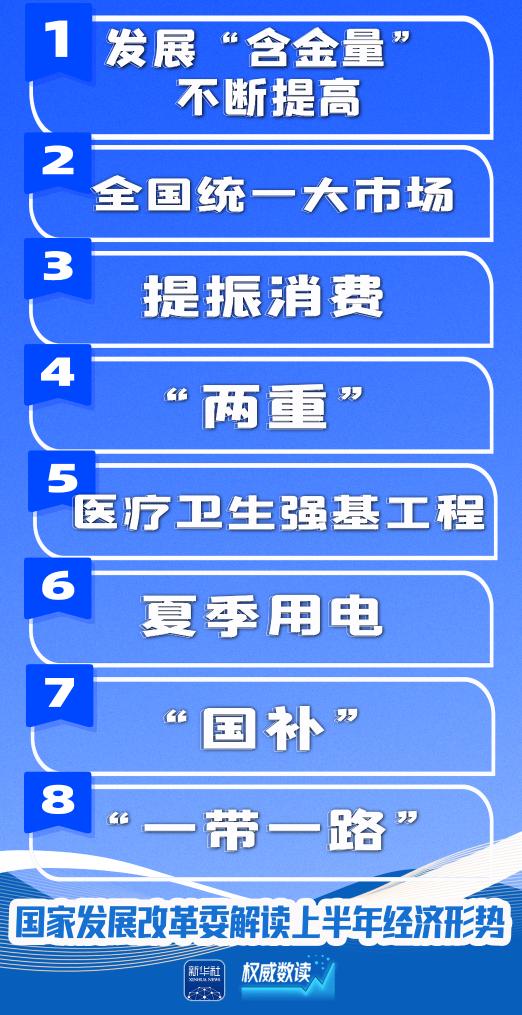
Economic Growth - The GDP grew by 5.3% year-on-year, an increase of 0.3 percentage points compared to the same period last year and the entire previous year [3] - Domestic demand contributed 68.8% to economic growth, while the import and export scale reached 20 trillion yuan, with exports increasing by 7.2% [3] National Unified Market - The construction of a national unified market has shown positive results, with the logistics cost to GDP ratio decreasing to 14%, the lowest level since records began, saving over 130 billion yuan in logistics costs [4] Consumer Spending - In the first half of the year, retail sales of consumer goods increased by 5%, with a 0.4 percentage point acceleration compared to the first quarter; final consumption contributed 52% to economic growth [5] - The "old-for-new" policy has driven sales exceeding 1.7 trillion yuan, with various departments and localities organizing diverse consumption promotion activities [5] Investment in Key Projects - The list of major strategic projects for this year has been fully allocated, with 800 billion yuan distributed and 735 billion yuan of central budget investment nearly completed [6] Healthcare Initiatives - The healthcare foundation project has been initiated, supporting around 600 county-level medical communities with over 11,000 medical equipment units [7] Electricity Demand - National peak electricity load has reached a historical high of 1.508 billion kilowatts, an increase of 57 million kilowatts compared to last year's peak [8] Special Bonds for Consumption - The third batch of 690 billion yuan in special bonds for consumer goods has been allocated, with plans for a fourth batch in October, completing the annual allocation target of 300 billion yuan [9] Trade with Belt and Road Countries - Trade with Belt and Road countries reached 1.129 trillion yuan in the first half of the year, growing by 4.7%, which is 1.8 percentage points higher than the overall growth rate [10]