可控核聚变

Search documents
FICC日报:股债汇商齐涨,关注金融街论坛政策信号-20251028
Hua Tai Qi Huo· 2025-10-28 08:00
Report Highlights Investment Rating - The overall rating for commodities and stock index futures is neutral [5]. Core Views - The release of the main targets of the 15th Five-Year Plan has boosted market sentiment, and expectations of an average GDP growth rate of around 5% during the 15th Five-Year Plan period have strengthened [1]. - After the Sino-US economic and trade consultations, the two sides reached a "very substantial framework agreement," and the US "no longer considers" imposing a 100% tariff on China [2][6]. - The Fed may stop shrinking its balance sheet in the next few months, and the expectation of another interest rate cut by the Fed within the year has increased [3]. - The US government shutdown has entered its 24th day, hitting the second-longest record in history, and the market has relatively underestimated the severity of the shutdown [3]. Summary by Directory Market Analysis - The A-share market strengthened on October 27, with the Shanghai Composite Index approaching 4000 points, hitting a new high for the year, and the ChiNext Index rising nearly 2%. The storage chip sector exploded, and the controllable nuclear fusion concept was repeatedly active. The bond market and commodity market also showed an upward trend [1]. International Situation - From October 26th to 27th, the Sino-US economic and trade teams held consultations in Kuala Lumpur, Malaysia, and reached a preliminary consensus on multiple important economic and trade issues [2][6]. - The Fed's road to easing may be relatively smooth, but the US government shutdown event still needs attention [3]. Commodity Market - In the short term, it is advisable to take a wait-and-see approach to the commodity market. In the second half of inflation, attention should be paid to possible breakthrough directions in non-ferrous metals and energy [4]. Policy and News - The central bank will resume open market treasury bond trading, and the CSRC will deepen the reform of the ChiNext and give play to the role of long-term funds [1]. - The People's Bank of China will explore a mechanism to provide liquidity to non-bank institutions in specific scenarios [6]. - The CSRC will introduce a shelf registration system for refinancing and broaden the support channels for mergers and acquisitions and reorganizations [6].
4000点不是不上 而是缓上、慢上、有节奏地上
Mei Ri Jing Ji Xin Wen· 2025-10-28 07:45
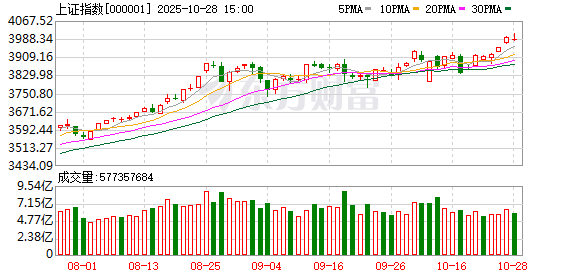
Core Points - The Shanghai Composite Index (SSE) broke through the 4000-point mark, reaching a ten-year high, but closed down by 0.22% [2][3] - The market experienced a significant increase of nearly 1000 points since April 7, indicating a "slow bull" market despite several adjustments along the way [3][5] - The breakthrough of the 4000-point level is historically significant, with previous occurrences in 2007, 2008, and 2015, totaling less than 15 months [3][10] Market Performance - The SSE closed at 3999.93 after initially breaking the 4000-point mark, with a trading volume of 2.15 trillion yuan, down by 192.3 billion yuan from the previous trading day [2][9] - Major sectors that performed well included Fujian, military industry, and port shipping, while sectors like non-ferrous metals, wind power equipment, and oil and gas saw declines [2][14] - Over 2900 stocks in the market closed down, indicating a broad market pullback [2] Sector Analysis - Financial stocks, particularly banks, were the main contributors to the SSE's initial rise above 4000 points, with Agricultural Bank of China and Industrial and Commercial Bank of China showing notable gains [6][9] - Technology stocks are expected to remain favored by investors if market volume increases, as they often serve as a barometer for market sentiment [8][11] - The traditional technology sectors did not lead the gains, with sectors like CPO and controlled nuclear fusion not being the main drivers of the market [12][14] Future Outlook - The market is anticipated to see a rise in risk appetite due to upcoming important meetings and positive factors from third-quarter reports, which may lead to renewed consensus on technology growth sectors [11] - The recent performance of the ChiNext Index, which showed the smallest decline among major indices, suggests resilience in growth-oriented stocks [10]

A股收评 | A股冲高回落 沪指时隔十年一度站上4000点 后续怎么走?
智通财经网· 2025-10-28 07:21
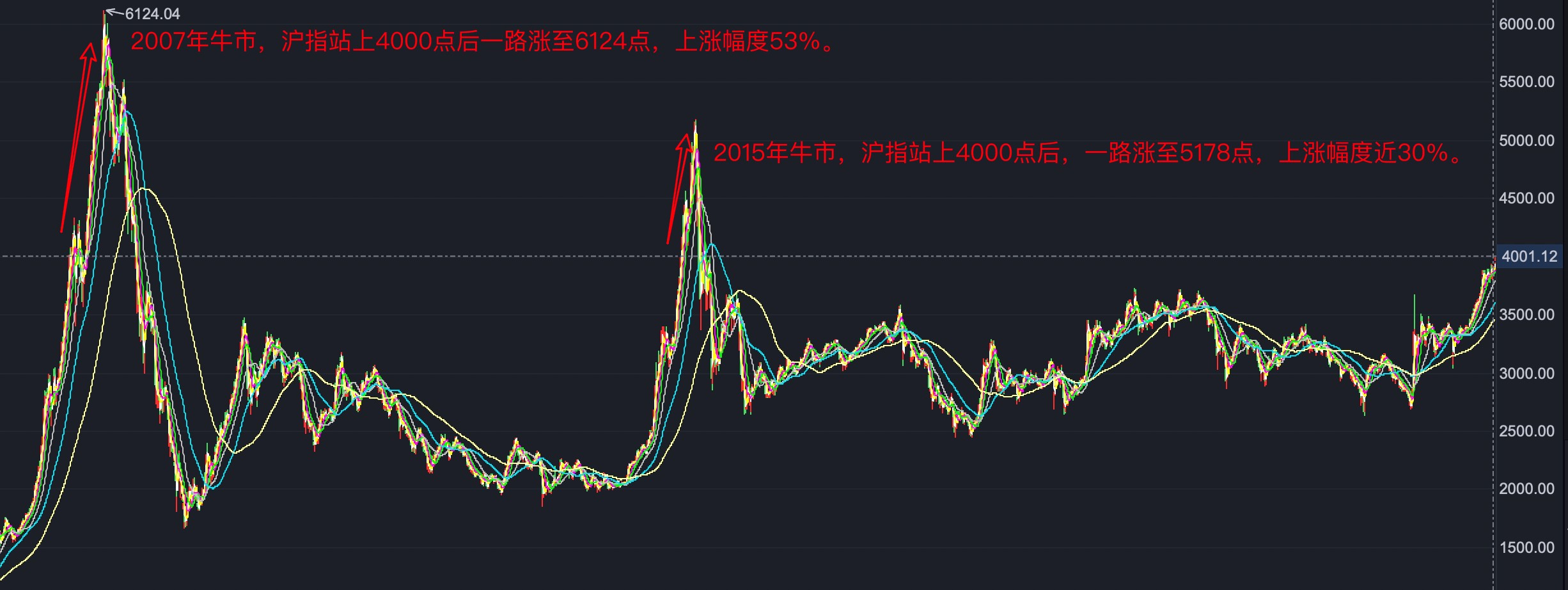
Core Viewpoint - The A-share market has seen the Shanghai Composite Index briefly surpass the 4000-point mark for the first time in ten years, indicating a potential bullish trend similar to previous bull markets in 2007 and 2015, where significant gains followed the index crossing this threshold [1][3][7]. Market Performance - On October 28, the Shanghai Composite Index closed down 0.22%, while the Shenzhen Component Index and the ChiNext Index fell by 0.44% and 0.15%, respectively [1]. - Historical data shows that after the index first crossed 4000 points in 2007, it rose to a peak of 6124 points within five months, marking a 53% increase. In 2015, it reached a high of 5178 points within two months, reflecting a nearly 30% gain [4][5][7]. Sector Highlights - The market has experienced rapid rotation of hot sectors, with notable strength in the Fujian sector, military industry, controllable nuclear fusion concepts, and quantum technology [3][10][11]. - The Fujian sector has been particularly strong, with stocks like Pingtan Development achieving significant gains due to the launch of a new international flight route [10]. - The controllable nuclear fusion sector is gaining traction, with expectations for significant market growth in the coming decades [11]. Future Outlook - Analysts suggest that the current market conditions differ from previous bull markets due to various macroeconomic factors, including global monetary easing and China's economic transformation [8][9]. - The "transformation bull market" is expected to continue, driven by new financial policies and capital market reforms, with a focus on technology and innovation sectors [12][17]. - Key sectors to watch include technology, new materials, and financial stability, with recommendations for investment in TMT, renewable energy, and defense industries [12][16][18].
中国核建股价月内涨57% 中国信达陪伴15年拟减持不超1%
Chang Jiang Shang Bao· 2025-10-28 06:40
Core Viewpoint - China National Nuclear Corporation (中国核建) has experienced a significant stock price increase, attributed to the rising interest in controllable nuclear fusion concepts and the company's overall stable operations [1][8]. Stock Performance - On October 27, China National Nuclear Corporation's stock closed at 13.93 CNY per share, with a daily increase of 4.82% [1][4]. - From October 23 to 27, the stock price rose by a cumulative 23.38% [5]. - Since the beginning of October, the stock has increased by approximately 57.40% [7]. Contractual Developments - In the first nine months of 2025, the company signed new contracts worth 112.962 billion CNY, an increase of 6.230 billion CNY compared to the same period last year [10]. - On October 27, the company announced that its subsidiary signed two contracts for the construction and installation of the nuclear island for the Haiyang Nuclear Power Units 5 and 6 [9]. Financial Performance - As of June 30, 2025, the company's contract liabilities reached 14.728 billion CNY, reflecting a year-on-year increase of 1.634 billion CNY [11]. - The company has shown consistent growth in its operating performance, with cumulative profits of 13.391 billion CNY since its listing [17]. Research and Development - In the first half of 2025, the company invested 1.260 billion CNY in research and development [18]. - The company has been increasing its R&D investments, with amounts of 1.635 billion CNY, 2.877 billion CNY, and 3.215 billion CNY from 2022 to 2024, respectively [18]. Shareholder Activity - The second-largest shareholder, China Cinda Asset Management, plans to reduce its stake by no more than 1% [19][21].


中泰股份(300435):业绩超预期,设备出海价值凸显
Shenwan Hongyuan Securities· 2025-10-28 05:43
Investment Rating - The report maintains a "Buy" rating for the company [1] Core Insights - The company reported a revenue of 2.115 billion yuan for the first three quarters of 2025, representing a year-on-year increase of 5.13%, and a net profit attributable to shareholders of 336 million yuan, up 77.07% year-on-year. In Q3 2025 alone, the company achieved a revenue of 813 million yuan and a net profit of 201 million yuan, reflecting year-on-year growth of 26.20% and 203.79% respectively, primarily driven by an increase in the export of deep-cooling equipment [1][7] - The company is actively expanding into the electronic gas industry, providing core equipment for global multinational corporations, including those in the controlled nuclear fusion sector. It supplies high-density plate-fin heat exchangers for major semiconductor companies like Intel, Samsung, Micron, and TSMC. The company's helium refrigerant has been successfully applied in multiple helium liquefaction plants, with capabilities in producing rare gases such as krypton, neon, xenon, and helium [7] - The company has demonstrated strong capabilities in exporting equipment, having exported to 54 countries and regions, and holds multiple international certifications such as ASME and CE. This positions the company favorably in high-barrier overseas markets, enhancing its brand reputation and industry barriers through collaborations with leading domestic and international firms [7] Financial Data and Profit Forecast - The company is projected to achieve total revenues of 3.368 billion yuan in 2025, with a year-on-year growth rate of 24.0%. The net profit attributable to shareholders is expected to reach 403 million yuan, with a projected growth rate of 38.0% in 2026 and 47.4% in 2027 [3][9] - The earnings per share (EPS) is forecasted to be 1.05 yuan in 2025, increasing to 1.44 yuan in 2026 and 2.13 yuan in 2027. The company's return on equity (ROE) is expected to improve from 10.1% in 2025 to 17.3% in 2027 [3][9]

可控核聚变关键材料取得重要进展,央企创新驱动ETF(515900)近一周累计涨幅同类居首,中钨高新涨停
Xin Lang Cai Jing· 2025-10-28 05:40
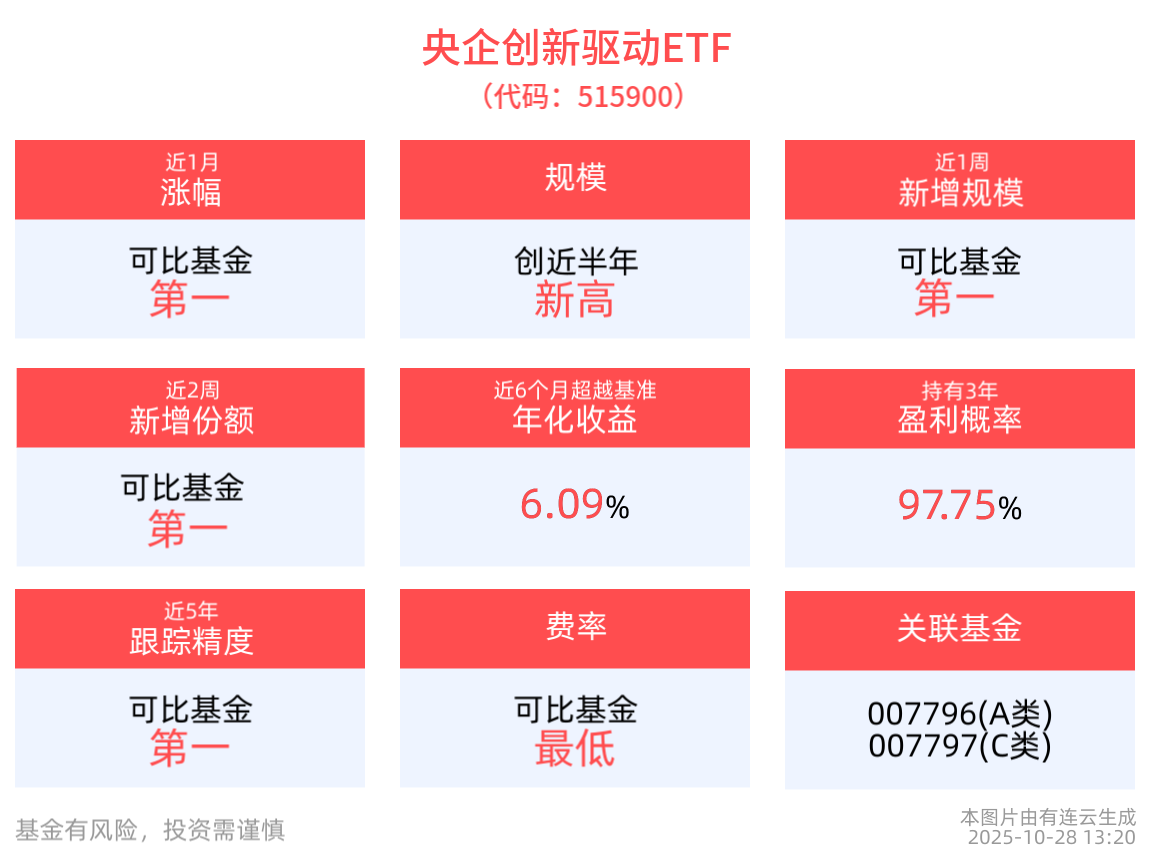
Core Insights - The China Central Enterprise Innovation Driven Index decreased by 0.17% as of October 28, 2025, with mixed performance among constituent stocks [3] - Notable gainers included Zhongtung High-tech, which rose by 10.02%, and China Materials Technology, which increased by 6.50% [3] - The Central Enterprise Innovation Driven ETF (515900) fell by 0.37%, with a latest price of 1.62 yuan [3] - Over the past week, the ETF has accumulated a rise of 3.90%, ranking in the top quarter among comparable funds [3] - The ETF's trading volume was 902.88 million yuan, with a turnover rate of 0.25% [3] - The ETF's average daily trading volume over the past year was 1989.74 million yuan, the highest among comparable funds [3] Company Developments - Zhongtung High-tech announced a cash acquisition of a 99.9733% stake in Hengyang Yuanjing Tungsten Industry from Minmetals Tungsten for 821 million yuan, constituting a related party transaction [3] - The successful development of second-generation high-temperature superconducting tape core material by the Institute of Metal Research, Chinese Academy of Sciences, marks a significant step in the clean energy materials sector [3] Industry Trends - The controllable nuclear fusion industry is entering a capital expenditure expansion phase, with significant investments exceeding 150 billion yuan in domestic fusion projects as of September 2025 [4] - The Central Enterprise Innovation Driven ETF reached a new high of 3.633 billion yuan in scale, ranking in the top quarter among comparable funds [4] - The ETF has seen a notable increase of 3 million shares over the past two weeks, also placing it in the top quarter among comparable funds [4] - The index tracks 100 representative listed companies from state-owned enterprises, assessing their innovation and profitability quality [4][5] Market Composition - As of September 30, 2025, the top ten weighted stocks in the index accounted for 36.04% of the total, including companies like China Shipbuilding and Hikvision [5]

大幅拉升,A股刷屏
Zheng Quan Shi Bao· 2025-10-28 05:24
Core Viewpoint - The A-share market has shown significant activity, with the Shanghai Composite Index surpassing 4000 points for the first time since August 2015, driven by sectors such as controllable nuclear fusion, domestic software, PCB, and commercial aerospace [1][3]. Controllable Nuclear Fusion Sector - The controllable nuclear fusion concept stocks have been on a continuous rise, with companies like Dongfang Tantalum and Antai Technology seeing multiple trading gains. Recent reports indicate that key materials for "artificial sun" technology have achieved domestic industrialization [1][7]. - The research team at the Chinese Academy of Sciences has successfully industrialized high-purity ton-level Hastelloy C276 metal substrates, which are crucial for the production of second-generation high-temperature superconducting tapes used in controllable nuclear fusion [7][8]. - Controllable nuclear fusion is recognized as a vital future energy direction, with advantages over nuclear fission, including minimal radioactive pollution and abundant raw materials sourced from seawater [9]. PCB Sector - PCB concept stocks have collectively strengthened, with companies like Aisen Co. and Meilian New Materials seeing gains exceeding 11%. Shengyi Technology has also reported a significant increase in revenue and profit forecasts, projecting a revenue increase of 108% to 121% year-on-year for the first three quarters of 2025 [4]. Domestic Software Sector - Domestic software stocks have shown active performance, with several companies reaching their daily price limits. The recent policy support from the government is expected to accelerate demand for domestic software and hardware companies, particularly as some leading firms enter a phase of performance realization [4]. Commercial Aerospace Sector - The commercial aerospace sector has rebounded, with companies like Aerospace Development reaching their price limits. A recent successful test of a large liquid rocket by Tianbing Technology marks a significant milestone in China's commercial aerospace capabilities [4]. Financial Sector - The financial sector has also seen notable movements, with companies like Ruida Futures and Huijin Co. experiencing sharp increases in stock prices [5]. Market Overview - The A-share market's three major indices opened lower but rose throughout the day, with the Shanghai Composite Index closing at 4005.44 points, up 0.21%. The onshore RMB also appreciated against the USD, reaching its highest level since November 2024, which may enhance foreign investment in RMB assets [3]. - The China Securities Regulatory Commission has introduced measures to optimize the Qualified Foreign Institutional Investor (QFII) system, aiming to create a more transparent and efficient investment environment for foreign investors [3].
刚刚,A股刷屏!
天天基金网· 2025-10-28 05:16
Core Viewpoint - The A-share market is experiencing significant movements, with the Shanghai Composite Index surpassing 4000 points for the first time since August 2015, driven by various sectors such as controllable nuclear fusion, domestic software, PCB, and commercial aerospace [3][5]. Group 1: Market Performance - On October 28, the Shanghai Composite Index reached 4005.44 points, up 0.21%, while the Shenzhen Component Index rose by 0.52% and the ChiNext Index increased by 1.35% [5]. - The onshore RMB appreciated against the USD, breaking the 7.10 mark, which analysts believe may enhance foreign investment in RMB assets [5]. Group 2: Policy Developments - The China Securities Regulatory Commission (CSRC) announced a series of measures to optimize the Qualified Foreign Institutional Investor (QFII) system, aiming to improve its adaptability and attractiveness for foreign investors [5]. - CSRC Chairman Wu Qing indicated plans to introduce a refinancing framework to support mergers and acquisitions, promoting industry consolidation among listed companies [5]. Group 3: Sector Highlights - The controllable nuclear fusion sector saw significant gains, with stocks like Dongfang Tantalum and Antai Technology hitting the daily limit, driven by positive news regarding the domestic industrialization of key materials [3][9]. - PCB stocks collectively surged, with companies like Aisen Co. and Meilian New Materials rising over 11%, and Shengyi Technology reporting a projected revenue increase of 108% to 121% year-on-year for the first three quarters of 2025 [6]. - Domestic software stocks were active, with companies like Rongji Software and Geer Software hitting the daily limit, supported by favorable policy developments for domestic technology [7]. Group 4: Commercial Aerospace Developments - The commercial aerospace sector rebounded, with stocks like Aerospace Development hitting the daily limit, following successful tests of the Tianlong-3 rocket, marking a breakthrough in multi-satellite deployment capabilities [7][9]. Group 5: Controllable Nuclear Fusion Insights - Controllable nuclear fusion is recognized as a key future energy direction, with significant advancements in the development of second-generation high-temperature superconducting materials, crucial for creating strong magnetic fields [10][11]. - The recent breakthroughs in the industrialization of high-purity Hastelloy C276 metal substrates for superconducting materials are expected to reduce reliance on imports and enhance domestic production capabilities [10][11].

可控核聚变关键材料取得重要进展!安泰科技、东方钽业两连板
2 1 Shi Ji Jing Ji Bao Dao· 2025-10-28 04:52
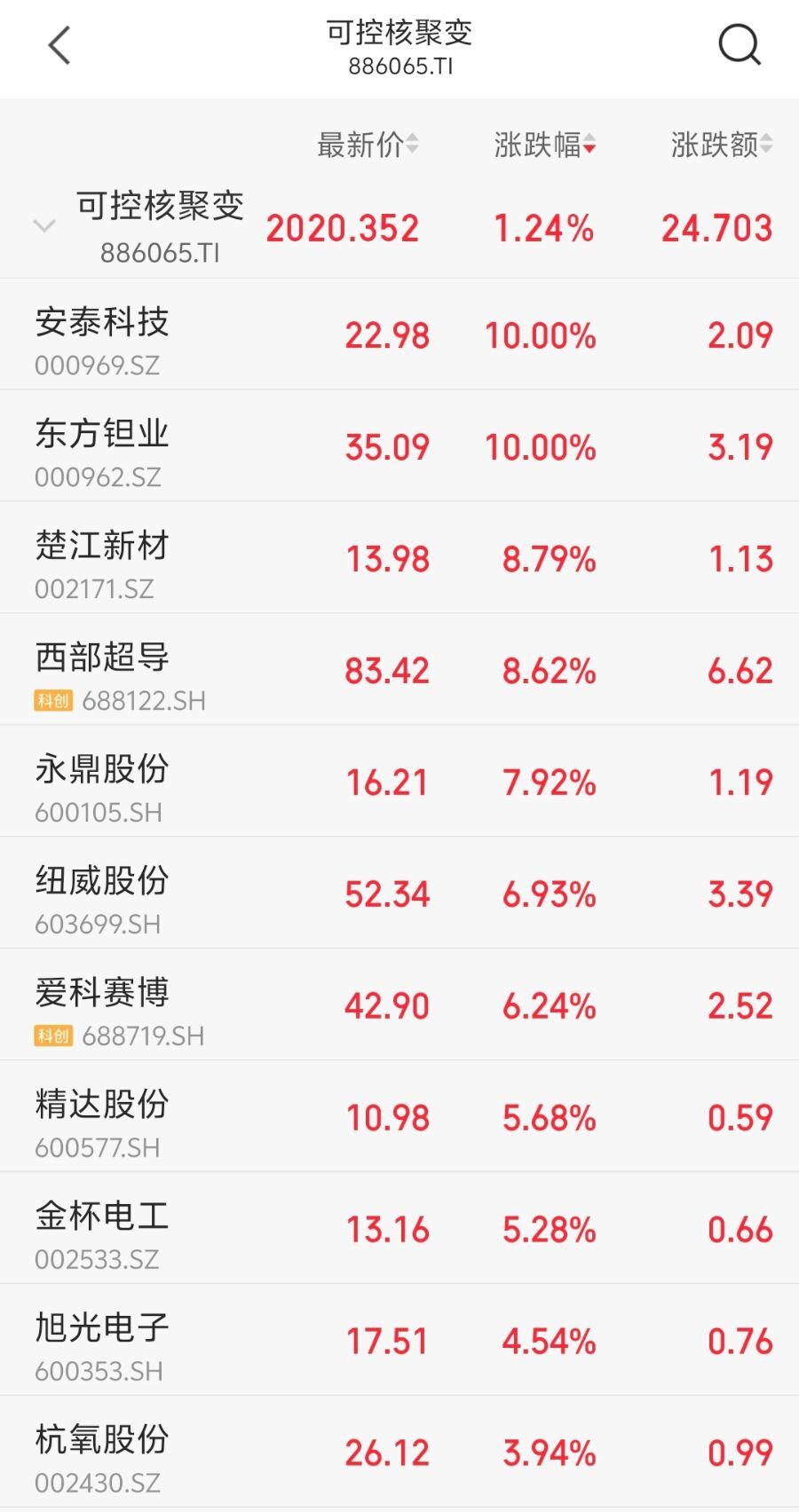
Core Insights - The controlled nuclear fusion sector continues to show strong momentum, with companies like Antai Technology and Dongfang Tantalum experiencing significant stock price increases [1][4] - The Chinese Academy of Sciences has successfully developed a second-generation high-temperature superconducting tape core material, marking a significant advancement in clean energy materials [3] - The Chinese "artificial sun" project is expected to be completed by 2027, potentially becoming the first device to achieve fusion power generation in human history [4] Company Performance - Antai Technology (000969.SZ) saw a stock price increase of 10.00%, reaching 22.98 [2] - Dongfang Tantalum (000962.SZ) also experienced a 10.00% rise, with a stock price of 35.09 [2] - Other companies like Western Superconducting (688162.SH) and Yongding Co. (600105.SH) also reported gains of 8.62% and 7.92%, respectively [2] Industry Developments - The global nuclear fusion market is projected to exceed $40 trillion by 2050, according to the International Atomic Energy Agency [4] - As of September 2025, the total investment in domestic nuclear fusion projects is expected to surpass 150 billion yuan, indicating a phase of capital expenditure expansion in the industry [4] - Various technological routes in nuclear fusion, including magnetic confinement and Z-pinch, are experiencing significant changes, with private capital increasingly involved in planned projects [5]


大幅拉升!刚刚,A股刷屏!
券商中国· 2025-10-28 04:45
Core Viewpoint - The A-share market has shown significant movements across multiple sectors, with the Shanghai Composite Index surpassing 4000 points for the first time since August 2015, driven by strong performances in sectors such as controllable nuclear fusion, domestic software, PCB, and commercial aerospace [1][3]. Sector Summaries Controllable Nuclear Fusion - Controllable nuclear fusion stocks have been on a continuous rise, with companies like Dongfang Tantalum and Antai Technology experiencing multiple trading halts due to price increases. Recent reports indicate that key materials for "artificial sun" technology have achieved domestic industrialization [1][7]. - The research team led by Rong Lijian has successfully developed high-purity ton-level Hastelloy C276 metal substrates for superconducting materials, overcoming previous technological bottlenecks [7][8]. - The second-generation high-temperature superconducting tape is crucial for creating strong magnetic fields necessary for plasma confinement, marking a significant advancement in clean energy exploration [8][9]. PCB Sector - PCB concept stocks have collectively strengthened, with companies like Aisen Co. and Meilian New Materials seeing gains exceeding 11%. Shengyi Technology has also reported a significant increase in revenue and profit forecasts, with expected revenue growth of 108% to 121% year-on-year [4]. Domestic Software - Domestic software stocks have shown active performance, with several companies reaching their daily price limits. The 20th National Congress has emphasized the importance of new productivity and technological self-reliance, suggesting a favorable policy environment for domestic software and hardware companies [4]. Commercial Aerospace - The commercial aerospace sector has rebounded, with companies like Aerospace Development and Aerospace Technology seeing strong stock performance. Recent successful tests of the Tianlong-3 rocket have set new records for satellite deployment in China, indicating advancements in the commercial aerospace industry [4][9]. Financial Sector - The financial sector has also shown notable movements, with companies like Ruida Futures and Huijin Co. experiencing significant price increases, reflecting a broader positive sentiment in the market [5]. Currency and Policy Impact - The onshore RMB has appreciated against the USD, reaching its highest level since November 2024, which may enhance foreign investment in RMB-denominated assets. Additionally, the China Securities Regulatory Commission has introduced measures to optimize the Qualified Foreign Institutional Investor (QFII) system, aiming to create a more transparent and efficient investment environment [3].