
货币政策

Search documents
金融人·事|21年央行“老兵”谢光启的新使命
Xin Lang Cai Jing· 2026-01-07 09:49
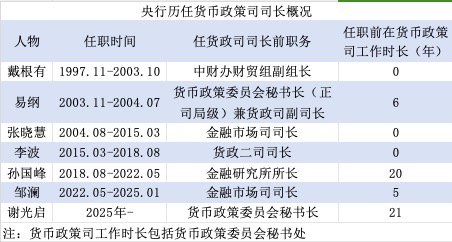
Core Insights - The People's Bank of China (PBOC) has outlined seven key priorities for the year, with a focus on effective monetary policy implementation amid a constrained policy space due to low interest rates [1][3][19] Leadership Transition - Xie Guangqi has been appointed as the Director of the Monetary Policy Department, marking a significant leadership change within the PBOC [1] - Xie has extensive experience in the Monetary Policy Department, having worked there for 21 years and participated in key policy transformations [15] Monetary Policy Challenges - Current policy interest rates are only 140 basis points above the theoretical zero lower bound, indicating limited room for further rate cuts [3][17] - The PBOC faces the challenge of maintaining economic stability and addressing low inflation, as the Consumer Price Index (CPI) has shown prolonged low growth [19] Historical Context and Research Contributions - Xie has a strong academic background, having published significant research on the relationship between executive compensation and company performance, which has influenced monetary policy discussions [4][5][6] - His involvement in various research projects has contributed to the development of structural monetary policy tools in China [11] Structural Monetary Policy Tools - The PBOC has increasingly relied on structural monetary policy tools to support specific sectors, such as small and micro enterprises, amid a changing economic landscape [11][12] - As of early 2025, structural monetary policy tools accounted for 13% of the PBOC's balance sheet, a significant increase from previous years [11] Economic Indicators and Future Directions - The PBOC aims to align social financing and money supply growth with economic growth and price stability targets, reflecting a shift in focus for monetary policy [13] - The central bank is expected to continue implementing moderately loose monetary policies to stimulate economic growth and stabilize prices in the coming year [19]

每日机构分析:1月7日
Xin Hua Cai Jing· 2026-01-07 09:45
花旗:韩国央行转向"长期按兵不动",2026年上半年加息基本无望 丹麦银行:挪威国债发行需求料稳健,但维持谨慎立场不变 摩根士丹利:澳大利亚四大银行股2026年估值或回调,降息预期逆转 【机构分析】 ·丹麦银行表示,挪威拟发行150亿至200亿挪威克朗的10年期国债,这进一步印证了该行对挪威债券市 场维持谨慎立场的合理性。尽管面临供应压力加大、外资参与度减弱等挑战,预计本周三的债券拍卖需 求仍将保持稳健。他强调,当前10年期国债的绝对收益率与资产互换利差均优于2025年同期水平,为 2026年债市开局创造了更有利的条件。 ·高盛分析师指出,2026年通胀前景显示,美国经济增长将成为政府债券收益率的主要驱动因素,进一 步强化债券资产的对冲属性。预计2026年底10年期美国国债收益率将升至4.20%(当前为4.16%),日 本10年期国债收益率将回落至2.0%(当前为2.12%),维持区间波动基准判断。 ·摩根士丹利表示,在通胀持续与潜在加息压力下,澳大利亚四大银行股估值或于2026年回调。该行指 出,自2023年底以来,四大行平均市盈率已因降息预期上升约6个基点,但这一趋势将在2026年逆转。 截至2025年1 ...
瑞达期货国债期货日报-20260107
Rui Da Qi Huo· 2026-01-07 09:41
Report Summary 1. Report Industry Investment Rating - Not provided in the given content. 2. Core Viewpoints of the Report - The bond market is currently facing multiple shocks, with a significant increase in adjustment pressure. The better-than-expected recovery of the manufacturing PMI in December may lead to a marginal improvement in the economic data of that month, weakening the fundamental support and reducing the short - term necessity of loose monetary policy. - After the holiday, the strong performance of the equity market has intensified the liquidity pressure on the bond market. - In January, the issuance scale of government bonds has increased compared with the same period last year, but the market allocation power remains weak, and the ultra - long bonds have continued to rise under the supply pressure. - In the short term, interest rates are expected to fluctuate weakly. [4] 3. Summary by Relevant Catalogs 3.1 Futures Market - **Futures Prices and Volumes**: On January 7, 2026, the closing prices of T, TF, TS, and TL futures all declined, with decreases of 0.08%, 0.06%, 0.03%, and 0.44% respectively. The trading volumes of T, TF, TS, and TL were 86,507, 69,708, 50,979, and 122,870 respectively, with increases of 3,627, 640, 7,144, and 15,230 respectively compared to the previous period. - **Futures Spreads**: Some spreads such as TL2603 - 2606 and TS2603 - 2606 decreased, while others like T03 - TL03, T2603 - 2606, etc. increased. - **Futures Positions**: The positions of T, TF, and TS decreased by 1,119, 1,320, and 2,839 respectively, while the position of TL increased by 4,241. The net short positions of T and TS increased, while that of TF decreased. [2] 3.2 Bond Market - **CTD Bonds**: The net prices of several CTD bonds such as 250018.IB, 220025.IB, etc. all declined. - **Active Treasury Bonds**: The yields of 1 - 10 - year active treasury bonds mostly increased, with the 1 - year yield remaining unchanged, and the 3 - year, 5 - year, 7 - year, and 10 - year yields increasing by 3.25bp, 2.75bp, 2.35bp, and 2.15bp respectively. [2] 3.3 Interest Rates - **Short - term Interest Rates**: The overnight silver - pledged repo rate decreased by 14.39bp, while the Shibor overnight rate increased by 0.30bp. The 7 - day silver - pledged repo rate decreased by 3.00bp, while the Shibor 7 - day rate increased by 2.80bp. The 14 - day silver - pledged repo rate increased by 4.00bp, while the Shibor 14 - day rate decreased by 1.20bp. - **LPR Rates**: Both the 1 - year and 5 - year LPR rates remained unchanged. [2] 3.4 Open Market Operations - On January 7, 2026, the issuance scale of reverse repurchase operations was 286 billion yuan, the maturity scale was 5,288 billion yuan, with a net回笼 of 5,002 billion yuan, and the interest rate was 1.4% for 7 - day operations. [2] 3.5 Industry News - **Monetary Policy**: The 2026 China People's Bank of China Work Conference was held from January 5th to 6th. The central bank will continue to implement a moderately loose monetary policy, use various monetary policy tools such as reserve requirement ratio cuts and interest rate cuts flexibly and efficiently to maintain sufficient liquidity, and strengthen financial support for key areas. - **Foreign Exchange Management**: The 2026 National Foreign Exchange Management Work Conference was held in Beijing, aiming to create a more convenient, open, safe, and intelligent foreign exchange policy environment. - **Trade Policy**: The Ministry of Commerce announced a ban on the export of all dual - use items to Japanese military users, military purposes, and other end - user purposes that contribute to enhancing Japan's military strength. [2] 3.6 Overseas Situation - The US raided Venezuela and arrested Maduro, causing geopolitical shocks. - The US ISM manufacturing PMI index in December 2025 unexpectedly dropped to 47.9, the lowest since 2024, indicating continuous manufacturing contraction. - The minutes of the Fed's December meeting showed differences among officials, but most participants believed that if inflation declined as expected, future monetary policy would be further relaxed. [4]

市场分析:电网资源行业领涨,A股小幅上行
Zhongyuan Securities· 2026-01-07 09:05
Market Overview - On January 7, the A-share market experienced slight fluctuations, with the Shanghai Composite Index facing resistance around 4097 points[2] - The total trading volume for both markets reached 28,818 billion yuan, above the median of the past three years[3] - The Shanghai Composite Index closed at 4,085.77 points, up 0.05%, while the Shenzhen Component Index rose 0.06% to 14,030.56 points[7] Sector Performance - Strong performers included coal, non-ferrous metals, electric grid equipment, and power equipment sectors[3] - Weaker sectors included shipbuilding, securities, jewelry, and education[3] - The average price-to-earnings (P/E) ratios for the Shanghai Composite and ChiNext indices were 16.76 times and 51.81 times, respectively, above the median levels of the past three years[3] Investment Outlook - The market is expected to maintain a slight upward trend, supported by improved corporate earnings structures and favorable monetary policies[3] - Investors are advised to focus on sectors such as coal, non-ferrous metals, electric grid equipment, and power equipment for short-term opportunities[3] - Anticipated continued easing of monetary policy and expectations of a prolonged interest rate cut cycle by the Federal Reserve may enhance market liquidity[3] Risks - Potential risks include unexpected overseas economic downturns, domestic policy changes, and macroeconomic disturbances[4]
铸造铝合金价格延续偏强格局,现货成交热度不减
Xin Lang Cai Jing· 2026-01-07 08:58
Group 1 - The core viewpoint of the articles indicates that the aluminum alloy market is experiencing fluctuations, with the main contract for casting aluminum alloy showing a slight increase in price, supported by macroeconomic factors and supply-demand dynamics [1][2] Group 2 - The main contract for casting aluminum alloy closed at 23,035 yuan, up 160 yuan, with a trading volume of 19,559 lots, an increase of 1,289 lots, and an open interest of 20,618 lots, up 456 lots [1] - The prices for various aluminum alloys have increased, with A356.2 averaging 25,700 yuan/ton, A380 at 24,900 yuan/ton, ADC12 at 23,400 yuan/ton, ZL102 at 25,100 yuan/ton, and ZLD104 at 25,000 yuan/ton, each rising by 200 yuan [1] - The macroeconomic environment suggests that the uncertainty in U.S. politics and the anticipated interest rate cuts by the Federal Reserve could drive aluminum prices higher, while geopolitical tensions are raising concerns over strategic resource competition [1] - The supply of scrap aluminum remains tight, and rising copper and aluminum prices are pushing up the cost of recycled aluminum, providing support for casting aluminum futures prices [2] - The industry is entering a seasonal consumption lull, with alloy plant operating rates declining and automotive sector demand weakening, leading to reduced procurement needs for casting aluminum [2] - Despite the seasonal decline in demand, the cost support remains firm, and with increased open interest and capital inflow, casting aluminum is expected to maintain a strong position [2]

瑞达期货股指期货全景日报-20260107
Rui Da Qi Huo· 2026-01-07 08:32
Report Industry Investment Rating - Not provided in the given content Core Viewpoints - Multiple factors support the upward movement of A-shares. The collective rebound of the three official PMI indexes in December implies signs of economic recovery. The overall macro - atmosphere of the market is warm, and A - shares have strong bottom support. The weak US economic data has a negative impact on the US dollar value. Although the US dollar - offshore RMB exchange rate has risen today, the RMB is still in an appreciation channel, and the strengthening exchange rate supports the expectation of loose monetary policy in the first quarter. Also, due to the relatively late Spring Festival this year, the A - share Spring market is significantly advanced as the market starts to trade the policy expectations of the Two Sessions in early March in advance [2] Summary by Relevant Catalogs Futures Market - **Contract Prices**: IF (2603) is at 4753.0, down 18.0; IH (2603) is at 3143.8, down 10.8; IC (2603) is at 7802.6, up 40.4; IM (2603) is at 7760.2, up 22.0. The corresponding prices of the second - tier contracts also show different trends [2] - **Price Spreads**: IF - IH spread is 1628.4, down 8.2; IC - IF spread is 3096.8, up 56.2; etc. The spreads between different contracts have different changes [2] - **Seasonal Spreads**: IF when - season - current month is - 19.8, down 2.4; IH when - season - current month is - 0.6, down 3.6; etc. The seasonal spreads of different contracts also change [2] - **Net Positions**: IF top 20 net positions are - 29,517.00, down 932.0; IH top 20 net positions are - 14,688.00, up 42.0; IC top 20 net positions are - 28,871.00, down 1714.0; IM top 20 net positions are - 46,097.00, down 2225.0 [2] Spot Market - **Spot Indexes**: The Shanghai and Shenzhen 300 is at 4776.67, down 14.0; the Shanghai 50 is at 3145.1, down 13.6; the CSI 500 is at 7875.1, up 61.0; the CSI 1000 is at 7906.4, up 41.5 [2] - **Basis**: IF main contract basis is - 23.7, down 11.0; IH main contract basis is - 1.3, down 4.4; IC main contract basis is - 72.5, down 44.7; IM main contract basis is - 146.2, down 43.7 [2] Market Sentiment - **Trading Volume and Balance**: A - share trading volume is 28,815.66 billion yuan, up 492.88 billion yuan; margin trading balance is 25,799.00 billion yuan, up 192.52 billion yuan; north - bound trading volume is 3185.91 billion yuan, up 226.86 billion yuan [2] - **Other Indicators**: The proportion of rising stocks is 39.64%, down 35.48%; Shibor is 1.266%, up 0.003%; IO at - the - money call option closing price is 38.80, down 13.80; IO at - the - money put option closing price is 62.20, up 5.60; etc. [2] Market Strength and Weakness Analysis - **Overall A - shares**: The score is 5.00, down 2.50; the technical aspect score is 4.00, down 3.50; the capital aspect score is 6.10, down 1.40 [2] Industry News - **PMI Data**: China's official manufacturing PMI in December is 50.1, up 0.9 percentage points from the previous month; non - manufacturing business activity index is 50.2%, up 0.7 percentage points; comprehensive PMI output index is 50.7%, up 1.0 percentage point. The US ISM manufacturing index in December 2025 drops from 48.2 to 47.9, hitting a new low since October 2024 [2] - **Policy**: The People's Bank of China deploys key work for 2026, including using various monetary policy tools such as reserve requirement ratio cuts and interest rate cuts, improving the structural monetary policy tool system, and the financial market monitoring index system [2] Market Performance - **Index Performance**: A - share major indexes close generally higher. The Shanghai Composite Index hits a new high with 14 consecutive positive daily lines. The ChiNext Index rises 0.31%, the Shenzhen Component Index rises 0.06%, and the Shanghai Composite Index rises 0.05%. The CSI 500 performs the strongest. Industry sectors show mixed performance, with comprehensive and coal sectors strengthening significantly and the petroleum and petrochemical sector leading the decline [2] Key Data to Follow - 1/7 21:15: US December ADP employment; 23:00: US November JOLTs job openings - 1/8 20:30: US December Challenger corporate layoff numbers - 1/9 9:30: China's December CPI and PPI; 21:30: US December non - farm payrolls, unemployment rate, and labor participation rate [3]
美元下跌 金属涨幅普遍回落 沪镍、双焦涨停 氧化铝涨近5%
Sou Hu Cai Jing· 2026-01-07 08:17
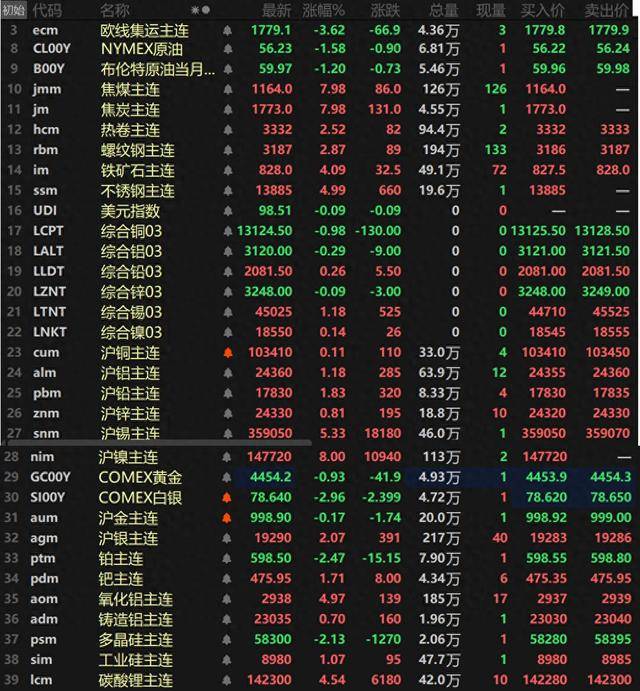
Metal Market - Domestic base metals collectively rose, with nickel closing at a limit-up of 8%, reaching 147,720 yuan/ton, the highest since June 2024 [1] - Tin increased by 5.33%, while aluminum and lead both rose over 1%, with aluminum up 1.18% and lead up 1.83% [1] - Alumina and casting aluminum also saw gains, with alumina rising by 4.97% and casting aluminum by 0.7% [1] - Lithium carbonate increased by 4.54%, and industrial silicon rose by 1.07%, while polysilicon fell by 2.13% [1] - In the black metal sector, stainless steel rose by 4.99%, iron ore by 4.09%, rebar by 2.87%, and hot-rolled coil by 2.52% [1] - Coking coal and coke both hit limit-up with a rise of 7.98%, priced at 1,164 yuan/ton and 1,773 yuan/ton respectively [1] - As of 15:07, foreign base metals showed mixed results, with London nickel's growth narrowing to 0.14% and copper down by 0.98% [1] - Precious metals saw COMEX gold down by 0.93% and silver down by 2.96%, while domestic gold fell by 0.17% and silver rose by 2.07% [1][2] Macro Environment - The central bank conducted a net withdrawal of 5,002 billion yuan through reverse repos, with a 7-day reverse repo operation of 286 billion yuan at a rate of 1.40% [5] - The US dollar index fell by 0.09% to 98.51, amid mixed signals from Federal Reserve officials regarding future monetary policy [6] - Upcoming economic data releases include China's foreign exchange reserves and gold reserves for December, as well as various US economic indicators [7] Oil Market - As of 15:07, both US and Brent crude oil prices fell, with US oil down by 1.58% and Brent by 1.2% [8] - Morgan Stanley analysts estimate a potential oversupply in the oil market of up to 3 million barrels per day in the first half of 2026 due to weak demand growth and increased supply from OPEC and non-OPEC countries [8] - API reported a decrease in US crude oil inventories by 2.77 million barrels, while gasoline and distillate inventories increased [8]
博时市场点评1月7日:沪指十四连阳,成交继续放量
Xin Lang Cai Jing· 2026-01-07 08:04
【博时市场点评1月7日】沪指十四连阳,成交继续放量 每日观点 今日沪深三大指数继续上涨,沪指收获十四连阳。两市成交较昨日继续放量至2.88万亿,资金情绪较 为活跃。2026年央行工作会议1月5日-6日召开,会议强调,继续实施适度宽松的货币政策,发挥增量政 策和存量政策集成效应,加大逆周期和跨周期调节力度。从全年的重点工作部署看,总体与去年保持一 致,均为七项重点工作,且排序保持一致,但对重点工作的布置更细致、更全面。扩大内需、优化供给 成为今年货币政策的重要着力点;总体要求方面,强调为经济稳定增长、高质量发展和金融市场稳定运 行营造良好的货币金融环境,相比去年,金融市场的稳定运行被纳入考量。往后看,当前经济仍处于弱 修复状态,在财政政策靠前发力的情况下,货币政策或积极配合,降准和结构性降息或值得期待。 消息面 2026年中国人民银行工作会议于1月5日至6日召开。会议部署了七项年度重点工作,首要任务是继续 实施好适度宽松的货币政策。会议明确将把促进经济高质量发展、物价合理回升作为重要考量,灵活运 用降准降息等多种工具,保持流动性充裕和社会融资条件相对宽松。会议还提出将建立在特定情景下向 非银机构提供流动性的机制 ...
邦达亚洲:美联储官员发表鸽派言论 黄金冲击4500关口
Xin Lang Cai Jing· 2026-01-07 07:53
Group 1: Monetary Policy Insights - The current monetary policy outlook is in a "delicate balance" due to rising unemployment and persistent high inflation, as stated by Barkin, the President of the Richmond Federal Reserve [1][6] - After a cumulative rate cut of 75 basis points last year, interest rates are now estimated to be within the neutral rate range, which neither stimulates nor suppresses economic growth [1][6] - Future policy will require careful balancing between the dual mandates of full employment and controlling inflation, with expectations of clearer economic data in the coming months [1][6] Group 2: Economic Growth Predictions - Barkin anticipates that tax cuts and regulatory easing could provide momentum for economic growth this year [1][6] - The Fed's rate cuts last year are likened to "buying insurance" for the economy, indicating a proactive approach to economic stability [1][6] Group 3: Gold Price Forecast - Morgan Stanley predicts that gold prices will rise to $4,800 per ounce by Q4 2026, surpassing last year's historical high, driven by declining interest rates, changes in Fed leadership, and continued buying by central banks and funds [1][6] - The recent events in Venezuela may attract more investors to gold for safety, although this factor is not a core basis for the $4,800 target [1][6]

邦达亚洲:经济数据表现疲软 欧元承压小幅收跌
Xin Lang Cai Jing· 2026-01-07 07:41
Group 1: Economic Indicators - The German Consumer Price Index (CPI) for December 2025 increased by 2.0% year-on-year, significantly lower than the 2.6% increase in November and below the market expectation of 2.2% [1][6] - This unexpected slowdown brings Germany's inflation rate back to the European Central Bank's (ECB) target level of 2% for the first time since June 2025 [1][6] - Economists expect the Eurozone's December CPI year-on-year growth to also fall to the 2% target [1][6] Group 2: Central Bank Policies - Analysts indicate that a single month's data is insufficient to prompt the ECB to adjust its current monetary policy stance [1][6] - The ECB's recent forecasts suggest that inflation rates will be slightly below the 2% target in 2026 and 2027, with policymakers expressing confidence in progress against inflation while remaining cautious of potential risks [1][6] - Federal Reserve Governor Milan stated that more aggressive interest rate cuts may be necessary this year to sustain economic growth, suggesting a potential reduction exceeding 100 basis points [7] Group 3: Market Reactions - The U.S. dollar index experienced slight gains, trading around 98.50, supported by reduced expectations for Fed rate cuts and safe-haven demand due to geopolitical tensions [9] - The euro declined slightly, trading around 1.1700, pressured by the stronger dollar and weak economic data from Germany [10] - The British pound also faced downward pressure, trading near 1.3510, influenced by profit-taking and weak economic indicators from the UK [11]