
通胀

Search documents
2025年11月南非CPI同比增长3.5%
Shang Wu Bu Wang Zhan· 2025-12-27 16:51
南非独立传媒网站12月18日报道, 南非统计局(Stats SA)最新数据显示,2025年11月南非消费者价 格指数(CPI)同比上涨3.5%,较10月的3.6%小幅回落,显示通胀水平持续降温。 数据显示,商品通胀已降至2.9%,而服务通胀略升至4.1%,住房及公用事业以及食品和非酒精饮 料仍是主要推升因素。南非经济研究局(BER)指出,燃油价格稳定对抑制通胀发挥了重要作用,但 水、电等公共事业收费及服务价格仍对通胀构成上行压力。 经济学家预计,若兰特持续走强、国际油价维持低位,通胀有望继续回落。市场预计,南央行下次 会议降息的概率约为50%,并普遍预期2026年将出现多次降息,预计2026年南CPI将大概率维持在3%至 4%区间。 (原标题:2025年11月南非CPI同比增长3.5%) ...
宏观经济周报:基期调整遇上价格回暖-20251227
Guoxin Securities· 2025-12-27 13:27
2026 年通胀形势中,一个不容忽视的技术性因素值得关注:CPI(居民消费 价格指数)统计中的基期权重调整,可能对通胀读数产生上行助推作用。 这一影响根植于我国 CPI 的统计制度设计。在计算过程中,各类商品与服务 的数量在基期确定后即保持固定,不随价格变动而调整。这意味着,在实际 生活中,当某种商品价格下跌时,居民往往倾向于购买更多数量,其消费支 出占比的降幅会小于价格降幅;但在 CPI 核算中,由于数量固定,该商品在 总消费篮子的金额权重会完全跟随价格同步下降,导致其统计权重持续偏离 实际消费结构。 证券研究报告 | 2025年12月27日 宏观经济周报 当基期调整遇上价格回暖 市场走势 以 2021-2025 年周期为例,肉类等部分商品价格经历显著且持续的下跌。在 这一过程中,其在 CPI 中的权重已被系统性压低,明显低于居民实际消费占 比。进入 2026 年,随着统计基期例行更新,各分项权重将迎来修正,以反 映最新的实际消费结构。这意味着过去几年价格下跌明显的品类,其统计权 重将面临一次性的明显上调。 恰逢 2026 年政策重心强调"反内卷"与推动价格合理回升,预计部分此前 承压的商品和服务价格将趋于 ...
日元暴跌,日央行紧急救市,创30年新高,人民币正式破7?
Sou Hu Cai Jing· 2025-12-27 06:01
日本央行加息,0.75%的政策利率,看着数字是1995年以来的新高,但放在全球主要经济体里,这点涨幅多少有点"洒洒水"的意思。 消息一出,日元对美元汇率不升反降,直接从155附近滑向了157。 其实市场早就预料到了,利好已经提前被"吃干抹净"。更深层的原因,在于日本经济正陷在一个自我矛盾的泥潭里,货币政策独木难支。 日本央行想通过加息来遏制通胀、稳定汇率。过去三十年的超宽松时代,日元几乎是全球最廉价的融资货币,无数套利交易者借日元、买美债,玩得不亦乐 乎。 日本央行咬牙做出加息的决定,本质上是想要给跌跌不休的日元汇率续命,但是这个操作加深了国际货币市场对日元的担忧,抛售日元成为短期最热门的交 易。 日本政府又不得不下场干预日元汇率,目前欧元兑日元周一再创历史新高,人民币兑日元也开始走强,可以直白一点的说,这一波加息的操作直接让日本政 府猝不及防。 为什么明明是为了挽救日元的操作最终成为了压死日元的最后一根稻草?相对来说人民币为什么会强势升值? 一场"走钢丝"上的货币政策表演 日本家庭的金融资产规模高达2200万亿日元,其中竟然有约一半,是以现金或低收益存款的形式"躺"在账户里的。 过去几十年,无论经济是冷是热 ...


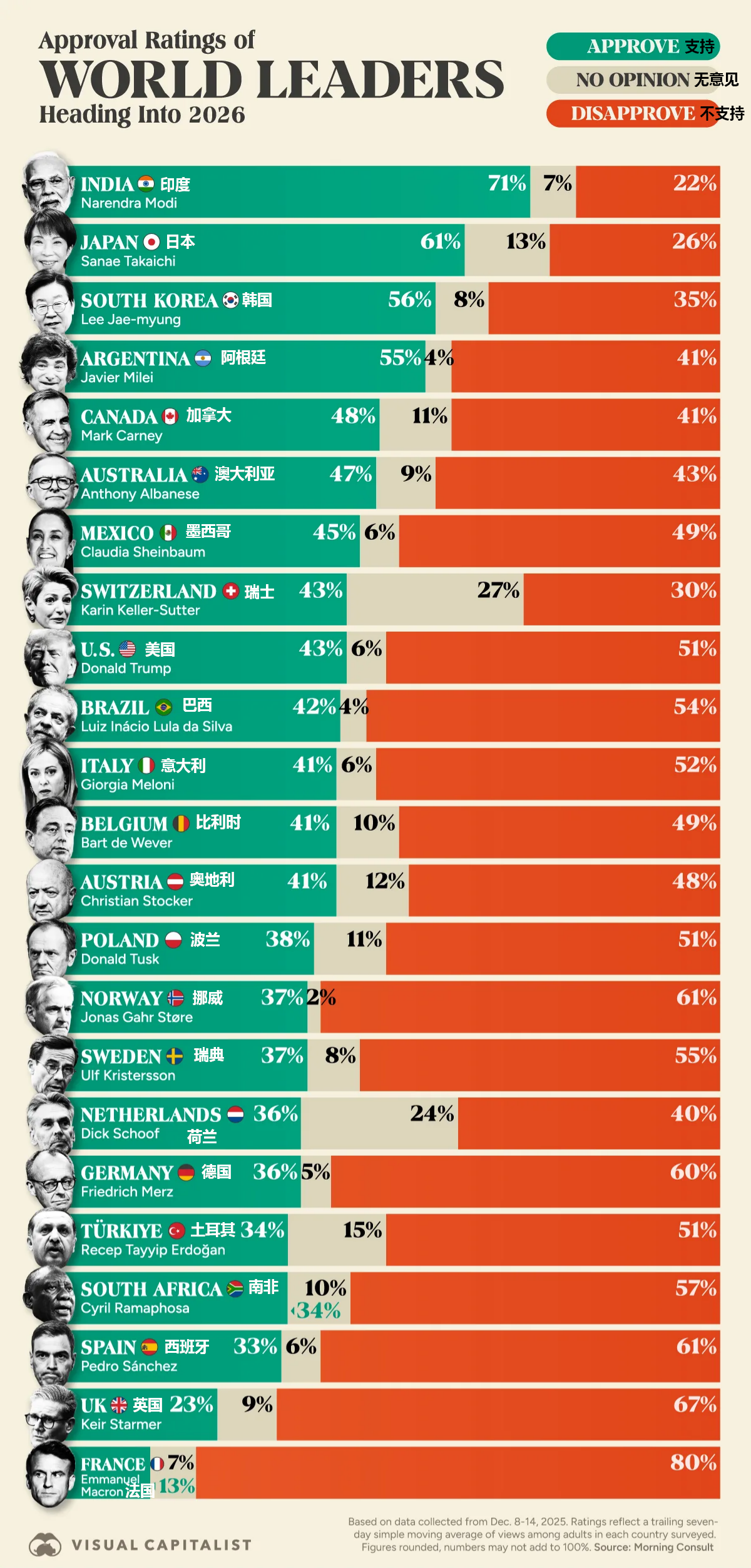
迈向2026年,全球多位主要领导人民调支持率一览
Ge Long Hui· 2025-12-27 01:44
Core Insights - The survey conducted by Morning Consult from December 8 to 14, 2025, indicates a decline in support rates for several global leaders, with Indian Prime Minister Modi leading at 71%, down from 75% in January 2025, reflecting ongoing inflation and political fatigue among voters [1][2]. Group 1: Leader Support Rates - Indian Prime Minister Narendra Modi holds the highest support rate at 71%, a decrease of 4% from earlier in the year [1][3]. - Japanese Prime Minister Sanae Takaichi and South Korean President Lee Jae-myung rank second and third with support rates of 61% and 56%, respectively [2][3]. - U.S. President Donald Trump has a support rate of 43%, with a disapproval rate of 51%, placing him in the middle of the rankings [2][3]. Group 2: Comparative Analysis - Leaders from Japan, South Korea, Canada, Austria, and Belgium have seen increases in their support rates, attributed to changes in leadership [1]. - French President Emmanuel Macron ranks lowest with a support rate of only 13% and a disapproval rate nearing 80% [2][3].
史上最惨烈的金融危机,将在2026年发生,这不是危言耸听,而是知名投资人罗杰斯的判断,对于时间点,其实他并不十分确定
Sou Hu Cai Jing· 2025-12-26 17:47
Group 1 - Jim Rogers predicts a severe financial crisis likely to occur in 2026, emphasizing the unsustainable nature of current debt levels [2][5] - The U.S. national debt has surpassed $34 trillion, with annual interest payments nearing $1 trillion, exceeding the defense budget [4] - Global debt is projected to reach $315 trillion by Q1 2024, indicating a widespread reliance on borrowing [5] Group 2 - Rogers expresses concern over the inflated asset prices in the AI sector, drawing parallels to the 2000 internet bubble [7] - The current high interest rates, maintained to combat inflation, create a dilemma for heavily indebted companies and nations [9] - Notable tech executives are selling their stocks, raising questions about their confidence in the future of AI [9][11] Group 3 - Rogers argues that the upcoming crisis could be worse than the 2008 financial crisis due to unprecedented debt levels [11] - There are contrasting views suggesting that AI could lead to a productivity boom that might alleviate debt burdens, though this is seen as a low-probability scenario [11] - The combination of high debt and visible asset bubbles could trigger a crisis with minimal external shocks needed to initiate a chain reaction [13] Group 4 - Rogers advises a conservative investment strategy, recommending holding cash and silver while avoiding popular bubble assets [15] - The focus on preserving capital is deemed more critical than seeking high returns in the current economic climate [15]

圣诞节假期过后,美债收益率基本持平
Xin Lang Cai Jing· 2025-12-26 13:10
周五,交易员结束圣诞节假期返市,为包含强劲美国经济数据的一周画上句号,美债收益率基本持平。 基准10年期美国国债收益率下跌不到1个基点,报4.132%。2年期国债收益率下跌1个基点,报3.497%。 1个基点等于0.01%。收益率与价格呈反向变动。 交易员继续评估最新经济数据。 美国劳工部周三报告称,截至12月20日当周的初请失业金人数为21.4万人,低于预期,并较前一周减少 1万人。 美国商务部周二还报告称,美国经济在第一季度增长了4.3%,为该国两年来最快的扩张速度。 AmeriVet Securities美国利率策略主管格雷戈里·法拉内洛(Gregory Faranello)本周早些时候写道:"经 济状况良好。在通胀和增长以这种速度运行的情况下,不可能指望10年期收益率大幅走低。" 责任编辑:张俊 SF065 周五,交易员结束圣诞节假期返市,为包含强劲美国经济数据的一周画上句号,美债收益率基本持平。 美国商务部周二还报告称,美国经济在第一季度增长了4.3%,为该国两年来最快的扩张速度。 AmeriVet Securities美国利率策略主管格雷戈里·法拉内洛(Gregory Faranello)本周早些 ...
金价突破意料之外 年度涨势注定载入史册
Jin Tou Wang· 2025-12-26 10:32
摘要周五(12月26日)亚洲时段开盘,贵金属大涨,现货黄金涨逾25美元至4505美元/盎司附近,银价暴涨 刷新历史高位。地缘紧张与委内瑞拉油轮封锁推升避险需求,交易员押注2026年美进一步降息。2025年 金价累涨约70%,或创1979年来最佳年度表现。机构看好2026年金价续涨,驱动含央行购金、降息预 期、去美元化及地缘风险等。 周五(12月26日)亚洲时段开盘,贵金属大涨,现货黄金涨逾25美元至4505美元/盎司附近,银价暴涨刷新 历史高位。地缘紧张与委内瑞拉油轮封锁推升避险需求,交易员押注2026年美进一步降息。2025年金价 累涨约70%,或创1979年来最佳年度表现。机构看好2026年金价续涨,驱动含央行购金、降息预期、去 美元化及地缘风险等。 尽管美联储年内已降息三次,但名义中性利率由2.5%升至3.5%,引发"鹰派转向"担忧——市场恐宽松 周期过早结束,2026年甚至可能逆转路径。债市已现端倪:10年期美债收益率坚守4.2%高位,收益率 曲线"熊陡"显示市场预判未来物价压力复燃,这意味着房贷、信用卡利率的下行缓解或比预期更弱更 短,对黄金而言,高利率环境会削弱其零息资产的相对吸引力,短期构成压制 ...
黄金还能涨多久?复盘70年代牛市,揭秘暴涨逻辑,现在该不该买?
Sou Hu Cai Jing· 2025-12-26 10:13
Core Viewpoint - The article discusses the complexities of gold price movements and the factors influencing these changes, emphasizing the importance of understanding historical trends and economic conditions to make informed investment decisions in gold. Group 1: Historical Context of Gold Prices - The last major bull market for gold began in August 1971 when the U.S. abandoned the gold standard, leading to a significant increase in gold prices [14] - The 1970s saw a dramatic rise in gold prices, but also significant corrections, such as a nearly 30% drop between 1975 and 1976 due to changes in monetary policy [16] - Economic conditions, such as the oil crisis and subsequent inflation, initially drove gold prices up, but rising interest rates led to a collapse in gold prices as investors preferred interest-bearing assets [18] Group 2: Current Market Dynamics - Recent gold price increases are attributed to three main factors: expectations of Federal Reserve interest rate cuts, geopolitical instability, and ongoing central bank purchases of gold [24] - The domestic gold market in China has lagged behind international prices due to currency fluctuations, particularly the depreciation of the RMB against the USD [5][10] - The recent appreciation of the RMB has made gold purchases more expensive for domestic investors, highlighting the need to consider exchange rates when investing in gold [10] Group 3: Investment Considerations - Gold serves as a hedge against inflation but does not generate interest, making its attractiveness relative to bank savings dependent on interest rates [9][12] - The article warns that no asset can continuously rise in value, with potential risks including uncontrolled inflation leading to interest rate hikes, which could drive investors away from gold [26][28] - The emergence of AI and its potential to boost economic productivity could lead to a shift away from gold investments towards riskier assets, depending on the actual impact of AI on the economy [30][32]

2026年全球经济分化中求稳,AI从资本开支走向价值兑现 | 界面预言家④
Xin Lang Cai Jing· 2025-12-26 09:46
Core Insights - The global economy is expected to experience a "weak recovery with strong uncertainty" in 2026, with a projected growth rate of around 3% [1][3] - The economic landscape will be characterized by significant regional disparities, with the US leveraging its AI advantages for resilience, while emerging Asian economies lead growth [1][4] - Inflation is anticipated to decline overall, but with notable regional differences, as global monetary policies gradually move away from high-interest rates [1][6] Economic Growth Projections - Global economic growth is forecasted to slow slightly from 3.3% in 2024 to 3.1% in 2026, with developed economies maintaining around 1.5% growth and emerging markets slightly above 4% [3][4] - The International Monetary Fund (IMF) attributes the resilience of global growth to technological advancements, particularly in AI, and the expansion of domestic demand in Asian emerging markets [3][4] Regional Economic Disparities - The US is expected to maintain steady growth due to its tech sector, while the Eurozone and the UK face structural challenges leading to weaker growth [4][5] - Emerging markets, particularly in Asia (India, ASEAN), are projected to be the main growth engines, contrasting with some Latin American and African countries facing high debt and low growth [4][5] Inflation Trends - Global inflation is predicted to decrease from 2024 to 2026, primarily due to falling energy prices, with the World Bank forecasting a 12% drop in commodity prices in 2025 and an additional 5% in 2026 [6] - However, inflation trends will vary significantly by region, with the US facing potential "second inflation" risks due to tariffs and labor supply issues, while Europe has largely controlled inflation [6][7] Monetary and Fiscal Policy Outlook - Global monetary policy is expected to shift towards moderate easing, with the US Federal Reserve likely to continue lowering interest rates in 2026, although the pace may vary [8][9] - Fiscal policy is anticipated to take a more prominent role in driving economic growth, focusing on strategic investments and resource allocation amid high global debt levels [9][10] Risks to Economic Growth - The global economy faces multiple risks, including geopolitical tensions, trade policy uncertainties, and potential financial market bubbles, particularly concerning AI investments and cryptocurrencies [10][11] - Concerns about a fragile job market and rising interest rates could pose significant challenges to economic stability and growth [11]

食品和能源价格拖累,12月东京CPI超预期回落,创十四个月新低
Hua Er Jie Jian Wen· 2025-12-26 08:01
随着食品和能源价格带来的上涨压力消退,日本东京的通胀降幅超出市场预期。尽管通胀数据大幅回 落,但核心指标仍维持在日本央行2%的目标之上,这表明央行目前的政策紧缩路径并未受到实质性阻 碍,未来加息轨道依然清晰。 据日本总务省周五发布的数据,12月东京不含生鲜食品的消费者价格指数(CPI)同比上涨2.3%,较上 月2.8%的涨幅大幅放缓。这一数据表现明显低于经济学家此前预期的2.5%。 作为全国通胀趋势的前瞻性指标,东京的数据显示整体价格压力正在减轻。12月整体通胀率从上月的 2.7%放缓至2%,而剔除能源后的更深层通胀指标也同步减速至2.6%。 此次数据的发布正值市场密切审视日本价格轨迹之时,投资者试图据此评估日本央行下一步政策行动的 具体时机。 通胀普遍降温,但核心通胀指标依然位于目标上方 据彭博报道,东京通胀数据的回落主要受到食品和能源价格压力减弱的驱动。作为日本全国价格趋势的 领先指标,东京CPI的走势往往预示着全国范围内的通胀动向。 风险提示及免责条款 市场有风险,投资需谨慎。本文不构成个人投资建议,也未考虑到个别用户特殊的投资目标、财务状况或需要。用户应考虑本文中的任何 意见、观点或结论是否符合其特定 ...