
全球央行购金

Search documents
年内涨约50%!金价为何一路高歌?
Xin Hua She· 2025-10-10 11:25
Core Viewpoint - The international gold price has surged over 51% this year, marking 2025 as potentially the year with the highest price increase since 1979 [1][2]. Price Trends - After an 8-day holiday break, gold trading resumed on October 9, with prices on the Shanghai Gold Exchange reaching 911.5 yuan per gram, up over 4.5% from September 30 [1]. - Domestic gold prices have also risen, with brands like Chow Tai Fook reporting prices around 1168 yuan per gram, an increase of 45 yuan since the end of September [1][2]. Contributing Factors - Multiple factors are driving the rise in gold prices, including geopolitical changes, global economic uncertainties, Federal Reserve interest rate cuts, and increased gold purchases by central banks [3][4]. - The recent U.S. government shutdown has heightened concerns over the dollar's credibility and U.S. sovereign debt, further pushing up gold prices [4]. Market Behavior - There is a noticeable shift in consumer behavior, with a decline in gold jewelry sales but a surge in investment in gold bars, indicating a market driven by investment rather than consumption [7]. - Central banks have shown a tendency to buy gold during price dips, and individual investors are also diversifying into gold amid a weakening dollar [6]. Future Outlook - Experts suggest that while there is medium to long-term support for gold prices, the rapid short-term increases may exceed expectations, leading to potential volatility [10]. - Gold is viewed as a long-term asset allocation tool rather than a short-term speculative investment, emphasizing the need for investors to understand the risks associated with different gold-related products [10].


财经聚焦|年内涨约50%!金价为何一路高歌?
Sou Hu Cai Jing· 2025-10-10 10:03
Core Viewpoint - International gold prices have surged significantly in 2023, with an increase of over 51%, marking it as potentially the largest annual gain since 1979 [1][5][6]. Price Movement - After an 8-day market closure for the National Day and Mid-Autumn Festival, gold prices in Shanghai rose sharply, with AU99.99 closing at 911.5 yuan per gram, up more than 4.5% from September 30 [1][5]. - Domestic gold prices have also increased, with brands like Chow Tai Fook reporting prices around 1168 yuan per gram, a rise of 45 yuan since the end of September [1][5]. Factors Driving Gold Prices - Multiple factors are contributing to the rise in gold prices, including geopolitical changes, global economic uncertainty, Federal Reserve interest rate cuts, and increased gold purchases by central banks [6][7]. - The recent U.S. government shutdown has heightened concerns over the dollar's credibility and U.S. sovereign debt, further pushing up gold prices [7]. Market Dynamics - There is a noticeable shift in consumer behavior, with a decline in gold jewelry sales but a surge in investment in gold bars, indicating a market driven by investment rather than consumption [8][9]. - The gold buyback business has been sluggish during the holiday period, attributed to the lack of signs of price stabilization or a peak [10]. Future Outlook - Experts suggest that while there is medium to long-term support for gold prices, the rapid short-term increases may exceed expectations, indicating potential volatility [15]. - Gold is viewed as a long-term asset allocation tool rather than a short-term speculative investment, emphasizing the need for investors to understand the risks associated with different gold investment products [15].

金价一路走高 黄金股相关ETF强势霸榜
Sou Hu Cai Jing· 2025-10-09 22:56
Group 1 - The A-share market saw all three major indices rise collectively, with the Shanghai Composite Index surpassing 3900 points, marking a new high in over a decade [1] - The precious metals sector experienced a surge, leading to significant increases in multiple gold-related ETFs, with two rising over 10% and several others in the non-ferrous metals sector increasing by over 8% [1][4] - The total trading volume of ETFs reached 581.19 billion yuan on October 9, an increase of nearly 30 billion yuan compared to September 30, with four ETFs exceeding 20 billion yuan in trading volume [1][5] Group 2 - The China Securities A500-related ETF has become a major attraction for capital inflow, alongside battery and gold-related ETFs [2] - During the National Day holiday, international gold prices reached new highs, with COMEX gold futures closing at 4007.9 USD per ounce on October 8 [3] - China's gold reserves increased to 7.406 million ounces (approximately 2303.523 tons) by the end of September, marking the 11th consecutive month of gold accumulation [3] Group 3 - The performance of gold-related ETFs was notably strong, with several ETFs seeing year-to-date increases exceeding 100%, including the gold stock ETF (159562) which rose by 103.43% [3] - The UBS Wealth Management CIO office indicated that the potential for further easing by the Federal Reserve and high inflation could lead to a decline in U.S. real interest rates, providing structural support for gold [4] - Analysts believe that gold is evolving from a traditional safe-haven asset to a core component of global reserve structure rebalancing, with optimistic forecasts for gold's future [7]
金价一路走高黄金股相关ETF强势霸榜
Zhong Guo Zheng Quan Bao· 2025-10-09 20:53
Group 1 - The A-share market saw all three major indices rise collectively, with the Shanghai Composite Index breaking through 3900 points, marking a new high in over a decade [1] - Gold-related ETFs experienced significant gains, with two ETFs rising over 10% and several others in the non-ferrous sector increasing by over 8% [1][2] - The total trading volume of ETFs reached 581.12 billion yuan on October 9, an increase of nearly 30 billion yuan compared to September 30, with four ETFs surpassing 20 billion yuan in trading volume [2][3] Group 2 - The international gold price reached new highs during the National Day holiday, with COMEX gold futures closing at 4007.9 USD per ounce on October 8 [1] - China's gold reserves increased to 74.06 million ounces (approximately 2303.523 tons) by the end of September, marking the 11th consecutive month of gold accumulation [1][3] - The performance of gold-related ETFs has been strong this year, with one ETF increasing by 103.43% year-to-date and its scale growing from 322 million yuan at the end of last year to 2.409 billion yuan [2] Group 3 - UBS Wealth Management's CIO office indicated that the potential for further easing by the Federal Reserve and high inflation could lead to a decline in U.S. real interest rates, providing structural support for gold [2] - Analysts believe that gold is evolving from a traditional safe-haven asset to a core component of global reserve structure rebalancing, with its pricing logic undergoing fundamental changes [4] - The outlook for gold remains optimistic among several investment banks, with expectations of continued market upward movement driven by factors such as Fed rate cuts and emerging sector growth [4]
黄金破4000之后怎么看?
2025-10-09 14:47
Summary of Key Points from the Conference Call Industry Overview - The conference call focuses on the **gold market** and its macroeconomic implications, particularly in relation to developed economies' fiscal risks and monetary credit concerns [1][3][4]. Core Insights and Arguments - The macroeconomic logic supporting gold prices remains unchanged, driven by concerns over fiscal risks in developed economies and the impact of global demand downturns [1][3]. - Gold prices are expected to remain optimistic throughout the year, with potential for further increases beyond **$4,000 per ounce**, although short-term pullback risks should be monitored [1][4]. - Key drivers for the recent surge in gold prices include the **U.S. government shutdown** and political changes in **Japan and France**, which have highlighted fiscal vulnerabilities in developed markets [2]. - The **ETF market demand**, central bank purchases, and futures market activity are critical factors influencing gold pricing dynamics [1][7]. - In 2025, the primary driver for new highs in gold prices is anticipated to be strong inflows into ETFs in Western markets, while declines in gold jewelry consumption in **China and India** have a minimal impact on prices [8][9]. Important but Overlooked Content - The behavior of financial investors, particularly in the ETF market and COMEX futures, significantly affects short-term price trends, while non-financial investors like jewelry consumers have less influence [7][10]. - The analysis of ETF regional structures, COMEX futures positions, and regional price differentials is essential for tracking gold price movements, revealing a cooling domestic investment climate amid ongoing overseas fiscal issues [11]. - Future challenges for the gold market include monitoring U.S. economic data in early 2026, as successful recovery trades or advancements in AI could lead to a diversion of funds away from gold, creating potential downward pressure on prices [6][12].
黄金周看点|黄金白银“沸腾”,有色金属走势亮眼
Xin Hua Cai Jing· 2025-10-09 05:56
Group 1: Precious Metals Market Overview - The recent surge in precious metals is driven by three main factors: the onset of the Federal Reserve's interest rate cut cycle, geopolitical risks from the U.S. government shutdown, and structural support from global central bank gold purchases [1][2][4] - Gold prices have reached a milestone, with spot gold exceeding $4000 per ounce for the first time, marking a year-to-date increase of over 54% [2][4] - Silver prices have also seen significant gains, with spot silver reaching a historical high of $49.54 per ounce, reflecting a year-to-date increase of over 68% [2][3] Group 2: Economic and Political Influences - The unexpected U.S. government shutdown has created uncertainty in economic data releases, impacting the Federal Reserve's monetary policy decisions and increasing market risk aversion [3][4] - Changes in political situations in countries like France and Japan have further highlighted gold's safe-haven attributes [2][3] Group 3: Silver Market Dynamics - Analysts note that silver has outperformed gold recently, indicating its high elasticity due to both financial and industrial demand [3][4] - The current gold-silver ratio is significantly above historical averages, suggesting that silver remains undervalued and has substantial room for price correction [3][4] Group 4: Future Outlook for Precious Metals - Analysts maintain an optimistic outlook for precious metals, citing ongoing global trade uncertainties and geopolitical risks as strong support factors [4][5] - The potential for continued Federal Reserve easing and escalating geopolitical conflicts could drive gold and silver prices higher [4][5] Group 5: Base Metals Market Overview - The base metals sector has shown strong performance, particularly copper, which has recently surpassed the $10,500 per ton mark and is expected to remain tight due to supply disruptions [6][7] - The price of cobalt has surged by 29% since September, reflecting a growing awareness of resource security among nations [6][7] Group 6: Supply Chain Concerns - Frequent disruptions in global copper supply, particularly from incidents in Indonesia and Chile, have tightened supply expectations and are likely to lead to higher copper prices in the fourth quarter [7] - The Grasberg mine incident is expected to have a long-term impact on global copper supply, potentially catalyzing a new upward cycle in copper prices [7]
贵金属狂飙!金价突破4000美元,白银迫近50美元大关
Sou Hu Cai Jing· 2025-10-08 12:53
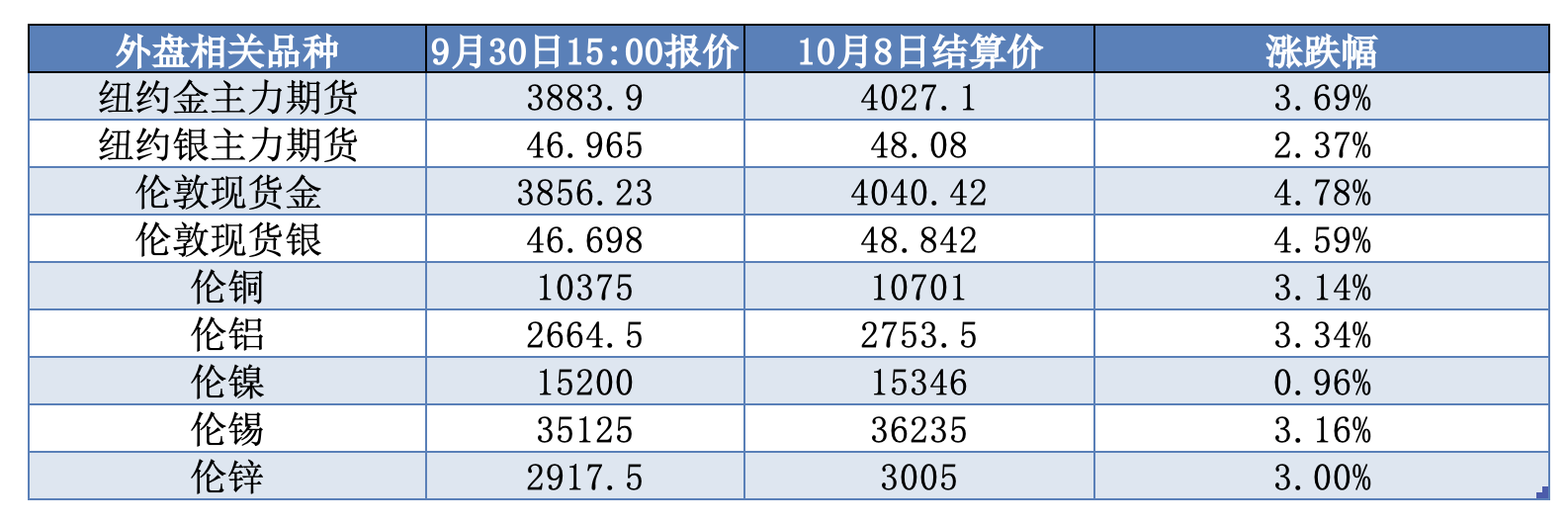
Core Viewpoint - The precious metals market is experiencing a historic moment, with gold prices surpassing $4000 per ounce, driven by a combination of risk aversion, expectations of interest rate cuts by the Federal Reserve, and ongoing central bank purchases of gold [2]. Group 1: Gold Market Performance - As of October 8, 2025, spot gold prices reached a record high of over $4000 per ounce, marking a significant milestone in the precious metals market [2]. - Year-to-date, gold prices have increased by more than 52%, translating to an approximate rise of $1400 per ounce [2]. - The New York futures market saw gold prices touch $4010 per ounce, indicating a new phase for the precious metals market [2]. Group 2: Silver Market Dynamics - Silver prices have also surged, nearing $48 per ounce, with a year-to-date increase of 67%, outperforming gold [2]. - The World Silver Association projects a global silver supply-demand gap of 120 million ounces by 2025, a historical record [4][8]. - Industrial demand for silver has surpassed 50% of total demand, with the photovoltaic industry being a key growth driver [4][5]. Group 3: Central Bank Activities - Central banks are expected to maintain strong demand for gold, with annual demand projected between 900 to 950 tons in 2025, slightly below last year's record levels [2]. - Notable central bank activities include Poland's central bank increasing its gold holdings by 67 tons and China's central bank maintaining a consistent increase in gold reserves [2]. Group 4: Market Influences - The U.S. government shutdown has raised concerns, with estimates suggesting a potential GDP loss of $15 billion per week [2]. - Geopolitical tensions, including the political crisis in France and the escalation of the Russia-Ukraine conflict, have heightened global risk aversion, benefiting gold as a traditional safe-haven asset [2]. - Market expectations for Federal Reserve interest rate cuts are rising, with a 97% probability of a cut in October and 88% in December, making gold more attractive in a low-interest-rate environment [2]. Group 5: Price Forecasts - Major financial institutions have raised their price forecasts for gold and silver, with Goldman Sachs increasing its 2026 gold price forecast from $4300 to $4900 per ounce [7]. - HSBC has adjusted its silver price forecasts for 2025 and 2026 to $38.56 and $44.5 per ounce, respectively [11]. - UBS has also raised its silver price predictions to $52 and $55 per ounce, reflecting a strong outlook for the silver market [12].
现货金价十日内连破两大关口,3900美元历史新高背后的“三重引擎”
Sou Hu Cai Jing· 2025-10-07 14:03
Core Viewpoint - The recent surge in gold prices, reaching a record high of $3920 per ounce, is driven by multiple favorable factors, marking gold as one of the best-performing assets of 2025 with an increase of over 48% year-to-date [1][3]. Group 1: Economic Indicators - Recent weak economic data from the U.S., including a decline in job openings and an increase in unemployment claims, has heightened expectations for a Federal Reserve interest rate cut, with a 94.6% probability of a 25 basis point cut in October [3]. - The U.S. government shutdown due to the failure to pass a funding bill has contributed to rising global risk aversion, further boosting demand for gold as a safe-haven asset [3]. Group 2: Global Demand for Gold - The share of the U.S. dollar in global central bank reserves has decreased from 60% in 2000 to 43% in 2024, with several countries, including China and India, increasing their gold holdings, indicating a fundamental shift in global gold demand [5]. - Domestic gold brands have rapidly adjusted their prices in response to international gold price movements, with significant increases in retail prices for gold jewelry [5]. Group 3: Market Predictions - UBS predicts that gold prices could reach between $3900 and $4200 by mid-2026, while Goldman Sachs is even more optimistic, suggesting a potential challenge to the $4000 mark [7]. - Experts advise investors to adopt a cautious approach, recommending a strategic allocation of around 5% of their portfolio to gold to hedge against inflation and market volatility [7]. Group 4: Broader Implications - The current gold bull market signifies not just a price increase but also a profound restructuring of the global monetary system and economic landscape, suggesting that the narrative surrounding gold is just beginning [9].

突破3800美元!黄金成最大赢家,但隐藏着三大风险
Sou Hu Cai Jing· 2025-10-01 02:06
Core Viewpoint - The surge in gold prices, reaching a historic high of over $3,800 per ounce, is driven by a combination of political instability in the U.S., expectations of interest rate cuts by the Federal Reserve, and systemic gold purchases by global central banks [1][2][4]. Group 1: Market Dynamics - The political deadlock in Washington, particularly the breakdown of negotiations between the Trump administration and congressional leaders, has heightened risk aversion in capital markets, propelling gold prices [1]. - The London gold market is experiencing a rare phenomenon where traders are rapidly transporting gold bars from the Bank of England to New York to fill physical gaps in the COMEX futures market, indicating deep-seated anxieties about the credibility of the U.S. dollar [1][3]. - The gold ETF market in China has seen a significant increase, with total assets reaching 160 billion yuan, reflecting strong investor confidence in gold as a financial asset [3]. Group 2: Influencing Factors - Strong expectations for interest rate cuts by the Federal Reserve are a key driver, with market predictions showing a 90% chance of a cut in October and a 65% chance in December, reducing the opportunity cost of holding gold [2]. - Geopolitical risks, including potential tariffs on Canada and Mexico, have shifted gold's demand from short-term hedging to long-term strategic allocation [2]. - Central banks globally are increasing their gold reserves, with a projected net purchase of 1,089.4 tons in 2024, indicating a structural shift in gold's role from an investment asset to a strategic reserve [2]. Group 3: Supply and Demand Imbalances - The global supply of gold is constrained, with new discoveries limited and recycling of gold affected by high prices, leading to a structural gap between demand and supply [4]. - The total demand for gold is expected to reach a record 4,974 tons in Q4 2024, while supply is only projected to grow by 1.2%, exacerbating the price increase [4]. - A significant movement of gold worth $82 billion from London to New York has led to a spike in gold leasing rates, indicating tight physical supply [3][4]. Group 4: Market Sentiment and Technical Indicators - The market sentiment is mixed, with institutional investors showing strong confidence in gold, as evidenced by hedge funds holding a record net long position of $73 billion, while some retail investors are taking profits [3]. - Technical indicators suggest that gold is in an overbought territory, with the 14-day Relative Strength Index (RSI) reaching 78, indicating potential for a correction if prices fall below $3,165 per ounce [4]. - The divergence in views on gold's future, with some believing its safe-haven properties are diminished while others see long-term support from central bank purchases, reflects the complex dynamics at play in the market [5].
贵金属数据日报-20250926
Guo Mao Qi Huo· 2025-09-26 03:30
1. Report Industry Investment Rating - No relevant information provided 2. Core Viewpoints of the Report - On September 25, the main contract of Shanghai gold futures closed down 0.45% to 854.72 yuan/gram, while the main contract of Shanghai silver futures closed up 0.08% to 10,411 yuan/kilogram [4]. - The US economic data is performing well, the US dollar index has rebounded, the trade situation between the US and Europe has further eased, and the market has closed positions in advance before the National Day holiday to avoid risks. As a result, the upward trend of gold has slowed down and entered a high - level shock. However, silver, boosted by its industrial attributes and the sharp rise of copper, has continued its upward trend. On the other hand, US Treasury Secretary Bessent urged a rate cut by the end of the year, and the probability of two more rate cuts this year remains high. In the long run, precious metal prices still have room to rise [4]. - In the medium - to - long term, the Fed still has room to cut interest rates this year, global geopolitical uncertainties persist, the US debt is unsustainable, and great - power competition intensifies, which will long - term increase the credit risk of the US dollar. The continuation of gold purchases by global central banks means that the medium - to - long - term center of gravity of gold is likely to continue to move up [4]. 3. Summary by Relevant Catalogs 3.1 Price Tracking of Internal and External Gold and Silver - **Price Data**: On September 25, 2025, the price of London gold was 3,740.94 US dollars/ounce, London silver was 43.96 US dollars/ounce, COMEX gold was 3,771.60 US dollars/ounce, COMEX silver was 44.26 US dollars/ounce, AU2510 was 851.74 yuan/gram, AG2510 was 10,370 yuan/kilogram, AU (T + D) was 850.58 yuan/gram, and AG (T + D) was 10,346 yuan/kilogram. Compared with September 24, the price of gold generally decreased, with a decline of 0.8% for London gold, 0.9% for COMEX gold, 0.5% for AU2510, and 0.5% for AU (T + D). The price of silver also mostly decreased, with a decline of 0.3% for London silver and 0.2% for COMEX silver, but AG2510 and AG (T + D) increased by 0.2% [3]. - **Spread/Ratio Data**: On September 25, 2025, the spread of gold TD - SHFE active price was - 1.16 yuan/gram, the spread of silver TD - SHFE active price was - 24 yuan/kilogram, the spread of gold internal - external market (TD - London) was - 4.78 yuan/gram, the spread of silver internal - external market (TD - London) was - 896 yuan/kilogram, the ratio of SHFE gold - silver main contracts was 82.14, the ratio of COMEX gold - silver main contracts was 85.22, the spread of AU2512 - 2510 was 2.98 yuan/gram, and the spread of AG2512 - 2510 was 41 yuan/kilogram. Compared with September 24, the spread of gold TD - SHFE active price increased by 28.9%, the spread of gold internal - external market (TD - London) decreased by 31.0%, etc. [3] 3.2 Position Data - **COMEX Gold and Silver Non - commercial Positions**: As of September 16, 2025 (weekly data), on September 24, the non - commercial long position of COMEX gold was 326,778 contracts, the non - commercial short position was 60,368 contracts, and the non - commercial net long position was 266,410 contracts. Compared with September 23, the non - commercial long position increased by 0.59%, the non - commercial short position decreased by 4.38%, and the non - commercial net long position increased by 1.78%. The non - commercial long position of COMEX silver was 71,623 contracts, the non - commercial short position was 20,085 contracts, and the non - commercial net long position was 51,538 contracts. Compared with September 23, the non - commercial long position decreased by 1.14%, the non - commercial short position increased by 8.49%, and the non - commercial net long position decreased by 4.45% [3]. - **ETF Positions**: On September 24, the position of the gold ETF - SPDR was 996.85 tons, and the position of the silver ETF - SLV was 15,469.12379 tons. Compared with September 23, the position of the gold ETF - SPDR decreased by 0.37%, and the position of the silver ETF - SLV remained unchanged [3]. 3.3 Inventory Data - **SHFE Inventory**: On September 25, 2025, the SHFE gold inventory was 65,634 kilograms, an increase of 8.41% compared with September 24. The SHFE silver inventory was 1,156,855 kilograms, a decrease of 0.43% compared with September 24 [3]. - **COMEX Inventory**: On September 24, 2025, the COMEX gold inventory was 39,807,223 troy ounces, an increase of 0.16% compared with September 23. The COMEX silver inventory was 527,155,089 troy ounces, an increase of 0.08% compared with September 23 [3]. 3.4 Interest Rate/Exchange Rate/Index Data - **Interest Rate and Exchange Rate**: On September 25, 2025, the US dollar index was 97.87, the 2 - year US Treasury yield was 3.57%, the 10 - year US Treasury yield was 4.16%, and the US dollar/Chinese yuan central parity rate was 7.11. Compared with September 24, the US dollar index increased by 0.06%, the 2 - year US Treasury yield increased by 0.65%, the 10 - year US Treasury yield increased by 1.13%, and the US dollar/Chinese yuan central parity rate remained unchanged [3][4]. - **Index**: On September 25, 2025, the S&P 500 index was 6,637.97, and the NYMEX crude oil price was 64.81. Compared with September 24, the S&P 500 index decreased by 2.76%, and the NYMEX crude oil price increased by 1.82% [4].