
劳动力市场

Search documents
今晚两份非农同时登场,“坏消息”或再成市场“好消息”?
Hua Er Jie Jian Wen· 2025-12-16 07:20
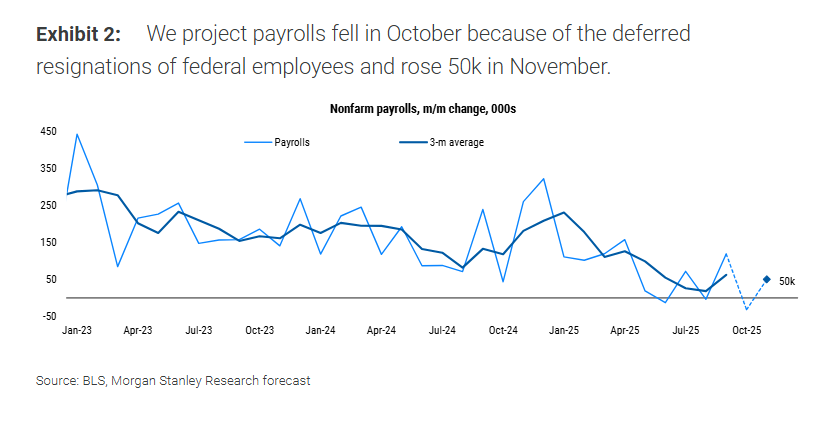
在美联储刚刚完成年内第三次降息、市场仍在为"明年1月还会不会继续降息"争论不休之际,因美国政府停摆延期的 非农就业报告,终于要在今晚揭晓,而且还是一次性端上两份——10月和11月报告。在鲍威尔明显转向"保就业"的 背景下,市场正在形成一种新的共识:就业数据的疲软,将增强美联储进一步降息的预期,可能推动美股上涨。 北京时间周二晚,美国劳工统计局(BLS)将同时公布10月和11月非农就业报告,但由于政府停摆期间暂停了家庭 调查,BLS不会公布10月失业率等数据。BLS已提前警告,11月家庭调查的统计误差将明显高于正常水平,未来几个 月相关数据的波动性也可能偏大。 从预期看,市场几乎没有形成共识。彭博调查显示,11月非农新增就业的中值仅为5万,预测区间从减少2万到增加 13万不等;失业率预计升至4.5%,若兑现将创2021年以来新高。至于10月非农,投行预测分歧更大,不少机构预计 将出现负增长。 高盛预计10月非农就业仅增加1万(私人部门增7万),11月增加5.5万(私人部门增5万),略高于市场共识但低于前 三个月平均水平。摩根士丹利则预测10月就业减少3万、11月增加5万,预计失业率将升至4.6%。 大摩首席美国 ...


贵属策略报:“农数据在即,价冲击前
Zhong Xin Qi Huo· 2025-12-16 07:19
Report Industry Investment Rating - Not provided Core Views - Gold price is approaching its previous high of $4381 as the non-farm payroll data is imminent. The short-term focus of the gold price is on the marginal changes in the non-farm payroll data, the US dollar, and interest rates, while it still has upward momentum in the medium term [1]. - The short-term pricing of gold focuses on the marginal changes in the non-farm payroll data, the US dollar, and interest rates, and the medium-term logic remains bullish. If the non-farm payroll data continues to confirm the weakening of the labor market, the upward space for the gold price is expected to open up again; if the data is temporarily strong, the gold price may fluctuate at a high level, but the callback space is expected to be limited. The medium-term direction of silver is still the same as that of gold, but it is more sensitive to the US dollar rebound and changes in risk appetite. It is expected to show high-level fluctuations and increased volatility in the short term, and may have a repair demand relative to gold [3]. Summary by Relevant Catalogs Key Information - Ukrainian President Zelensky held a five-hour meeting with a US envoy in Berlin on Sunday to seek an end to the war with Russia and proposed the goal of giving up joining NATO. The negotiations are expected to continue on Monday [2]. - US President Trump said he prefers former Federal Reserve Governor Kevin Warsh or National Economic Council Director Kevin Hassett to lead the Fed next year [2]. - A closely watched survey released by the Bank of Japan on Monday showed that the business sentiment index of large Japanese manufacturers reached a four-year high in the three months ended December, indicating that the Japanese economy has withstood the impact of US tariff hikes [2]. Price Logic - Gold: After the FOMC cut interest rates as expected in December, the overall tone of the meeting was dovish. The growth outlook was revised upward, the inflation path was revised downward, and sufficient reserves were maintained through short-term Treasury bond purchases. The liquidity environment still supports gold. Powell emphasized the continuous weakening of employment, so the market's expectation of subsequent easing has not completely subsided. At the same time, the "explicit + implicit" divergence within the Fed has increased, and the uncertainty of the Fed's independence has introduced a structural risk premium into the US dollar credit pricing [3]. - Silver: On the premise that the expectation of loose liquidity has not been falsified, the medium-term direction is still the same as that of gold. However, due to the large previous increase and crowded positions, it is more sensitive to the US dollar rebound and changes in risk appetite. The spot structure is still tight, but it is difficult to drive a trend market alone. In the short term, it mainly shows high-level fluctuations and increased volatility, and may have a repair demand relative to gold [3]. Outlook - In the short term, the focus range for London gold is [4150, 4500] US dollars per ounce, and for London silver is [55, 65] US dollars per ounce [3]. Index Information - **Comprehensive Index**: Not provided with specific data - **Special Index**: The commodity index is 2258.84, up 0.17%; the commodity 20 index is 2585.31, unchanged; the industrial products index is 2184.69, up 0.24%; the PPI commodity index is 1354.37, down 0.35% [46]. - **Sector Index**: The precious metals index on December 15, 2025, is 3669.23, up 0.69% today, up 4.97% in the past 5 days, up 10.87% in the past month, and up 65.85% since the beginning of the year [47].
沪银上涨情绪降温 米兰称通胀前景良好
Jin Tou Wang· 2025-12-16 04:10
谈到劳动力市场,米兰表示:"经验表明,劳动力市场恶化可能发生得很快,而且是非线性的,并且难 以逆转。""部分原因是货币政策存在几个季度的滞后效应,因此,正如我所主张的,更快地放松政策将 适当地使我们更接近中性立场。" 今日周二(12月16日)亚盘时段,白银期货目前交投于14768一线下方,今日开盘于14944元/千克,截至发 稿,白银期货暂报14690元/千克,下跌0.14%,最高触及14957元/千克,最低下探14659元/千克,目前来 看,白银期货盘内短线偏向看跌走势。 美联储理事米兰再次表示,美联储的政策立场对经济而言过于紧缩,他指出通胀前景良好,而劳动力市 场出现了一些预警信号。 米兰表示,他预计随着租金涨幅从新冠疫情期间的峰值回落至正常水平,住房通胀将会缓解。他认为, 由于劳动力市场降温,服务业通胀不太可能面临上行压力。一些服务业通胀的驱动因素,例如投资组合 管理费,反映的是统计上的异常现象,而不是消费者实际感受到的价格变化。 【要闻速递】 另外,美联储理事米兰表示,他很可能在明年1月底任期届满后继续留任,直到新任理事获得确认填补 他的空缺。米兰计划继续留在理事会之际,正值特朗普考虑人选以接替将于5 ...
今晚九点半非农!就业被系统性高估,风险或已提前到来?
Jin Shi Shu Ju· 2025-12-16 02:24
经济学家的预测显示,过去两个月美国劳动力市场持续降温。他们认为,9月出人意料的强劲增长(当 月总计新增11.9万个岗位)不太可能延续,并强调这一亮眼的总体数据很可能会被下修。 更值得警惕的是,美国就业市场正在呈现出一种不同以往的运行状态。进入2025年下半年,分析人士普 遍观察到一种"既不招人、也不裁人"的劳动力市场格局。 "10月和11月的数据都可能偏弱,"安普瑞斯金融首席经济学家拉塞尔·普赖斯(Russell Price)表示。他 补充称,在9月出现超预期表现之后,相关数据很可能"会朝相反方向回落"。他个人预计10月和11月的 月度就业增长均在3万至4万之间,失业率则保持在4.4%。 "冻结"的劳动力市场 在美联储再次强调通胀仍然偏高但就业下行风险加大的背景下,投资者将密切关注周二21:30公布的美 国11月非农报告。这份报告将显得不同寻常,因为它将同时包含11月的全部数据以及10月的部分数据。 整体来看,经济学家预计,11月美国新增4万个就业岗位,11月失业率预计维持在4.4%,与9月持平。 推迟至今才公布的10月非农新增人口数据预计将显示政府部门岗位大幅减少,原因是联邦雇员的买断计 划。与10月失业率 ...
连投三次反对票的美联储理事称“基础”通胀已接近目标
Xin Lang Cai Jing· 2025-12-15 19:39
美联储理事斯蒂芬·米兰再次指出,从他对通胀的温和展望以及劳动力市场出现的警讯来看,央行当前 的政策立场对经济产生了不必要的限制性。 责任编辑:丁文武 米兰表示,他预计随着租金涨幅从新冠疫情期间的飙升中恢复正常,住房通胀将会得到缓解。他指出, 劳动力市场的降温决定了剔除住房、食品和能源的服务业通胀不太可能出现上行压力。他还说,投资组 合管理费等服务业通胀驱动因素反映的是统计异常,而非消费者实际的价格感受。 "疫情之后曾出现过一轮大幅通胀,导致价格上涨," 米兰在周一于纽约哥伦比亚大学的一场活动上 说,"美国家庭依然对那段经历感到理所当然的不安,也对负担能力的下降感到不满,但目前价格已经 重新企稳,尽管是在更高的水平上。政策应该反映这一点。" 美联储官员在上周的会议上连续第三次降息,但暗示未来是否会进一步下调利率尚无定论。一些决策者 担心通胀持续高于美联储2%的目标,而另一些人则更关注劳动力市场放缓的问题。 米兰是美国总统唐纳德·特朗普最新任命的美联储理事,他承认商品价格通胀存在粘性,但认为这并非 源于政府的关税政策。他还预计住房服务价格的通胀下降将抵消商品价格的上涨。 米兰谈到劳动力市场时表示,美联储不必要地将 ...

美联储理事米兰:目前劳动力市场远未达到严重紧张的程度。现在需要制定2027年的货币政策。
Sou Hu Cai Jing· 2025-12-15 16:58
来源:金融界AI电报 美联储理事米兰:目前劳动力市场远未达到严重紧张的程度。现在需要制定2027年的货币政策。 ...
蔡昉:人机互补是AI时代劳动力市场的唯一出路
和讯· 2025-12-15 09:14
Core Viewpoint - The article discusses the "Alignment Problem" in AI, emphasizing the need to ensure AI systems align with human values and intentions, particularly in the context of labor market impacts and the necessity for proactive measures to address potential inequalities [2][3]. Group 1: AI and Labor Market Dynamics - AI is expected to exacerbate structural employment contradictions, necessitating effective policy responses to address these challenges [3]. - The relationship between AI development and employment must be managed carefully, focusing on complementarity between human capital and AI skills rather than competition [2]. - The "Solow Paradox" is referenced, highlighting the potential for AI to improve productivity without immediate visible benefits, suggesting that the distribution of productivity gains may not be equitable [5][6]. Group 2: Employment Characteristics and Challenges - The current labor market is characterized by three main features: new employment forms, localized labor mobility, and age-related disparities in the workforce [12]. - The rise of new employment forms may lead to increased informal employment, which poses risks to social security and worker rights [12]. - Labor mobility is decreasing, with workers increasingly remaining in local areas, which could hinder productivity improvements and wage growth [13]. Group 3: Policy Recommendations and Future Directions - Proactive measures are needed at various stages (preemptive, during, and post-implementation) to address the alignment of AI with employment priorities [7][14]. - Education and vocational training must evolve to meet the demands of the AI era, promoting lifelong learning and adaptability in the workforce [14]. - The importance of sharing productivity gains through reforms and social safety nets is emphasized to ensure equitable benefits from AI advancements [8][15].

零度解读12月10日美联储利率决议发布会
Di Yi Cai Jing· 2025-12-15 03:58
Policy Rate Direction - The Federal Reserve has lowered the policy rate by 75 basis points since September, bringing it to a range of 3.5% to 3.75%, indicating a shift towards a more neutral stance [1][4][7] - The economic outlook remains optimistic, with projected growth of 1.7% for this year and 2.3% for next year, despite a government shutdown impacting data collection [4][5] - The Fed's decision to lower rates reflects a balance between inflation risks and a weakening labor market, with a focus on supporting employment [6][8] Inflation Risks - Inflation remains a concern, primarily driven by tariffs affecting goods, with expectations that the impact will peak in the first quarter of next year [10][11] - The Fed acknowledges the persistent nature of inflation, which has been more stubborn than anticipated, and is cautious about potential future inflationary pressures [10][11] - The committee is divided on the assessment of inflation risks, with some members expressing differing views on the severity and duration of these risks [10][12] Macro Environment and Labor Market - The labor market is showing signs of weakness, with job growth potentially being overstated due to adjustments in data collection methods [14][15] - The Fed is concerned about the K-shaped economic recovery, where wealthier individuals are benefiting disproportionately, while lower-income consumers are struggling [15][17] - The impact of AI and automation on labor productivity is noted, with potential long-term benefits but short-term job displacement concerns [16][17] Federal Reserve's Approach - The Fed is committed to controlling inflation at 2% while also supporting the labor market, indicating a dual focus on price stability and employment [13][19] - The current policy stance is seen as appropriate, allowing the Fed to wait and observe economic developments before making further adjustments [6][8] - The Fed's asset management strategy is aimed at ensuring sufficient reserves in the banking system, particularly in light of upcoming tax payment periods [18][20]
中资离岸债每日总结(12.12) | 11月末广义货币(M2)余额同比增长8%
Sou Hu Cai Jing· 2025-12-15 03:14
Group 1 - The U.S. Department of Labor reported a significant increase in initial jobless claims, rising by 44,000 to 236,000 for the week ending December 6, marking the highest level since March 2020 and exceeding market expectations of 220,000 [2] - The labor market is showing signs of weakness, with recent layoffs announced by companies such as PepsiCo and HP, contributing to a rise in consumer confidence concerns [2] - The Federal Reserve has announced a third consecutive interest rate cut to support the "gradually cooling" labor market, with Chairman Powell indicating "significant" downside risks to the current employment situation [2] Group 2 - The Chinese central bank reported that the social financing scale reached 440.07 trillion yuan by the end of November 2025, reflecting an 8.5% year-on-year growth [10] - The People's Bank of China is committed to implementing a moderately loose monetary policy to stabilize economic growth and financial market operations, while also addressing financial risks [10] - A reverse repurchase operation was conducted by the People's Bank of China, with a total of 120.5 billion yuan at a rate of 1.40%, resulting in a net withdrawal of 19.3 billion yuan for the day [10]

大摩:美联储下一步动向及市场反应
2025-12-15 01:55
Summary of Conference Call Records Industry Overview - The records primarily discuss the Federal Reserve's monetary policy and its implications for the economy and markets, particularly focusing on interest rates, inflation, and labor market conditions. Key Points and Arguments Federal Reserve's Monetary Policy - The Federal Reserve's decision to lower interest rates will heavily depend on future economic data rather than pre-set risk assessments, as emphasized by Powell [1] - Powell ruled out the possibility of future rate hikes, indicating a shift towards data dependency for future monetary policy decisions [2] - The Fed is expected to lower rates again in January 2026, with potential further cuts in April 2026 to support the labor market, bringing the federal funds rate to a range of 3% to 3.25% [1][4] Labor Market Conditions - Technical adjustments in the labor market may lead to downward revisions in employment data, including annual benchmark revisions and immigration controls, contributing to uncertainty in labor market conditions [2] - It is estimated that employment growth in 2025 could be about 60,000 jobs lower than previously reported due to these adjustments [2] - Despite these adjustments, the unemployment rate remains relatively stable, suggesting that lower interest rates may be beneficial for managing associated risks [2] Inflation and Tariff Impact - Tariff-related inflation is expected to peak in the first quarter of 2025, with year-on-year inflation rates slightly above 3% before beginning to decline [3] - The inflationary effects of tariffs are considered temporary, with expectations that inflation will remain above the Fed's 2% target until 2027 as a trade-off for maintaining the labor market [3] Long-term Interest Rates and Dollar Trends - The current yield on 10-year Treasury bonds is close to 4%, with expectations for a moderate decline in the first half of 2026 as the Fed continues to lower policy rates [5] - The unusual situation of long-term bond yields being significantly higher than the Fed's policy rate is expected to attract more investors, preventing a substantial rise in long-term rates [5] - The trend of dollar depreciation that began in January is anticipated to continue in the first half of the year, with a potential rebound in the second half [6] Other Important Insights - The internal divisions within the FOMC regarding monetary policy decisions highlight the complexity of the current economic environment [2] - Powell's confidence in managing future economic trends through policy adjustments reflects a proactive approach to potential economic challenges [2]