
市场多元化

Search documents
安徽领跑,苏浙紧跟“上分”!上半年外贸“成绩单”出炉
Guo Ji Jin Rong Bao· 2025-07-18 13:40
Group 1: Anhui Province - Anhui's total import and export value reached 458.54 billion yuan, a year-on-year increase of 15.2%, ranking sixth nationally and first in the Yangtze River Delta [3] - Exports of mechanical and electrical products amounted to 222.91 billion yuan, growing by 18.5%, accounting for 71.9% of the province's total exports [3] - Exports of "new three samples" (new energy vehicles, lithium batteries, photovoltaic products) reached 37.13 billion yuan, increasing by 67.8%, highlighting Anhui's leading position in the green low-carbon sector [3] - Anhui's exports of self-owned brand products were 155.98 billion yuan, up 9.1%, making up 50.3% of total exports, indicating a focus on brand building [4] - Trade with Belt and Road countries reached 248.49 billion yuan, a growth of 14.9%, accounting for 54.2% of total trade, showing success in expanding emerging markets [5] - The comprehensive bonded zone in Anhui saw imports and exports of 79.45 billion yuan, a year-on-year increase of 31.6%, contributing significantly to the province's foreign trade growth [5] Group 2: Zhejiang Province - Zhejiang's total import and export value reached 2.73 trillion yuan, a year-on-year increase of 6.6%, with exports surpassing 2 trillion yuan for the first time [6] - The province contributed 19.8% to national export growth, ranking first in the country, due to deep engagement in emerging markets and global supply chain layout [6] - Exports to the EU, ASEAN, Latin America, the Middle East, and Africa grew significantly, effectively compensating for reduced exports to the US [7] - Companies in Zhejiang are diversifying risks through "supply chain going abroad," enhancing flexibility and responsiveness [8] Group 3: Jiangsu Province - Jiangsu's total import and export value reached 2.81 trillion yuan, a year-on-year increase of 5.2%, accounting for 12.9% of the national total [9] - The province's trade structure optimization reflects a shift towards high-quality development, with general trade and processing trade both contributing significantly [10] - High-end market innovations, such as adjustable garden umbrellas, are meeting the demands of markets like the US, supporting sustained growth [11] - Foreign-invested enterprises in Jiangsu had an import and export value of 1.32 trillion yuan, growing by 5.8%, highlighting the province's attractiveness to foreign investment [12]


崇达技术(002815) - 2025年7月16日投资者关系活动记录表
2025-07-17 05:24
Market Outlook - The global printed circuit board (PCB) market is expected to grow by 6.8% in value and 7.0% in shipment volume in 2025, driven by increased demand in sectors like mobile phones, servers, and communications [2] - The company anticipates a significant increase in sales orders in high-demand areas, particularly in high-layer boards for communications and servers, as well as high-density interconnect (HDI) boards for mobile phones [2] Capacity and Production - Current overall capacity utilization is approximately 85% [3] - The company is accelerating the release of high-layer PCB capacity in its Zhuhai plants and is planning to establish a new HDI factory in Jiangmen to meet customer demand [3][4] - Ongoing construction of a production base in Thailand aims to enhance the overseas production network [3] Profitability Improvement Measures - The company is focusing on high-value customers and orders, optimizing the sales structure by eliminating loss-making orders and increasing the proportion of high-margin orders [4] - Strengthening the sales team by recruiting experienced professionals and implementing performance incentives to boost sales efficiency [4] - Enhancing cost management through standardized cost control measures and improving material utilization [5] - Innovating product offerings to meet high-value customer demands, particularly in high-frequency and high-reliability PCB products [5] Financial Strategy - The company aims to improve operational performance to support the conversion of convertible bonds, ensuring a stable cash flow for repayment [6] - A flexible exit strategy for convertible bonds will be maintained, adapting to market conditions and investor needs [6] Raw Material Cost Management - The company is facing rising raw material costs, particularly for copper and other key materials, and is implementing measures to mitigate these pressures [7] - Strategies include dynamic cost monitoring, improving material efficiency, and selectively raising prices for certain products [8] U.S. Market Exposure - Currently, approximately 10% of the company's revenue comes from the U.S. market [9] - The company is diversifying its market presence to reduce reliance on the U.S. market, with domestic sales exceeding 50% [9] - Strategies to address U.S. tariffs include optimizing customer cooperation terms and accelerating the establishment of overseas production bases [10]

中国出口的天,真没塌下来
Zhong Guo Xin Wen Wang· 2025-07-14 13:20
Group 1 - China's export scale exceeded 13 trillion yuan in the first half of the year, achieving a year-on-year growth of 7.2%, marking a historical high for the same period [1] - In June, the total import and export scale reached 3.85 trillion yuan, with exports at 2.34 trillion yuan, growing by 7.2%, indicating a recovery in growth rates [1] - The complete industrial chain and continuous technological upgrades provide a strong foundation for China's export resilience amid challenging external environments [1][2] Group 2 - China's manufacturing value added has consistently exceeded 30 trillion yuan annually since the 14th Five-Year Plan, maintaining its position as the world's largest manufacturing country for 15 consecutive years [2] - High-tech product exports grew by 9.2% in the first half of the year, with significant increases in exports of high-end machine tools, ships, and marine engineering equipment [2] - China's trade partnerships expanded, with over 190 countries and regions experiencing growth in imports and exports, and the number of trading partners with a trade scale exceeding 50 billion yuan increased by 5 compared to the previous year [2] Group 3 - Exports to emerging markets contributed significantly to growth, with imports and exports to Africa increasing by 14.4% and to Central Asia by 13.8% in the first half of the year [3] - Despite a decline in export growth to the U.S., China's export resilience is supported by strong product competitiveness and market diversification [3] - Various international organizations have downgraded global trade growth forecasts for 2025, but China has maintained its own pace and rhythm in trade [3]
特朗普刚加税,不到24小时,加拿大找上中国,说了句前所未有的话
Sou Hu Cai Jing· 2025-07-13 04:17
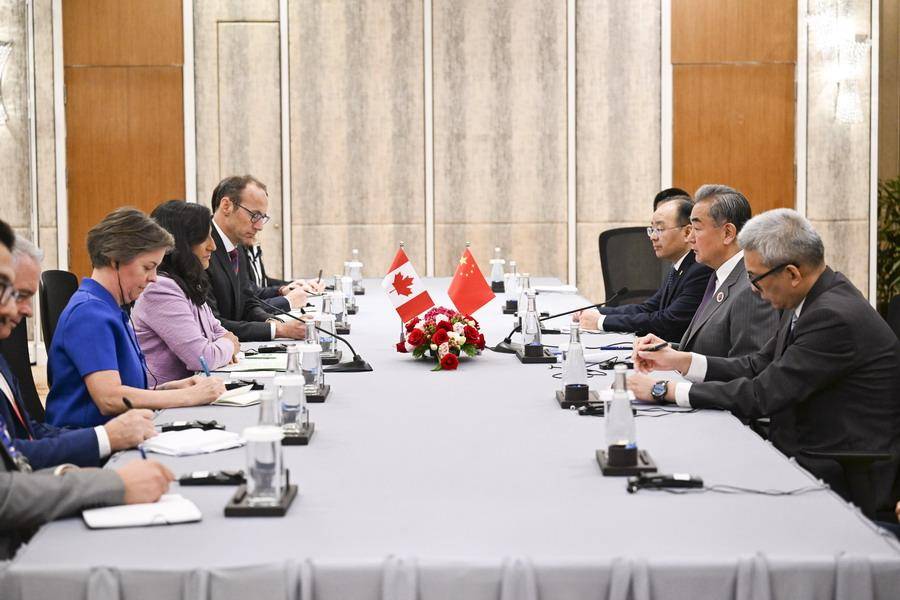
Core Viewpoint - The recent announcement by Trump to impose tariffs on Canadian goods has prompted Canada to seek support from China, indicating a shift in international trade dynamics and alliances [1][3][5]. Group 1: Tariff Announcement and Implications - On July 10, Trump announced tariffs of up to 35% on Canadian imports, citing Canada's high tariffs on U.S. dairy products as a significant threat to U.S. economic and national security [3][5]. - This move is seen as part of a broader strategy to restart a global trade war, with 23 countries receiving similar tariff notifications, including major economies like Japan and Brazil [5][6]. - The decision to target Canada, despite its status as a close ally and major trading partner, reflects Trump's "America First" policy and the need to demonstrate quick results to his voter base [6][8]. Group 2: Canada's Response and Shift Towards China - Following the tariff announcement, Canadian Foreign Minister Anand met with Chinese Foreign Minister Wang Yi, expressing a desire to "recalibrate" Canada-China relations and restore cooperation across various sectors [8][9]. - Canada's pivot towards China is driven by the unpredictability of U.S. trade policies, which have repeatedly put Canada at a disadvantage, and the need to diversify its economic partnerships [9][11]. - The meeting signaled a willingness from both Canada and China to engage in constructive dialogue and explore mutually beneficial cooperation, highlighting the potential for a stronger economic relationship [9][11]. Group 3: Broader Trade Dynamics - The current trade tensions and the U.S.'s aggressive tariff policies are eroding its credibility in the international trade system, pushing countries like Canada to seek alternative partnerships [11]. - China's commitment to multilateralism and free trade positions it as a stable and reliable partner for countries looking to reduce dependence on the U.S. market [8][11].
抢出口!越南上半年GDP增速创14年新高,后续要警惕哪些风险?
第一财经· 2025-07-10 09:29
Core Viewpoint - Vietnam's economy has shown strong growth in the first half of 2025, with a GDP growth rate of 7.52%, the highest for the same period since 2011, driven largely by exports and trade agreements with the US [1][5][9]. Economic Performance - Vietnam's GDP growth in Q2 2025 reached 7.96%, contributing to a first-half growth rate of 7.52%, marking a 14-year high [5]. - The total export volume in the first half of the year increased by 14.4%, with the top three export categories being computers and electronics, mobile phones, and machinery, accounting for 46% of total exports. Notably, the growth in computers and electronics surged by 42% [5][6]. Trade Dynamics - The US remains Vietnam's largest export market, with exports totaling $70.91 billion in the first half of the year, while China is the largest source of imports at $84.7 billion [6]. - The recent trade agreement with the US has led to a temporary reduction in tariffs, allowing Vietnamese goods to be exported at a lower rate, which has stimulated export growth [2][13]. Sectoral Disparities - Despite overall economic growth, not all sectors are performing equally. Industries such as textiles, leather, and wood processing are experiencing a slowdown in order growth [7]. - Domestic consumption in Vietnam is recovering but remains cautious, indicating potential challenges for sustained economic momentum [7]. Future Outlook - The Vietnamese government has set an ambitious target of 8% economic growth for the year, but achieving this may be challenging given the current growth rate and external economic uncertainties [9]. - The OECD has projected a GDP growth of 6.2% for 2025, with a further decline to 6% in 2026, although it acknowledges a positive long-term outlook for Vietnam compared to other Southeast Asian nations [9]. Export Strategies - Vietnamese companies are under pressure to fulfill export orders before the implementation of higher tariffs, leading to increased production and delivery efforts [11][12]. - To ensure sustainable growth, businesses are encouraged to diversify their markets and strengthen ties with countries that have free trade agreements, targeting emerging markets in the Middle East, Northeast Asia, and Africa [14][15]. Investment Factors - Key internal factors contributing to Vietnam's economic growth include increased public infrastructure investment, a recovering real estate market, and significant administrative reforms by the government [16].

1-5月肇庆进出口增速全省第3
Nan Fang Du Shi Bao· 2025-07-09 09:16
Economic Overview - The economic performance of Zhaoqing City remains stable in the first five months of the year, with certain industries showing growth vitality [2] - The total foreign trade import and export value reached 16.94 billion RMB, an increase of 15.5% year-on-year [2] Industrial Performance - The industrial added value above designated size increased by 4.4% year-on-year, with manufacturing and electricity, heat, gas, and water production and supply growing by 4.5% and 5.2% respectively [3] - Key industries such as computer communication and other electronic equipment manufacturing, electrical machinery and equipment manufacturing, and automobile manufacturing contributed significantly to industrial growth, with increases of 15.1%, 28.2%, and 15.0% respectively [3] - Advanced manufacturing industries grew by 17.7%, equipment manufacturing by 21.6%, and advanced equipment manufacturing by 33.7% [3] Investment Trends - Fixed asset investment decreased by 7.8% year-on-year, with infrastructure investment increasing by 17.4% [4] - Real estate development investment saw a significant decline of 42.3%, with commodity housing sales area down by 34.1% and sales revenue down by 35.1% [4] Trade Dynamics - Processing trade imports and exports reached 4.22 billion RMB, growing by 55%, maintaining over 50% growth for four consecutive months [5] - Private enterprises accounted for 63% of the total foreign trade import and export value, with a year-on-year increase of 20% [6] Export and Import Composition - Mechanical and electrical products exports amounted to 5.89 billion RMB, a growth of 14.1%, making up 48.6% of total exports [6] - Metal raw materials imports grew by 53.7%, accounting for 72.3% of total imports, with significant increases in imports of unrefined copper and copper materials [6] Consumer Market - The total retail sales of consumer goods reached 52.511 billion RMB, with a year-on-year growth of 3.7% [7] - Sales of smart home appliances surged by 1022.8%, indicating a strong demand in the consumer electronics sector [7] - The financial market remains stable, with total deposits growing by 11.1% year-on-year [7]

美国关税政策对全球经济金融的影响与走向研判
Jin Rong Shi Bao· 2025-07-07 03:23
Group 1: Characteristics of US Tariff Policy - The US tariff policy since 2025 has shown a broad coverage and significant expansion, imposing a 10% basic tariff on nearly all imported goods, impacting various industries including electronics, machinery, chemicals, and textiles [2][3] - The tariff rates are differentiated based on trade deficit and competitive relationships, with complex exemption processes for even "friendly" countries, indicating a strategic use of tariffs for economic and political goals [3] - The policy exhibits high uncertainty, with frequent adjustments causing confusion among global trade participants, complicating long-term business planning [3] Group 2: Impact on the US Economy - The tariff policy aims to protect domestic industries and reduce trade deficits, but it has led to rising inflation pressures, with the Federal Reserve adjusting GDP growth forecasts down by 0.3 percentage points to 1.4% for 2025 [4] - US companies, including local and foreign firms, face increased import costs disrupting supply chains, with small furniture manufacturers and farmers in the Midwest experiencing severe financial difficulties due to tariff impacts [5] - The US's international credibility is damaged due to erratic policy changes, leading to decreased confidence among global investors and trade partners, reflected in the reduced attractiveness of US Treasury bonds [6] Group 3: Global Economic and Financial Impact - The US tariff policy disrupts global trade and capital flows, raising import prices and suppressing trade activity, with the World Bank predicting a decline in global trade growth rates for 2025 and 2026 [7][8] - The policy negatively affects global economic growth, with rising import prices reducing consumer purchasing power and investment uncertainty leading to cautious business decisions [8] - The tariffs challenge existing international trade rules, prompting a shift towards new regional trade agreements and increasing the influence of emerging economies in global trade rule-making [8] Group 4: Challenges and Opportunities for China - China's export costs rise due to US tariffs, particularly in the automotive sector, where exports to the US reached $17.15 billion in 2024, leading to profit compression and increased logistics costs [9][10] - The demand for Chinese exports in machinery, textiles, and apparel declines as US tariffs diminish price competitiveness, with a potential 20-30% drop in textile exports anticipated with a 10% tariff increase [10] - The pressure to relocate supply chains increases as multinational companies consider moving production to regions with lower tariffs, impacting China's position in global supply chains [11] Group 5: China's Response to US Tariff Policy - China has taken a firm stance against US tariffs, implementing reciprocal measures and engaging in trade talks to maintain economic relations [13] - The country is enhancing trade ties with other economies through initiatives like the Belt and Road, reducing reliance on the US market and expanding its global trade footprint [13][14] - China is advocating for multilateral mechanisms to address US violations of trade rules, strengthening its position in global trade discussions and enhancing its economic resilience [14]
全球及中国无菌容器系统动向追踪及前景动态分析报告2025-2031年
Sou Hu Cai Jing· 2025-07-01 04:16
Core Insights - The article discusses the evolution of U.S. tariff policies and their impact on the sterile container system industry, highlighting the urgency for Chinese companies to internationalize due to domestic market saturation and global opportunities [2][3]. Section Summaries 1. U.S. Tariff Policy Evolution and Impact on the Sterile Container System Industry - The article defines sterile container system products and analyzes the core aspects of U.S. tariff policies [2]. - It emphasizes the impact of U.S. tariff adjustments on global supply chains and the necessity for Chinese sterile container system companies to expand internationally [2][3]. - The research aims to analyze policy impacts and summarize corporate strategies while providing future planning recommendations [2]. 2. Industry Impact Assessment - The article outlines optimistic, conservative, and pessimistic scenarios for the global sterile container system industry scale trends from 2024 to 2031 [3][9]. - It discusses the direct effects of tariff policies on Chinese sterile container system companies, including cost pressures and market access challenges [3][4]. 3. Global Market Share of Enterprises - The article presents the market share and rankings of major global sterile container system companies based on revenue and sales from 2022 to 2025, with 2025 being a forecast year [3][11]. - It includes data on sales revenue, market share, and pricing trends for these companies [3][11]. 4. Corporate Response Strategies - The article suggests strategies for companies to shift from export dependence to global capacity layout, including regional production networks and localized technology strategies [4][5]. - It emphasizes the importance of optimizing supply chain resilience and diversifying markets, particularly in emerging markets [4][5]. 5. Future Outlook: Global Industry Restructuring and China's Role - The article provides long-term trend predictions and strategic recommendations for the sterile container system industry [4][5]. 6. Current Global Capacity Distribution - The article forecasts global sterile container system supply and demand from 2020 to 2031, detailing production capacity, output, and utilization rates [6][7]. 7. Market Size and Growth Potential in Key Regions - The article analyzes the sales volume and revenue of the global sterile container system market, comparing data from 2020, 2024, and 2031 [7][8]. 8. Overview of Major Global Manufacturers - The article includes profiles of major manufacturers in the sterile container system market, detailing their production bases, sales regions, and market positions [8][9]. 9. Product Type Scale Analysis - The article categorizes sterile container systems by product type, including plastic, glass, and metal containers, and compares sales revenue and volume forecasts [9][10]. 10. Application Scale Analysis - The article categorizes sterile container systems by application, including hospitals, clinics, and laboratories, and provides sales and revenue forecasts [10][11].



外贸企业进入“后关税时代”
经济观察报· 2025-06-20 12:11
Core Viewpoint - The article emphasizes the necessity for Chinese foreign trade enterprises to diversify their overseas markets due to uncertainties in the U.S. market, marking a shift towards a "post-tariff era" where market diversification is a consensus among industry players [2][10]. Group 1: Market Diversification - Zhang Jiong, Vice President of the Guangdong Import and Export Chamber of Commerce, highlights the intense state of the U.S.-China tariff war and the impossibility of returning to previous conditions, urging companies to explore new markets [7][10]. - The cross-border e-commerce sector is particularly affected by tariff changes, with the tax rate on packages valued under $800 reduced from 120% to 54%, impacting low-priced products significantly [8][10]. - The North American e-commerce market is projected to be worth approximately $1.3 trillion in 2024, while the European market is valued at $800 billion, indicating substantial opportunities despite the challenges [9][10]. Group 2: Company Strategies - Guangdong Guanneng Electric Power Technology Development Co., a newcomer in foreign trade, has initiated an overseas expansion plan, focusing on markets outside the U.S. due to the potential in other regions [3][16]. - Ningbo Benye Heavy Industry Co. has pivoted towards the renewable energy sector, developing new products like firefighting reconnaissance robots, and plans to start expanding in Southeast Asia where market entry barriers are lower [12][13][14]. - Guanneng Technology aims to leverage its expertise in smart electric operation robots and plans to follow state-owned enterprises into overseas projects in regions like Australia and Malaysia, prioritizing quality and stability in its products [16][17]. Group 3: Emerging Markets - The article discusses the growing opportunities in Saudi Arabia, where local government initiatives are pushing for economic diversification away from oil dependency, creating a favorable environment for Chinese enterprises [20][21]. - A project involving collaboration between Chinese and Saudi companies is underway, focusing on the booming hotel industry and logistics capabilities in Riyadh, indicating a strategic move towards meeting local demands [21][22]. - The article also notes that while there are pressures in the domestic real estate sector, the Saudi market presents a viable opportunity for Chinese companies, emphasizing the importance of risk assessment before entering new markets [22].
湖北前5月进出口总值超3287亿 民营企业占70.9%成外贸主力军
Chang Jiang Shang Bao· 2025-06-16 00:43
Core Insights - Hubei Province's foreign trade continues to show high growth, with a total import and export value of 328.74 billion RMB in the first five months of 2025, representing a year-on-year increase of 26.9% [1][2] Group 1: Trade Performance - Exports reached 238.37 billion RMB, a significant increase of 36.3%, while imports totaled 90.37 billion RMB, growing by 7.4% [1] - Private enterprises have become the main driving force behind Hubei's foreign trade growth, accounting for 70.9% of the total import and export value, with a year-on-year increase of 31.1% [2] - The general trade method accounted for 80.6% of the total trade, with a value of 264.96 billion RMB, showing a growth of 36.5% [3] Group 2: Trade Partners and Markets - ASEAN and the EU are Hubei's top two trading partners, with import and export values of 78.21 billion RMB and 41.05 billion RMB, reflecting increases of 64.3% and 41.6% respectively [3] - Exports to emerging markets such as India and Brazil also saw significant growth, increasing by 34.3% and 14.4% respectively [3] Group 3: Regional Contributions - Wuhan City led the province with an import and export value of 178.77 billion RMB, accounting for 54.4% of the total [3] - Other cities like Huangshi, Yichang, and Xiangyang also contributed significantly, with respective import and export values of 30.82 billion RMB, 21.12 billion RMB, and 19.96 billion RMB [3] Group 4: Export and Import Structure - The export of electromechanical products reached 120.59 billion RMB, growing by 23%, making up over half of the total exports [4] - Major imports included bulk commodities, with a total import value of 29.93 billion RMB, representing over 30% of total imports, and significant increases in copper ore and coal imports [4]