猪周期

Search documents
猪价反弹、产能调控,猪周期新走向引关注
2 1 Shi Ji Jing Ji Bao Dao· 2025-10-30 07:49
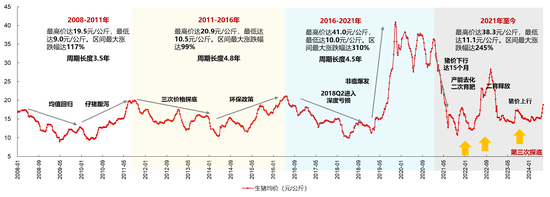
Group 1 - The core viewpoint is that pig prices have rebounded recently, with an average price of 12.51 yuan/kg as of October 30, which is an increase of 0.18 yuan/kg from the previous day and approximately 1.5 yuan/kg higher than the lowest point in mid-October [1] - Short-term price increases are driven by seasonal consumption recovery and heightened sentiment for secondary fattening, while rising prices will increase the costs of secondary fattening, necessitating attention to the sustainability of this trend [1] - Long-term expectations indicate a downward shift in recent pig price levels, with deepening breeding losses and the advancement of capacity regulation policies, which are expected to enhance the outlook for long-term price stabilization [1] Group 2 - The Ministry of Agriculture and Rural Affairs has recently reiterated the need to strengthen the regulation of pig production capacity, with the number of breeding sows recorded at 40.35 million as of the end of September, a decrease of 450,000 from the peak at the end of last year [2] - Policy regulations regarding production capacity, slaughter weight, and environmental funding are being fully implemented, with leading companies responding positively; for instance, Muyuan Foods reported a breeding sow inventory of 3.305 million at the end of September, a reduction of 126,000 from the end of June [2] - The expectation for future market cycles indicates that capacity regulation will remain a central theme for some time, with an anticipated increase in the elimination of outdated capacity and a further emphasis on the cost advantages of high-quality production capacity, leading to better profit elasticity post-regulation [2]


永顺生物前三季度盈利能力稳步提升 实现净利润超3千万
Cai Jing Wang· 2025-10-29 07:12
Core Viewpoint - Yongshun Biological has demonstrated strong operational resilience with a slight increase in net profit despite a decrease in revenue, indicating effective cost control and product optimization strategies [1][2]. Financial Performance - In the first three quarters of 2025, Yongshun Biological achieved operating revenue of 180 million yuan, with a net profit attributable to shareholders of 30.28 million yuan, reflecting a year-on-year growth of 4.56% [1]. - The company's operating income decreased by 10.18% year-on-year, attributed to the cyclical fluctuations in the pig farming industry [2]. - The net cash flow from operating activities reached 74.66 million yuan, a significant increase of 34.97% year-on-year, indicating strong cash flow management [2]. - Asset impairment losses were reduced by 75.49% year-on-year, primarily due to improved inventory turnover and efficiency [2]. Product Development and Innovation - Yongshun Biological has focused on innovation, investing 15.31 million yuan in R&D, which is approximately 8.50% of its operating revenue [3]. - The company has recently obtained production licenses for two significant products: a quadrivalent inactivated vaccine for avian influenza and a bivalent inactivated vaccine for H5 subtype avian influenza, enhancing its market position in poultry vaccines [3]. - Additional product approvals include a new vaccine for pigeon newcastle disease and several other vaccines for swine diseases, indicating a robust pipeline for future growth [3]. Industry Outlook - The pig farming industry is expected to rebound in the fourth quarter, supported by policy adjustments and market corrections, positioning Yongshun Biological favorably for sustained growth in the upcoming industry cycle [4].

分论坛:大宗商品与周期|国泰海通证券2026年度策略会
国泰海通证券研究· 2025-10-29 06:09
Core Insights - The article discusses the significant role of commodities in the current global economic landscape, highlighting the pressures of supply chain and manufacturing chain restructuring due to de-involution and trade frictions, as well as the strategic value of de-sovereignized assets [1] Group 1: Commodity Analysis - Understanding gold as a key expression of global de-sovereignized assets [1] - Copper prices are viewed as the new king of commodities in the AI era [1] - The completion of industrial de-involution and the revitalization of the new energy industry chain [1] - Traditional steel mills are undergoing transformation in the black metal sector [1] Group 2: Market Dynamics - The pig cycle is at a bottom, driven by both policy and market factors [1] - The economic changes reflected in the tire industry, focusing on rubber's de-involution and international expansion [1] Group 3: Agenda Overview - The agenda includes discussions on interest rate cuts and long-term narratives affecting precious metals [2] - Supply disruptions and macroeconomic fluctuations impacting non-ferrous metal price outlooks [2] - Insights into the new energy market under the backdrop of de-involution policies [2] - The dual influence of policy and market on the cyclical rotation of the pig industry [3] - Black commodity raw materials and large dry bulk freight market outlook [4]

国投期货农产品日报-20251028
Guo Tou Qi Huo· 2025-10-28 14:36
Report Industry Investment Ratings - **Positive trend prediction**: Soybean No. 1, soybean meal, soybean oil, and palm oil are rated with three stars, indicating a clearer long - term trend and relatively appropriate investment opportunities currently [1]. - **Negative trend prediction**: Rapeseed meal, rapeseed oil, corn, live pigs, and eggs are rated with one star, suggesting a bias towards short - term trends but poor operability on the trading floor [1]. Core Views - The prices of various agricultural products are affected by multiple factors such as trade relations, supply and demand, and policies. Different agricultural products have different price trends and investment suggestions [2][3][4]. Summary by Related Catalogs Soybean No. 1 - The main contract of soybean No. 1 futures rebounded rapidly from the low today, covering the decline of the previous two days and accompanied by an increase in positions. The domestic soybean auction had a premium, with an average transaction price of 3,925 yuan/ton and a premium of 0 - 140 yuan/ton. The transaction rate was 34.49%. The price difference between domestic and imported soybeans stopped falling and rebounded slightly. Short - term attention should be paid to the performance of the imported soybean trade and the policy guidance of domestic soybeans [2]. Soybean & Soybean Meal - Affected by the easing of Sino - US negotiations, US soybeans rose continuously this week, and the 2601 contract of Dalian Commodity Exchange decreased its positions by more than 70,000 lots and rose 1.40% today. The current domestic soybean arrivals are sufficient, the soybean crushing volume is stable, the soybean meal pick - up has increased, and the soybean meal inventory has decreased slightly on a weekly basis. Attention should be paid to the APEC summit at the end of the month. Amid many uncertainties in Sino - US trade, continue to wait and see and look for long - position opportunities after the Sino - US trade issue is resolved [3]. Soybean Oil & Palm Oil - The main contract of US soybeans continued to rise. Although the Brazilian soybean CIF premium fell and the RMB continued to appreciate, the domestic imported soybean cost still increased. The futures market showed a pattern of strong meal and weak oil, and the soybean crushing profit was still in the red. Short - term attention should be paid to the risk of the oil - to - meal ratio correction. In the long run, palm oil is expected to be resilient, and it is recommended to allocate vegetable oils on dips. In the short term, be cautious about the price correction of palm oil due to the pressure in the Malaysian market [4]. Rapeseed Meal & Rapeseed Oil - Domestic rapeseed meal rose significantly, and the rapeseed sector was stronger than its competitors, which was related to market concerns about Sino - Australian relations. The export of Australian rapeseed to China is not yet stable. The Russian rapeseed has been listed for crushing, and its export trade to China is not optimistic. The rapeseed oil price is expected to be under pressure in the short term, while the rapeseed meal price has short - term rebound momentum [6]. Corn - The Dalian corn futures rose 0.28% today. The supply of new corn in the Northeast continues, and the price has risen slightly. The new corn in Jilin may be listed in large quantities again soon, which will suppress the market price. The downstream demand is mainly for rigid procurement. With the possible easing of Sino - US relations, the corn import situation should be continuously monitored. The Dalian corn is expected to continue to run weakly at the bottom [7]. Live Pigs - The live pig futures weakened significantly today, showing a divergence between the futures and spot markets. The spot price continued to rise, with the national average slaughter price reaching 12.5 yuan/kg, up 0.3 yuan. The futures increased positions and declined, with the near - month contract leading the decline. Although the supply pressure is still large, the large price difference between fattening pigs may promote second - round fattening and hog retention, and the pork consumption is expected to improve in the fourth quarter. However, due to the continuous supply pressure, a short - position strategy is recommended after the price rebounds. The pig price is likely to form a double - bottom pattern, and a second bottom may occur in the first half of next year [8]. Eggs - The egg futures failed to continue the previous upward trend, opening lower this morning and oscillating downward throughout the day without filling the gap. The near - month contract led the decline today, and the positions decreased by 10,000 lots. The spot price in Hebei started to fall, with a large decline in the price of small eggs. In the medium term, the industry needs to accelerate the elimination of old hens. The unsold cold - storage eggs are also a potential pressure on the spot market. A short - position strategy is recommended at high prices [9].
猪卖的更多挣的却更少 神农集团Q3净利润同比下降近八成|财报解读
Xin Lang Cai Jing· 2025-10-27 16:05
Core Viewpoint - The swine industry is experiencing a downturn, leading to significant pressure on the performance of listed pig farming companies, including Shennong Group, which reported a nearly 80% decline in net profit for Q3 2023 [1][2]. Financial Performance - For the first three quarters of 2023, Shennong Group achieved revenue of 3.923 billion yuan, a year-on-year decrease of 3.79%, and a net profit attributable to shareholders of 462 million yuan, down 3.89% [1]. - In Q3 2023, the company reported revenue of 1.126 billion yuan, a year-on-year decline of 28.90%, with a net profit of 74.06 million yuan, reflecting a 79.21% decrease [1]. Production and Sales - Shennong Group has been expanding its production capacity since its listing, with pig output increasing from 411,000 heads in 2020 to 1.521 million heads in 2023, and projected to reach 2.2715 million heads in 2024 [1][2]. - In the first three quarters of 2023, the company sold 2.1096 million pigs, nearing the total sales for the entire previous year [2]. Market Conditions - The company faced a challenging market environment, with pig sales prices declining in Q3, hitting a year-low of 12.82 yuan/kg in September, which significantly impacted net profit [2]. - Despite the adverse market conditions, Shennong Group maintained a low debt ratio of 27.07%, the lowest among listed pig farming companies, and had a complete cost of 12.5 yuan/kg in September, placing it in the top tier of the industry [2]. Strategic Decisions - On July 29, 2023, the company announced the termination of its plan to issue A-shares to specific investors for 2024, retracting its application [3]. - The previous issuance plan aimed to raise a total of 290 million yuan for various projects, including the construction of a breeding base and biosecurity upgrades [3].

温氏股份三季度营收利润双降:猪价持续下挫逼近成本线 现金短债比低至0.38财务压力大
Xin Lang Cai Jing· 2025-10-24 05:22
Core Viewpoint - The financial performance of Wens Foodstuffs Group has significantly declined in Q3 2023, with a notable drop in revenue and net profit, raising concerns about the company's future profitability and financial stability [1][2][7]. Financial Performance - For the first three quarters of 2023, Wens recorded revenue of 75.817 billion yuan, a slight decrease of 0.04% year-on-year, and a net profit attributable to shareholders of 5.256 billion yuan, down 18.29% year-on-year [1]. - In Q3 alone, revenue fell by 9.8%, marking the first quarterly revenue decline since 2024 [1][2]. - The net profit in Q3 saw a dramatic decline of 65.02%, following a 42.83% drop in Q2 [2]. Market Conditions - The average selling price of live pigs dropped to 13.18 yuan per kilogram in September, down 5.18% month-on-month and 30.81% year-on-year, nearing the company's breeding costs [2][3]. - The overall pig farming industry is currently in a marginal profit state, with net profits for large-scale pig farming at 21 yuan per head and for small-scale farming at 6 yuan per head as of July 2025 [2]. Cost Structure - Wens Foodstuffs has a strong cost control capability, with a breeding cost of approximately 12.4 yuan per kilogram, which is 2 yuan lower than the industry average [3]. - The company's gross margin for the first three quarters was 12.82%, down 3.51 percentage points year-on-year, while the net margin was 7.15%, down 1.65 percentage points [3]. Cash Flow and Debt Management - Operating cash flow decreased by 35.9% to 8.199 billion yuan, with significant increases in cash payments for goods and services [4]. - The cash-to-short-term debt ratio is low at 0.38, indicating financial pressure, despite a reduction in the debt ratio from 61.41% to 49.41% [5]. - The company has been reducing leverage, with total interest-bearing debt decreasing, but still faces substantial repayment pressure [5][6]. Investment and Future Outlook - Wens Foodstuffs plans to invest 30-50 billion yuan annually in fixed assets, primarily for upgrading poultry and pig farming facilities [6]. - The company is currently engaged in 20 construction projects, including chicken and pig farms, as well as feed mills [6]. - The future profitability of the pig farming business is uncertain, especially with fluctuating feed prices and ongoing market pressures [6][7].

猪价持续低位震荡,温氏股份第三季度净利润下滑超60%
Sou Hu Cai Jing· 2025-10-24 03:44
Core Viewpoint - The financial performance of Wens Food Group in the third quarter of 2025 reflects significant challenges due to the cyclical downturn in the pig and chicken industries, despite some signs of price recovery in the pork market [1][4]. Financial Performance - For the first three quarters of 2025, Wens Food Group reported a revenue of 75.788 billion yuan, a slight decrease of 0.03% year-on-year, while net profit attributable to shareholders was 5.256 billion yuan, down 18.29% [1]. - In Q3 2025, the company achieved a revenue of 25.937 billion yuan, representing a year-on-year decline of 9.76%, with net profit dropping significantly by 65.02% [2]. - The basic earnings per share for the first three quarters was 0.7930 yuan, down 18.25% year-on-year [1]. Industry Context - The pig farming sector is currently at a cyclical low, with the average price of external three yuan pigs in Q3 2025 at 13.88 yuan/kg, down 28.9% year-on-year, marking a significant decline [2]. - Wens Food Group's pig sales price in September 2025 was 13.89 yuan/kg, a decrease of 29% year-on-year, with further declines noted in the latter part of the quarter [2]. - The chicken business also faced price pressures, with the average sales price for white feather chickens in June 2025 at 10.29 yuan/kg, down 24.78% year-on-year [3]. Supply and Demand Dynamics - The pig industry is experiencing an oversupply, with the number of breeding sows at 40.43 million, exceeding the normal level [4]. - Demand for pork remains weak, with limited consumption boosts from the recent holidays, leading to a decline in slaughter rates and increased inventory levels [4]. - The average loss per pig for self-breeding and self-raising operations was 7.27 yuan in September, with losses worsening in October [4]. Policy and Market Outlook - Regulatory measures are being implemented to address supply-demand imbalances, including controlling breeding sow expansion and culling excess stock [5]. - Experts suggest that the current low prices for pork may have reached their bottom, with expectations for a potential rebound in prices post-October [5]. - The ongoing "pig cycle" presents both challenges and opportunities for the industry to optimize its structure and improve quality, with a more stable and sustainable development anticipated in the future [6].
农产品日报-20251022
Guo Tou Qi Huo· 2025-10-22 11:19
Report Industry Investment Ratings - **Bullish with some uncertainty**: Soybean (★☆☆), Egg (★☆☆) [1] - **Trend of long position**: Soybean No.1 (★★★), Soybean Meal (★★★), Soybean Oil (★★★) [1] - **Trend of short position**: Palm Oil (☆☆☆), Rapeseed Meal (☆☆☆), Rapeseed Oil (☆☆☆), Live Pig (☆☆☆) [1] - **Relatively balanced short - term trend**: Corn (★☆☆) [1] Core Views - The report analyzes the market conditions of various agricultural products, including soybean, soybean meal, soybean oil, palm oil, rapeseed meal, rapeseed oil, corn, live pig, and egg, and provides investment suggestions based on supply - demand relationship, trade policies, and market sentiment [2][3][7] Summary by Related Catalogs Soybean No.1 - The main contract of domestic soybeans reduced positions, and the price continued to decline. The auction price was 3900 yuan/ton, the same as last week. The market participants are actively purchasing new grains. The spread between domestic and imported soybeans is oscillating. The US soybean market lacks official data, and the export demand is uncertain. Short - term attention should be paid to the purchase performance and policy guidance [2] Soybean & Soybean Meal - The soybean meal futures first declined and then rose, and the spot price dropped by 10 - 20 yuan/ton. The domestic soybean arrival volume is sufficient, and the supply in the fourth quarter is generally stable. If the Sino - US trade relationship deteriorates, the supply in the first quarter of next year may be tight. In the context of high supply and high inventory, if the trade does not ease, the soybean meal futures will likely continue to oscillate weakly. It is recommended to wait and see [2] Soybean Oil & Palm Oil - The ratio of soybean oil to palm oil started to decline, with palm oil falling more. The EU proposed a ban on importing forest - destroying commodities, and the Malaysian palm oil production and export increased in October. The US soybean market lacks data, and the export demand is uncertain. Short - term attention should be paid to the ratio adjustment, and in the long - term, opportunities for oil to be stronger than meal should be sought [3] Rapeseed Meal & Rapeseed Oil - The domestic rapeseed products market is weak. The market is waiting for the development of Sino - US and Sino - Canadian economic and trade relations. The Canadian rapeseed harvest is over, but the export has not improved. The Australian rapeseed will arrive in the fourth quarter, and the Russian rapeseed oil export to China may increase. The short - term trend of rapeseed products futures is not obvious [5] Corn - The main contract of corn futures oscillated weakly. The spot price in the Northeast is stable, and the supply of wet corn is sufficient. The downstream demand is mainly for rigid needs. The new corn listing in the Northeast will increase in the next two weeks, and the corn futures will likely continue to run weakly at the bottom [6] Live Pig - The live pig spot price rebounded driven by secondary fattening, and the futures oscillated narrowly. The pig price has entered a rebound cycle, but due to the large supply pressure, the strategy of shorting on rallies is recommended after the rebound. The pig price is likely to form a double - bottom pattern, and there may be a second bottom in the first half of next year [7] Egg - The egg futures rose and then fell, and the market remained weak. The old - hen culling sentiment is cautious, and the cold - storage eggs have not been fully sold. The short - selling trend of the futures continues [8]
量升难抵价跌,温氏股份三季度净利“腰斩”,四季度如何突围?
Di Yi Cai Jing· 2025-10-22 10:47
Core Viewpoint - The decline in pig prices is significantly impacting the entire breeding industry, with leading domestic pig farming company Wens Foodstuffs Group reporting a substantial drop in profits due to falling prices despite increased sales volume [1][2][5]. Financial Performance - In the third quarter, Wens Foodstuffs Group's net profit attributable to shareholders fell by 65% year-on-year, with a non-recurring net profit decline of 68% [1][2]. - For the first three quarters, the company achieved revenue of 75.817 billion yuan, a slight decrease of 0.04% year-on-year, and a net profit of 5.256 billion yuan, down 18.3% [2]. - The gross profit margin decreased by 4.5 percentage points to 12.82% due to lower pig product prices [2]. Sales and Pricing Trends - Despite increasing pig sales volume, the average selling price of pigs fell sharply, with prices dropping from 14.58 yuan/kg in July to 13.18 yuan/kg in September, a decline of 9.6% [3]. - In September, Wens sold 332.53 million pigs, the highest monthly sales for the year, but revenue decreased by 30.81% compared to the previous year [3]. Cost Management - The company has managed to reduce its management and financial expenses, with management costs down 24.41% and financial costs down 26.82% year-on-year [6]. - As of the end of the third quarter, the asset-liability ratio was 49.41%, the lowest in four years, due to a significant reduction in short-term and long-term borrowings [6]. Industry Outlook - The overall pig price trend remains pessimistic, with prices continuing to decline into the fourth quarter, creating challenges for the company's performance [5][6]. - The self-breeding profit for the pig farming industry is currently negative, indicating ongoing financial pressure [7]. - Market conditions suggest that supply will remain high while demand is weak, leading to continued pressure on pig prices [7].
A股震荡之际,这个赛道持续逆市吸金,原因何在?
Xin Lang Ji Jin· 2025-10-22 08:09
Core Viewpoint - Significant capital is flowing into the agricultural, animal husbandry, and fishery sectors, which are perceived as undervalued despite the overall market stagnation [1][4] Group 1: Industry Dynamics - The pig farming industry is currently facing substantial losses due to declining pork prices, which may lead to a significant industry reshuffle [1] - Recent government policies emphasize supply-side reforms, with major pig farming companies required to reduce production by 1 million heads by the end of the year [1] - Historical data indicates that the pig farming sector has experienced four cycles since 2006, and current prices are at a four-year low, suggesting limited downside potential [1][3] Group 2: Market Valuation - The agricultural, animal husbandry, and fishery sectors are viewed as a "golden pit" for investment, with the agricultural ETF's price-to-book ratio at 2.57, placing it in the 29.3 percentile of the last decade [4][5] - The current valuation levels are below historical averages, indicating a potential for significant upside as the industry recovers [5] Group 3: Future Outlook - Long-term projections suggest that as the market clears and supply-side policies take effect, pork prices are expected to stabilize and eventually rise [3] - The correlation between pork prices and the stock prices of pig farming companies is strong, indicating that an increase in pork prices could lead to substantial profits for these companies [3] - Investment institutions express optimism about the agricultural sector's role in food security and economic development, highlighting opportunities in large-scale farming and emerging consumer trends [6]