
社会融资规模

Search documents
11月末社融存量同比增长8.5%
Mei Ri Jing Ji Xin Wen· 2025-12-14 13:56
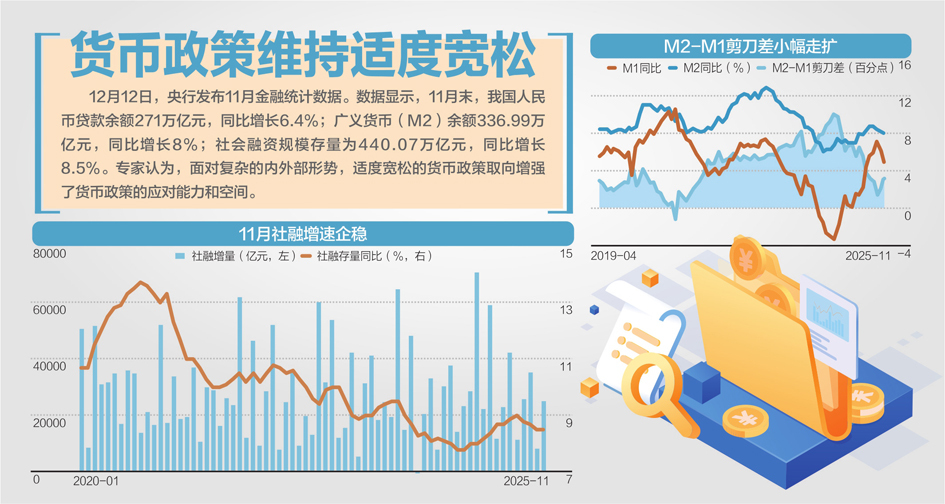
Group 1 - The core viewpoint of the article highlights the current state of China's financial statistics, indicating a stable growth in social financing and monetary supply, which supports economic development [1][3][7] - As of November 2025, the total social financing scale reached 440.07 trillion yuan, with a year-on-year growth of 8.5% [1][7] - The broad money (M2) balance stood at 336.99 trillion yuan, reflecting a year-on-year increase of 8%, which is 0.9 percentage points higher than the same period last year [3] Group 2 - In the first eleven months of the year, the increase in social financing was 33.39 trillion yuan, which is 3.99 trillion yuan more than the previous year [7] - The total amount of new government debt this year reached 1.186 trillion yuan, an increase of 290 billion yuan compared to last year, leading to a higher proportion of government bonds in the social financing scale [1] - The growth rate of loans has slightly decreased, with a total increase of 15.36 trillion yuan in RMB loans for the first eleven months, and a month-on-month increase of 390 billion yuan in November [4][6] Group 3 - The balance of RMB loans to the real economy accounted for 60.8% of the total social financing scale, which is a decrease of 1.3 percentage points year-on-year [5] - Experts indicate that the decline in loan growth reflects the transition of economic drivers from traditional investment to consumption, with reduced reliance on bank loans for new growth points [6] - The financial institutions' loan write-offs exceeded 1 trillion yuan this year, which also contributed to the downward pressure on loan growth, although these funds continue to support the real economy [4][6] Group 4 - The article emphasizes the need for a scientific and robust monetary policy framework, focusing on optimizing the mechanisms for basic currency issuance and maintaining reasonable growth in financial totals [8][10] - It suggests that a market-oriented approach should guide financial institutions in optimizing their financing structures, enhancing the quality and efficiency of financial services to the real economy [10] - Recent innovations in monetary policy tools, such as including government bond trading in the monetary policy toolbox, are expected to improve liquidity management in the financial system [10]

11月金融数据点评:政策发力和科技融资需求拉动社融回暖
Orient Securities· 2025-12-14 07:31
Group 1: Financial Data Overview - In November, social financing (社融) increased by 159.7 billion yuan year-on-year, a significant recovery compared to a decrease of 595.9 billion yuan in October[6] - The overall credit scale stabilized, but the willingness of residents to "leverage" remains low, with long-term loans decreasing by 290 billion yuan year-on-year in November[6] - Corporate bond financing demand was strong, with an increase of 178.8 billion yuan year-on-year in November, maintaining above 150 billion yuan for three consecutive months[6] Group 2: Policy Impact and Economic Trends - Policy support and strong financing demand in the technology sector are the main drivers of the recovery in social financing[6] - The impact of government bond financing on social financing has weakened, with a year-on-year decrease of 104.8 billion yuan in November, significantly less than the 564.3 billion yuan decrease in October[6] - The distribution of 500 billion yuan in government debt quotas to local governments is expected to provide effective support to the real economy[6] Group 3: Future Outlook and Risks - Despite the recovery in social financing, underlying demand issues persist, as indicated by declines in M1 and M2 money supply[6] - The widening gap between M1 and M2 suggests ongoing challenges in the economy[10] - Risks include potential economic recovery falling short of expectations amid escalating trade tensions and tighter overseas monetary policies[4]
2025年11月金融数据点评:有效信贷需求仍显疲态,存款搬家放缓
Yin He Zheng Quan· 2025-12-14 05:33
Investment Rating - The report maintains a "Recommended" rating for the banking industry [1]. Core Insights - The effective credit demand in the banking sector remains weak, with a slowdown in deposit migration observed [5]. - Social financing (社融) increased by 2.49 trillion yuan in November, showing a year-on-year increase of 159.7 billion yuan, while the total social financing stock grew by 8.5% year-on-year [5]. - The contribution of government bonds and RMB loans to social financing has weakened, while corporate bonds and off-balance-sheet financing have gained traction [5]. - The demand for credit from the household sector continues to be weak, with a notable decrease in short-term loans [5]. - The growth rates of M1 and M2 have declined, indicating a slowdown in deposit migration [5]. - The report suggests that the support from government bonds for social financing is diminishing, and credit demand still needs to recover [5]. - The report highlights the ongoing dividend value of banks, driven by factors such as a low-interest-rate environment and substantial dividend payouts, and continues to favor the banking sector [5]. Summary by Sections Banking Industry Overview - The banking sector is experiencing a decline in effective credit demand and a slowdown in deposit migration [5]. Social Financing and Credit Demand - In November, social financing increased by 2.49 trillion yuan, with a year-on-year increase of 159.7 billion yuan, while the total stock grew by 8.5% [5]. - RMB loans increased by 405.3 billion yuan in November, which is a year-on-year decrease of 116.3 billion yuan [5]. - Household loans decreased by 206.3 billion yuan, indicating insufficient consumer demand [5]. Monetary Supply and Deposits - M1 and M2 growth rates were 4.9% and 8% respectively, with a month-on-month decline [5]. - The total deposits in financial institutions increased by 1.41 trillion yuan in November, which is a year-on-year decrease of 760 billion yuan [5]. Investment Recommendations - The report recommends focusing on banks such as Industrial and Commercial Bank of China, Agricultural Bank of China, and others, highlighting their ongoing dividend value [5].
非标融资和政府债托底社融,实体信贷收缩,对消费与投资拖累大!
Sou Hu Cai Jing· 2025-12-13 20:11
Group 1 - In November 2025, new social financing increased by 6.9% year-on-year, primarily supported by non-standard financing and government bonds, while core credit demand from the real economy remained weak [2][4][8] - Non-standard financing became the main contributor, with trust loans and other non-standard assets increasing significantly, indicating a reliance on flexible funding channels to support infrastructure and local projects [4][6] - Government bonds played a leading role, with net issuance of 1.2 trillion yuan in November, but the growth rate declined due to a high base effect, highlighting the increasing share of government-related financing in total social financing [6][7] Group 2 - Resident loans continued to contract, reflecting weak real estate cycles and insufficient consumer spending, with a significant year-on-year decrease in new resident loans [9][11] - The real estate market showed signs of weakness, with high household savings rates and declining property prices, leading to a lack of purchasing intent among residents [12][13] - Consumer confidence dropped, exacerbated by external pressures such as high global inflation and domestic supply excess, indicating a need for policy shifts to stimulate consumption [13][14] Group 3 - Corporate funding needs increased year-on-year, but the debt structure revealed a lack of confidence in future investments, with a notable preference for short-term financing over long-term expansion [14][17] - New short-term loans surged, while medium- to long-term loans saw a decline, reflecting a cautious approach among businesses amid low demand and economic uncertainty [17][19] - Fixed asset investment showed a rare decline, indicating insufficient capital formation and the need for improved business environments and tax incentives to stimulate long-term demand [19][20] Group 4 - Fiscal policy is expected to shift focus from replacing local hidden debts to promoting fixed asset investment in 2026, aiming to support economic growth [20][22] - The central economic work conference emphasized maintaining active fiscal policies, with potential measures to boost investment in real estate and infrastructure [22][23] - However, challenges remain regarding investment efficiency amid existing overcapacity, and the potential for government debt to exceed credit could further dampen household and corporate demand [22][23]
金融数据点评:表外融资支撑社融增速走平
SINOLINK SECURITIES· 2025-12-13 12:53
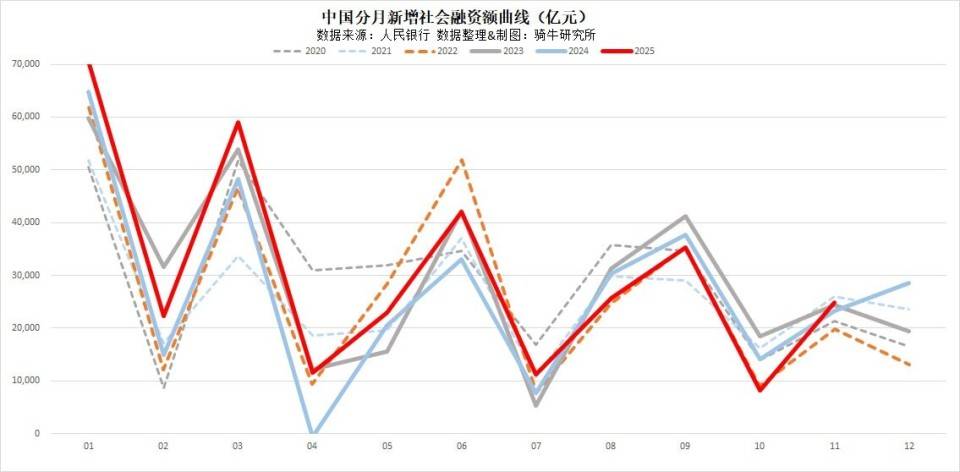
Report Summary 1. Industry Investment Rating No industry investment rating is provided in the report. 2. Core Viewpoints - In November, the new social financing scale was not low, mainly driven by corporate credit and off - balance - sheet financing. However, the credit structure remained poor, with bill financing reaching a record high for the same period, corporate medium - and long - term loans at the lowest level since 2016 for the same period, and both short - term and medium - and long - term household loans at record lows for the same period. The credit demand of the real sector was significantly weak. Looking ahead, the net financing scale of government bonds in December may decline slightly month - on - month, still dragging down social financing. The intensive implementation of 500 billion yuan of policy - based financial instrument support projects from October to December may boost social financing to some extent, but the weak credit demand and the banks' desire to reserve projects for January next year may cause significant disturbances to social financing [6][33]. 3. Summary by Content Social Financing Aggregate - In November, the stock growth rate of social financing remained flat at 8.5%. The new social financing in November was 2.49 trillion yuan, an increase of 159.7 billion yuan year - on - year. Compared with the average of 2.3 trillion yuan in the same period of the past five years, the new social financing scale in November this year was not much different from the historical average, falling at the upper edge of the new scale in the same period of the past five years [2][8]. Factors Contributing to the Increase in Social Financing - Off - balance - sheet financing was one of the main contributors to the year - on - year increase in social financing this month. In November, trust loans and undiscounted bank acceptance bills in the off - balance - sheet financing items both increased year - on - year, supporting social financing. The new trust loan scale in November has generally declined compared with October since 2020, but this month's trend was anti - seasonal, possibly related to the recently launched new policy - based financial instrument support projects. In addition, corporate bonds were another supporting item for the increase in social financing this month. In November, new corporate bonds increased by 178.8 billion yuan to 416.9 billion yuan, the highest level in the same period since 2020, and were the only item with an increase in direct financing projects [3][15][18]. Credit Structure - There was a divergence between the total social financing and the credit structure. Although the overall performance of social financing in November was not bad, credit was still weak. Corporate sector credit increased by 360 billion yuan year - on - year to 610 billion yuan, mainly driven by short - term corporate loans and bill financing, while medium - and long - term corporate loans decreased year - on - year. Household sector credit had a negative growth for the first time in the same period in history [4][20]. - New medium - and long - term corporate loans were at the lowest level in the same period since 2016. The reasons for the year - on - year increase in corporate sector credit this year were the low base of corporate sector credit in November 2024 and the simultaneous efforts of short - term corporate loans and bill financing in November this year, which pushed up the corporate credit scale this month. In November, short - term corporate loans increased by 110 billion yuan year - on - year to 100 billion yuan, higher than the average of 50.2 billion yuan in the same period of the past five years. The new short - term corporate loan scale this year has always been at the upper edge of the historical same period, possibly because although the economy was sluggish, enterprises still needed a certain amount of funds for business turnover, and banks may also have vigorously issued short - term corporate loans at the end of the quarter to boost the scale. The new bill financing scale in November was at a record high for the same period, indicating that corporate credit issuance was still weak, and bill financing was used to increase the total credit scale. Medium - and long - term corporate loans decreased by 40 billion yuan year - on - year to 170 billion yuan, the lowest level in the same period since 2016, and the growth rate of the balance of medium - and long - term corporate loans further declined by 0.05 percentage points to 7.8%, having declined for 28 consecutive months [4][20][21]. - Household sector credit had a negative growth for the first time in the same period in history. In November, household sector credit decreased by 476.3 billion yuan year - on - year to - 206.3 billion yuan. Among them, short - term household loans decreased by 178.8 billion yuan year - on - year to - 215.8 billion yuan, also setting a record low for the same period. Contrary to short - term corporate loans, short - term household loans have basically been at the lower edge of the historical same period this year, and have even set record lows for the same period many times, possibly indicating weak household consumption willingness against the background of unstable income expectations. Medium - and long - term household loans decreased by 290 billion yuan year - on - year to 1 billion yuan, also the lowest value for the same period. The year - on - year growth rate of the sales area of commercial housing in 30 large and medium - sized cities in November declined to - 30.91%, the lowest level since May 2024, while the growth rate of the commercial housing sales area in the same period last year was 11.6%, indicating that current household home - buying willingness was also weak [5][24]. M1 and M2 - The growth rate of M1 continued to decline by 1.3 percentage points. In November this year, the monthly incremental scale of M1 was 0.89 trillion yuan, while the incremental scale of M1 in November last year was 2.15 trillion yuan. As the impact of the ban on manual interest compensation had gradually dissipated and the low - base effect faded, the growth rate of M1 continued to decline by 1.3 percentage points to 4.9% in November [6][25]. - Fiscal expenditure had limited support for M2. In terms of deposits, both household and corporate deposits decreased year - on - year in November, indicating that deposit creation was also not ideal against the background of sluggish loans. At the same time, non - bank deposits decreased by 100 billion yuan year - on - year to 80 billion yuan, and the new scale was significantly lower than that in the same period since 2022. Historically, the growth rate of the non - bank deposit balance had a certain similarity with the trend of the Shanghai Composite Index. The stock market had a slight correction in November, which may have led to a low new non - bank deposit scale in November. In summary, the growth rate of M2 further declined by 0.2 percentage points to 8% in November. In addition, fiscal deposits decreased by 190 billion yuan year - on - year to - 50 billion yuan. The fiscal expenditure intensity was generally weaker than that from 2021 to 2023 and stronger than that in 2024, but its support for the M2 growth rate was limited [6][30].
宏观经济点评:政府债券加力支撑社融超季节性回升
KAIYUAN SECURITIES· 2025-12-13 11:12
Group 1: Social Financing and Credit Growth - In November, the social financing scale increased by 24,885 billion yuan, exceeding the expected 20,191 billion yuan and significantly higher than the previous value of 8,161 billion yuan[3] - The growth of RMB loans was 3,900 billion yuan, below the expected 5,043 billion yuan and higher than the previous value of 2,200 billion yuan[3] - Corporate loans showed marginal recovery with an increase of 6,100 billion yuan, which is 3,600 billion yuan more than the same month last year[3] Group 2: Government Bonds and Fiscal Policy - Government bond financing in November reached 12,041 billion yuan, a year-on-year decrease of 1,048 billion yuan but a month-on-month increase of 7,189 billion yuan[3] - The issuance of special bonds was 4,922 billion yuan, a month-on-month increase of 2,048 billion yuan, indicating strong government support for social financing[3] - The net financing of general government bonds reached 6,108 billion yuan, reflecting a significant increase of 4,563 billion yuan month-on-month[3] Group 3: Household and Corporate Loan Trends - Household loans decreased by 2,063 billion yuan in November, a year-on-year reduction of 4,763 billion yuan, but showed improvement compared to the previous month[3] - The short-term loans for households decreased by 1,788 billion yuan year-on-year, but the consumer loan data showed marginal improvement due to seasonal factors[3] - Corporate short-term loans increased by 1,000 billion yuan, indicating a shift from negative to positive growth year-on-year[3] Group 4: Monetary Supply and Deposit Trends - M1 growth rate fell by 1.3 percentage points to 4.9%, while M2 growth rate decreased to 8%[4] - Both household and corporate deposits continued to show year-on-year declines, with reductions of 1,200 billion yuan and 947 billion yuan respectively[4] - Fiscal deposits decreased by 1,900 billion yuan year-on-year, suggesting an increase in fiscal spending beyond seasonal expectations[4]
如何理解11月金融数据
GF SECURITIES· 2025-12-13 07:21
Group 1: Financial Data Overview - In November, social financing increased by 2.49 trillion yuan, exceeding the market average expectation of 2 trillion yuan, with a year-on-year increase of 159.7 billion yuan[3] - The total social financing scale for the first eleven months of 2025 reached 33.39 trillion yuan, an increase of 3.99 trillion yuan compared to the same period last year[3] - The growth rate of social financing stock remained stable at 8.5%, unchanged from the previous month[3] Group 2: Loan and Financing Breakdown - RMB loans to the real economy increased by 14.93 trillion yuan, a year-on-year decrease of 1.28 trillion yuan[3] - Corporate loans increased by 4.05 trillion yuan, with a year-on-year decrease of 116.3 billion yuan, marking the fifth consecutive month of decline[3] - Government bond financing reached 1.2 trillion yuan in November, a year-on-year decrease of 104.8 billion yuan[4] Group 3: Market Trends and Implications - The corporate financing environment improved, as indicated by the BCI index rising to 52.50 in November from 52.41 in October[4] - The demand for residential loans remains weak, with short-term loans decreasing by 178.8 billion yuan and long-term loans decreasing by 290 billion yuan[3] - Policy-driven financial tools are beginning to show effects, particularly in infrastructure investment, which may influence corporate financing demand in the upcoming quarters[6]
央行披露:同比多增近4万亿元!
新华网财经· 2025-12-13 06:31
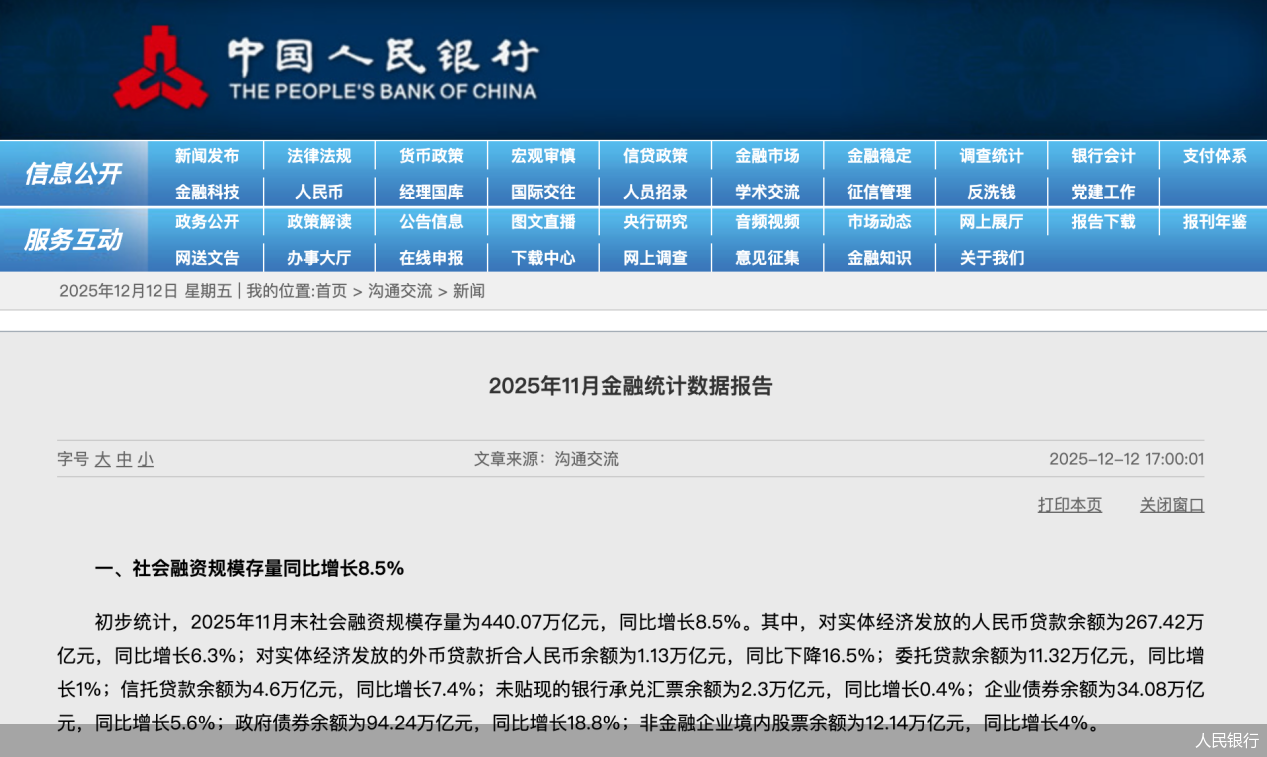
Core Viewpoint - The article highlights the stable growth of social financing, M2, and RMB loans in China, indicating a moderately loose monetary policy that supports high-quality economic development [2][3][5]. Group 1: Financial Statistics - As of the end of November, the total social financing stock was 440.07 trillion yuan, a year-on-year increase of 8.5%, which is 0.7 percentage points higher than the same period last year [4][8]. - In the first eleven months, the cumulative increase in social financing was 33.39 trillion yuan, which is 3.99 trillion yuan more than the same period last year [4][6]. - The RMB loan balance reached 271 trillion yuan by the end of November, with a year-on-year growth of 6.4%, and a total increase of 15.36 trillion yuan in the first eleven months [10][11]. Group 2: Government Bonds and Financing - Government bonds have been a key driver of social financing growth, with the balance of government bonds reaching 94.24 trillion yuan, a year-on-year increase of 18.8% [7][8]. - The net financing amount of government bonds is expected to exceed 12 trillion yuan this year, with the contribution of government bonds to social financing significantly increasing due to a rise in the fiscal deficit rate [7][8]. - By the end of November, government bonds accounted for 21.4% of social financing, an increase of 1.8 percentage points year-on-year, with government bond financing contributing to 40% of the increase in social financing [8][9]. Group 3: Loan Quality and Structure - The average interest rate for newly issued corporate loans was approximately 3.1%, which is about 30 basis points lower than the same period last year [16]. - The growth of inclusive small and micro loans and medium to long-term loans for manufacturing continues to outpace overall loan growth, indicating a focus on supporting key sectors [16]. - The article emphasizes the need to analyze financial data from a broader perspective, considering social financing scale and money supply rather than just loan growth to assess financial support for the real economy [14][15].
前11个月社融增量超去年全年,M2增速维持高位释放货币政策宽松信号
Bei Jing Shang Bao· 2025-12-13 03:29
Core Viewpoint - The financial data for November 2025 indicates a continued trend of slowing loan growth, with a focus on optimizing credit structure while maintaining reasonable growth in total financing and broad money supply [1][4][5]. Loan Growth - In the first eleven months of 2025, RMB loans increased by 15.36 trillion yuan, with household loans rising by 533.3 billion yuan and corporate loans increasing by 14.4 trillion yuan [4][5]. - As of the end of November 2025, the total RMB loan balance reached 271 trillion yuan, reflecting a year-on-year growth of 6.4%, with a slight decrease in growth rate compared to the previous month [5][6]. - November saw a monthly increase of 390 billion yuan in RMB loans, which is 1,883 billion yuan less than the same month last year [4][5]. Social Financing Scale - The total social financing scale reached 440.07 trillion yuan by the end of November 2025, with a year-on-year growth of 8.5%, surpassing the total for the entire year of 2024 [1][8]. - In November alone, the new social financing amounted to 2.49 trillion yuan, which is 1.67 trillion yuan more than the previous month and 1,597 billion yuan more than the same month last year [8][9]. Direct Financing - Direct financing remains a strong support for social financing, with government bonds, corporate bonds, and RMB loans being the main contributors [9][10]. - Government bond net financing reached 13.15 trillion yuan in the first eleven months, accounting for 39.4% of the total social financing [10]. Monetary Policy - As of the end of November, the broad money supply (M2) stood at 336.99 trillion yuan, growing by 8% year-on-year, while the narrow money supply (M1) grew by 4.9% [11][12]. - The current monetary policy is characterized as moderately accommodative, with expectations for continued easing in 2026, including potential interest rate cuts and reserve requirement ratio reductions [14].
前11个月人民币贷款增加15.36万亿元
Ren Min Ri Bao Hai Wai Ban· 2025-12-13 01:51
Group 1 - The core viewpoint of the articles highlights the significant increase in China's RMB loans and deposits in the first 11 months of the year, indicating a robust financial environment [1][2] - In the first 11 months, RMB loans increased by 15.36 trillion yuan, with corporate loans accounting for 14.4 trillion yuan of this total [1] - By the end of November, the total RMB loan balance reached 271 trillion yuan, reflecting a year-on-year growth of 6.4% [1] Group 2 - Household loans increased by 533.3 billion yuan in the first 11 months, while corporate medium- and long-term loans rose by 8.49 trillion yuan [1] - The broad money supply (M2) reached 336.99 trillion yuan at the end of November, with a year-on-year growth of 8% [1] - The total social financing stock was 440.07 trillion yuan at the end of November, showing a year-on-year increase of 8.5% [2]