贸易紧张局势

Search documents
金价探涨!2025年7月11日各大金店黄金价格多少钱一克?
Jin Tou Wang· 2025-07-11 07:36
Domestic Gold Market - Domestic gold prices remain stable, with three gold stores reporting price increases. Chow Sang Sang's gold price increased by 5 yuan per gram, reaching 1004 yuan per gram, making it the highest-priced store. Shanghai China Gold maintains the lowest price at 969 yuan per gram, resulting in a price difference of 35 yuan per gram between the highest and lowest stores [1] - The latest gold prices from various brands on July 11, 2025, show that Lao Miao Gold is priced at 999 yuan per gram (up 3), while other brands like Liufu and Chow Tai Fook remain unchanged at 998 yuan per gram. Lao Fengxiang is priced at 1002 yuan per gram (up 2), and the overall market shows a mix of price stability and slight increases [1] Platinum Prices - Platinum prices also experienced a rebound, with Chow Sang Sang's platinum jewelry price increasing by 3 yuan per gram, now priced at 551 yuan per gram. The article invites readers to inquire about other platinum prices for further updates [1] Gold Recycling Prices - The gold recycling price has increased by 1.6 yuan per gram, with significant price differences among brands. The current gold recycling price is 760.30 yuan per gram, while brands like Cai Bai and Lao Fengxiang have higher recycling prices at 765.70 and 773.30 yuan per gram, respectively [2] International Gold Market - The spot gold price has shown an upward trend, closing at 3323.76 USD per ounce, with a 0.31% increase. As of the latest report, it is currently at 3341.88 USD per ounce, reflecting a 0.55% rise. The increase is attributed to market expectations of interest rate cuts by the Federal Reserve and uncertainties surrounding U.S. tariffs [4] - The market anticipates a 65.8% probability of a rate cut in September and an 84.5% probability in October, influenced by inflation data and economic performance. Additionally, President Trump's announcement of tariffs on copper and Canadian imports has heightened global trade tensions, contributing to increased market uncertainty [4] - Overall, the outlook for spot gold remains bullish, supported by expectations of Federal Reserve rate cuts and ongoing tariff uncertainties, suggesting that domestic gold prices are unlikely to see significant declines in the short term [4]


FPG财盛国际:特朗普刚刚重大宣布!将对加拿大商品征收35%关税
Sou Hu Cai Jing· 2025-07-11 03:09
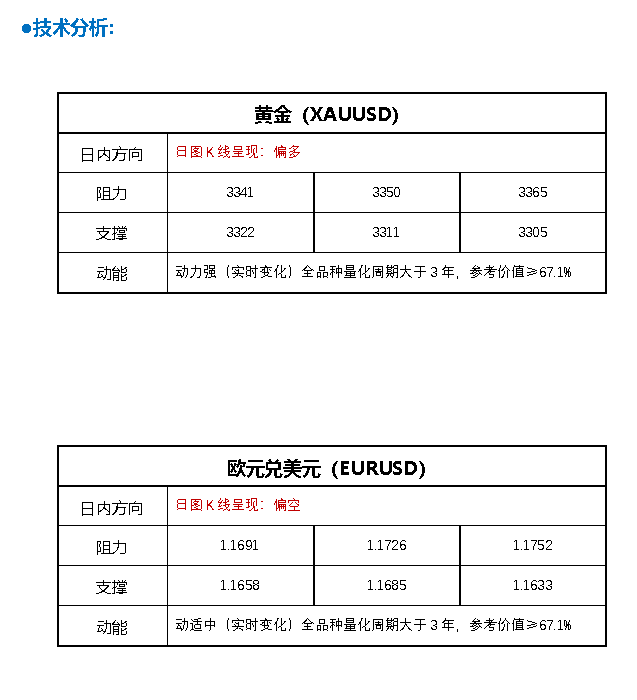
Group 1 - Trump announced a 35% tariff on goods imported from Canada, effective August 1, 2025, indicating a continuation of his economic policies [1] - The announcement has led to a quick rise in the USD/CAD exchange rate, reaching a high of 1.3730, reflecting investor expectations of increased trade tensions [1] - Spot gold prices surged over $10 in early Asian trading, reaching around $3,336 per ounce due to the heightened trade tensions [1] Group 2 - Analyst Felix noted that gold prices managed to reclaim the Fibonacci retracement level of $3,297 after briefly falling below it, with the RSI showing a slight recovery [2] - Analyst Chad emphasized that gold needs to break above the 50-day simple moving average (SMA) at $3,323 to initiate a more significant rebound, targeting $3,346 [3] - If gold fails to break the 50-day SMA, it may face increased selling pressure and retest the Fibonacci support level at $3,297 [3] Group 3 - The daily chart for gold shows a bullish bias with resistance levels at $3,340, $3,350, and $3,365, while support levels are at $3,322, $3,311, and $3,302 [4] - The daily chart for EUR/USD indicates a bearish bias with resistance levels at 1.1691, 1.1726, and 1.1752, and support levels at 1.1658, 1.1685, and 1.1633 [5]
白银突破阻力位 官员们对利率前景存在分歧
Jin Tou Wang· 2025-07-10 09:33
Group 1 - Silver prices are currently experiencing fluctuations, with a recent increase to $36.57 per ounce, marking a rise of 0.55% [1] - The opening price for silver today was $36.34 per ounce, reaching a high of $36.71 and a low of $36.27 [1] - Market expectations are building around the Federal Reserve signaling a potential interest rate cut, which may limit short-term gains for silver prices [3] Group 2 - The Federal Reserve's June policy meeting minutes reveal a divergence among officials regarding interest rate outlooks, contributing to rising gold prices [2] - Analysts suggest that if inflation data continues to cool, the likelihood of a rate cut in September will increase, potentially weakening the dollar and supporting higher gold prices [2] - Trade tensions are expected to impact global economic growth, with new tariffs likely raising import costs and inflation pressures, enhancing gold's role as a hedge against macroeconomic instability [2] Group 3 - Aviva Investors anticipates a flattening of the long end of the Japanese government bond yield curve, suggesting a shift from long-term to short-term bond issuance [2] - The company notes that while monetary policy remains cautiously tightening, the timing of interest rate hikes remains highly uncertain [2] - Japanese automakers are significantly reducing export prices to the U.S. in response to high tariffs, with vehicle export price index to North America dropping 19.4% year-on-year, the largest decline since 2016 [2]
全球贸易格局再掀波澜 贵金属多头重启
Jin Tou Wang· 2025-07-10 08:23
【要闻速递】 周三(7月9日),特朗普宣布自8月1日起对从巴西进口的商品以及铜产品征收高达50%的关税,震惊全 球市场。更令人关注的是,特朗普还在本周早些时候针对14个国家发布了关税通知,其中包括对韩国和 日本进口商品征收25%的关税,并威胁称若无法达成协议,关税将于8月1日正式生效。此外,特朗普又 于周三新增了对七个次要贸易伙伴的关税通知,进一步扩大了贸易战的影响范围。 这些激进的关税措施不仅加剧了全球贸易紧张局势,也让市场对未来经济不确定性充满担忧。黄金作为 传统避险资产,在这种背景下自然受到投资者追捧。 City Index资深分析师Matt Simpson却提醒道:"市场对关税新闻的反应似乎正在减弱,'关税疲劳'已经显 现,交易商可能需要新的催化剂来激发市场波动。"尽管如此,特朗普的关税政策仍在短期内为金价提 供了显著的上涨动能。 【技术分析】 从技术角度来看,黄金价格的看涨潜力仍然有限。日线图显示,金价在斐波那契水平之间形成下行通 道。金价仍低于6月份跌势的38.2%回撤位,该位在3325美元/盎司附近构成阻力位。与此同时,平坦的 20日简单移动平均线(SMA)与6月份跌势的50%斐波那契回撤位在3 ...
7月9日白银晚评:特朗普关税扰动市场 白银短期回落未改上行趋势
Jin Tou Wang· 2025-07-09 09:41
Group 1 - The current silver price is trading at $36.46 per ounce, with a daily opening at $36.69 and a high of $36.76, while the lowest price reached $36.42 [1][2] - Recent U.S. tariff policies announced by President Trump have escalated trade tensions, leading to increased market volatility and heightened risk aversion among investors [3] - The inverse relationship between the U.S. dollar and silver prices has created pressure on silver, but the demand for safe-haven assets has surged, driving funds into silver and pushing its price upward [3] Group 2 - The current silver price is in a weekly consolidation phase, with a daily upward trend still intact; short-term pullbacks are expected, but support is seen around the Bollinger lower band at $36.14 [4] - The CCI indicator has turned upward from the oversold zone, suggesting potential for further price increases [4] - The recommended trading strategy is to focus on buying on dips, indicating a bullish outlook for silver [4]
贸发会议报告:今年下半年全球贸易或将遭遇更大“逆风”
news flash· 2025-07-09 00:43
Core Insights - The United Nations Conference on Trade and Development (UNCTAD) reported that global trade is expected to grow by $300 billion in the first half of the year, but faces increasing resistance in the second half due to uncertainties in U.S. trade policies and global geopolitical tensions [1] Trade Growth Analysis - Global trade grew approximately 1.5% in the first quarter, with an expected growth of 2% in the second quarter [1] - Price increases are the main driver of the growth in global trade value, while trade volume only increased by 1% [1] - Service trade remains the primary driver of global trade growth, with a 9% increase over the past four quarters [1] Trade Imbalance Concerns - The report indicates a worsening global trade imbalance, with the U.S. trade deficit continuing to expand over the past four quarters [1] - The recent U.S. tariff measures have heightened the risk of trade fragmentation, and potential further unilateral actions by the U.S. could escalate trade tensions and disrupt global supply chain stability [1]
关税威胁施压德国经济:5月进出口降幅超预期
智通财经网· 2025-07-08 07:54
与此同时,德国新政府大规模增加国防和基础设施支出的计划带来了一些乐观的预期。年初时GDP的增 长幅度超出预期,但关于这种增长势头是否会减弱或是否会演变成可持续的复苏,各方观点不一。一季 度经济增长率为 0.4%,这在一定程度上是因为企业和出口商提前应对了美国的关税措施,不过私人消 费和投资也大幅增长。 周一公布的数据显示,5月份工业生产意外出现增长,表明企业在美国可能大幅提高关税之前加紧生产 以抢占出口先机,这为经济能够摆脱多年停滞状态的预期提供了有力支撑。德国5月季调后工业产出环 比增长1.2%,好于经济学家预期的环比下降0.2%,前值为环比下降1.4%。其中,汽车、制药和能源领 域的产出均有所上升。 智通财经APP获悉,由于美国总统特朗普发出的关税威胁,德国对美国的出口量在 5 月份大幅下降,其 出口额创下了三年多以来的新低。德国统计部门周二表示,5月总出口额环比下降1.4%,市场预期为下 降0.5%,而 4 月份修正为下降1.6%。5月进口额环比下降3.8%,市场预期为下降0.9%,其中来自美国的 进口更是下降了超过 10%。5月贸易顺差从4月修正后的 157 亿欧元增加到了 184 亿欧元(约合 21 ...
有色商品日报(2025年7月8日)-20250708
Guang Da Qi Huo· 2025-07-08 05:05
1. Report Industry Investment Rating No relevant content provided. 2. Core Views of the Report - **Copper**: Overnight LME copper weakened with a 0.69% decline to $9,784 per ton, and SHFE copper主力 fell 0.15% to 79,390 yuan per ton. There are concerns about a resurgence of trade tensions, and inventories at LME, Comex, and in the domestic market have increased. Short - term copper prices may be weak but the downside may be limited. Low inventories at home and abroad, along with domestic import losses and the discount pattern, are favorable for the bulls [1]. - **Aluminum**: Alumina trended strongly, while Shanghai aluminum trended weakly. There are both ore disturbances and new production pressures in alumina. With news of the exit of backward production capacity, the short - term policy may guide the market to fluctuate strongly. There is a marginal game between weakening electrolytic aluminum demand and low - delivery products. There is a risk of a short squeeze in the near - term, so it is not advisable to be overly bearish [1][2]. - **Nickel**: Overnight LME nickel fell 0.85%, and Shanghai nickel fell 0.39%. In the stainless - steel industry chain, although there is production reduction, the overall inventory remains high. In the new - energy industry chain, the demand for nickel sulfate in July increased slightly month - on - month. In the short term, it will continue to fluctuate, and attention should be paid to overseas policy disturbances [2]. 3. Summary by Relevant Catalogs 3.1 Research Views - **Copper**: LME copper prices declined overnight, and SHFE copper also fell. Concerns about trade tensions and increased inventories have put pressure on copper prices. However, low inventories and import losses support the bulls [1]. - **Aluminum**: Alumina showed a strong trend, while Shanghai aluminum was weak. There are complex factors in the alumina market, and the short - term policy may drive the market. There is a risk of a short squeeze in the near - term [1][2]. - **Nickel**: LME and Shanghai nickel prices fell. In the stainless - steel and new - energy industries, the situation is mixed. In the short term, it will fluctuate, and overseas policies need attention [2]. 3.2 Daily Data Monitoring - **Copper**: On July 7, 2025, compared with July 4, 2025, the price of flat - water copper decreased by 640 yuan per ton, and the inventory at LME and Comex increased [3]. - **Lead**: The average price of 1 lead increased by 50 yuan per ton, and the inventory at the Shanghai Futures Exchange increased [3]. - **Aluminum**: The prices in Wuxi and Nanhai decreased, and the inventory at LME and the Shanghai Futures Exchange increased [4]. - **Nickel**: The price of Jinchuan nickel decreased by 1,500 yuan per ton, and the inventory at the Shanghai Futures Exchange increased [4]. - **Zinc**: The主力 settlement price decreased by 0.7%, and the inventory at the Shanghai Futures Exchange increased while the LME inventory decreased [5]. - **Tin**: The主力 settlement price decreased by 1.2%, and the inventory at the Shanghai Futures Exchange increased while the LME inventory decreased [5]. 3.3 Chart Analysis - **Spot Premium**: Charts show the spot premium trends of copper, aluminum, nickel, zinc, lead, and tin from 2019 - 2025 [7][9][10]. - **SHFE Near - Far Month Spread**: Charts display the near - far month spreads of copper, aluminum, nickel, zinc, lead, and tin from 2020 - 2025 [11][14][16]. - **LME Inventory**: Charts present the LME inventory trends of copper, aluminum, nickel, zinc, lead, and tin from 2019 - 2025 [18][20][22]. - **SHFE Inventory**: Charts show the SHFE inventory trends of copper, aluminum, nickel, zinc, lead, and tin from 2019 - 2025 [25][27][29]. - **Social Inventory**: Charts display the social inventory trends of copper, aluminum, nickel, zinc, stainless - steel, and 300 - series from 2019 - 2025 [31][33][35]. - **Smelting Profit**: Charts present the trends of copper concentrate index, rough copper processing fee, aluminum smelting profit, nickel - iron smelting cost, zinc smelting profit, and stainless - steel 304 smelting profit rate from 2019 - 2025 [38][40][42]. 3.4 Non - Ferrous Metals Team Introduction - **Zhan Dapeng**: A master of science, currently the director of non - ferrous metals research at Everbright Futures Research Institute. He has over a decade of experience in commodity research and has won many industry awards [45]. - **Wang Heng**: A master of finance from the University of Adelaide, Australia. He is a non - ferrous metals researcher at Everbright Futures, mainly focusing on aluminum and silicon [45]. - **Zhu Xi**: A master of science from the University of Warwick, UK. She is a non - ferrous metals researcher at Everbright Futures, mainly focusing on lithium and nickel [46].
特朗普威胁对日韩等多国征25%关税,央行增持推动金价暴涨超2%
Sou Hu Cai Jing· 2025-07-08 01:15
Group 1 - The core viewpoint of the articles highlights the escalating trade tensions due to the Trump administration's tariff policies, which are causing significant market volatility and impacting global financial markets [1][3]. - The U.S. plans to impose a 25% tariff on all products imported from Japan and South Korea starting August 1, 2025, as part of a broader strategy to address trade imbalances [3]. - Additional tariffs will be applied to various countries, including 25% on Kazakhstan and Malaysia, 30% on South Africa, and 40% on Laos and Myanmar, indicating a comprehensive approach to trade policy [3]. Group 2 - Central banks are increasingly adding gold to their reserves, with China's central bank reporting a rise in gold reserves to 73.9 million ounces, marking the eighth consecutive month of increases [4]. - Following the announcement of tariffs, international gold prices surged over 2%, reaching $3,360 per ounce, reflecting heightened demand for gold as a safe-haven asset amid trade tensions [4]. - The performance of the gold market contrasts sharply with the decline in global stock markets, where major U.S. indices fell significantly due to concerns over tariff policies [4].

江沐洋:7.8国际黄金走势有筑底迹象今日低多看涨操作思路
Sou Hu Cai Jing· 2025-07-07 23:03
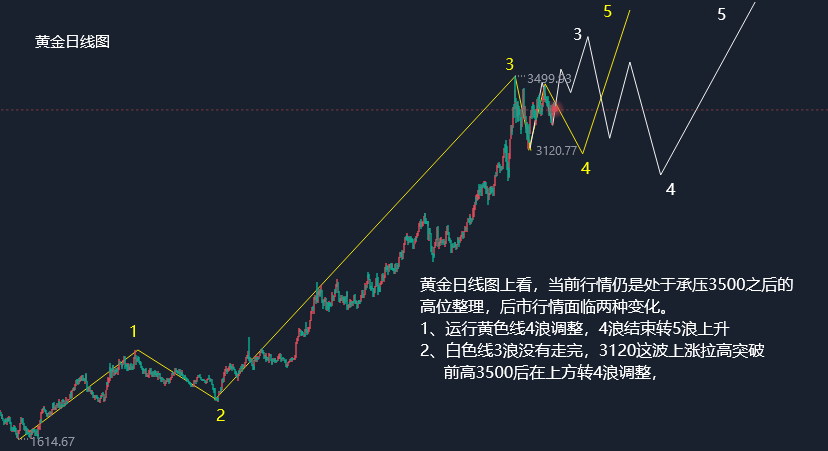
Group 1 - Current market sentiment for gold is cautious due to the prospect of sustained high interest rates from the Federal Reserve, which diminishes gold's appeal, while trade tensions and geopolitical risks provide some support for safe-haven assets [1] - The recent non-farm payroll data has weakened expectations for a rate cut by the Federal Reserve in July, leading to an increase in U.S. Treasury yields and the dollar index, which puts pressure on non-yielding assets like gold [1] - Market participants are closely monitoring the June FOMC meeting minutes, which will clarify members' assessments of the current economic outlook and future policy direction, potentially influencing interest rate trends [1] Group 2 - The daily structure of gold prices indicates a potential fourth wave adjustment after a peak at 3500, with expectations of further price movements following this adjustment [2] - On the 4-hour chart, a combined WXY three-wave adjustment is observed, with specific price levels identified for potential movements within the Y wave [4] - Recent price action shows gold rebounding to around 3342 before retreating, with a focus on support levels around 3296, which aligns with Fibonacci retracement levels [6] Group 3 - Trading strategies suggest buying near 3317/18 with a stop loss at 3311 and a target of 3325-3327, while also recommending short positions in the 3325-28 range with a stop loss at 3331 [7] - The domestic gold products, such as accumulation gold and futures, are closely correlated with international gold prices, with short-term trading opportunities identified amid recent price declines [8] - Accumulation gold opened lower following international gold trends, with specific support levels highlighted for potential buying opportunities [8]