
贸易顺差

Search documents
德国9月季调后贸易顺差为153亿欧元,预估为顺差168亿欧元
Mei Ri Jing Ji Xin Wen· 2025-11-07 07:21
Core Insights - Germany's adjusted trade surplus for September was €15.3 billion, which was below the forecast of €16.8 billion [1] - The previous value was revised from a surplus of €16.9 billion to a surplus of €17.2 billion [1] Economic Indicators - The trade surplus indicates a decrease compared to the forecast and previous values, suggesting potential shifts in Germany's trade dynamics [1] - The adjustment in previous values reflects ongoing changes in trade performance and economic conditions [1]
贸易顺差扩大澳元不涨反跌
Jin Tou Wang· 2025-11-07 03:31
Group 1 - The Australian dollar (AUD) stabilized against the US dollar (USD) at 0.6472 after the US Supreme Court heard debates regarding Trump's tariff policies [1] - The latest ADP employment report indicated an addition of over 42,000 jobs in the US last month, surpassing the expected median of 40,000, reversing a previous decline of 32,000 jobs [1] - The ISM report showed an increase in the services PMI from 50 to 52.4, while S&P's data indicated a rise from 54.2 to 54.8 [1] Group 2 - Australia's trade surplus for September expanded to AUD 3.938 billion, exceeding the expected AUD 3.850 billion and the previous value of AUD 1.111 billion [2] - Exports turned positive with a growth of 7.9%, while imports increased by 1.1%, lower than the previous growth of 3.3% [2] Group 3 - The AUD/USD pair stabilized after hitting a low of 0.6463, coinciding with a key support level that aligns with an ascending trend line since May 12 [3] - A head and shoulders pattern has formed, indicating a bearish reversal, with the neckline being the aforementioned ascending trend line [3] - The most likely forecast for AUD/USD is bearish, with an initial target at the psychological level of 0.6400; a break above the 100-day moving average at 0.6541 would invalidate the bearish outlook [3]
贸易数据利好 澳元持稳0.650上方
Jin Tou Wang· 2025-11-06 12:29
Core Viewpoint - The Australian dollar (AUD) against the US dollar (USD) remains above the 0.6500 level following a trade surplus that exceeded expectations, despite a general decline in the USD and a recovery in risk sentiment [1] Group 1: Technical Analysis - The AUD/USD pair is currently consolidating, with the 200-day simple moving average (SMA) at approximately 0.6440 acting as a significant support level, reinforced by the October low [1] - A potential downward trend could lead the AUD/USD to test the critical 200-day moving average support at 0.6445, with further declines possibly reaching the August low of 0.6414 and the June low of 0.6372 [1] - If bullish momentum returns, the October high at 0.6629 will be the immediate resistance, with potential upward movement towards 0.6707, followed by key levels at 0.6942 and 0.7000 [1] Group 2: Market Sentiment and Indicators - The Relative Strength Index (RSI) has rebounded above 45, indicating potential upward movement, while the Average Directional Index (ADX) above 16 suggests a sustained but weak trend [1] - The daily chart indicates that the AUD/USD pair is consolidating within a rectangular formation, showing sideways movement and remaining below the nine-day exponential moving average (EMA), which indicates weak short-term momentum [1] Group 3: Support and Resistance Levels - A successful breakout above the psychological level of 0.6500 could lead to testing the lower boundary of the rectangle around 0.6460, followed by the five-month low of 0.6414 recorded on August 21 [2] - Initial resistance is found at the nine-day EMA of 0.6520, followed by the 50-day EMA at 0.6539; breaking these levels would improve short- and medium-term price momentum [2] - Further upward movement would indicate a bullish trend, supporting the AUD/USD pair to approach the 13-month high of 0.6707 set on September 17 [2]
【环球财经】印尼三季度GDP同比增长5.04%
Xin Hua Cai Jing· 2025-11-05 07:14
Core Insights - Indonesia's GDP growth for Q3 2025 is reported at 5.04%, aligning closely with market expectations of 5% but slightly lower than the previous quarter's growth of 5.12% [1] - Key drivers of economic growth include exports and government spending, with exports of goods and services increasing by 9.91% year-on-year [1] - Fixed asset investment and private consumption growth have slowed, with fixed asset investment growing by 5.04% and household final consumption expenditure increasing by 4.89% [1] Economic Performance - The trade surplus for September reached $4.34 billion, marking 65 consecutive months of surplus since May 2020 [1] - The quarterly economic growth rate is 1.43%, with the electricity and gas sector showing the highest growth at 5.42% [1] - Other sectors such as construction and manufacturing also showed positive growth, while public administration and financial services experienced contraction [1] Government Outlook - The Indonesian government maintains its GDP growth target for the year at 5.2%, supported by sound fiscal policies and expectations of loose monetary policy [2] - The Finance Minister has set a target for Q4 growth to exceed 5.5% [2]
阿根廷9月进口创新高,贸易顺差持续收窄
Shang Wu Bu Wang Zhan· 2025-10-30 14:54
Core Insights - Argentina's imports reached a record high in September, leading to a narrowing trade surplus [1] Trade Data Summary - In September, Argentina's export value was $8.128 billion, while imports totaled $7.207 billion, resulting in a trade surplus of $921 million, marking the 21st consecutive month of surplus [1] - September imports increased by 10.1% month-on-month, the largest rise since September of the previous year, with seasonally adjusted imports reaching the highest level since August 2022 [1] - Notable increases in imports were seen in consumer goods and automobiles [1] Export Performance - In September, exports grew by 16.9% year-on-year and 1.3% month-on-month, continuing a five-month growth streak [1] - The temporary reduction in export withholding taxes significantly boosted soybean exports, which surged by 47% year-on-year [1] Cumulative Trade Surplus - From January to September, the cumulative trade surplus reached $6.03 billion, only 40% of the surplus recorded in the same period of 2024 [1] - The total trade surplus for the year is projected to be $7.7 billion, representing a year-on-year decline of 31.3% [1]
特朗普关税实施半年,中日欧对美顺差均减少
3 6 Ke· 2025-10-24 10:14
Group 1 - Japan's trade surplus with the United States decreased by 22.6% in the first half of 2025, amounting to 3.3222 trillion yen, marking the first decline in nine half-year periods [2] - Japan's exports to the U.S. fell by 10.2% to 9.7115 trillion yen, primarily due to declines in the automotive and machinery sectors [2] - The average price of Japanese cars exported to the U.S. dropped by 20.8% to 3.6 million yen, compared to 4.55 million yen in the same period last year [3] Group 2 - Japanese automakers are absorbing U.S. tariffs to maintain domestic sales prices, with a reported average price drop of 11.6% in September [5] - Some companies are passing on tariff costs by raising prices locally, which may negatively impact sales volume [5] - There is a trend of relocating production bases from Japan to the U.S., exemplified by Nissan moving part of its SUV production to the U.S. [5] Group 3 - China's trade surplus with the U.S. decreased by 29.8% in the first half of 2025, with exports down by 25.7% [6] - The European Union's trade surplus with the U.S. fell by 20% in the same period, with exports decreasing by 5% and imports from the U.S. increasing by 4% [6] Group 4 - Japan's overall trade balance showed a deficit of 1.2238 trillion yen in the first half of 2025, continuing a trend of deficits for nine consecutive half-year periods [7] - The Comprehensive and Progressive Agreement for Trans-Pacific Partnership (CPTPP) aims to strengthen multilateral cooperation in free trade [7]

特朗普关税实施半年,中日欧对美顺差均减少
日经中文网· 2025-10-24 08:03
Group 1 - Japan's trade surplus with the US decreased by 22.6% year-on-year in the first half of 2025, amounting to 3.3222 trillion yen, primarily due to high tariffs imposed by the Trump administration [2][4] - Japan's exports to the US fell by 10.2% in the first half of the year, marking the first decline in nine and a half years, with significant drops in the automotive and machinery sectors [4][6] - The average price of Japanese cars exported to the US decreased by 20.8% compared to the previous year, reflecting the impact of tariffs and market conditions [4][6] Group 2 - Other countries, including China and the Eurozone, also experienced a reduction in trade surpluses with the US, with China's surplus decreasing by 29.8% and the Eurozone's by 20% [2][7] - The overall trade balance for Japan showed a deficit of 1.2238 trillion yen in the first half of 2025, continuing a trend of deficits for nine and a half consecutive periods [7] - The ongoing trade tensions and tariff increases between the US and China could lead to further declines in trade volumes, impacting global trade dynamics [6][7]
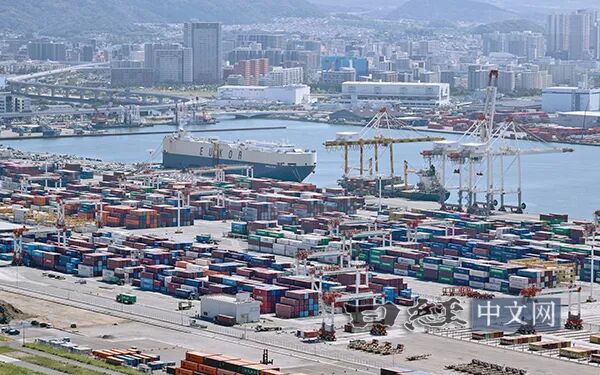
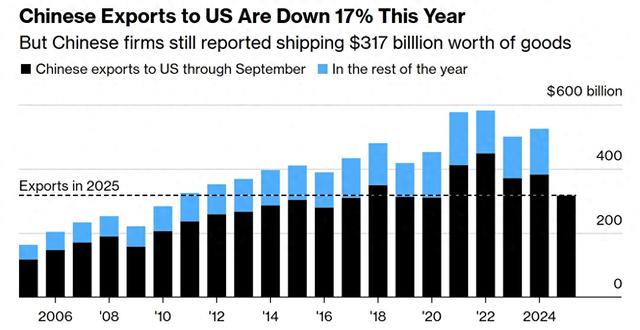
美国硬抗关税也得买,“每天从中国进口额仍有10亿美元”
Guan Cha Zhe Wang· 2025-10-22 09:39
Core Insights - The article highlights the resilience of Chinese exports despite ongoing trade tensions with the U.S., suggesting that many Chinese products remain indispensable to the U.S. market, thereby enhancing China's bargaining power in upcoming trade negotiations [1][4]. Trade Performance - Chinese exports to the U.S. reached over $100 billion in Q3 2023, contributing to a trade surplus of nearly $67 billion, despite an overall decline in trade volume [1][4]. - In September, China's exports grew by 8.3% year-on-year, surpassing economists' expectations, indicating a robust export performance [9][11]. Product-Specific Insights - Certain products, such as electric bicycles and refined copper, saw significant export growth, with electric bicycle exports valued at over $500 million and refined copper exports rising to $270 million [4][5]. - The export of smartphones, laptops, and computer components to the U.S. amounted to nearly $8 billion, despite being less than half of the previous year's figures [5]. Market Dynamics - The article notes that the U.S. tariffs have had limited impact on the import of certain Chinese goods due to their critical role in global supply chains, particularly in sectors like rare earths and electronics [1][4]. - Analysts suggest that the restructuring of supply chains to replace Chinese goods would take time, indicating a continued reliance on Chinese products [1][8]. Future Outlook - There is speculation that the U.S. and China may seek to ease trade tensions in the coming weeks, with both sides potentially making concessions [11]. - The Chinese government emphasizes the need for continued efforts to stabilize foreign trade amid a complex external environment [11].
日本上半财年对美出口同比大降
Xin Hua Wang· 2025-10-22 07:28
Core Viewpoint - Japan's exports to the United States have significantly decreased due to the impact of U.S. tariffs on automobiles and steel, leading to a substantial reduction in Japan's trade surplus with the U.S. [1] Group 1: Trade Statistics - In the first half of the fiscal year 2025 (April to September 2023), Japan's exports to the U.S. fell by 10.2% to 9.71 trillion yen (approximately 64 billion USD) [1] - The trade surplus with the U.S. decreased by 22.6% to 3.32 trillion yen (approximately 22 billion USD) [1] - The decline in exports was primarily driven by a 22.7% drop in automobile exports, which constitute over one-third of Japan's total exports to the U.S. [1] Group 2: Global Trade Overview - Japan's total exports increased slightly by 0.2% year-on-year to 53.65 trillion yen (approximately 352 billion USD) [1] - Japan's imports decreased by 3.2% year-on-year to 54.88 trillion yen (approximately 360 billion USD) [1]