
黄金

Search documents
行业、主题ETF合计规模破万亿元,年内增长超77%
Mei Ri Jing Ji Xin Wen· 2025-10-10 05:56
Core Insights - The ETF market has seen significant growth in 2023, with industry and thematic ETFs increasing from less than 600 billion yuan at the beginning of the year to over 1 trillion yuan, marking a growth of over 77% [4][5][6] - Investment strategies have shifted, with some investors buying more of underperforming ETFs while others are taking profits from high-performing ones [4][9][10] ETF Market Overview - As of September 30, there are 483 thematic ETFs and 84 industry ETFs, with total assets surpassing 1 trillion yuan [5][6] - The combined scale of these ETFs has increased by 462.77 billion yuan this year, contrasting sharply with the 330 billion yuan increase in broad-based ETFs [5][6] Performance Analysis - 16 industry and thematic ETFs have seen gains exceeding 80% this year, with 150 products yielding over 50% returns [7] - The top-performing ETF, Guotai Chuangye Board AI ETF, has surged by 121.53%, while other notable performers include ETFs focused on communication and gold [7][8] Fund Flow Dynamics - The market has shown a clear trend of "buying the dip," with funds flowing into underperforming ETFs like the coal ETF, which despite a 5.65% decline, saw its scale increase by nearly 300% [9][10] - Conversely, some high-performing ETFs have experienced a decrease in scale, indicating a "take profit" strategy among investors [10] Sector Performance - The top-performing ETFs are primarily in technology sectors such as AI, communication, and chips, while energy and coal ETFs have faced declines [8] - Notably, the performance of the Huatai-PineBridge CSI Innovation Drug ETF was surprising, as it launched mid-September and did not perform as expected [8]

A股节后迎来开门红 上证指数站上3900点
Zhong Guo Zheng Quan Bao· 2025-10-09 21:49
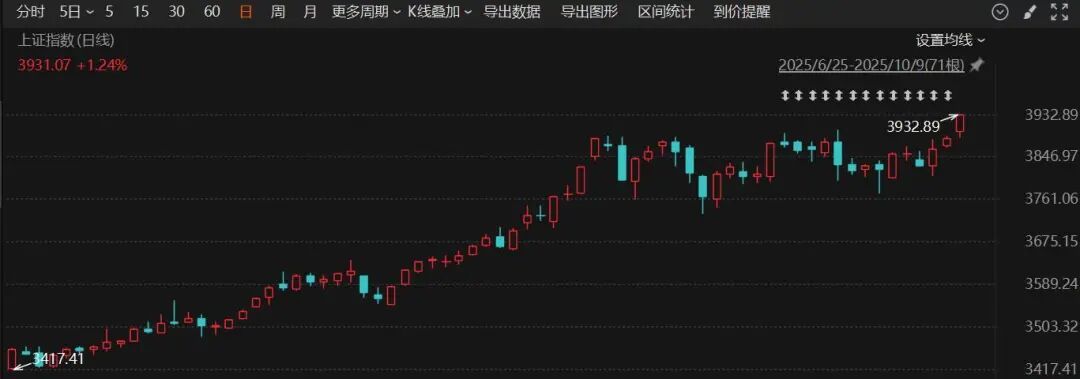
Market Performance - A-shares experienced a strong opening on October 9, with the Shanghai Composite Index rising over 1% to surpass 3900 points, marking a new high in over 10 years [1] - More than 3100 stocks in the A-share market increased, with nearly 100 stocks hitting the daily limit [1] - The total trading volume exceeded 2.6 trillion yuan, with a significant increase in market activity [1][2] Index Movements - By the end of the trading day, the Shanghai Composite Index, Shenzhen Component Index, ChiNext Index, and STAR Market 50 Index rose by 1.32%, 1.47%, 0.73%, and 2.93% respectively, while the North Stock 50 Index fell by 0.18% [1] - Large-cap indices such as the Shanghai 50 Index and CSI 300 Index increased by 1.06% and 1.48%, respectively, indicating strong performance in large-cap stocks [1] Sector Performance - Strong performances were noted in sectors such as gold, rare earths, nuclear fusion, copper, and storage chips, with technology and cyclical stocks showing significant strength [1] - Among the Shenwan first-level industries, non-ferrous metals, steel, and coal sectors led the gains, rising by 7.60%, 3.38%, and 3.00% respectively [1] - Conversely, sectors such as media, real estate, and social services experienced declines, with drops of 1.43%, 1.39%, and 1.03% respectively [1] Trading Volume - The trading volume for A-shares reached 2.67 trillion yuan, an increase of 474.6 billion yuan compared to the previous trading day [2] - The trading volume in the Shanghai market was 1.2169 trillion yuan, while the Shenzhen market recorded 1.4363 trillion yuan [2] - Since August 13, the A-share market has seen trading volumes exceed 2 trillion yuan for 36 consecutive trading days [2]
行业、主题ETF合计规模破万亿元 年内增长超77%
Mei Ri Jing Ji Xin Wen· 2025-10-09 14:38
Core Viewpoint - The ETF market has experienced significant growth in 2023, with industry and thematic ETFs seeing their combined scale increase from less than 600 billion to over 1 trillion yuan, marking a growth of over 77% [1][2]. ETF Market Overview - As of September 30, there are 483 thematic ETFs and 84 industry ETFs, with total scales of 774.79 billion yuan and 287.63 billion yuan respectively, surpassing 1 trillion yuan in total scale [2]. - The combined scale of these ETFs has increased by 462.77 billion yuan this year, compared to a much smaller increase of 330 billion yuan for broad-based ETFs [2]. Fund Flow Dynamics - The shift in investor behavior is evident, with some investors buying more of underperforming ETFs while others take profits from those that have performed well [1][4]. - Notably, the coal ETF, despite a decline of 5.65%, saw its scale grow from 2.8 billion yuan to 11.4 billion yuan, a nearly 300% increase [1][7]. Performance of ETFs - 16 industry and thematic ETFs have seen gains exceeding 80% this year, with 150 products yielding over 50% returns [4]. - The top-performing ETF, the Guotai Chuangye Board AI ETF, has surged by 121.53%, while other notable performers include the Guotai Zhongzheng All Index Communication Equipment ETF and the Yongying Zhongzheng Hong Kong Gold Industry ETF, with increases of 96.19% and 87.3% respectively [4][5]. Sector Analysis - The top-performing ETFs are primarily from two sectors: technology, represented by AI, communication, and chips, and gold stocks [5]. - Conversely, the worst performers include energy and coal ETFs, with declines exceeding 6% [6]. Fund Size and Performance Correlation - Among ETFs with scales exceeding 10 billion yuan, the top three in terms of scale are the Guotai Fund's Securities ETF, the Jiashi Fund's Sci-Tech Chip ETF, and the Huabao Fund's Broker ETF [7]. - The Jiashi Fund's Sci-Tech Chip ETF leads in annual returns at 75.1%, while the only declining product among the large-scale ETFs is the Penghua Fund's Wine ETF, which has dropped over 4% [7][8]. Investment Strategies - The trend of "buying the dip" is evident, with significant inflows into ETFs that have underperformed, while some investors are also taking profits from high-performing ETFs [8]. - The top three ETFs in terms of scale increase this year are the Guotai Fund's Securities ETF, the Huaxia Fund's Robotics ETF, and the Jiashi Fund's Sci-Tech Chip ETF, indicating a mix of strategies among investors [8].
22个巡查组,即将进驻!联系方式公布→
证券时报· 2025-10-09 10:12
Core Viewpoint - The article discusses the upcoming safety production assessment and inspection work scheduled for November 2023, involving 22 central inspection teams across various regions in China, aimed at addressing safety production issues and collecting feedback from the public and workers [1]. Group 1: Safety Production Assessment - In November 2023, 22 central safety production assessment teams will conduct inspections in 31 provinces, autonomous regions, municipalities, and the Xinjiang Production and Construction Corps as part of the 2025 safety production assessment plan [1]. - The assessment will focus on major safety production issues, illegal activities, and suggestions for improving safety production responsibilities from frontline workers [1]. Group 2: Public Participation - From October 9 to October 31, 2023, the State Council's Safety Production Committee Office will accept reports of safety production issues through internet, phone, and mail [1][2]. - The public is encouraged to provide objective and truthful feedback regarding safety production issues in their regions [2]. Group 3: Reporting Methods - The reporting methods include a dedicated website and a phone line available from October 9 to 31, 2023, daily from 8:00 AM to 6:00 PM [3][4]. - Mail submissions should be addressed to a specific postal box in Beijing, ensuring proper formatting [5].

一手避险一手科技 三大概念领衔节后行情
Mei Ri Jing Ji Xin Wen· 2025-10-09 08:51
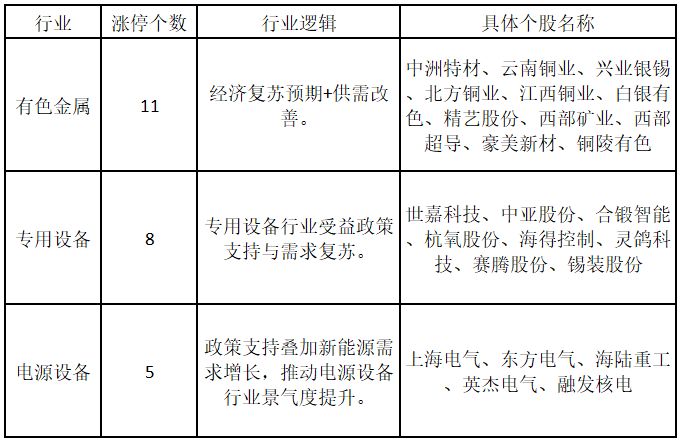
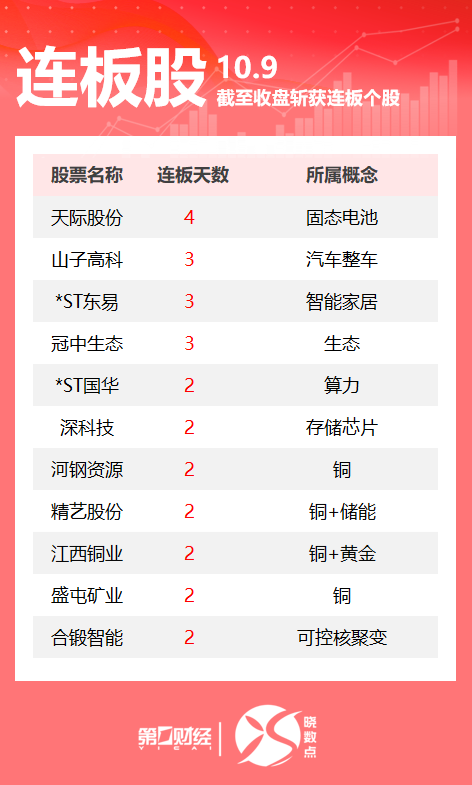
Market Overview - The Shanghai Composite Index rose by 1.32%, reaching a new high for the year, while the median stock performance was relatively weak with a median change of 0.47% [1] - A total of 88 stocks hit the daily limit up, an increase of 36 from the previous day, while 18 stocks hit the limit down, an increase of 17 [2] Key Sectors - The sectors with the most limit-up stocks included non-ferrous metals, specialized equipment, and power equipment [3] - The notable limit-up sectors today were: - Non-ferrous metals: 11 stocks, driven by economic recovery expectations and supply-demand improvements [3] - Specialized equipment: 8 stocks, benefiting from policy support and demand recovery [3] - Power equipment: 5 stocks, supported by policy backing and growth in new energy demand [3] Conceptual Highlights - The most prominent concepts among limit-up stocks were nuclear fusion, domestic chips, and gold [4] - Limit-up stocks in the nuclear fusion sector numbered 10, driven by technological breakthroughs and expectations for energy alternatives [4] - Domestic chip stocks also numbered 10, propelled by self-sufficiency demands and increased policy support [4] - Gold stocks reached 10, influenced by rising international risk aversion and expectations of interest rate cuts by the Federal Reserve [4] Individual Stock Performance - 15 stocks reached historical highs, including Tongfu Microelectronics, Hezhong Intelligent, and others [5] - 26 stocks reached near one-year highs, including Jiangxi Copper, YD Technology, and others [6] Main Capital Inflows - The top five stocks by net capital inflow included Northern Rare Earth, Shanghai Electric, and others, with Northern Rare Earth seeing a net inflow of 2.658 billion yuan [8][9] - The top five stocks by net inflow as a percentage of market value included Changfu Co., Lingge Technology, and others, with Changfu Co. at 10.18% [10] Limit-Up Stock Rankings - The stocks with the highest limit-up capital included Tongfu Microelectronics, Shanghai Electric, and others [10] - The stocks with the most consecutive limit-ups included Tianji Co., Shanzi Gaoke, and others [11]
连板股追踪丨A股今日共100只个股涨停 这只固态电池概念股4连板
Di Yi Cai Jing· 2025-10-09 08:47
Group 1 - The core viewpoint of the article highlights the performance of various stocks in the A-share market, particularly focusing on the surge in metal copper sector stocks such as HeSteel Resources and Jiangxi Copper, which achieved two consecutive trading limit increases [1] Group 2 - On October 9, a total of 100 stocks in the A-share market reached their daily limit up, indicating strong market activity [1] - The solid-state battery concept stock Tianji Co., Ltd. achieved four consecutive limit increases, showcasing significant investor interest in this sector [1] - Other notable stocks with consecutive limit increases include Shanzi Gaoke (3 consecutive limits) in the automotive sector, and *ST Dongyi (3 consecutive limits) in smart home technology [1] - The copper sector saw multiple stocks, including HeSteel Resources, Jiangxi Copper, and others, each achieving two consecutive limit increases, reflecting positive market sentiment towards copper-related investments [1]
A股狂飙!3900点里程碑重现,黄金冲破4000美元引爆市场
Sou Hu Cai Jing· 2025-10-09 07:14
Market Analysis - Global capital markets have shown significant increases during the holiday period, particularly in gold, US stocks, and copper, driven primarily by AI narratives [2] - The A-share market has returned to 3900 points after 10 years, with technology stocks being the main upward momentum, heavily influenced by external market sentiment and capital flow [2] - The continued rise of indices indicates signs of capital returning before the holiday, with October expected to be a competitive month for individual stocks [2] Gold Market Insights - Three anchors for gold pricing have been identified: reserve value, consumption value, and trading value [2] - With the ongoing expansion of dollar credit cracks, a long-term bull market for gold is anticipated, as the demand for gold is expected to grow [2] - By 2025, domestic gold jewelry companies are expected to see sales increases and performance improvements [2] Sector Performance - The gold concept stocks opened significantly higher, with several stocks reaching their daily limit, reflecting strong market interest [3] - The semiconductor sector is also active, with AMD's partnership with OpenAI leading to a notable increase in AMD's stock price [4] - Solid-state battery concept stocks have shown strong fluctuations, driven by advancements in battery technology [5] Index Performance - The Shanghai Composite Index has shown a strong upward trend post-holiday, with a focus on whether it can maintain above 3950 points [9] - The ChiNext Index has reached new highs, with technology stocks being the primary drivers, although the performance remains characterized by rotation rather than collective surges [9] Investment Outlook - The consensus among broker reports indicates a positive macro environment for A-shares following the holiday, with a focus on resource and AI sectors [15] - The long-term logic supporting gold's continued rise is centered around the restructuring of the global monetary credit system, with gold being viewed as a stabilizing asset during economic turbulence [15] - The ongoing accumulation of US debt poses risks to monetary credit, further enhancing gold's appeal as a safe-haven asset [16]



沪指突破3900点,A股“王者归来”,这一概念掀涨停潮
Zheng Quan Shi Bao· 2025-10-09 04:55
Market Overview - The Shanghai Composite Index has surpassed 3900 points for the first time in 10 years, marking a new high [1] - The ChiNext Index and the Shenzhen Component Index also reached multi-year highs, with significant trading volume exceeding 1 trillion yuan within the first hour of trading [1][3] Sector Performance - The New Energy sector saw a collective surge, with the sector index rising over 6%, reaching a historical high [5] - Key stocks in the New Energy sector, such as Haheng Huadong and Zhongzhou Special Materials, hit the daily limit of 20% increase [5] - Other sectors like non-ferrous metals, consumer electronics, and chips also performed well, while sectors such as film and television, tourism, real estate, and liquor saw declines [3] New Energy Developments - Significant advancements in the New Energy field were reported during the National Day holiday, including the launch of a large-capacity sodium-ion battery energy storage station in Guangxi [7] - Breakthroughs in solid-state lithium battery technology were achieved by a team from the Chinese Academy of Sciences, addressing issues related to interface resistance and ion transport efficiency [8] - The controlled nuclear fusion sector also made progress with key developments in the BEST project in Anhui, indicating a clearer commercialization path for fusion technology [9] Precious Metals Market - The precious metals sector experienced a substantial increase, with the sector index rising nearly 9% to reach a historical high [11] - Domestic gold futures surged over 900 yuan, closing at 913.9 yuan, also a record high [13] - The recent U.S. government shutdown has been identified as a catalyst for the rise in gold prices, with historical parallels drawn to previous government shutdowns [13][14]
A股芯片半导体集体爆发,芯原股份涨16%,全市场超3200股上涨
2 1 Shi Ji Jing Ji Bao Dao· 2025-10-09 03:32
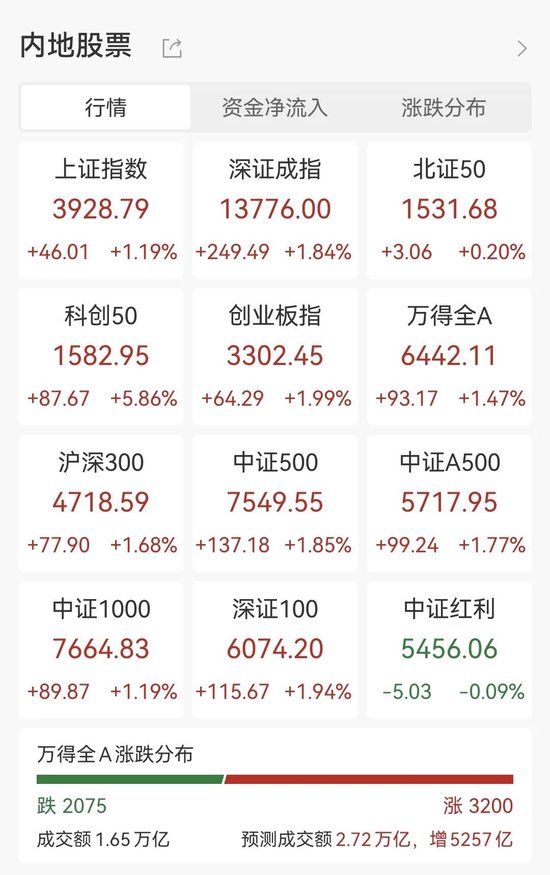
Market Overview - The three major indices opened higher on October 9, with the Shanghai Composite Index rising by 1.19% to surpass 3900 points for the first time since August 2015 [1][2] - The Shenzhen Component increased by 1.84%, and the ChiNext Index rose by 1.99%, with over 3200 stocks in the two markets experiencing gains [1][2] - The total trading volume reached 1.65 trillion yuan, an increase of 525.7 billion yuan compared to the previous trading day [1] Sector Performance - The STAR 50 Index saw a gain of over 5%, with significant increases in the semiconductor industry, including Chipone Technology rising over 16% [1][2] - The GPU, controllable nuclear fusion, and rare earth sectors led the gains, while real estate and short drama sectors faced declines [3][4] - Notable stocks included ZTE Corporation, which hit the daily limit with a trading volume exceeding 12 billion yuan, and H-shares rising nearly 12% to a historical high [3] Chip Sector Highlights - The storage chip sector experienced a significant surge, with companies like Huahong Semiconductor and Yake Technology hitting their daily limits [4][5] - The STAR 50 ETF increased by 3.31%, with stocks such as Western Superconducting and Chipone Technology showing gains of over 16% [5][6] - A recent report indicated that global storage chip prices have been rising, with expectations of a 10% increase in server eSSD prices and a 10-15% rise in DDR5 RDIMM prices in Q4 2025 [6] Gold and Precious Metals - Gold futures surged, with the main contract breaking the 900 yuan/gram mark, reaching a historical high of 913.5 yuan/gram [7][8] - The precious metals sector saw collective gains, with companies like Sichuan Gold and Zhongjin Gold rising significantly [8] Nuclear Fusion and Rare Earth Developments - The controllable nuclear fusion sector showed strong performance, with companies like Hezhong Intelligent and Western Superconducting gaining traction following news of China's nuclear fusion device construction [9] - Rare earth stocks also performed well, with Baotou Steel and Northern Rare Earth seeing increases after the Ministry of Commerce announced new export controls on rare earth technologies [10]




国庆期间港股有哪些亮点?
Changjiang Securities· 2025-10-09 02:43
Group 1 - The Hong Kong stock market showed positive performance during the National Day holiday, with the Hang Seng Index rising by 0.4%, the Hang Seng Tech Index increasing by 1.3%, and the Hang Seng China Enterprises Index up by 0.2% from October 1 to October 6, 2025. The gains were primarily driven by October 2 [2][5][6] - The MSCI Hong Kong Growth Index fell by 0.3%, while the MSCI Hong Kong Value Index decreased by 0.1% during the same period [5][6] - Key sectors that performed well included steel (+5.60%), electronics (+3.90%), non-ferrous metals (+3.78%), and power equipment and new energy (+3.43%), while agriculture, real estate, food and beverage, and consumer services sectors lagged [5][6] Group 2 - Gold and AI narratives emerged as leading themes during the holiday period, with the U.S. government shutdown impacting market sentiment and driving up COMEX gold and silver prices, benefiting the non-ferrous metals sector in Hong Kong [6][7] - The release of the experimental version DeepSeek-V3.2-Exp on September 29, 2025, contributed to the growth of the AI industry chain in China, leading to significant gains for semiconductor leaders and major internet companies in the Hong Kong market [6][7] Group 3 - As of October 6, 2025, the AH premium rate stood at 129.6%, close to the historical average of 127.1% since 2009, showing a significant decline from over 140% in May [7] - The VHSI index remained stable around 21, indicating a steady market environment, while the average daily trading volume in Hong Kong stocks showed an upward trend [7][8] - Short-term liquidity tightened slightly during the holiday period, as indicated by the 3-month HIBOR and overnight HIBOR rates [7][8] Group 4 - Future prospects for the Hong Kong stock market suggest potential for new highs, contingent on three assumptions: continued inflow of southbound capital, the performance of AI technology and new consumption sectors, and the transmission of monetary policy from broad money to broad credit [8] - The report emphasizes that if these conditions are met, the Hong Kong market could see further upward momentum, supported by a rebound in related industries [8]