长债收益率

Search documents
2026年2月金融数据预测:社融增速或延续小幅下行
Hua Yuan Zheng Quan· 2026-02-28 07:48
1. Report Industry Investment Rating - No information provided in the given content 2. Core Views of the Report - Forecasts for February 2026: 750 billion yuan in new loans, 1.99 trillion yuan in social financing increment, M2 reaching 349.2 trillion yuan with a YoY increase of 8.9%, new - caliber M1 YoY increase of 5.0%, and social financing growth rate of 8.1% [2] - New loans in February may be less than the same period last year due to weak real - economy financing demand, mortgage prepayment pressure, and weak consumer credit demand. It is expected that short - term personal loans will be - 30 billion yuan, medium - and long - term personal loans will be - 15 billion yuan, short - term corporate loans will be + 30 billion yuan, medium - and long - term corporate loans will be + 45 billion yuan, and bill financing will be + 30 billion yuan [3] - M2 growth rate in February may be stable. The new - caliber M1 growth rate is expected to be 5.0% at the end of February 2026, with little change from the previous month. M2 growth rate is expected to be 8.9% [3] - Social financing increment in February may be less than the same period last year, and the growth rate will decline slightly. The social financing growth rate may continue to decline in the next few months and reach about 7.5% by the end of 2026. The social financing increment in 2026 is predicted to be about 35 trillion yuan [3] - The adjustment of long - term bonds may be an opportunity. After the adjustment at the end of February, the yield of long - term bonds is expected to fall again after the sentiment stabilizes. The target points for the 10Y Treasury bond are 1.75% in Q1 and 1.70% in Q2. It is expected that the 10Y Treasury bond yield will fluctuate between 1.6% - 1.9% in 2026 [3] 3. Summary by Relevant Catalogs Forecast of New Loans - In February 2026, new loans are expected to be 750 billion yuan, less than the same period last year. Due to factors such as weak real - economy financing demand, mortgage prepayment pressure, and weak consumer credit demand, the new loans in 2026 may still be less than the same period last year [2][3][7] Forecast of M2 and M1 - The new - caliber M1 growth rate at the end of February 2026 is expected to be 5.0%, with little change from the previous month. The M2 growth rate at the end of February is expected to be 8.9%, relatively stable [3] Forecast of Social Financing - The social financing increment in February 2026 is predicted to be 1.99 trillion yuan, less than the 2.23 trillion yuan in February 2025. The social financing growth rate at the end of February is expected to drop to 8.1%. The social financing growth rate may continue to decline in the next few months and reach about 7.5% by the end of 2026. The social financing increment in 2026 is predicted to be about 35 trillion yuan [2][3][10] Analysis of Long - Term Bonds - The adjustment of long - term bonds at the end of February may be an opportunity. After the sentiment stabilizes, the yield of long - term bonds is expected to fall again. The target points for the 10Y Treasury bond are 1.75% in Q1 and 1.70% in Q2. It is expected that the 10Y Treasury bond yield will fluctuate between 1.6% - 1.9% in 2026. The allocation of ultra - long bonds by insurance funds may increase in March, and the yield of the 30Y Treasury bond active bond is expected to reach 2.2% [3]
2026年1月金融数据点评:开年金融数据的几点信号
Hua Yuan Zheng Quan· 2026-02-14 06:56
Group 1: Report Industry Investment Rating - No information provided Group 2: Core Views of the Report - In January 2026, new loans increased significantly less year-on-year, reflecting weak credit demand. The Spring Festival in 2026 was late, and the early repayment of personal loans before the Spring Festival might affect February's personal loan data. Due to the forward - leaning credit delivery rhythm and weak credit demand, new loans in 2026 may continue to increase less year - on - year [2]. - The M1 growth rate temporarily rebounded. The new - caliber M1 growth rate at the end of January 2026 was 4.9%, up 1.1 percentage points from the end of last month, mainly due to the low year - on - year base and active stock market transactions. The M2 growth rate at the end of January was 9.0%, up 0.5 percentage points from the end of last month, mainly affected by the year - on - year base [2]. - The social financing growth rate declined month - on - month in January 2026, and it is expected to continue to decline in 2026. The social financing increment in January was 7.22 trillion yuan, a slight year - on - year increase. It is expected that new loans (in the social financing caliber) will increase slightly less year - on - year in 2026, the net financing of government bonds will expand year - on - year, the social financing increment will be similar year - on - year, and the social financing growth rate will decline slightly, reaching about 7.5% at the end of 2026 [2]. - There is further room for the long - term bond yield to decline. The long - term bond yield may decline by 5 - 10BP in the first quarter, the 10Y Treasury bond yield is expected to reach 1.75%, the 30Y Treasury bond active bond may return below 2.2%, and the 1Y large - bank inter - bank certificate of deposit rate may fall below 1.55%. It is expected that the 10Y Treasury bond yield will fluctuate in the range of 1.6% - 1.9% in 2026, and the bond market trend may be significantly stronger than the initial expectation [2]. Group 3: Summary by Related Catalogs 1. January 2026 Financial Data - New loans in January 2026 were 4.71 trillion yuan, a year - on - year decrease of 0.42 trillion yuan. Personal loans increased by 4565 billion yuan (short - term loans + 1097 billion yuan, medium - and long - term loans + 3469 billion yuan), and corporate loans increased by 4.45 trillion yuan (short - term loans + 2.05 trillion yuan, medium - and long - term loans + 3.18 trillion yuan, bill discounting - 8739 billion yuan) [2]. - At the end of January, M2 reached 347.2 trillion yuan, with a year - on - year growth rate of 9.0%; M1 had a year - on - year growth rate of 4.9%; the social financing growth rate was 8.2% [1]. - The social financing increment in January was 7.22 trillion yuan (7.05 trillion yuan in January 2025), a slight year - on - year increase. The increase mainly came from the net financing of government bonds and undiscounted bank acceptance bills. The increment of RMB loans to the real economy in January was 4.9 trillion yuan, a year - on - year decrease of 3194 billion yuan; entrusted loans were - 192 billion yuan, trust loans were - 4 billion yuan, undiscounted bank acceptance bills were + 6293 billion yuan; corporate bond net financing was 5033 billion yuan; government bond net financing was 9764 billion yuan [2]. 2. Forecast for 2026 - It is expected that new loans (in the social financing caliber) will increase slightly less year - on - year in 2026, the net financing of government bonds will expand year - on - year, the social financing increment will be similar year - on - year, and the social financing growth rate will decline slightly, reaching about 7.5% at the end of 2026 [2]. - It is expected that the 10Y Treasury bond yield will fluctuate in the range of 1.6% - 1.9% in 2026, and the bond market trend may be significantly stronger than the initial expectation [2].
【笔记20260206— 到底缺什么力?】
债券笔记· 2026-02-06 10:29
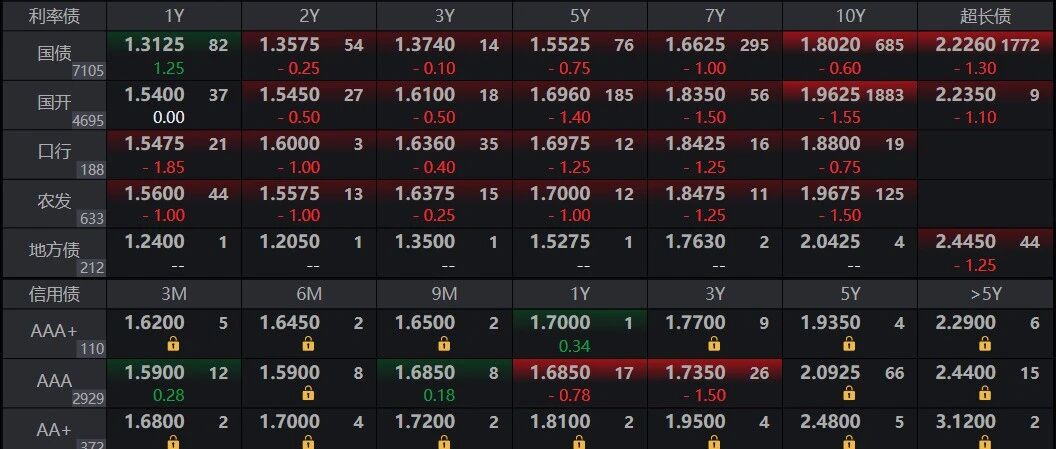
Core Viewpoint - The article discusses the current state of the financial market, highlighting a slight decline in the stock market and a balanced, loose funding environment, which may indicate potential investment opportunities and risks in the near future [3]. Group 1: Market Conditions - The funding environment is described as balanced and loose, with a slight decline in long-term bond yields [3]. - The central bank conducted a reverse repurchase operation of 315 billion yuan for 7-day and 3000 billion yuan for 14-day terms, with a net withdrawal of 1460 billion yuan due to the maturity of 4775 billion yuan in 7-day reverse repos [3]. - The overnight interbank funding rates showed a slight decrease, with DR001 around 1.28% and DR007 around 1.46% [3]. Group 2: Interest Rates and Bond Market - The weighted average rates for various funding types showed a decline, with R001 at 1.36% (down 6 basis points), R007 at 1.53% (down 2 basis points), and R014 at 1.59% [4]. - The 10-year government bond yield fluctuated, starting at 1.805% and dropping to a low of 1.80% during the day, indicating a mixed sentiment in the bond market [5]. - The article suggests that the 10-year bond yield of 1.80% is perceived as a significant psychological barrier for investors, with previous ranges not effectively containing the yield [5]. Group 3: Investor Sentiment and AI Industry - Investor sentiment appears cautious, with two-thirds of investors planning to hold bonds through the holiday, anticipating a potential rally to break the 1.80% yield barrier [5]. - The article critiques the current state of the AI industry, suggesting that it lacks imagination and is overly focused on competition rather than innovation [5].

中信证券首席经济学家明明:2026年长债收益率或“先下后上”
2 1 Shi Ji Jing Ji Bao Dao· 2026-01-07 07:38
Group 1 - In 2025, the domestic capital market demonstrated strong resilience and vitality, with major equity indices surpassing 4000 points, particularly in technology and banking sectors [1] - The central economic work conference has laid out plans for 2026, indicating that growth-stabilizing policies are expected to continue, which may further enhance market confidence [1] - Consumption is projected to continue its moderate recovery, becoming the main driver of economic growth, while investment is expected to stabilize amid structural improvements [4][3] Group 2 - The fiscal policy is anticipated to maintain a moderate expansion, with new special bond quotas expected to reach 5 trillion yuan, and the scale of ultra-long-term special government bonds likely to remain at 1.3 trillion yuan [6][5] - The consumer price index (CPI) is expected to rise moderately, with an annual average around 0.5%, while the producer price index (PPI) is projected to turn positive year-on-year by the third quarter [4] - The monetary policy is expected to have room for further easing, with potential for both reserve requirement ratio cuts and interest rate reductions, particularly focusing on supporting technology, green initiatives, and consumption [5][6] Group 3 - The bond market is expected to experience a "down then up" trend in long-term bond yields, influenced by economic recovery, fiscal expansion, and improved policy expectations [7] - The RMB is projected to maintain a stable appreciation trend, supported by a weaker dollar, a stabilizing domestic economy, and ongoing foreign exchange demand [8] - Key sectors such as artificial intelligence and high-end manufacturing are anticipated to emerge as new highlights in the industry landscape, driven by supportive technology policies [12][10]

2025年11月银行间本币市场运行报告
Sou Hu Cai Jing· 2025-12-30 03:21
Group 1: Money Market Overview - The average daily trading volume in the money market increased to 7.86 trillion yuan in November, a 2.3% month-on-month rise, with total trading volume reaching 157.2 trillion yuan, up 13.7% month-on-month [2] - The central bank conducted a net injection of 600 billion yuan in medium to long-term funds, maintaining a balanced and accommodative liquidity environment, while the main repo rates saw a slight increase [3] - The average daily balance in the money market decreased to 12.5 trillion yuan, down 1.7% month-on-month, with net lending balances from large commercial banks and policy banks also declining by 11.3% and 3% respectively [5] Group 2: Bond Market Activity - The issuance of bonds in the primary market increased to 4.7 trillion yuan in November, a 21.2% month-on-month rise, with net financing reaching 2.18 trillion yuan, up 119.3% month-on-month [6] - The trading volume of bonds also saw an increase, with 30.3 trillion yuan in total transactions, reflecting a 3% month-on-month growth [7] - Long-term bond yields experienced fluctuations, with the 10-year government bond yield mostly ranging between 1.8% and 1.85%, and the yield curve steepening [8] Group 3: Interest Rate Swaps - The interest rate swap curve shifted upward, with the 6-month, 1-year, and 5-year SHIBOR 3M swap rates increasing by 2 and 6 basis points respectively [9] - The average daily transaction volume in the RMB interest rate swap market decreased by 7.8% month-on-month, with a total nominal principal of 3.7 trillion yuan [9]
长债收益率创下新高,新一轮风险在酝酿?
大胡子说房· 2025-12-14 03:33
Core Viewpoint - The article highlights the rising long-term bond yields in major economies, indicating a lack of market confidence and potential financial instability, which could lead to a global financial crisis driven by debt issues [1][16][17]. Group 1: Long-term Bond Yields - Major economies are experiencing record high long-term bond yields, with the US 10-year Treasury yield surpassing 4.15%, Japan's 30-year yield reaching 3.445%, and Germany's 10-year yield at 2.836% [1]. - Rising yields reflect a market that is selling off bonds, necessitating higher returns to attract buyers, which could lead to a vicious cycle of increasing yields and declining confidence [2][18]. Group 2: Debt Dynamics - The high levels of debt in Western economies are largely driven by past economic growth fueled by borrowing, with the US playing a central role in this dynamic [4]. - The US government has accumulated a debt of $38 trillion, with annual interest payments alone amounting to $1.2 trillion [5]. - The global reliance on the US dollar as the world's reserve currency creates a closed loop where global earnings in dollars are reinvested into US Treasury bonds, allowing the US to continue its spending [6][7]. Group 3: Inflation and Interest Rates - The US has faced rising domestic inflation due to extensive quantitative easing (QE) measures and tariff increases, prompting the Federal Reserve to initiate a cycle of interest rate hikes [9][12]. - The challenge for the US government is balancing the need to control inflation while managing rising interest payments on its debt, which consumes a significant portion of fiscal revenue [12][15]. Group 4: Global Economic Implications - The dilemma facing major economies is whether to prioritize inflation control or economic growth, with potential repercussions for the global financial system [21][22]. - The situation is exacerbated by the interconnectedness of the global economy, where issues in the US can lead to widespread financial distress [17][18]. Group 5: Investment Strategies - The article suggests that in light of rising inflation and debt concerns, investors should focus on assets that generate real cash flow and can withstand inflation, rather than relying on long-term bonds [31]. - It emphasizes the importance of reducing debt and maintaining cash flow flexibility in a high-volatility environment [32]. - The need for a new economic growth breakthrough, particularly through technological advancements like AI, is highlighted as essential for overcoming current economic challenges [30][31].

【笔记20251201— 债农的宏观视野与内卷艺术】
债券笔记· 2025-12-01 11:40
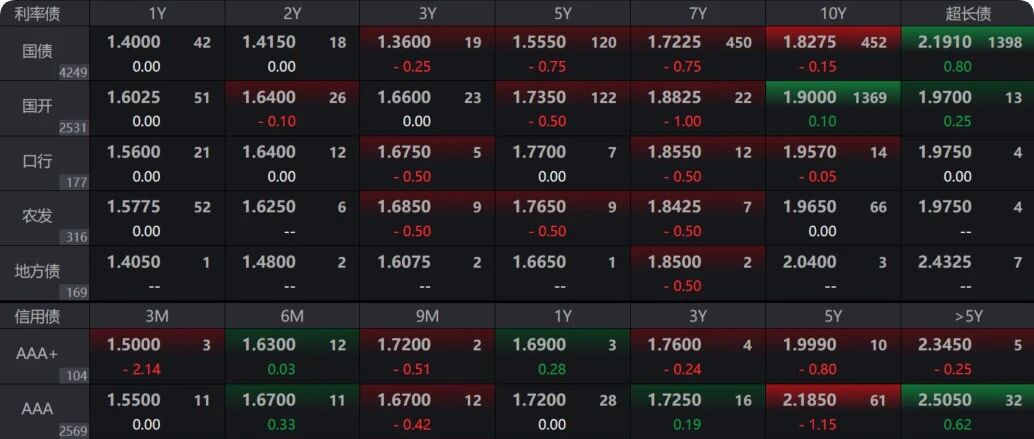
Core Viewpoint - The article emphasizes the importance of using rational analysis to navigate market fluctuations while aligning with the prevailing market trends, rather than attempting to predict market tops or bottoms [1]. Group 1: Macro Economic Indicators - The November PMI data met expectations, with the official manufacturing PMI reported at 49.2, indicating a stable economic outlook [5]. - The central bank reportedly purchased 200 billion yuan in bonds in November, contributing to a mixed performance in the stock market, with the Shanghai Composite Index returning to 3900 points [5]. - The central bank conducted a 107.6 billion yuan reverse repurchase operation, with a net withdrawal of 231.1 billion yuan due to 338.7 billion yuan in reverse repos maturing [3]. Group 2: Interest Rates and Bond Market - The weighted rates for various repo codes showed slight decreases, with R001 at 1.37% (down 5 basis points) and R007 at 1.49% (down 3 basis points) [4]. - The 10-year government bond yield fluctuated around 1.83%, with the lowest rate dropping to 1.822% before slightly recovering to 1.8275% [5]. - The interest rates for government bonds varied, with the 1-year bond at 1.40% and the 10-year bond at 1.8275%, reflecting a range of changes across different maturities [7].
【笔记20251027— 大A3999,债市6666】
债券笔记· 2025-10-27 11:32
Core Viewpoint - The article discusses the current financial market conditions, highlighting the impact of central bank policies, particularly the resumption of bond purchases and the decline in MLF (Medium-term Lending Facility) interest rates, which have contributed to a bullish sentiment in the stock market and a significant drop in long-term bond yields [1][3]. Financial Market Overview - The central bank conducted a net injection of 348.3 billion yuan through reverse repos and MLF operations, indicating a balanced and slightly loose liquidity environment [1]. - The overnight and seven-day repo rates have shown upward trends, with DR001 around 1.45% and DR007 at approximately 1.58% [1]. - The 10-year government bond yield opened at 1.85% but later fell to around 1.795% following the announcement of resumed bond purchases by the central bank [3]. Stock Market Performance - The stock market experienced a strong performance, with the index reaching a peak of 3999 points, driven by positive sentiment from the weekend's trade negotiations between China and the U.S. [3]. - The article notes that the stock market's rise was anticipated, as traders had already priced in expectations of reaching 4000 points [3]. Bond Market Dynamics - The bond market initially showed cautious sentiment but reacted positively to the central bank's announcement, leading to a significant drop in yields [3]. - The MLF interest rate was reported to have decreased to approximately 1.8375%, further supporting the bullish trend in the bond market [3].

【笔记20250808— 餐饮住宿利润暴跌67%】
债券笔记· 2025-08-08 15:09
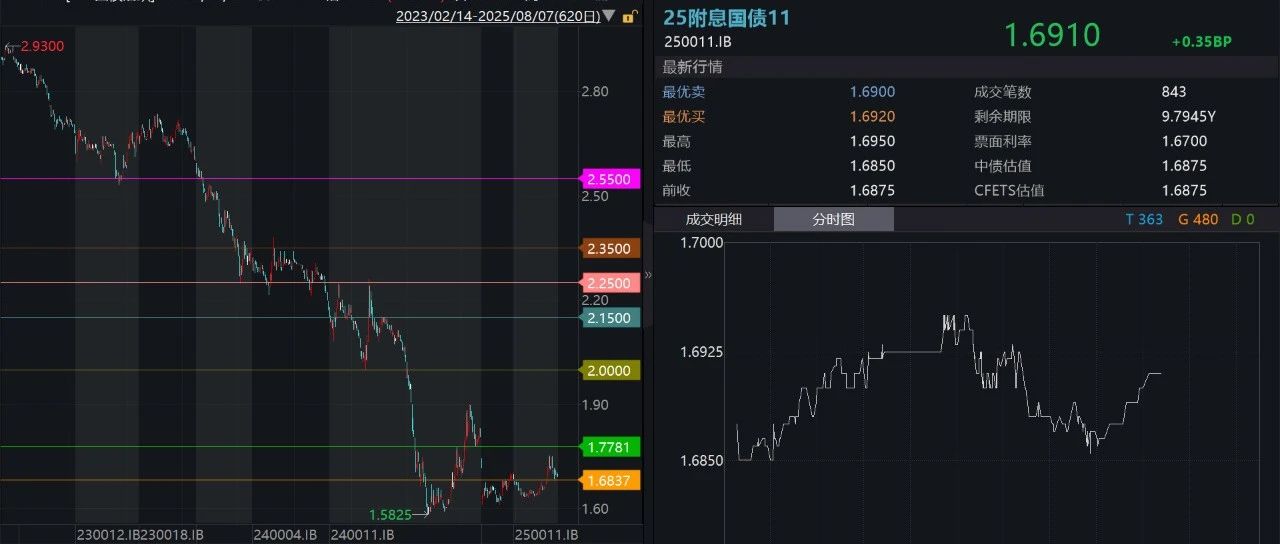
Core Viewpoint - The market appears chaotic and random on the surface, but it actually follows a significant trend, whether it is rising, falling, or consolidating [1] Group 1: Market Conditions - The restaurant and accommodation sector experienced a profit drop of 67% in the first half of 2025 [8] - The central bank conducted a 122 billion yuan reverse repurchase operation, with 126 billion yuan maturing today, resulting in a net withdrawal of 4 billion yuan [4] - The interbank funding market showed a slight decline in funding rates, with DR001 around 1.31% and DR007 around 1.43% [5] Group 2: Bond Market - The bond market saw a slight increase in long-term bond yields, with the 10-year government bond yield dropping to approximately 1.685% before closing at 1.691% [7][10] - The issuance of local government bonds was stable, with new issuance rates about 5 basis points higher than the secondary market, aligning with market expectations [8] - The market is anticipating the upcoming Producer Price Index (PPI) data, as there are concerns about rising commodity prices [8]
每日债市速递 | 国债期货收盘全线下跌
Wind万得· 2025-07-24 22:32
Open Market Operations - The central bank announced a 7-day reverse repurchase operation of 331 billion yuan at a fixed rate with an interest rate of 1.40%, with a total bid amount of 331 billion yuan and a successful bid amount of 331 billion yuan. On the same day, 450 billion yuan of reverse repos matured, resulting in a net withdrawal of 119.5 billion yuan [1] Funding Conditions - The interbank market's funding conditions have tightened further, with a decrease in funding supply. The overnight repurchase weighted rate (DR001) rose nearly 28 basis points, surpassing the 1.65% mark. In the overseas market, the latest overnight financing rate in the US is 4.28% [3] Interbank Certificates of Deposit - The latest transaction for one-year interbank certificates of deposit among major banks is around 1.64% [6] Bond Market - The yields on medium to long-term bonds in the interbank market increased by approximately 3 basis points, while government bond futures saw a significant decline, with the 30-year main contract dropping by 0.92% [8][10] Government Bond Futures - Government bond futures closed lower across the board, with the 30-year main contract down 0.92%, the 10-year main contract down 0.29%, the 5-year main contract down 0.21%, and the 2-year main contract down 0.07% [10] Policy Announcements - The National Development and Reform Commission and the State Administration for Market Regulation released a draft for public consultation on the amendment to the Price Law, aiming to clarify standards for unfair pricing behaviors, including low-price dumping and price collusion [11] - The People's Bank of China and the Ministry of Agriculture and Rural Affairs issued opinions to enhance financial services for rural reforms, emphasizing increased financial resource input in key areas of rural revitalization and innovative financing models [11] - Beijing's Development and Reform Commission reported that all 320 major projects in the city commenced in the first half of the year, with investment growth of 14.1%, outpacing the national growth rate of 11.3% [12] Global Macro - The Reserve Bank of Australia's chairman expects core inflation to gradually decline to 2.5%, while the global economy faces uncertainty. Monthly data suggests that core CPI may not meet expectations, prompting a cautious and gradual easing path [14] Bond Market Events - In June, the northbound trading of Bond Connect reached 852.8 billion yuan, and in the first half of the year, securities firms underwrote technology innovation bonds totaling 381.39 billion yuan, a year-on-year increase of 56.48% [16]